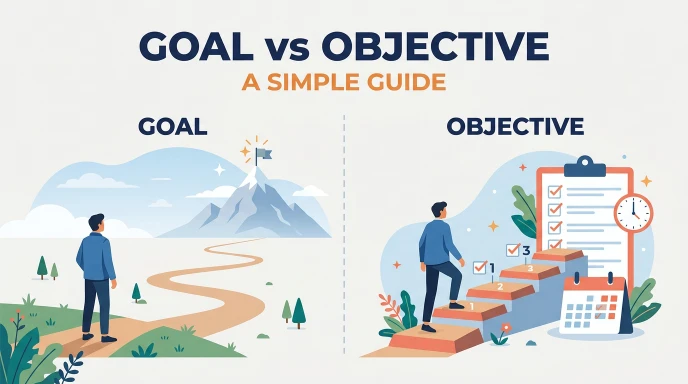
A goal is the big result you want to achieve, while an objective is a specific, measurable step that helps you reach it.
Understanding the difference between goal and objective makes planning easier at school, work, in business, and in personal life. Many people use these words interchangeably, but they serve different purposes. A goal gives you direction, while an objective shows you how to make progress.
For example, improving your business is a goal, but increasing monthly sales by 15% within six months is an objective. In this guide, you will learn what each term means, how they work together, and when to use them correctly.
Quick Answer: Difference Between Goal and Objective
A goal is a broad outcome you want to achieve, whereas an objective is a clear, measurable result that helps you achieve that goal.
Example: Your goal is to improve your fitness. Your objective is to walk for 30 minutes five days a week for the next month.
Definition of Goal and Objective
- Goal: A general result or long-term outcome that a person, team, or organization wants to achieve.
- Objective: A specific result or milestone that helps turn a goal into action. It often includes a measurable target and a deadline.
In simple words, a goal tells you where you want to go, and an objective explains what you need to accomplish along the way.
Pronunciation
- Goal: US and UK pronunciation: /ɡoʊl/ : sounds like “gohl.”
- Objective: US and UK pronunciation: /əbˈdʒɛktɪv/ : sounds like “ub-JEK-tiv.”
The pronunciations are essentially the same in American and British English, although accents may affect the exact sounds.
Now that the definitions are clear, let’s compare how these words differ in everyday situations.
Difference Between Goal and Objective: Comparison
| Feature | Goal | Objective |
| Meaning | A broad outcome you want to achieve. | A specific result that supports a goal. |
| Purpose | Provides direction and motivation. | Turns the desired outcome into action. |
| Time frame | Often long-term, but can also be short-term. | Usually has a defined time frame. |
| Measurement | May be difficult to measure directly. | Usually has a clear way to measure progress. |
| Scope | Covers a wider result or ambition. | Focuses on a smaller, defined outcome. |
| Planning | Describes what you ultimately want. | Identifies what you need to accomplish. |
| Flexibility | Can remain the same while plans change. | May be adjusted as circumstances change. |
| Example | Build a successful online business. | Reach 1,000 monthly visitors within three months. |
| Relationship | Provides the overall direction. | Supports or contributes to achieving the goal. |
The key difference is that goals describe the desired destination, while objectives define concrete results that move you toward it. However, not every goal must be long-term, and not every objective needs to be a small task. An objective can be a substantial milestone in a larger plan.
Key Differences Explained Between Goal and Objective
1. Goals Provide Direction, While Objectives Create Focus
A goal describes the result you want. An objective narrows that ambition into a clear target.
For example, a student may have a goal of becoming better at mathematics. An objective could be to score at least 85% on the next mathematics test.
The goal provides motivation, while the objective gives the student a practical target to work toward.
2. Goals Can Be Broad, but Objectives Are More Specific
A goal can express an ambition without explaining every detail. Objectives require greater clarity.
For instance:
- Goal: Improve customer satisfaction.
- Objective: Increase the customer satisfaction survey score from 80% to 90% by the end of the quarter.
The objective gives the team a starting point, a target, and a deadline. These details make progress easier to assess.
3. Goals Describe Outcomes, While Objectives Establish Milestones
Goals often describe the overall change you want to see. Objectives establish milestones that help you track that change.
Suppose a small company wants to expand its online presence. Its goal might be to become a recognized brand in its market.
One objective could be to publish 20 useful articles over the next two months. Another could be to increase qualified website traffic by 20% within six months.
These objectives support the broader goal, although achieving them does not automatically guarantee brand recognition.
4. Objectives Are Usually Easier to Measure
Some goals, such as becoming more confident or building a better reputation, are difficult to measure directly.
Objectives can make these ambitions more practical.
For example:
- Goal: Become more confident when speaking in public.
- Objective: Deliver one five-minute presentation each week for eight weeks and request feedback after each presentation.
The objective measures practice and feedback, not confidence itself. This distinction matters because completing an activity does not always prove that the desired personal change has occurred.
5. Goals Can Stay Stable While Objectives Change
A goal may remain useful even when your original plan stops working.
Imagine that your goal is to launch an online store. Your first objective is to attract 500 visitors through social media in one month. If the platform produces little traffic, you might revise your objective to test email marketing and search-focused content.
The overall goal remains the same, but your approach changes in response to evidence.
6. Goals Explain Why, While Objectives Clarify What and When
Goals connect to the reason behind your efforts. Objectives clarify the results you intend to achieve and when you want to achieve them.
For example, a nonprofit organization may have a goal of improving access to education. One objective could be to provide 200 students with school supplies before the next academic year begins.
The goal explains the larger purpose. The objective makes part of that purpose actionable.
What Is a Goal, and How Does It Work?
A goal is the outcome that guides your decisions and priorities. It can relate to personal development, education, health, business, or a larger organizational mission.
Goals help answer a basic question: What do I want to achieve?
Consider these examples:
- Personal: Become more organized.
- Education: Earn a degree in computer science.
- Business: Expand into a new market.
- Career: Qualify for a management position.
- Fitness: Improve overall endurance.
Goals can be short-term or long-term. Finishing a book this month is a short-term goal, while earning a professional qualification over several years is a long-term goal.
A useful goal should provide direction without forcing you to decide every detail immediately. Once you know the outcome you want, you can identify the objectives that will help you get there.
What Is an Objective, and How Does It Work?
An objective turns an intention into a defined result. It helps you decide what success should look like and how you will recognize progress.
A strong objective often answers four questions:
- What result do you want to achieve?
- How will you measure it?
- When should you achieve it?
- What evidence will show that you succeeded?
For example, “get better at writing” is a broad intention. A clearer objective is “write three 500-word practice articles each week for the next four weeks and revise each one using an editing checklist.”
This objective identifies a measurable activity and a time frame. If the real goal is to improve writing quality, you should also review if the articles become clearer and more accurate.
Objectives can be used at different levels. A company may set an annual objective, a department may establish quarterly objectives, and an individual employee may create weekly objectives that support the department’s work.
How Do Goals and Objectives Work Together?
Goals and objectives work best as connected parts of one plan. The goal defines the intended outcome, while objectives establish the results or milestones that help you move toward it.
A simple planning structure looks like this:
Goal → Objectives → Actions → Measurement → Review
Here is an example for a content website:
- Goal: Grow the website’s organic audience.
- Objective 1: Publish 12 well-researched articles within six weeks.
- Objective 2: Improve internal links across 20 existing articles.
- Objective 3: Review relevant search performance after three months.
- Actions: Research topics, write content, update pages, and monitor results.
- Measurement: Track impressions, clicks, relevant rankings, and engagement with the content.
The distinction is important: publishing 12 articles is a measurable objective, but it does not guarantee more organic traffic. The result depends on factors such as search demand, content quality, competition, indexing, and if the pages meet readers’ needs.
A good plan therefore tracks both completed work and meaningful outcomes.
Difference Between Goal and Objective in Business
Businesses use goals and objectives to align daily work with larger priorities. Without clear objectives, teams may understand the company’s ambition but disagree about what to do next.
Consider a software company that wants to improve customer retention.
Goal: Build stronger, longer-lasting customer relationships.
Objectives:
- Increase the customer renewal rate from 85% to 90% by the end of the year.
- Respond to 90% of support requests within one business day.
- Interview 30 customers about their experience over the next quarter.
Each objective measures a different part of the effort. Together, they can help the company understand if its customer experience is improving.
Business goals can also involve revenue, market share, employee development, customer service, or product quality. Objectives should match the goal and remain realistic given the team’s time, budget, and resources.
What Is the Difference Between Goals, Objectives, and Strategies?
These three terms are related, but they answer different questions.
| Term | Main question | Example |
| Goal | What do we want to achieve? | Increase brand awareness. |
| Objective | What measurable result do we want, and by when? | Increase unaided brand recall by five percentage points within one year. |
| Strategy | What overall approach will help us achieve it? | Build a consistent educational content program. |
| Tactic | What specific action will we take? | Publish two expert-led articles each week. |
A strategy is the general approach you choose. Tactics are the practical actions used to carry out that strategy.
For example, a business might use search-focused content, email campaigns, and partnerships as tactics within a wider growth strategy. Its objective would define the measurable outcome these activities are intended to support.
Keeping these terms separate makes planning easier to communicate and evaluate.
Difference and Similarity Between Goal and Objective
Goals and objectives differ in scope and function, but they share an important purpose: both help people organize effort around a desired result.
| Feature | Goal | Objective | Similarity |
| Meaning | Broad desired outcome. | Specific intended result. | Both describe what you want to achieve. |
| Scope | Usually covers a wider ambition. | Usually focuses on a defined milestone. | Both contribute to planning. |
| Measurement | May be qualitative or quantitative. | Often has measurable criteria. | Both can be reviewed for progress. |
| Time frame | Can be short-term or long-term. | Usually includes a target date or period. | Both can have deadlines. |
| Use | Sets direction and purpose. | Clarifies priorities and expected results. | Both support decision-making. |
| Flexibility | Can remain stable as plans change. | Can be revised as circumstances change. | Both should reflect current needs. |
| Example | Become a stronger writer. | Complete four writing exercises each week for a month. | Both support writing improvement. |
This table clearly shows the difference and similarity between goal and objective for quick understanding.
Common Mistakes With Goal and Objective
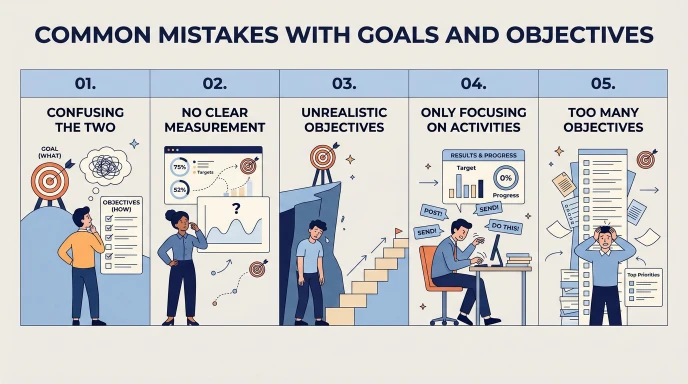
Many beginners understand the definitions but still use the terms incorrectly. These are the mistakes to avoid.
Mistake 1: Treating Goals and Objectives as Exact Synonyms
Incorrect approach: “Our goal is to increase sales by 10% this quarter” and “Our objective is to increase sales” are treated as identical statements.
Better approach: Use the broader goal to describe the desired business outcome, then define the specific target and deadline in the objective.
Remember that a goal can also be measurable. The distinction is mainly about how broadly or specifically the outcome is framed.
Mistake 2: Creating an Objective Without a Clear Measure
Weak objective: Improve customer service soon.
Better objective: Increase the customer satisfaction score from 82% to 88% within six months.
A measure gives the team a way to evaluate progress. If a precise number is not appropriate, define observable evidence of success instead.
Mistake 3: Setting Unrealistic Objectives
Weak objective: Double sales in one week without additional resources or a clear reason to expect such growth.
Better approach: Review historical performance, available resources, market conditions, and the time required to achieve the target.
An objective should be challenging enough to encourage progress but realistic enough to guide useful action.
Mistake 4: Focusing Only on Activities
Weak objective: Post on Instagram every day.
Posting is an activity, not necessarily the outcome you want. If the goal is to increase meaningful engagement, track relevant results such as saves, comments, or qualified visits alongside publishing frequency.
Instagram and Meta provide platform-specific analytics that can help businesses assess content performance. Those measurements should be chosen according to the campaign’s purpose rather than treated as automatic proof of business success.
Mistake 5: Creating Too Many Objectives
A long list of objectives can divide attention and make priorities unclear.
Choose a manageable number of important objectives, assign responsibility, and review them regularly. Additional targets should support the main goal rather than compete with it.
Real-Life Examples of Goals and Objectives
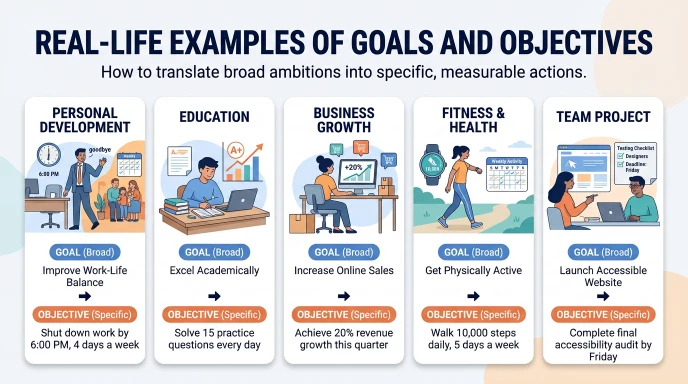
The easiest way to understand the difference between goal and objective is to see how both terms work in practical situations.
Example 1: Personal Development
Situation: Maya wants to manage her time better while balancing work and family responsibilities.
- Goal: Improve work-life balance.
- Objective: Finish work-related tasks by 5:30 p.m. on at least four weekdays each week for the next month.
The goal describes the desired improvement. The objective defines a specific behavior that can be tracked.
Example 2: Education
Situation: Daniel wants to improve his academic performance before the end of the school year.
- Goal: Become a stronger student.
- Objective: Complete five practice questions in each difficult subject every weekday for six weeks and review his test results weekly.
This plan measures consistent practice and progress. Daniel can revise it if his results show that another learning method would work better.
Example 3: Business Growth
Situation: A small online retailer wants to attract more customers.
- Goal: Grow the business.
- Objective: Increase monthly sales revenue by 12% within the next six months.
The retailer may use product improvements, advertising, customer research, and email marketing as strategies or tactics. Revenue data will show if the target has been reached.
Example 4: Fitness and Health
Situation: Alex wants to become more physically active.
- Goal: Improve physical fitness.
- Objective: Complete a 30-minute walk five days a week for eight weeks.
A fitness app can help Alex record walking time and consistency. If the broader goal is improved endurance, Alex should also consider an appropriate measure of endurance rather than relying only on the number of walks completed.
Example 5: Team Project
Situation: A design team needs to release a new website.
- Goal: Launch a useful, accessible website that meets customer needs.
- Objective: Complete user testing with 20 participants and resolve all critical accessibility issues before launch.
The objective identifies a milestone and a completion condition. The goal remains broader because a successful launch also depends on usability, reliability, content, and customer needs.
When Should You Use a Goal or an Objective?
Use a goal when you need to describe a broad ambition, set direction, or explain why a project matters.
Use an objective when you need to define a specific result, establish a deadline, assign responsibility, or evaluate progress.
Here are some practical examples:
- During brainstorming: Start with a goal so everyone understands the intended outcome.
- When building a project plan: Define objectives that break the ambition into manageable milestones.
- During a performance review: Use objectives to discuss measurable results, while goals explain the wider purpose of the work.
- When tracking progress: Review objective measurements and assess if they contribute to the goal.
- When priorities change: Revisit the objectives first if the overall goal remains relevant.
A helpful rule is to write the goal before choosing the objectives. This reduces the risk of completing tasks that look productive but do not contribute to the intended result.
Why Do People Get Confused About Goals and Objectives?
People often confuse these terms because both refer to desired outcomes. Their meanings also overlap in everyday conversation, business documents, education, and project management.
Everyday Language
In casual conversation, someone might say, “My objective is to get a better job,” or “My goal is to complete a course this month.” Both sentences are understandable.
Formal planning often makes a clearer distinction, but ordinary language does not always follow a strict framework.
Workplace and Industry Differences
Different organizations may use the terms in slightly different ways. A company might call a quarterly sales target a goal, while another company might label the same target an objective.
The important thing is to define the terms clearly within a particular plan. A consistent shared definition is more useful than arguing over labels.
Social Media and Online Content
Online discussions often use words such as goals, targets, milestones, and objectives loosely. Business platforms and productivity tools may also organize these concepts differently.
For example, a project management system might let users create goals and assign tasks without requiring a formal objective layer. That difference in software design does not change the underlying distinction between a desired outcome and a specific result.
How Search Engines Understand Goal and Objective
Search engines such as Google try to identify what a page means and if it answers the searcher’s question. For a query such as “difference between goal and objective,” the likely intent is informational and comparative.
A useful page should therefore explain both terms, compare them directly, and provide examples that make the distinction easy to apply.
Relevant content may include:
- Concise definitions of goal and objective.
- A comparison table with clear differences.
- Examples from personal life, education, and business.
- Answers to related questions about strategies, targets, and planning.
- Consistent terminology and useful internal links to related topics.
Google’s search systems do not guarantee rankings because an article includes a certain number of keywords, headings, or entities. Clear explanations, helpful examples, accessible formatting, and reliable information are sensible editorial priorities, but no particular structure guarantees a top position.
Instagram and Meta are relevant when discussing marketing objectives on their platforms, not because they directly determine how Google interprets every article about goals. Keeping each entity connected to the correct context makes the explanation more useful and accurate.
Expert Insight: How to Set Better Goals and Objectives
The most useful planning systems connect ambition with evidence. A well-written goal gives people a reason to act, while well-designed objectives help them determine if their actions are producing the intended results.
One practical method is to use the SMART framework for objectives. SMART commonly stands for Specific, Measurable, Achievable, Relevant, and Time-bound.
For example:
Goal: Improve the quality of a company’s customer support.
SMART objective: Increase the percentage of support tickets resolved within one business day from 75% to 90% over the next three months, without reducing customer satisfaction.
This objective is specific, measurable, and time-bound. It also includes an important safeguard: speed should not come at the expense of service quality.
There is one more useful distinction. Measure both leading indicators and outcomes when possible.
Leading indicators track activities or early signs of progress, such as the number of customer interviews completed. Outcomes show the result, such as a change in customer satisfaction or retention.
This approach helps teams avoid mistaking completed tasks for achieved goals. It also gives them evidence to decide if to continue, adjust, or replace an objective.
Frequently Asked Questions
What is the main difference between a goal and an objective?
A goal describes the broad outcome you want to achieve, while an objective defines a specific result or milestone that helps you reach it.
Is a goal bigger than an objective?
A goal is usually broader than an objective. However, the distinction depends on how the terms are used in a particular planning system.
Can a goal be measurable?
Yes. A goal can be measurable, such as increasing annual revenue by 20%. Objectives often add more specific milestones, deadlines, or measures that support the broader goal.
What is an example of a goal and an objective?
A goal is to improve writing skills. An objective is to write three practice articles each week for one month and review each article for clarity and grammar.
What comes first, a goal or an objective?
The goal usually comes first because it establishes the desired outcome. You can then develop objectives that help you make progress toward it.
What is the difference between a goal, an objective, and a strategy?
A goal describes the desired outcome, an objective defines a specific result, and a strategy explains the overall approach you will use to achieve that result.
Are objectives always short-term?
No. Objectives can cover weeks, months, or years. Their defining feature is specificity, not simply their duration.
Can you have multiple objectives for one goal?
Yes. A single goal may require several objectives. For example, growing a business may involve objectives for sales, customer retention, product quality, and website performance.
What is the difference between an objective and a target?
An objective describes an intended result, while a target often specifies a precise level of performance. For example, increasing customer satisfaction is an objective, and reaching a score of 90% is its target.
Are goals and objectives important in project management?
Yes. Goals explain the intended project outcome, while objectives help teams define milestones, measure progress, assign responsibilities, and determine if important results have been achieved.
Conclusion
The difference between goal and objective comes down to scope and purpose. A goal describes the outcome you want to achieve, while an objective identifies a specific result that helps you move toward that outcome.
For example, becoming a better writer is a goal. Completing three writing exercises each week for a month is an objective that supports it. The goal provides direction, and the objective creates a practical way to track progress.
Both terms are useful in personal development, education, business, and project management. A goal can be broad or measurable, and an objective can cover either a short or long period. What matters most is that each term has a clear role in your plan.
To use them effectively, begin by defining what success means to you. Then create realistic objectives with clear measurements and suitable deadlines. Review your progress regularly, and change your approach when the evidence suggests a better path.
In short, goals tell you what you want to achieve, and objectives help you define the results needed to get there. When the two work together, planning becomes clearer, progress becomes easier to evaluate, and your actions are more likely to support the outcome you actually want.
READ MORE ABOUT!
- Difference Between Endothermic and Exothermic: Easy Guide
- Difference Between Broccoli and Broccolini: A Simple Guide

I am Emily Johnson, a USA-based content writer who creates easy-to-read blogs on language and daily life topics. I explain complex ideas in simple English for students and beginners so they can understand easily.