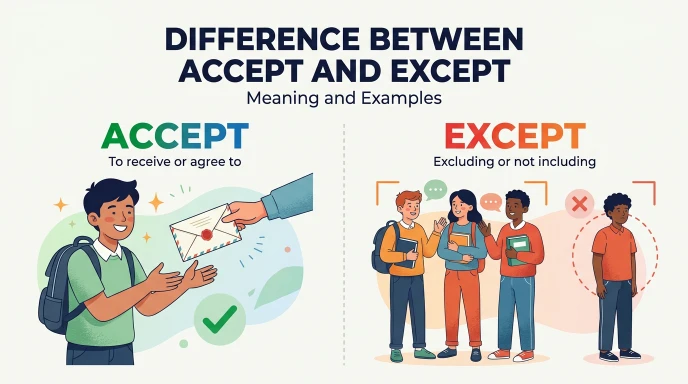
Have you ever confused accept with except while writing an email, answering a question, or sending a text? The difference between accept and except is simple once you understand how each word works. Accept means to receive or agree to something, while except means to exclude something or someone.
Although they sound similar, their meanings are very different. Many learners mix them up because they differ by only one letter. In this guide, you will learn what accept and except mean, how to pronounce them in American and British English, and when to use each word. Clear definitions, comparison tables, common mistakes, and real-life examples will help you choose the correct word with confidence.
Quick Answer: Difference Between Accept and Except
Accept means to receive, agree to, or approve something. Except means to exclude someone or something from a group.
- Accept: I accept your invitation.
- Except: Everyone came except Daniel.
Remember: You accept something, but you leave someone or something out with except.
Definitions of Accept and Except
- Accept: To receive something willingly, agree to an offer, or recognize something as true or valid.
- Except: To exclude someone or something, or to indicate that a person or thing is not included.
Example: I accept all the suggestions except the last one.
In this sentence, accept shows agreement, while except identifies the suggestion that is excluded.
Pronunciation
Both words have two syllables and sound very similar, which explains why people sometimes confuse them in conversation.
| Word | American English | British English | Stress |
| Accept | /əkˈsɛpt/ | /əkˈsept/ | Second syllable |
| Except | /ɪkˈsɛpt/ | /ɪkˈsept/ | Second syllable |
The pronunciations are broadly similar in American and British English. The main distinction is the initial vowel sound: accept commonly begins with an unstressed schwa sound, while except starts with a short, unstressed vowel closer to the sound in it.
Both words emphasize the second syllable: ac-CEPT and ex-CEPT.
Because the pronunciation difference is subtle, learning the meaning and grammatical role of each word is more reliable than depending on sound alone.
Difference Between Accept and Except: Comparison
| Feature | Accept | Except |
| Main meaning | To receive or agree | To exclude or leave out |
| Part of speech | Usually a verb | Usually a preposition or conjunction |
| Common purpose | Shows agreement or willingness | Identifies an exception |
| Typical context | Offers, invitations, decisions, and payments | Lists, rules, groups, and exclusions |
| Example | I accept the offer. | Everyone agreed except Mia. |
| Sentence role | Describes an action or response | Introduces something excluded |
| Common phrase | Accept responsibility | Everyone except me |
| Opposite idea | Refuse or reject | Include, depending on context |
Similarities and Differences Between Accept and Except
| Feature | Accept | Except | Similarity |
| Spelling | Starts with A | Starts with E | Both contain similar letters |
| Pronunciation | Ends with the same /sept/ sound | Ends with the same /sept/ sound | Both sound alike |
| Meaning | Receive or agree | Exclude or leave out | Both can appear in decisions |
| Grammar | Commonly a verb | Commonly a preposition or conjunction | Both fit into everyday sentences |
| Formality | Used in formal and informal English | Used in formal and informal English | Both are standard English words |
| Context | Offers and acceptance | Exceptions and exclusions | Both help explain situations |
| Writing | Expresses agreement | Clarifies limits or exclusions | Both improve precision when used correctly |
This table clearly shows the difference and similarity between accept and except for quick understanding.
Key Differences Explained Between Accept and Except
1. Accept Shows Agreement, While Except Shows Exclusion
The most important difference between accept and except is what each word communicates.
When you accept something, you show that you are willing to receive it, agree to it, or approve it. When you use except, you identify something that is not included.
Examples:
- I accept your apology.
- Everyone accepted the invitation except Mark.
In the first sentence, the speaker receives an apology willingly. In the second, Mark is excluded from the group of people who accepted the invitation.
2. Accept Is a Verb, While Except Usually Introduces an Exception
Accept is a verb because it describes an action or state of agreement.
Except is most commonly a preposition or conjunction because it introduces an exclusion.
Examples:
- The manager accepted my proposal.
- All employees attended except the manager.
A quick grammar check can help: if the word describes receiving or agreeing, accept is likely correct. If it identifies someone or something left out, use except.
3. Accept Works With Offers, Ideas, and Responsibility
You can accept a gift, an invitation, an apology, a job offer, or responsibility for a mistake.
Examples:
- She accepted the job offer.
- He accepted responsibility for the error.
- We accept several payment methods.
These sentences describe receiving, agreeing, or recognizing something.
4. Except Works With Groups, Lists, and Rules
Use except when you want to identify an item that does not belong to a group or does not follow a general statement.
Examples:
- Every student passed except Liam.
- The store is open every day except Sunday.
- All the files were uploaded except one.
In each example, except sets a clear boundary around the statement.
5. Accept Can Be Followed by Different Types of Objects
The word accept works with physical objects, decisions, ideas, and situations.
Examples:
- She accepted the package.
- I accept your explanation.
- He learned to accept the situation.
This flexibility makes accept useful in personal conversations, professional communication, and academic writing.
6. Except Helps Make Statements More Precise
The word except prevents a general statement from being misunderstood as applying to every person or thing.
Example:
Without an exception: All applications are complete.
With an exception: All applications are complete except Jordan’s.
The second sentence gives a more accurate picture of the situation.
7. Accept and Except Can Appear in the Same Sentence
Using both words together is an effective way to remember their meanings.
Example: The committee accepted every proposal except the one submitted late.
Here, accepted describes the committee’s decision, while except identifies the proposal that was excluded.
When Should You Use Accept?
Use accept when someone receives something, agrees to an offer, approves a suggestion, or acknowledges a situation.
Accept an Offer or Invitation
When you agree to participate in an event or take an opportunity, use accept.
Example: I accepted my friend’s invitation to dinner.
Accept Responsibility
When you acknowledge your role in a mistake or outcome, use accept.
Example: The team leader accepted responsibility for the missed deadline.
Accept Payments or Requests
Businesses often use accept to explain which payments, bookings, or requests they allow.
Example: This online store accepts credit cards and digital payments.
Accept a Situation
Sometimes, accept means recognizing reality even when you do not like it.
Example: She eventually accepted that the project needed more time.
When Should You Use Except?
Use except when excluding a person, object, day, condition, or possibility.
Except in a List of People
Example: Everyone in the class completed the assignment except Noah.
Noah is the only student excluded from the statement.
Except in Schedules
Example: The clinic operates daily except on public holidays.
The word identifies a specific exception to the usual schedule.
Except in Instructions and Rules
Example: All visitors may enter except those without a valid pass.
The rule applies generally but excludes visitors who do not meet the stated condition.
Except in Business Communication
Example: All invoices have been paid except invoice number 104.
This wording identifies the one outstanding invoice without suggesting that the others remain unpaid.
Common Mistakes With Accept and Except
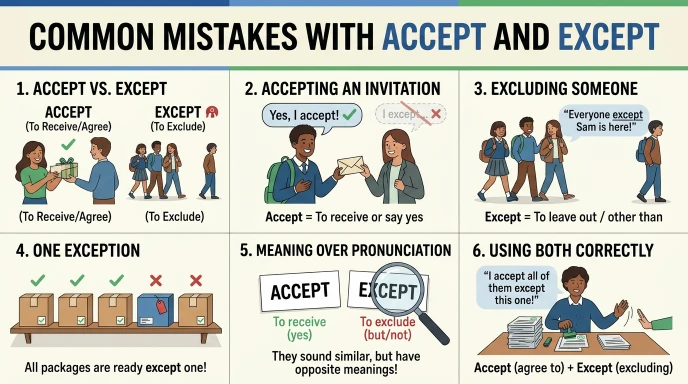
Many learners make these mistakes because the two words look and sound alike. The easiest solution is to check the meaning of the sentence before choosing a word.
Mistake 1: Writing “Except” Instead of “Accept”
Incorrect: I except your invitation.
Correct: I accept your invitation.
Why? The sentence describes agreeing to an invitation, so accept is the correct verb.
Mistake 2: Writing “Accept” Instead of “Except”
Incorrect: Everyone was present accept James.
Correct: Everyone was present except James.
Why? James is excluded from the group, so the sentence needs except.
Mistake 3: Confusing Acceptance With an Exception
Incorrect: All orders are ready accept one.
Correct: All orders are ready except one.
Why? The sentence identifies an order that is not included in the general statement.
Mistake 4: Choosing a Word Based Only on Pronunciation
Incorrect approach: Using whichever word sounds right.
Correction: Read the sentence for meaning. If it describes receiving or agreeing, choose accept. If it excludes something, choose except.
Pronunciation can help, but context is usually a more dependable guide.
Mistake 5: Using Accept When You Mean Include
Incorrect: Everyone accept the late applicants may attend.
Correct: Everyone except the late applicants may attend.
Why? The sentence sets a restriction. The late applicants are excluded.
Mistake 6: Forgetting the Role of Except in Longer Sentences
Incorrect: I accept all the changes, accept the final one.
Correct: I accept all the changes except the final one.
Why? The first accept describes agreement. The second word must introduce the exception.
Real-Life Examples of Accept and Except
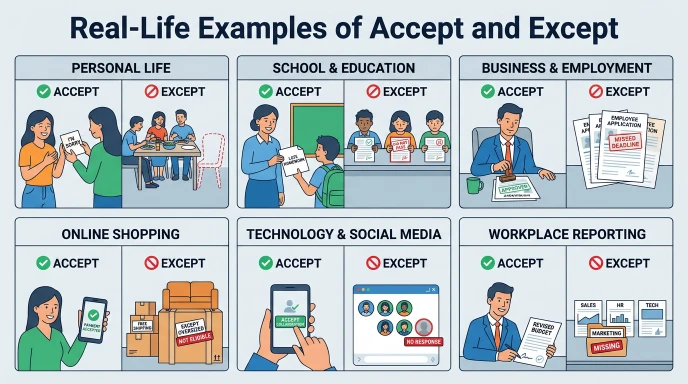
These examples show how the difference between accept and except appears in everyday situations.
Example 1: Personal Life
Accept: Maya accepted her friend’s apology after their disagreement.
Except: Everyone in the family attended the dinner except Maya.
The first sentence describes an emotional response. The second identifies someone who was not present.
Example 2: School and Education
Accept: The teacher accepted my assignment one day late.
Except: All students passed the test except Ryan.
These examples demonstrate how the words function in common academic situations.
Example 3: Business and Employment
Accept: The company accepted the candidate’s application.
Except: All candidates were interviewed except those who missed the deadline.
In the first example, the company receives or approves an application. In the second, a group is narrowed by an exclusion.
Example 4: Online Shopping
Accept: The website accepts payments through several digital methods.
Except: All items qualify for free shipping except oversized furniture.
The first sentence explains an available payment option. The second clarifies a limit in a business policy.
Example 5: Technology and Social Media
Accept: I accepted the invitation to collaborate on an Instagram project.
Except: All the team members responded to the message except Olivia.
The same distinction applies to messages, invitations, and online teamwork on platforms such as Instagram, YouTube, and other social networks.
Example 6: Workplace Reporting
Accept: The department accepted the revised budget.
Except: Every department submitted its report except marketing.
The first sentence communicates approval. The second identifies a department that did not submit its report.
How Can You Remember the Difference Between Accept and Except?
A simple memory trick can help you choose the correct word quickly.
Accept = Agree or Allow
Think of accepting a gift, an offer, or an invitation. You are receiving something or saying yes.
Except = Exclude
Think of making a list and leaving one item out. That item is the exception.
Try this two-question test:
- Am I receiving something or agreeing to something? Use accept.
- Am I leaving someone or something out? Use except.
For example, consider this sentence:
“I will accept every invitation except the one scheduled for Monday.”
You agree to receive the invitations, but you exclude the Monday invitation.
This method works in emails, school assignments, business reports, and everyday messages. It is more reliable than memorizing spelling alone because it connects each word to its purpose.
Why Do People Get Confused Between Accept and Except?
Similar Pronunciation
Both words contain a similar ending sound, and their first syllables are unstressed in many accents. This can make them difficult to distinguish in fast conversation.
Similar Spelling
The words differ by only one initial letter. When typing quickly, a writer may choose the wrong word without noticing the change in meaning.
Autocorrect and Typing Errors
Spell-check tools may recognize both words as correctly spelled. Because accept and except are real English words, software may not flag the error when the wrong word is used in a sentence.
Learning English Through Conversation
People who learn English mainly through speaking may understand both words but struggle to choose the correct spelling in writing. Practicing with short, meaningful examples can help build confidence.
The key insight is that this is not just a spelling problem. It is a word-choice problem. Checking the sentence’s meaning is often the fastest way to catch the error.
How Do Search Engines Understand Accept and Except?
Search engines such as Google use language context to interpret what a page is about. A page discussing the difference between accept and except provides signals through its title, definitions, examples, headings, and related terms.
For example, a page that explains accepting invitations and excluding items from lists provides useful context for the two words. Related questions, such as “Is accept the opposite of except?” or “How do I use except in a sentence?”, can also help a page address different forms of the same informational need.
However, using these words repeatedly does not automatically improve rankings. Google does not guarantee a top position because an article follows a particular heading structure or contains a specific number of keywords.
For WordeDiff, the stronger approach is to explain the distinction clearly, use accurate examples, organize the information for easy scanning, and answer the reader’s actual question without unnecessary repetition.
Social media platforms such as Instagram and YouTube may also expose people to written examples of these words, but their recommendation systems are different from Google’s web-search ranking system.
Expert Insight: The Best Way to Choose the Correct Word
The most dependable way to distinguish accept from except is to focus on the word’s function in the sentence.
In practical editing, replacing a questionable word with a simpler expression can reveal the intended meaning. For instance, if you can replace the word with “agree to” or “receive,” accept is probably correct. If you can replace it with “excluding” or “not including,” except is usually the right choice.
Consider these sentences:
- I accept everyone except those who arrive after the deadline.
- We accept the rules, except for the final condition.
The first sentence uses accept for agreement and except for exclusion. The second uses the same distinction to express partial agreement.
This approach is useful for students, writers, editors, customer-service teams, and professionals preparing reports or emails. It also works regardless of if you use American or British English.
There is no need to rely on an invented grammar rule or a complicated mnemonic. Understanding the meaning of each word is enough to make the right choice in most situations.
Frequently Asked Questions
What Is the Main Difference Between Accept and Except?
Accept means to receive or agree to something, while except means to exclude someone or something. For example, “I accept the offer” and “Everyone came except Ben.”
Is Accept the Opposite of Except?
No. They are not direct opposites. Accept means to receive or agree, while except identifies an exclusion. Depending on the context, refuse may be the opposite of accept, and include may be the opposite of exclude.
How Do You Use Accept and Except in a Sentence?
Use accept for agreement or receiving something: “She accepted the invitation.” Use except for exclusion: “Everyone attended except her brother.”
Why Do Accept and Except Sound So Similar?
Both words have two syllables and share a similar ending sound. Their first syllables may be unstressed, making the difference harder to hear in everyday conversation.
Is It Accept or Except My Apologies?
The correct phrase is usually “accept my apologies.” It means to receive or acknowledge an apology. For example, “Please accept my apologies for the delay.”
What Is the Difference Between Accept and Except in Grammar?
Accept is a verb. Except is usually a preposition or conjunction that introduces an exclusion. Their different grammatical roles reflect their different meanings.
Can Accept and Except Be Used in the Same Sentence?
Yes. For example, “I accept all the invitations except the one for Friday.” The first word describes agreement, and the second identifies an excluded invitation.
What Is an Easy Trick to Remember Accept vs. Except?
Remember accept = agree or receive and except = exclude. Ask yourself if the sentence describes saying yes or leaving something out.
Are Accept and Except Pronounced the Same Way?
No, although they sound similar. The first vowel differs in common pronunciations, while the second syllable is stressed in both words. Accent differences can affect how noticeable the distinction is.
Conclusion
Understanding the difference between accept and except becomes much easier when you focus on meaning rather than spelling. Accept is a verb that means to receive, agree to, or approve something. Except is used to exclude a person, item, or condition from a general statement.
For example, “I accept the invitation” means you agree to attend. “Everyone accepted the invitation except Sara” means Sara is the exception. These two words can appear in the same sentence, but they perform different jobs.
When writing an email, completing a school assignment, preparing a business report, or posting on social media, take a moment to check what you want to communicate. If you mean “receive” or “agree,” use accept. If you mean “excluding” or “not including,” use except.
The difference between accept and except is small in spelling but important in meaning. Remembering this simple rule will help you write more clearly, avoid common grammar mistakes, and use both words confidently in everyday English.
READ MORE ABOUT!
- Difference Between Habit and Routine: What Sets Them Apart?
- Difference Between Skill and Ability: Key Differences Explained

I am James Carter, a professional content writer from the United States. I specialize in writing simple and clear comparison blogs that help students and readers understand difficult topics easily. My writing focuses on everyday language, education, science, and lifestyle topics. I believe that learning should be easy for everyone, so I use simple words and real-life examples in my articles.