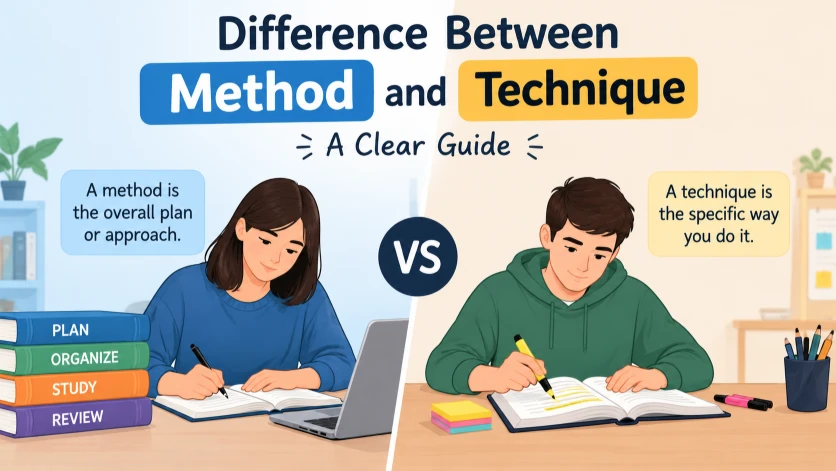
The difference between method and technique is that a method is an organized way to achieve a goal, while a technique is a specific skill or action used to carry out a task. For example, a teacher may use group learning as a method and ask students to brainstorm ideas as a technique.
Many people confuse these terms because they often appear together in education, business, sports, and research. Understanding the difference between method and technique helps you choose the right word in everyday English and professional writing. This guide explains their meanings, key differences, practical examples, common mistakes, and how to use each term correctly.
Quick Answer: Difference Between Method and Technique
A method is a planned way of doing something, while a technique is a particular way of performing a specific action.
For example, a student may use a study method based on active learning and a technique such as making flashcards to remember important facts.
Definitions of Method and Technique
- Method: An organized process or plan used to complete a task or achieve a particular goal.
- Technique: A specific skill, action, or procedure used to perform part of a task effectively.
In simple words, a method gives you the overall approach, while a technique explains how to perform a particular action within that approach.
Pronunciation
| Word | US pronunciation | UK pronunciation |
| Method | METH-uhd | METH-uhd |
| Technique | tek-NEEK | tek-NEEK |
The pronunciations are broadly the same in American and British English, although accents may affect individual sounds.
Now that the definitions are clear, let’s explore how these words differ in real situations.
Comparison: Method vs. Technique
| Feature | Method | Technique |
| Main meaning | An overall way to achieve a goal | A specific way to perform an action |
| Scope | Usually broader | Usually narrower |
| Purpose | Organizes the process | Helps carry out a task |
| Structure | Often includes several steps | May involve one skill or action |
| Flexibility | Can include different techniques | Can change within the same method |
| Learning | Explains an approach to learning | Develops a particular skill |
| Professional use | Research method or teaching method | Interview technique or research technique |
| Example | A method for learning a language | Using flashcards to learn vocabulary |
The key distinction is that a method usually provides the broader plan, whereas a technique focuses on how a particular part is performed. However, their scope can overlap depending on the field.
Key Differences Explained Between Method and Technique
1. A Method Gives You the Overall Plan
A method provides an organized approach to completing a task. It may contain several steps, tools, and techniques.
For example, a teacher may follow a project-based learning method. Students research a topic, work in groups, develop a project, and present their findings.
The method organizes the whole learning experience rather than focusing on one small action.
2. A Technique Focuses on a Specific Action
A technique is a particular way of performing an activity. It often focuses on skill, accuracy, or effectiveness.
For example, a student may use a mind map to organize ideas before writing an essay. Creating a mind map is a technique that supports the wider method of planning and drafting.
This distinction helps explain why a technique can often be used in several different methods.
3. Methods Can Include Multiple Techniques
One method does not have to rely on a single technique. In many situations, combining techniques makes the overall approach more effective.
Consider a language-learning method that includes listening, speaking, reading, and writing. A learner might use repetition to practice pronunciation, flashcards to remember vocabulary, and role-play to improve conversation skills.
Each technique serves a different purpose within the broader method.
4. Techniques Can Be Used Across Different Methods
A technique is not always tied to one particular approach.
For example, brainstorming can be used in a classroom, a business meeting, a marketing project, or a research discussion. The overall method may change, but the technique can remain the same.
This flexibility is one reason techniques are useful when adapting a process to different needs.
5. A Method Organizes Work, While a Technique Improves Execution
A method helps answer, “What overall process should I follow?” A technique helps answer, “How should I perform this specific action?”
For example, a fitness training method may focus on progressive strength training. A lifting technique covers details such as posture, movement, and control during an exercise.
Both matter, but they solve different problems.
6. Methods and Techniques Can Be Evaluated Differently
A method is often evaluated by looking at the overall process and if it achieves the intended goal. A technique may be evaluated by examining how well a specific task is performed.
For instance, a company might evaluate its customer-service method by measuring customer satisfaction and resolution times. It might assess an employee’s questioning technique by observing if the questions are clear and useful.
A good technique cannot always rescue a poorly designed method, and a good method still needs suitable techniques to work well.
Difference and Similarity Between Method and Technique
| Feature | Method | Technique | Similarity |
| Meaning | An overall approach | A specific way of acting | Both describe ways of doing something |
| Scope | Generally broader | Generally more focused | Both can support a shared goal |
| Structure | May contain several procedures | May be one procedure or skill | Both can form part of a process |
| Purpose | Guides the overall work | Supports task execution | Both can improve results |
| Application | Used in education, research, and business | Used in the same fields | Both apply across many industries |
| Flexibility | Can combine different techniques | Can fit different methods | Both can be adapted to a situation |
| Evaluation | Often assessed as a complete process | Often assessed by performance | Both can be reviewed and improved |
This table clearly shows the difference and similarity between method and technique for quick understanding.
How Are Method and Technique Used in Different Fields?
The difference between method and technique becomes easier to understand when you see how professionals use the terms.
In Education and Learning
A teaching method describes the overall approach an educator uses to help students learn. Examples include lecture-based teaching, inquiry-based learning, and cooperative learning.
Teaching techniques are the specific actions used during lessons, such as asking open-ended questions, giving short quizzes, or using a demonstration.
For example, an inquiry-based teaching method may use questioning and small-group discussion as techniques.
In Scientific Research
Research methods describe the broad process used to investigate a question. Examples include surveys, experiments, interviews, and observational studies.
Research techniques are specific procedures used to collect or analyze information, such as calibrating an instrument, coding interview responses, or measuring a sample.
The distinction is not absolute: some academic fields use terms such as research method and research technique in overlapping ways. The important thing is to explain what the procedure actually involves.
In Business and Management
A business method outlines how an organization approaches a task or process. A sales method, for example, may define how a team identifies leads, understands customer needs, presents solutions, and follows up.
A sales technique is a specific action within that process, such as asking a discovery question or demonstrating a product’s benefits.
The method gives the sales team a repeatable process; the technique helps employees handle particular moments effectively.
In Sports and Fitness
A training method describes the overall structure of a workout program. Examples include interval training and circuit training.
A technique focuses on how a movement is performed. A runner’s technique may include posture and stride mechanics, while a weightlifter’s technique may include grip, body position, and controlled movement.
A well-designed training method still requires appropriate techniques for safe and effective performance.
In Technology and Digital Work
A software development method may organize how a team plans, builds, tests, and releases a product. Agile development, for example, provides an iterative approach to project work.
A technique might be code review, debugging, or writing automated tests. These actions support the development process.
Tools such as GitHub can help teams carry out these activities, but the tool itself is not automatically the method or technique. It is a resource used to implement the chosen process.
Real-Life Examples of Method and Technique
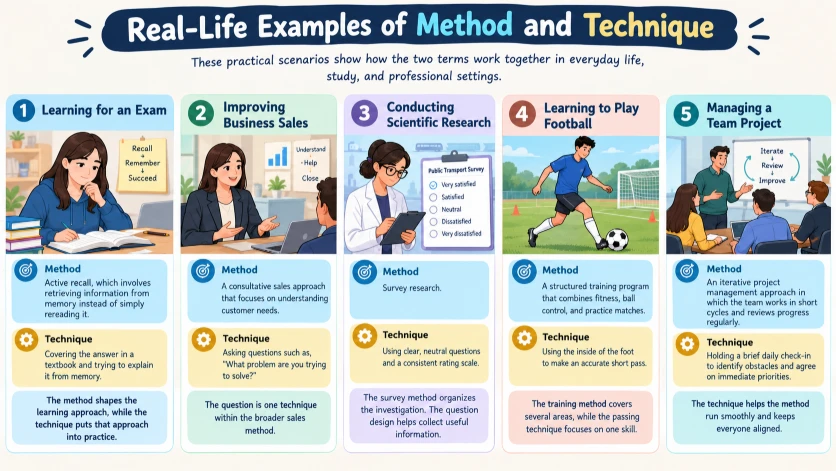
These practical scenarios show how the two terms work together in everyday life, study, and professional settings.
Example 1: Learning for an Exam
A student wants to remember more information before an important exam.
- Method: Active recall, which involves retrieving information from memory instead of simply rereading it.
- Technique: Covering the answer in a textbook and trying to explain it from memory.
The method shapes the learning approach, while the technique puts that approach into practice.
Example 2: Improving Business Sales
A sales manager wants the team to understand customers better and increase successful sales.
- Method: A consultative sales approach that focuses on understanding customer needs.
- Technique: Asking questions such as, “What problem are you trying to solve?”
The question is one technique within the broader sales method.
Example 3: Conducting Scientific Research
A researcher wants to understand how people feel about public transport.
- Method: Survey research.
- Technique: Using clear, neutral questions and a consistent rating scale.
The survey method organizes the investigation. The question design helps collect useful information.
Example 4: Learning to Play Football
A beginner wants to improve performance on the football field.
- Method: A structured training program that combines fitness, ball control, and practice matches.
- Technique: Using the inside of the foot to make an accurate short pass.
The training method covers several areas, while the passing technique focuses on one skill.
Example 5: Managing a Team Project
A company needs to complete a project with several employees.
- Method: An iterative project management approach in which the team works in short cycles and reviews progress regularly.
- Technique: Holding a brief daily check-in to identify obstacles and agree on immediate priorities.
The method shapes the project workflow, while the check-in is one technique for keeping work coordinated.
When Should You Use Method or Technique?
Choose the word that best describes the role of the action in your sentence.
Use method when discussing the overall approach.
Examples: teaching method, research method, problem-solving method, and payment method.
Use technique when discussing a particular skill or action.
Examples: breathing technique, interview technique, drawing technique, and memorization technique.
When both words seem possible, consider what you want to emphasize. If you are describing the whole process, method is usually more suitable. If you are describing how a specific task is performed, technique is often the better choice.
Common Mistakes With Method and Technique
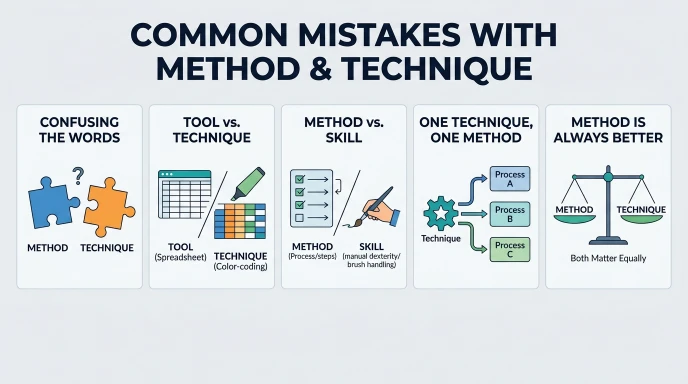
Mistake 1: Treating Both Words as Exact Synonyms
Incorrect assumption: A method and a technique always mean the same thing.
Correction: They overlap, but a method usually refers to a broader approach, while a technique usually refers to a specific way of performing an action.
Mistake 2: Calling Every Tool a Technique
Incorrect: “The spreadsheet is my technique for organizing the project.”
Better: “I use a spreadsheet as a tool to organize the project, and I use color coding as a technique to highlight priorities.”
A tool is something you use; a technique is how you do something.
Mistake 3: Using Method When You Mean a Specific Skill
Unclear: “Her method for holding the paintbrush is excellent.”
More precise: “Her brush-handling technique is excellent.”
The second sentence focuses on a particular skill rather than an entire process.
Mistake 4: Assuming a Technique Always Belongs to One Method
Incorrect assumption: Every technique can be used only within a single method.
Correction: Many techniques are flexible. Brainstorming, for example, can support several teaching, planning, and problem-solving methods.
Mistake 5: Assuming a Method Is Always Better
Incorrect assumption: A method is more important simply because it is broader.
Correction: Both matter. A suitable method provides direction, but poor execution can weaken the result. A strong technique is valuable when it supports the right goal.
Why Do People Get Confused About Method and Technique?
There are three common reasons.
First, their meanings overlap. Both words describe ways of doing something, so everyday sentences sometimes allow either word without causing confusion.
Second, different fields use the terms differently. In scientific research, education, sports, and business, a technique may be treated as a component of a method. In other contexts, the terms may be used more loosely.
Third, people often focus on the action rather than its role. Someone might describe a process as a method in one conversation and call a particular part of it a technique in another.
Regional English differences are not the main reason for the confusion. Both terms are used in American and British English, and the broad distinction remains similar.
How Search Engines Understand Method and Technique
When someone searches Google for the difference between method and technique, the likely goal is to understand two related words and learn how to use them correctly.
A useful explanation should answer the direct question, show a comparison, and provide examples from real contexts. Related searches may involve research methods, teaching techniques, learning strategies, and problem-solving approaches.
Google’s understanding of language and context helps it connect related concepts rather than relying only on exact keyword matches. On platforms such as Instagram and YouTube, people may encounter the words in educational videos, tutorials, or professional content, where the surrounding context helps explain their meaning.
For writers, the practical lesson is simple: define both terms clearly and show how they work in context. Repeating the same keyword without adding useful information is less helpful than explaining the distinction accurately.
Expert Insight: Can a Technique Become a Method?
Yes, depending on how the term is being used.
A technique may become part of a larger method when it is combined with other actions and organized into a repeatable process. For example, flashcards are a study technique. When a learner combines flashcards with scheduled review, practice questions, and progress checks, those activities may form part of a broader study method.
The reverse distinction is useful, too. A method can contain many techniques without losing its identity as an overall approach.
This shows that the difference between method and technique is mainly about scope and function, not a rigid rule that applies identically in every profession. Good writing makes that relationship clear rather than pretending the words never overlap.
Frequently Asked Questions
What is the main difference between method and technique?
A method is an overall approach to achieving a goal, while a technique is a specific way of performing an action within that approach.
Is a technique part of a method?
Yes. A technique often supports a method by helping someone perform a particular task. For example, active recall can be part of a broader study method.
What is an example of a method and a technique?
A teacher may use cooperative learning as a teaching method and brainstorming as a technique to help students share ideas and solve problems.
What is the difference between a method and a procedure?
A method is a general approach to completing a task. A procedure usually describes a sequence of steps to follow. A procedure can be part of a method, although the terms sometimes overlap.
What is the difference between a method and a strategy?
A strategy is a plan designed to achieve a goal, often by choosing priorities and deciding where to focus effort. A method is an organized way of carrying out work. A strategy may guide the choice of method and techniques.
Can method and technique be used interchangeably?
Sometimes, especially in casual speech or specialized fields, but they are not always interchangeable. Use method for the broader approach and technique for the specific skill or action when you want to be precise.
What is the difference between research method and research technique?
A research method describes the overall approach to investigating a question, such as conducting a survey or experiment. A research technique describes a particular procedure, such as coding interview answers or measuring a sample.
Which is more important, method or technique?
Neither is always more important. A suitable method provides direction, while appropriate techniques help carry it out effectively. The best results often depend on both.
Conclusion
The difference between method and technique comes down to their scope and purpose. A method is an overall approach used to achieve a goal, while a technique is a specific skill or action used to perform a task. Although these words sometimes overlap, understanding their usual meanings helps you communicate more clearly.
For example, a student might follow an active-learning method and use flashcards as a study technique. A business might follow a consultative sales method and use open-ended questions as a technique. In both cases, the method provides the broader approach, while the technique supports a particular part of the process.
When choosing between the two words, ask yourself if you are describing the complete approach or a specific action. Use method when you mean the overall process, and use technique when you mean how a particular task is performed.
Remember that context matters. In research, education, sports, and business, specialists sometimes use these terms in overlapping ways. The goal is not to force a rigid distinction into every sentence but to choose the word that communicates your meaning most accurately.
READ MORE ABOUT!
- Difference Between Endothermic and Exothermic: Easy Guide
- Difference Between Endothermic and Exothermic: Easy Guide

I am James Carter, a professional content writer from the United States. I specialize in writing simple and clear comparison blogs that help students and readers understand difficult topics easily. My writing focuses on everyday language, education, science, and lifestyle topics. I believe that learning should be easy for everyone, so I use simple words and real-life examples in my articles.