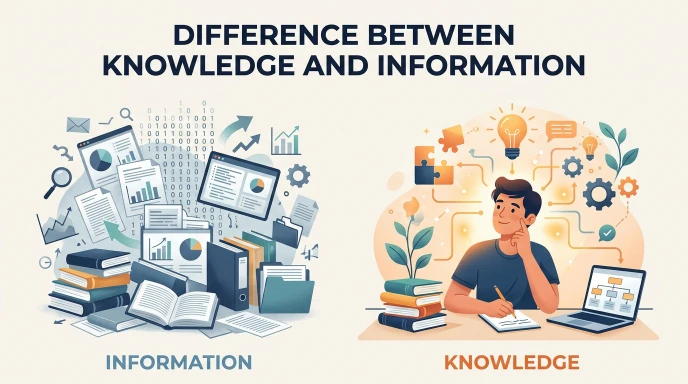
The difference between knowledge and information is that information consists of facts, data, and details, while knowledge is the understanding you gain by learning, interpreting, and applying that information. For example, reading about healthy eating gives you information.
Knowing how to plan balanced meals puts that information into practice. Understanding this difference helps in education, business, technology, and everyday decisions.
Many people use knowledge and information as if they mean the same thing, but they serve different purposes. The difference between knowledge and information becomes clearer when you look at how people learn, solve problems, and make choices. In this guide, you will learn what each term means, how they are connected, when to use them, and why both matter in the digital world.
Quick Answer: Difference Between Knowledge and Information
Information is a collection of facts or details that tells you something. Knowledge is the understanding you develop from that information and your ability to use it effectively.
Example: A weather app tells you that rain is expected tomorrow. That is information. Knowing to carry an umbrella and protect your outdoor plans is an application of that knowledge.
Definition of Knowledge and Information
- Knowledge: The understanding, skills, and insights a person gains through learning, experience, observation, and the use of information.
- Information: Facts, data, or details that have been organized or presented in a meaningful way.
In simple words, information tells you what something is or what is happening. Knowledge helps you understand what it means and what to do with it.
Pronunciation
| Word | US pronunciation | UK pronunciation |
| Knowledge | /ˈnɑː.lɪdʒ/ | /ˈnɒl.ɪdʒ/ |
| Information | /ˌɪn.fɚˈmeɪ.ʃən/ | /ˌɪn.fəˈmeɪ.ʃən/ |
Both words are common in American and British English. The pronunciation of knowledge varies slightly by accent, while information places its main stress on the syllable “ma.”
Now that the definitions are clear, let’s compare how these two concepts work in real life.
Comparison: Knowledge vs. Information
| Feature | Information | Knowledge |
| Meaning | Facts, details, or organized data. | Understanding gained through learning and experience. |
| Main purpose | Provides facts about a subject. | Helps explain facts and guide actions. |
| Source | Books, websites, reports, and databases. | Study, practice, observation, and reflection. |
| Form | Can appear as text, numbers, images, or audio. | Exists as understanding, skills, and mental models. |
| Experience | Can be received without personal experience. | Often develops through experience and interpretation. |
| Application | Supplies details for a task or decision. | Helps a person choose and perform an appropriate action. |
| Measurement | Can be counted in records, words, or data points. | Is harder to measure because understanding varies. |
| Sharing | Often easy to copy, store, and distribute. | Can be shared, but practical skills may require demonstration. |
| Example | A guide explains how a bicycle works. | A rider understands how to balance and control a bicycle. |
Information and knowledge are closely connected, but they are not interchangeable. Information supplies facts, while knowledge helps people understand and use those facts.
Key Differences Explained Between Knowledge and Information
1. Information Provides Facts, While Knowledge Builds Understanding
Information gives you details about a subject. Knowledge develops when you understand those details and see how they fit together.
For example, a student may read that plants need sunlight, water, and nutrients. These facts are information. When the student understands how changing sunlight or watering affects plant growth, that understanding becomes knowledge.
2. Information Can Be Collected, but Knowledge Must Be Developed
You can collect information by reading a book, watching a video, or searching Google. However, simply seeing a fact does not mean you fully understand it.
Suppose you watch a YouTube tutorial about repairing a bicycle. The instructions provide information. Practicing the repair, learning why each step matters, and correcting mistakes help build knowledge.
3. Information Describes What Is Happening, While Knowledge Helps Explain Why
A business report may show that sales dropped by 20% in one month. This is information.
A manager who examines customer feedback, seasonal trends, pricing, and previous sales may discover why sales declined. That understanding is knowledge and can support a better business decision.
4. Information Can Be Stored Digitally, but Knowledge Is More Than Storage
Computers can store enormous amounts of information in databases, documents, and cloud systems. Yet storing facts does not automatically mean a computer understands their meaning in the way a person does.
For example, a company database may contain thousands of customer complaints. Knowledge develops when employees identify recurring problems and use those findings to improve a product or service.
5. Information Can Be Shared Quickly, While Knowledge May Require Practice
Sending someone a document is an easy way to share information. Transferring practical knowledge can take more time because it may require explanation, observation, feedback, and practice.
A chef can share a recipe in seconds. Helping a beginner understand heat control, texture, timing, and seasoning may require several cooking sessions.
6. Information May Be Accurate but Still Be Misleading Without Context
A statistic can be correct but leave out details that change its meaning. Knowledge involves considering the source, circumstances, limitations, and relationship between facts.
For example, a report might show that a company’s revenue increased. That sounds positive, but expenses may have increased even faster. Understanding the full situation requires more than reading one number.
7. Knowledge Helps People Solve Problems
Information can identify a problem, provide instructions, or describe possible solutions. Knowledge helps people decide which solution fits a particular situation.
A mechanic may consult a manual for a car’s engine specifications. Experience and technical understanding help the mechanic identify the actual fault and select the right repair.
How Are Knowledge and Information Connected?
Knowledge and information are different, but one often helps create the other. Information provides material that people can interpret, compare, test, and remember. Those activities can turn facts into meaningful understanding.
A simple learning process looks like this:
Data
Raw numbers, observations, or signals
Information
Data organized into meaningful facts
Knowledge
Understanding built through interpretation and learning
Application
Using understanding to make decisions or solve problems
This sequence is a useful learning model, not a strict rule. People can gain knowledge through direct experience, observation, and practice without first reading organized information. They can also use existing knowledge to recognize new information and learn more quickly.
For example, a gardener who already understands plants may notice that a plant’s leaves are turning yellow. That existing knowledge helps the gardener interpret the new observation and decide what to investigate.
What Is the Difference Between Knowledge and Information in Education?
In education, information is what students receive, while knowledge is what they understand and can use.
A student may memorize historical dates, scientific definitions, or mathematical formulas. Memorization provides access to information, but deeper learning involves understanding relationships, explaining ideas, and applying concepts to unfamiliar questions.
Consider a mathematics lesson. A student might memorize a formula for calculating area. That is information the student has learned. When the student understands why the formula works and can use it to calculate the floor space of a room, the student demonstrates knowledge.
Teachers can help students develop knowledge by encouraging them to:
- Explain concepts in their own words.
- Connect new lessons to what they already know.
- Practice using ideas in different situations.
- Ask questions instead of memorizing every answer.
- Reflect on mistakes and correct misunderstandings.
The same principle applies to professional training. Reading workplace safety rules is useful, but knowing how to respond calmly and correctly during an emergency requires practical understanding and preparation.
Why Is Information Important for Building Knowledge?
Information matters because it gives people the facts and evidence they need to learn about the world. Without reliable information, knowledge can remain incomplete, outdated, or based on incorrect assumptions.
However, more information does not always produce better knowledge. A person who reads hundreds of unrelated articles may remember less than someone who studies a few reliable sources carefully.
The quality of information matters as much as the quantity. Useful information should be relevant, understandable, reasonably current, and supported by trustworthy evidence.
For example, someone researching nutrition may find conflicting advice on social media. Comparing credible medical guidance, checking publication dates, and understanding the evidence can help that person develop a more reliable understanding.
A practical approach is to ask three questions whenever you encounter new information:
- Is it reliable? Check the source and supporting evidence.
- What does it mean? Consider the context and how the facts relate.
- How can I use it? Apply the information carefully and check the results.
These steps help turn passive reading into active learning.
Difference Between Knowledge and Information in Business
Businesses rely on both information and knowledge to make decisions, serve customers, and improve performance.
Information often appears in sales reports, financial statements, customer surveys, inventory records, and website analytics. Knowledge develops when people interpret those records using experience, expertise, and an understanding of business goals.
For example, a store owner may learn from a report that a particular product sells more on weekends. The report provides information. Understanding customer shopping habits and adjusting inventory for busy days demonstrates knowledge.
Modern businesses also use tools such as Google Analytics to study website traffic. The numbers can reveal which pages attract visitors, where people leave a website, and which channels bring customers. Business knowledge helps teams investigate the reasons behind those patterns and choose suitable improvements.
This distinction matters because data alone does not guarantee a good decision. Teams need to interpret evidence, consider risks, and understand the business situation.
How Do Knowledge and Information Work in Technology and AI?
Technology makes information easier to collect, organize, search, and share. Search engines, social platforms, databases, and artificial intelligence systems can process information at a scale that would be difficult for a person to manage manually.
However, information access and knowledge are not the same thing.
Google and Search Engines
Google helps people find webpages, answers, documents, and other information. Search results can introduce a learner to reliable sources, but the learner still needs to evaluate those sources and understand the material.
Finding an answer is the beginning of learning, not always proof of understanding.
Instagram and YouTube
Instagram and YouTube distribute educational videos, tutorials, explanations, and demonstrations. A short video may provide useful information about cooking, fitness, or technology.
Still, watching a demonstration does not guarantee that someone can perform the task correctly. Practice and feedback help turn the information into usable knowledge.
Artificial Intelligence
AI systems can summarize documents, identify patterns, answer questions, and generate explanations based on their training and available context. Their outputs can help people work with information more efficiently.
However, an AI-generated answer may contain errors, missing context, or unsupported claims. Users should verify important information and apply their own judgment, particularly when making consequential decisions.
The important distinction is between accessing information, processing information, and demonstrating understanding through reliable application. These are related abilities, but they should not be treated as identical.
Difference Between Knowledge and Information: Similarities and Differences
| Feature | Knowledge | Information | Similarity |
| Meaning | Understanding of a subject. | Facts and meaningful details. | Both contribute to learning. |
| Purpose | Supports reasoning and action. | Communicates facts and findings. | Both help people make decisions. |
| Development | Grows through learning and experience. | Can be gathered from various sources. | Both can grow over time. |
| Communication | Shared through teaching and demonstration. | Shared through text, speech, and media. | Both can be communicated. |
| Accuracy | Depends on evidence and correct interpretation. | Depends on the quality of the facts. | Both can be correct or incorrect. |
| Use | Helps solve problems and apply ideas. | Supplies details used to understand problems. | Both support problem-solving. |
| Technology | Can be supported by tools and learning systems. | Easily stored and processed digitally. | Both are important in modern technology. |
| Example | Knowing how to interpret a sales report. | The figures shown in the report. | Both relate to the same business situation. |
This table clearly shows the difference and similarity between knowledge and information for quick understanding.
Common Mistakes With Knowledge and Information
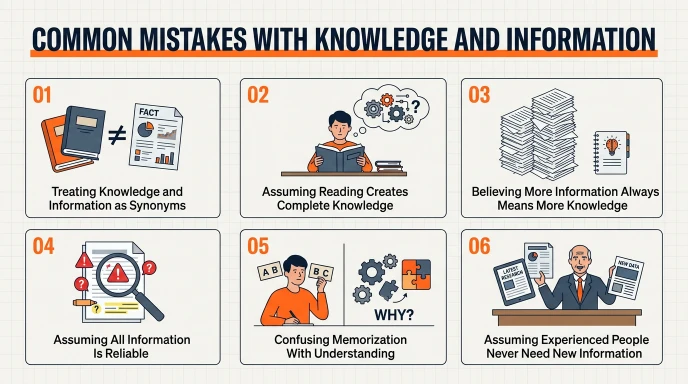
Many people confuse these terms because they are closely connected. Here are common errors and how to avoid them.
Mistake 1: Treating Knowledge and Information as Synonyms
Incorrect: “Information and knowledge always mean exactly the same thing.”
Correct: Information refers to facts and details, while knowledge involves understanding those facts and using them appropriately.
Mistake 2: Assuming That Reading Creates Complete Knowledge
Reading a book can provide valuable information, but it does not guarantee that you can apply everything in it.
How to avoid it: Explain what you learned in your own words, practice the skill, and test your understanding with real examples.
Mistake 3: Believing That More Information Always Means More Knowledge
Collecting many articles, notes, or videos can feel productive. However, information overload can make it harder to identify the most important ideas.
How to avoid it: Focus on relevant, trustworthy sources and organize the main points before moving on to more material.
Mistake 4: Assuming That All Information Is Reliable
A social media post or online article may contain outdated facts or misleading claims.
How to avoid it: Check the original source, compare credible references, and look for supporting evidence.
Mistake 5: Confusing Memorization With Understanding
Remembering a definition is useful, but it may not show that you understand the concept.
How to avoid it: Apply the concept to a new situation. If you can explain why it works and when it applies, you have stronger evidence of understanding.
Mistake 6: Assuming That Experienced People Never Need New Information
Experience helps people interpret situations, but it cannot replace updated facts in every field.
How to avoid it: Combine existing knowledge with current evidence, especially when technology, research, or industry practices change.
Real-Life Examples of Knowledge and Information
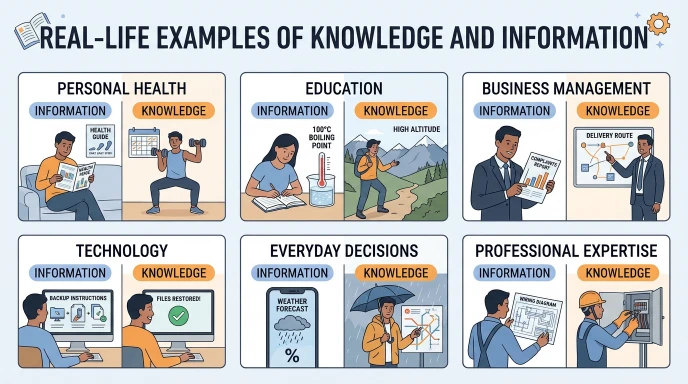
These examples show how the difference between knowledge and information appears in everyday life and professional settings.
Example 1: Personal Health
A person reads that regular physical activity supports general health. This is information.
Understanding how to choose an appropriate activity, follow a manageable routine, and recognize personal limitations involves knowledge. Specific health decisions may also require qualified professional advice.
Example 2: Education
A student learns that water boils at a certain temperature under standard atmospheric pressure. This is information.
Understanding how atmospheric pressure affects boiling point and using that principle to explain what happens at high altitudes demonstrates deeper knowledge.
Example 3: Business Management
A manager receives a report showing that customer complaints have increased. The report contains information.
The manager investigates the complaints, identifies a recurring delivery problem, and changes the process. That response uses knowledge to solve a business issue.
Example 4: Technology
A user reads a guide explaining how to back up files to cloud storage. The instructions provide information.
The user learns to schedule backups, check that files are saved correctly, and restore them when needed. This demonstrates practical knowledge.
Example 5: Everyday Decisions
A weather app reports a high chance of rain. This is information.
Understanding how rain may affect your commute and choosing suitable clothing or transportation applies that information through knowledge.
Example 6: Professional Expertise
An electrician consults a technical document containing wiring specifications. The document provides information.
The electrician uses training, practical experience, and knowledge of electrical safety to assess the situation and carry out appropriate work.
These examples show that information is useful on its own, but knowledge often determines how effectively a person can use it.
When Should You Use Knowledge or Information?
Choose the term that matches what you want to communicate.
Use “information” when discussing facts or details.
Examples: customer information, travel information, research information, and information about a product.
Use “knowledge” when discussing understanding or expertise.
Examples: scientific knowledge, practical knowledge, historical knowledge, and knowledge of a subject.
Compare these sentences:
- “The employee received information about the new software.”
- “The employee gained knowledge of how to use the new software.”
The first sentence focuses on the details received. The second focuses on what the employee learned to understand or do.
Both sentences are correct, but they emphasize different stages of learning.
Why Do People Get Confused About Knowledge and Information?
There are several reasons these words are often mixed up.
First, both relate to learning. Information can help someone gain knowledge, so the two concepts naturally appear together in conversations about education and research.
Second, everyday language sometimes uses them loosely. Someone might say they have knowledge of a topic when they simply mean they have read about it. The exact meaning depends on the context.
Third, digital technology makes information easy to access. Search engines and social platforms can deliver answers in seconds. This convenience may make it feel as though finding an answer is the same as understanding it.
Finally, different professions emphasize different meanings. In education, knowledge often relates to learning and understanding. In information technology, information may refer to organized data that a system can store, retrieve, or process.
The easiest way to avoid confusion is to ask: Am I talking about the facts someone receives, or the understanding they develop from those facts? That question usually makes the correct word clear.
How Search Engines Understand Knowledge and Information
Search engines such as Google organize and retrieve content to help users find relevant answers to their questions. A query about information may indicate that a user wants facts, records, or details. A query about knowledge may indicate interest in understanding a topic, learning a skill, or developing expertise.
For example, someone searching for “information about photosynthesis” may want a definition and basic facts. Someone searching for “how to understand photosynthesis” may benefit more from a clear explanation, examples, and a step-by-step lesson.
Content creators should therefore focus on the meaning behind a query instead of repeating a keyword throughout a page.
Useful content should:
- Answer the main question clearly and early.
- Explain important terms in simple language.
- Include accurate examples and relevant context.
- Use headings that help readers find specific answers.
- Link claims to trustworthy evidence where appropriate.
- Address related questions without adding unnecessary filler.
Search visibility is not guaranteed by using these terms in a particular frequency or structure. Google uses many systems to assess and present relevant content, and the exact ranking process is complex. Clear, helpful content gives users a better experience, but no article structure guarantees the top position.
Expert Insight: How to Turn Information Into Knowledge
A useful way to understand this topic is to think of knowledge as more than the possession of facts. It includes the ability to interpret evidence, recognize patterns, explain relationships, and make informed decisions.
Students can test their understanding instead of relying only on memorization. Professionals benefit from combining reliable information with experience, critical thinking, and feedback. Businesses can also use reports and data to make better decisions rather than simply collecting more records.
One important distinction is that experience alone does not guarantee accurate knowledge. People can learn incorrect ideas from repeated mistakes or unreliable sources. Strong knowledge requires checking assumptions and updating beliefs when better evidence becomes available.
A practical learning method is to follow four steps:
- Collect: Find reliable information from suitable sources.
- Understand: Explain the main idea in your own words.
- Apply: Use what you learned in a practical situation.
- Review: Check the result and correct any misunderstandings.
This approach works for academic subjects, professional skills, technology, and everyday decisions. It also highlights why information and knowledge work best together: information supplies evidence, while knowledge helps people interpret and apply it responsibly.
Frequently Asked Questions
What is the main difference between knowledge and information?
Information consists of facts and details, while knowledge is the understanding gained by interpreting, learning, and applying those facts.
Is knowledge more important than information?
Neither is always more important. Information provides facts, while knowledge helps people understand and use them. Most effective decisions require both.
Can you have information without knowledge?
Yes. A person can read a report or memorize facts without fully understanding their meaning or knowing how to apply them.
Can knowledge exist without information?
Yes. People can develop knowledge through direct experience, observation, experimentation, and practice without relying on written or digital information.
What is the difference between data, information, and knowledge?
Data consists of raw observations or values. Information gives those values meaning through organization and context. Knowledge develops when people understand and apply that information.
What is an example of knowledge and information?
A recipe listing ingredients and cooking times provides information. Understanding how to adjust the heat and recognize when the food is ready demonstrates practical knowledge.
What is the difference between knowledge and information in education?
Information includes facts and lesson content that students receive. Knowledge involves understanding those ideas and applying them to questions, tasks, and real-life situations.
How does information become knowledge?
Information can become knowledge through careful study, interpretation, practice, reflection, and feedback. Simply reading or memorizing facts does not always create deep understanding.
What is the difference between knowledge and information in business?
Business information includes sales figures, customer feedback, and financial reports. Business knowledge involves interpreting those details to identify problems, understand trends, and make better decisions.
Why are knowledge and information important?
Information helps people access facts and evidence. Knowledge helps them understand those facts, solve problems, learn new skills, and make informed choices.
Conclusion
The difference between knowledge and information comes down to facts versus understanding. Information provides the details you need to learn about a subject, while knowledge helps you interpret those details and use them effectively.
For example, reading instructions for using a computer gives you information. Learning how to operate the computer, solve common problems, and apply its features demonstrates knowledge. The same principle applies to education, business, technology, and everyday life.
Both concepts are essential. Information keeps people informed, while knowledge helps them make sense of what they learn. Reliable information supports accurate knowledge, and practical experience helps people apply that knowledge to real situations.
To build stronger knowledge, do more than collect facts. Check your sources, explain ideas in your own words, practice what you learn, and review the results. These habits help turn information into meaningful understanding.
Ultimately, understanding the difference between knowledge and information can improve the way you study, work, research, and make decisions. The goal is not simply to know more facts, but to understand what those facts mean and how to use them wisely.
READ MORE ABOUT!
- Difference Between Respectful and Respectable: Easy Guide
- Difference Between Verbal and Oral: Meaning and Examples

I am Emily Johnson, a USA-based content writer who creates easy-to-read blogs on language and daily life topics. I explain complex ideas in simple English for students and beginners so they can understand easily.