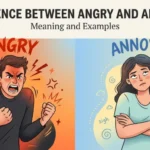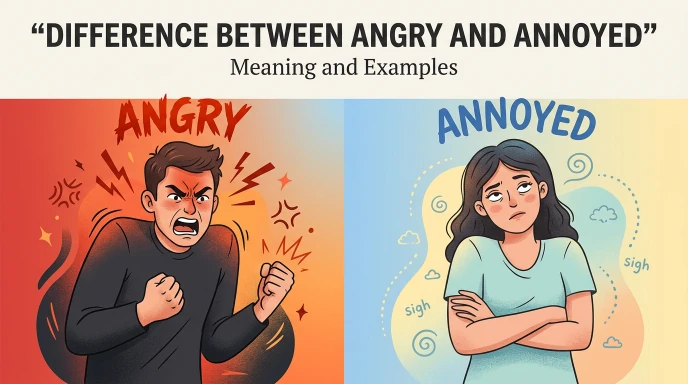
Have you ever felt upset because someone insulted you, but felt only slightly bothered when someone interrupted your work? These feelings show the difference between angry and annoyed. Angry usually describes a strong feeling of displeasure, while annoyed often means feeling bothered, irritated, or impatient by something unpleasant.
The difference between angry and annoyed depends on the intensity of the feeling, its cause, and how long it lasts. Both words describe negative emotions, but they are not always interchangeable. In this guide, you will learn what angry and annoyed mean, how to use them correctly, and how to recognize the difference through everyday examples, workplace situations, and conversations.
Quick Answer: Difference Between Angry and Annoyed
Angry means feeling strong displeasure or hostility because something has upset you. Annoyed means feeling bothered or irritated by something that causes frustration.
Example: You may feel annoyed when someone keeps tapping their pen during a meeting. You may feel angry when that person deliberately insults you in front of your colleagues.
The main difference is emotional intensity, although the situation and the person also matter.
Definitions of Angry and Annoyed
- Angry: Feeling strong displeasure because of something you consider wrong, unfair, hurtful, or frustrating.
- Annoyed: Feeling irritated, bothered, or impatient because something is unpleasant, distracting, or inconvenient.
Both words describe emotions, and either can be mild or intense depending on the context.
Pronunciation
| Word | US pronunciation | UK pronunciation |
| Angry | /ˈæŋɡri/ | /ˈæŋɡri/ |
| Annoyed | /əˈnɔɪd/ | /əˈnɔɪd/ |
Angry sounds like “ANG-gree,” with the stress on the first syllable. Annoyed sounds like “uh-NOYD,” with the stress on the second syllable.
The pronunciations are broadly similar in American and British English. Now, let’s look at how their meanings differ in everyday situations.
Difference Between Angry and Annoyed: Comparison
| Feature | Angry | Annoyed |
| Meaning | Feeling strong displeasure or anger | Feeling bothered or irritated |
| Intensity | Often stronger | Often milder |
| Common causes | Insults, betrayal, injustice, or serious frustration | Noise, interruptions, delays, or repeated habits |
| Emotional response | May involve outrage or resentment | Often involves impatience or irritation |
| Typical duration | May last for minutes, hours, or longer | May disappear quickly when the problem stops |
| Physical signs | May include a tense jaw, raised voice, or clenched fists | May include sighing, frowning, or rolling the eyes |
| Common expressions | “I’m really angry about what happened.” | “I’m annoyed by the constant noise.” |
| Social context | Often used for serious disagreements | Often used for everyday inconveniences |
These are general patterns, not strict rules. A person can be intensely annoyed or only slightly angry. The words depend on the speaker’s feelings and the situation.
Key Differences Explained Between Angry and Annoyed
1. Emotional Intensity
The most noticeable difference between angry and annoyed is how strongly someone feels.
Anger often involves a deeper sense of being wronged, disrespected, or treated unfairly. Annoyance usually describes a smaller irritation that makes it difficult to stay patient.
Example:
- Angry: “I’m angry because you lied to me about something important.”
- Annoyed: “I’m annoyed because you keep leaving your shoes in the hallway.”
The first situation damages trust. The second creates an inconvenience.
2. The Cause of the Feeling
Anger can arise when someone believes that a boundary has been crossed or an injustice has occurred. Annoyance commonly develops when something interferes with comfort, concentration, or expectations.
For instance, a worker may become annoyed when a printer repeatedly jams. However, the same worker may feel angry if a manager publicly takes credit for their work.
The distinction is not simply about how serious an event looks to others. It is also about what the event means to the person experiencing it.
3. How People Express Their Emotions
People express anger and annoyance in different ways, but there is no single behavior that proves what someone feels.
An angry person might speak loudly, argue, or become unusually quiet. An annoyed person might sigh, make a short comment, or show impatience.
Example:
- Angry: “You had no right to share my private messages!”
- Annoyed: “Could you please stop interrupting me?”
Both speakers are upset, but the first expresses a more serious sense of violation.
4. How Long the Feeling Lasts
Annoyance often fades when the irritating situation ends. Anger may continue because the underlying problem remains unresolved.
Imagine that a neighbor plays loud music while you are studying. You may feel annoyed until the music stops. If the neighbor repeatedly ignores reasonable requests, your annoyance could develop into anger.
However, anger does not always last longer than annoyance. A brief incident can cause intense anger that fades quickly, while a small daily irritation can continue for weeks.
5. The Effect on Relationships
Anger and annoyance can both affect relationships, but their effects depend on how people respond.
A person who feels annoyed by a friend’s habit of arriving late may simply ask the friend to be more punctual. A person who feels angry after repeated broken promises may question if the friendship is dependable.
The useful question is not just if someone is angry or annoyed. It is if the emotion points to a problem that needs to be discussed.
6. The Words People Use
The words often communicate how seriously someone views a situation.
For example:
- “I’m a little annoyed” suggests mild irritation.
- “I’m really angry” communicates stronger displeasure.
- “I’m getting annoyed” suggests that patience is wearing thin.
- “I’m furious” expresses a much stronger level of anger.
These expressions help people communicate their emotional state without needing a long explanation.
What Does It Mean to Be Angry?
Being angry means experiencing displeasure, often because something feels unfair, hurtful, threatening, or wrong. Anger is a normal human emotion. It does not automatically mean that someone is aggressive or unable to control themselves.
People may feel angry when someone breaks their trust, ignores an important boundary, or treats them unfairly.
Common Signs of Anger
Anger may show up through:
- A tense face or clenched jaw.
- A faster heartbeat or tense muscles.
- A strong urge to confront someone.
- Repeated thoughts about an unfair situation.
- Speaking more firmly or raising one’s voice.
Not everyone shows anger in the same way. Some people express it openly, while others become quiet and withdraw.
Examples of Angry in Sentences
- She was angry when she discovered that someone had stolen her idea.
- He felt angry after being blamed for a mistake he did not make.
- The customer became angry when the company refused to honor its written agreement.
- I was angry because my friend shared something I had told her in confidence.
In each example, the emotion is connected to a situation the person considers important or unfair.
What Does It Mean to Be Annoyed?
Being annoyed means feeling irritated, bothered, or impatient because something disrupts your comfort, attention, or expectations.
Annoyance often appears during ordinary activities. A loud notification, an unnecessary interruption, or a repeated question can make someone annoyed even when no one intends to cause harm.
Common Signs of Annoyance
Someone who is annoyed may:
- Sigh or frown.
- Give short answers.
- Become impatient.
- Ask someone to stop repeating a behavior.
- Find it difficult to concentrate.
These signs are not definitive. A person might sigh because they are tired rather than annoyed, so it is better to consider the context instead of assuming what someone feels.
Examples of Annoyed in Sentences
- I was annoyed because my phone kept buzzing during dinner.
- She felt annoyed when her coworker interrupted her presentation.
- He looked annoyed when the bus arrived twenty minutes late.
- They were annoyed by the website’s repeated error messages.
These examples describe irritating experiences that do not necessarily involve a serious conflict.
Can You Be Angry and Annoyed at the Same Time?
Yes. Anger and annoyance can happen together, especially when a small irritation becomes part of a larger problem.
Imagine that your coworker interrupts you during a meeting. At first, you feel annoyed because you cannot finish your point. When the coworker repeatedly dismisses your ideas and takes credit for your work, you may become angry.
The feelings overlap, but they can reflect different parts of the experience:
- Annoyance: The interruption is frustrating.
- Anger: The repeated behavior feels disrespectful or unfair.
You can also feel annoyed with someone you care about without being angry with them as a person. For example, a parent may feel annoyed when a child repeatedly asks the same question while they are busy.
Understanding both feelings can help people describe what is bothering them more accurately.
Difference and Similarity Between Angry and Annoyed
| Feature | Angry | Annoyed | Similarity |
| Core meaning | Strong displeasure | Irritation or bother | Both are negative emotions |
| Typical intensity | Often strong | Often mild to moderate | Both vary in intensity |
| Common trigger | Injustice or hurt | Inconvenience or repetition | Both respond to unpleasant events |
| Physical reaction | May involve tension or a raised voice | May involve sighing or frowning | Both can cause physical changes |
| Communication | May involve confrontation | May involve a request to stop something | Both can be expressed verbally |
| Duration | Can be brief or long-lasting | Can be brief or persistent | Neither has a fixed duration |
| Relationship impact | May signal a serious conflict | May signal a minor frustration | Both can affect relationships |
| Resolution | May require accountability or repair | May require a change in the irritating situation | Both can improve when the cause is addressed |
This table clearly shows the difference and similarity between angry and annoyed for quick understanding.
Common Mistakes With Angry and Annoyed
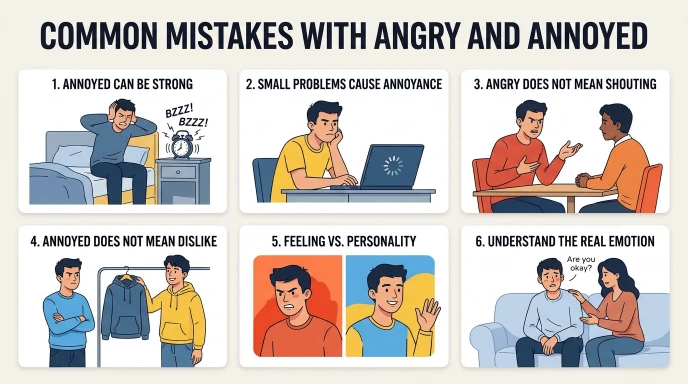
Many English learners use these words interchangeably because both describe unpleasant feelings. However, choosing the right word can make a sentence more precise.
Mistake 1: Assuming Annoyed Always Means Mild
Incorrect assumption: “Annoyed” can never describe a strong feeling.
Correction: Annoyance is often mild, but repeated irritation can become intense. The context and words such as “extremely” or “deeply” help communicate the degree.
Example: “I was extremely annoyed when the alarm kept ringing all night.”
Mistake 2: Using Angry for Every Small Inconvenience
Less natural: “I was angry because the website took five seconds to load.”
More natural: “I was annoyed because the website took five seconds to load.”
The second sentence usually fits a minor inconvenience better. However, if the delay caused a serious problem, anger might be appropriate.
Mistake 3: Assuming Angry People Always Shout
Anger does not always involve loud speech or aggressive behavior.
Better understanding: Someone can be angry and still speak calmly, explain their concerns, or ask for a solution.
Example: “I am angry about this decision, but I want to discuss it respectfully.”
Mistake 4: Assuming Annoyance Means Dislike
Feeling annoyed with someone does not necessarily mean you dislike them.
Example: “I love my brother, but I’m annoyed when he borrows my things without asking.”
The person values the relationship but dislikes a particular behavior.
Mistake 5: Confusing the Feeling With the Person
Calling someone “an angry person” suggests a broader pattern, while saying “I’m angry” describes a current emotional state.
Likewise, “She is annoyed” describes how she feels now, not necessarily her personality.
Tip: Describe the emotion or behavior rather than making a permanent judgment about someone.
Mistake 6: Ignoring the Reason Behind the Emotion
A person may appear annoyed when the real issue is feeling ignored, disrespected, or overwhelmed.
Instead of assuming, ask a calm question such as, “Is something bothering you?” This can help clarify the problem without escalating the situation.
Real-Life Examples of Angry and Annoyed
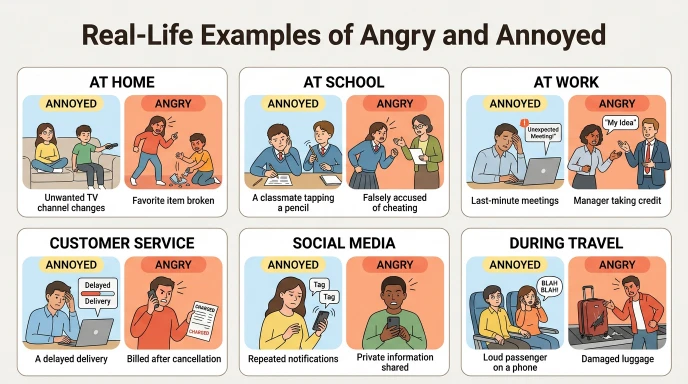
These situations show how the difference between angry and annoyed works in everyday life.
Example 1: At Home
Annoyed: Maya feels annoyed because her brother keeps changing the television channel while she watches a show.
Angry: Maya feels angry when her brother deliberately breaks something that belongs to her.
The first situation is an irritating habit. The second involves damage to her property.
Example 2: At School
Annoyed: A student becomes annoyed when another student keeps tapping a pencil during a test.
Angry: The student becomes angry when a classmate falsely accuses them of cheating.
The first disrupts concentration. The second threatens the student’s reputation.
Example 3: In the Workplace
Annoyed: An employee feels annoyed when a coworker schedules meetings without checking everyone’s availability.
Angry: The employee feels angry when a manager knowingly gives someone else credit for their work.
Both situations can be frustrating, but the second may involve a more serious professional concern.
Example 4: In Customer Service
Annoyed: A customer is annoyed because an online order arrives one day later than expected.
Angry: The customer is angry because the company repeatedly charges them after confirming that their subscription has been canceled.
The difference depends on the impact, the company’s response, and the customer’s expectations.
Example 5: On Social Media
Annoyed: Someone feels annoyed when a friend tags them in too many Instagram posts.
Angry: Someone feels angry when a person deliberately shares their private information without permission.
Instagram and other social platforms can create both minor frustrations and serious disagreements. The platform itself does not determine the emotion; the situation does.
Example 6: During Travel
Annoyed: A passenger feels annoyed because another passenger speaks loudly on the phone.
Angry: A passenger feels angry when someone deliberately pushes them or damages their luggage.
These examples demonstrate that the difference between angry and annoyed is about the person’s reaction to what happened, not simply where the event takes place.
When Should You Use Angry or Annoyed?
Choose the word that best reflects the feeling you want to communicate.
Use Angry When the Situation Feels Serious
Use angry when you want to express strong displeasure, especially when you feel hurt, betrayed, disrespected, or treated unfairly.
Examples:
- “I’m angry that you broke your promise.”
- “The residents were angry about the unfair decision.”
- “She was angry when she discovered the missing money.”
Use Annoyed When Something Bothers You
Use annoyed when a situation irritates you, tests your patience, or makes it difficult to concentrate.
Examples:
- “I’m annoyed by these constant notifications.”
- “He was annoyed because the meeting started late.”
- “She felt annoyed when the same question was asked again.”
What If Both Words Seem Correct?
Sometimes either word works, but the meaning changes slightly.
Compare these sentences:
- “I’m annoyed that you forgot to call.”
- “I’m angry that you forgot to call.”
The first may suggest disappointment or irritation. The second may suggest that the forgotten call had greater emotional importance or that it is part of a repeated problem.
Neither sentence is automatically correct or incorrect. The speaker’s actual feelings determine the best choice.
Why Do People Get Confused Between Angry and Annoyed?
There are several reasons these words can be difficult to distinguish.
1. Their Meanings Overlap
Both words describe negative emotional responses. A frustrating situation can cause annoyance, anger, or both.
For example, a delayed train might annoy one passenger and anger another passenger who is about to miss an important appointment.
2. People Experience Emotions Differently
One person may consider a repeated interruption a minor irritation. Another may interpret it as disrespect.
Personal expectations, previous experiences, stress, and the importance of the situation all influence emotional reactions.
3. Tone Changes the Meaning
Someone who says “I’m annoyed” in a calm voice may sound mildly irritated. Another person might say the same words with intense frustration.
Written messages remove many vocal cues, making emotional meaning harder to interpret. A short text such as “Fine.” may indicate annoyance, anger, disappointment, or simply a desire to end the conversation.
4. Everyday Language Is Flexible
In casual conversations, people sometimes use “angry,” “annoyed,” “irritated,” “upset,” and “frustrated” in overlapping ways.
However, their meanings are not identical. “Upset” is broader, “irritated” often suggests annoyance, and “frustrated” usually emphasizes difficulty or blocked progress.
Recognizing these differences helps speakers communicate more clearly.
How Search Engines Understand Angry and Annoyed
Search engines such as Google interpret searches by considering the meaning and context of the words, rather than relying only on exact keyword matches.
For a query such as “difference between angry and annoyed,” the likely intent is informational and comparative. The searcher wants definitions, distinctions, and examples that clarify when each word should be used.
A useful article addresses several related needs:
- Definitions: What does each word mean?
- Comparison: How do their intensity and usage differ?
- Examples: How do they work in real sentences?
- Practical guidance: When should someone use one word instead of the other?
- Related vocabulary: How do angry, annoyed, irritated, and frustrated compare?
Google Search may display concise definitions or relevant passages when they answer a user’s question clearly. However, there is no guaranteed formula for earning a featured snippet or reaching the top of search results.
Social platforms such as Instagram, Meta’s services, and YouTube also contain conversations in which people express annoyance or anger. Their recommendation systems serve different purposes from Google Search, so their ranking signals should not be treated as identical.
For a language-learning article, the most useful strategy is to answer the main question directly, use accurate examples, organize information clearly, and avoid adding unrelated material simply to include more keywords.
Expert Insight: Understanding the Emotion Behind the Word
A useful way to distinguish anger from annoyance is to ask two questions: How intense is the feeling, and what does the situation mean to the person experiencing it?
Intensity matters, but meaning matters too. A minor delay can cause intense anger when it threatens something important. A serious inconvenience might produce only mild annoyance in someone who is relaxed and has plenty of time.
In practical communication, naming the emotion accurately can help people explain their needs. “I’m annoyed because I cannot concentrate” identifies a distraction. “I’m angry because you ignored a boundary I clearly explained” identifies a deeper concern.
It is also important not to diagnose another person’s emotions from facial expressions or a single message. A person who looks irritated may be tired, worried, or distracted.
The best approach is to consider the circumstances and, when appropriate, ask the person directly. Emotional vocabulary works best when it helps people understand one another rather than label or blame them.
Frequently Asked Questions
Is being angry and annoyed the same thing?
No, being angry and annoyed is not exactly the same. Annoyed usually means mildly upset or irritated, while angry often describes a stronger emotional reaction.
Is mad the same as annoyed?
Not exactly. Mad often means angry, especially in American English, while annoyed usually describes feeling bothered or irritated by something.
What is the difference between anger and frustration?
Anger is a strong feeling of displeasure, while frustration happens when something blocks your goals or does not go as expected. For example, you may feel frustrated when your computer stops working and angry if the problem continues.
Is “annoyed” another word for “angry”?
Sometimes, but the words have different levels of intensity. Annoyed usually suggests mild irritation, while angry often expresses a stronger feeling.
How do I say I’m annoyed?
You can say, “I’m annoyed by the constant noise,” “That really bothers me,” or “I’m getting irritated.” These expressions communicate that something is upsetting you.
What does “annoyed” mean?
Annoyed means feeling slightly angry, irritated, or bothered by someone or something. For example, “She was annoyed when her friend kept interrupting her.”
Conclusion
The difference between angry and annoyed comes down to the nature and intensity of an emotional response. Angry usually expresses stronger displeasure, particularly when someone feels hurt, betrayed, disrespected, or treated unfairly. Annoyed generally describes irritation, impatience, or discomfort caused by something bothersome.
For example, you might feel annoyed when a coworker repeatedly interrupts your conversation. If that coworker deliberately takes credit for your work, you might feel angry because the situation involves a deeper concern.
Still, these words are not separated by a strict boundary. People respond differently to the same event, and a small frustration can become serious when it continues. You can also experience anger without shouting or feel annoyed with someone you love.
When choosing between the words, consider what happened, how strongly you feel, and what you want others to understand. Use annoyed for everyday irritation and angry when you want to express stronger displeasure, while remembering that context determines the best choice.
Understanding the difference between angry and annoyed makes everyday English more precise and can help you communicate your feelings more clearly in personal relationships, school, and the workplace.
READ MORE ABOUT!
- Difference Between Effective and Efficient: Differences Explained
- Difference Between Childish and Childlike: Meaning and Examples

I am Emily Johnson, a USA-based content writer who creates easy-to-read blogs on language and daily life topics. I explain complex ideas in simple English for students and beginners so they can understand easily.