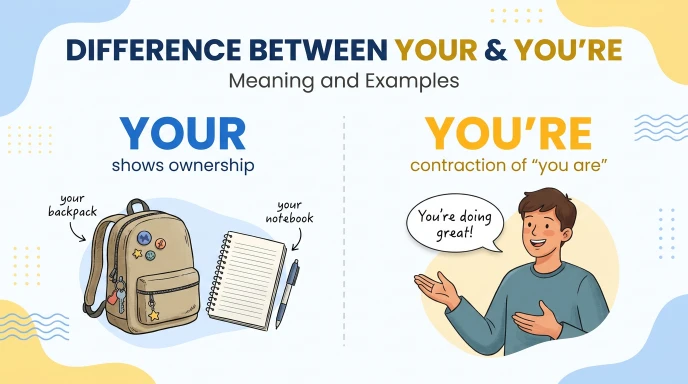
Have you ever written “your welcome” instead of “you’re welcome” in a text message? Many people confuse these words because they sound exactly the same, but they have different meanings. The difference between your and you’re is simple: your shows ownership, while you’re is the short form of “you are.”
Knowing when to use each word helps you write clear messages, emails, school assignments, and professional documents. In this guide, you’ll learn what your and you’re mean, how to use them correctly, and why people often mix them up. You’ll also find easy grammar rules, common mistakes, real-life examples, and simple tricks to remember the difference.
Quick Answer: Difference Between Your and You’re
Your shows that something belongs to or is connected to someone. You’re is a contraction of “you are.”
- Your: “Your phone is on the table.”
- You’re: “You’re using your phone.”
Easy trick: Replace “you’re” with “you are.” If the sentence still makes sense, use you’re. If it does not, you probably need your.
Definitions of Your and You’re
- Your: A possessive determiner used before a noun to show that something belongs to, or is associated with, the person being addressed.
- You’re: A contraction of “you are,” used to combine the pronoun “you” with the verb “are.”
Examples:
- Your book is interesting.
- You’re reading an interesting book.
Pronunciation
| Word | US pronunciation | UK pronunciation |
| Your | /jʊr/ or /jɔːr/ | /jɔː/ or /jʊə/ |
| You’re | /jʊr/ or /jɔːr/ | /jɔː/ or /jʊə/ |
Pronunciation varies by accent. In many American and British accents, your and you’re sound the same. This makes them homophones: words that share a pronunciation but have different meanings or spellings.
Because you cannot always hear the difference, you need to understand the sentence to choose the correct spelling.
Difference Between Your and You’re: Comparison
| Feature | Your | You’re |
| Meaning | Shows ownership or association | Means “you are” |
| Grammar | Possessive determiner | Pronoun plus verb contraction |
| Purpose | Identifies something connected to you | Describes you or what you are doing |
| Followed by | Usually a noun or noun phrase | An adjective, verb phrase, or other complement |
| Example | Your bag is missing. | You’re late for class. |
| Expansion | Cannot be expanded to “you are” | Can be expanded to “you are” |
| Apostrophe | Does not use an apostrophe | Requires an apostrophe |
| Common mistake | Writing “your welcome” | Writing “you’re book” |
The biggest difference is grammatical: your points to something associated with you, while you’re tells the reader something about you.
Key Differences Explained Between Your and You’re
1. Your Shows Ownership
Use your when referring to something that belongs to, or is associated with, the person you are speaking to.
Examples:
- Your jacket is hanging by the door.
- Please check your homework before submitting it.
- I like your new hairstyle.
The noun that follows your helps identify what is being discussed. Ownership does not always mean legal possession. In “your opinion,” for example, the word refers to an opinion associated with the person.
2. You’re Means You Are
Use you’re when you could write “you are” instead.
Examples:
- You’re very kind. → You are very kind.
- You’re learning English. → You are learning English.
- You’re ready for the meeting. → You are ready for the meeting.
This replacement test is one of the simplest ways to avoid grammar mistakes.
3. Your Usually Comes Before a Noun
Your normally introduces a noun or noun phrase.
Examples:
- Your answer is correct.
- Your friends are waiting outside.
- I appreciate your help.
The word identifies whose answer, friends, or help is being discussed.
However, the noun does not have to appear immediately after your. In “your carefully written report,” the adjective phrase “carefully written” comes between your and the noun report.
4. You’re Can Come Before an Adjective or Verb Phrase
You’re commonly appears before an adjective, a present participle, or another phrase that completes “you are.”
Examples:
- You’re happy.
- You’re working hard.
- You’re a good listener.
- You’re going to enjoy the movie.
In each case, you are can replace you’re without changing the basic meaning.
5. Your and You’re Are Not Interchangeable
Although the words sound alike, changing one for the other can make a sentence grammatically incorrect or change its meaning.
Incorrect: “You’re shoes are dirty.”
Correct: “Your shoes are dirty.”
Incorrect: “Your going to love this.”
Correct: “You’re going to love this.”
The best way to choose is to check what the sentence means, rather than relying on how it sounds.
6. You’re Uses an Apostrophe
The apostrophe in you’re marks the missing letters in the contraction of “you are.”
- You are = you’re
- Your = possessive word, with no apostrophe
Compare these sentences:
- You’re responsible for your own choices.
- Your teacher said you’re ready for the exam.
Both words can appear in the same sentence because they serve different grammatical purposes.
What Does Your Mean in English?
Your is a possessive determiner. It comes before a noun to show that something belongs to or relates to the person being addressed.
Examples of Your in Sentences
- Is this your umbrella?
- Your idea could help the team.
- Please bring your identification card.
- I enjoyed your presentation.
- Your account settings need an update.
Notice that your can refer to physical objects, personal qualities, ideas, relationships, and other things associated with someone.
For example, “your responsibility” does not describe an object you own. It identifies a responsibility connected to you.
How to Use Your Correctly
Ask yourself: What thing, person, or idea is connected to you?
If the sentence identifies something associated with the person being addressed, your is likely correct.
For example:
- “Please remember your password.” The password is associated with the person.
- “Your manager will contact you.” The manager is connected to the person in the sentence.
This simple question helps you use your naturally in everyday English.
What Does You’re Mean in English?
You’re is the contraction of “you are.” It combines the pronoun you with the present-tense form of the verb be, are.
Examples of You’re in Sentences
- You’re doing a great job.
- You’re welcome to join us.
- You’re not alone.
- You’re becoming more confident.
- You’re the person I wanted to meet.
Each sentence makes sense when you’re is expanded to you are.
For example, “You’re becoming more confident” becomes “You are becoming more confident.”
How to Use You’re Correctly
Try replacing you’re with “you are.”
- “You’re tired.” → “You are tired.” Correct.
- “You’re my best friend.” → “You are my best friend.” Correct.
- “You’re going home.” → “You are going home.” Correct.
Now consider “You’re phone is ringing.” Replacing you’re gives “You are phone is ringing,” which is incorrect. The correct sentence is “Your phone is ringing.”
Difference and Similarity Between Your and You’re
| Feature | Your | You’re | Similarity |
| Meaning | Shows possession or association | Means “you are” | Both refer to the person being addressed |
| Grammar | Possessive determiner | Contraction | Both are common English words |
| Apostrophe | No apostrophe | Uses an apostrophe | Both are spelled with five or fewer letters |
| Pronunciation | Often sounds like “you’re” | Often sounds like “your” | They are homophones in many accents |
| Sentence role | Introduces a noun phrase | Describes or identifies the subject | Both help build meaningful sentences |
| Formal writing | Fully acceptable | Common, but contractions may be avoided in some formal styles | Both are standard English |
| Text messages | Shows ownership or association | Shortens “you are” | Both appear frequently in digital communication |
| Expansion | No direct “you are” expansion | Expands to “you are” | Context helps readers understand both |
This table clearly shows the difference and similarity between your and you’re for quick understanding.
Common Mistakes With Your and You’re
Even confident English speakers sometimes make these errors, especially when typing quickly. Here are the most common mistakes and how to fix them.
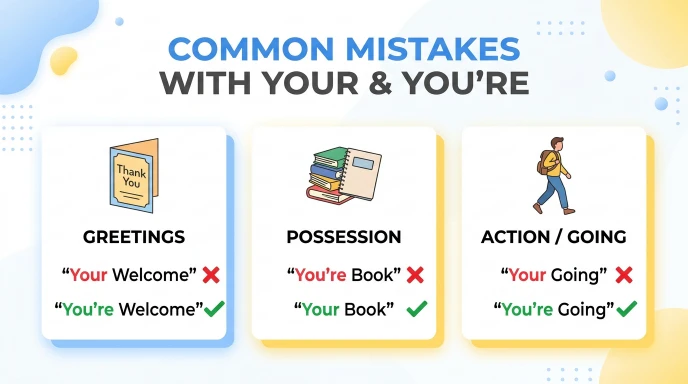
Mistake 1: Writing “Your Welcome”
Incorrect: “Your welcome!”
Correct: “You’re welcome!”
Why? The phrase means “You are welcome,” so you’re is the correct form.
Mistake 2: Writing “You’re Book”
Incorrect: “You’re book is on the desk.”
Correct: “Your book is on the desk.”
Why? The sentence identifies whose book it is. Your must come before the noun book.
Mistake 3: Writing “Your Going”
Incorrect: “Your going to be late.”
Correct: “You’re going to be late.”
Why? The sentence means “You are going to be late.” The contraction you’re is needed.
Mistake 4: Adding an Apostrophe to Your
Incorrect: “I like you’re idea.”
Correct: “I like your idea.”
Why? Your shows association or ownership. It does not need an apostrophe.
Mistake 5: Choosing by Sound Alone
Incorrect: Assuming that the word that sounds right must be spelled correctly.
Correction: Check the sentence’s grammar and meaning.
Example:
- “Your amazing.” → Incorrect if you mean “You are amazing.”
- “You’re amazing.” → Correct.
Since the words sound alike in many accents, pronunciation alone cannot reliably tell you which spelling to use.
Mistake 6: Avoiding You’re in Every Formal Sentence
Some people believe contractions are always grammatically wrong in formal English.
Correction: You’re is standard English. Some academic, legal, or formal writing styles prefer expanded forms such as “you are,” but this is a style choice rather than a rule that makes contractions incorrect.
Real-Life Examples of Your and You’re
The following examples show how these words work in different situations.
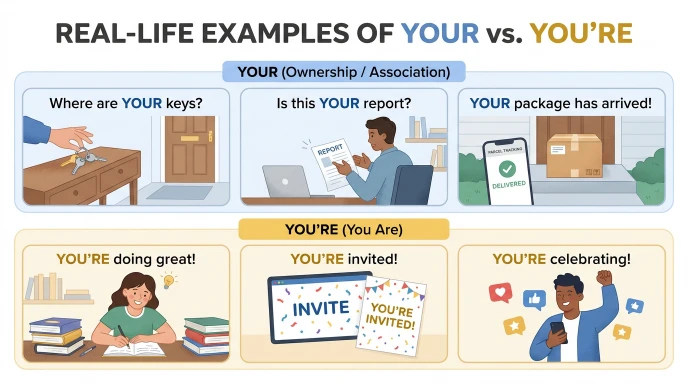
Example 1: Everyday Conversation
Your: “Your keys are next to the door.”
You’re: “You’re going to forget your keys if you leave now.”
The first sentence identifies whose keys they are. The second tells the person what they are likely to do.
Example 2: School and Education
Your: “Your assignment is due on Friday.”
You’re: “You’re making good progress on your assignment.”
Your identifies the assignment associated with the student. You’re means “you are” and describes the student’s progress.
Example 3: Workplace Communication
Your: “Your report needs one more revision.”
You’re: “You’re responsible for sending the final report.”
The first sentence refers to a report connected to the recipient. The second identifies the recipient’s responsibility.
Example 4: Business Emails
Your: “Thank you for your time and support.”
You’re: “You’re invited to attend our product presentation.”
Both words are useful in professional communication. Your refers to the recipient’s time and support, while you’re means “you are invited.”
Example 5: Social Media and Texting
Your: “Your new profile picture looks great.”
You’re: “You’re going viral!”
People often type these expressions quickly on Instagram, YouTube, and other social platforms. Even when a message is casual, using the right spelling makes it easier to read and understand.
Example 6: Customer Service
Your: “Your order has been shipped.”
You’re: “You’re able to track your order online.”
The first sentence refers to the customer’s order. The second means “You are able to track your order online.”
These examples show that the same rule applies across personal messages, education, business, and digital communication.
When Should You Use Your or You’re?
Use the following decision guide whenever you are unsure which word belongs in a sentence.
Use Your When Referring to Something Associated With Someone
Choose your when a noun or noun phrase identifies something connected to the person you are addressing.
Examples:
- Your car is outside.
- Your opinion matters.
- Please update your profile.
- I received your email.
Use You’re When You Mean You Are
Choose you’re when it can be expanded to you are.
Examples:
- You’re early.
- You’re doing well.
- You’re invited to the event.
- You’re going to enjoy this book.
What About “Your” Before an -ing Word?
This is a useful detail that often confuses learners.
Both of these sentences are correct, but they mean different things:
- “Your singing is beautiful.” Here, singing is a noun describing the activity or skill.
- “You’re singing beautifully.” Here, you’re means “you are,” and singing is part of the verb phrase.
This is a good example of why checking the sentence’s structure is more reliable than looking at the next word alone.
Why Do People Get Confused Between Your and You’re?
1. They Sound the Same
In many English accents, your and you’re have the same pronunciation. When people write what they hear, it is easy to select the wrong spelling.
2. English Contractions Can Be Tricky
English uses apostrophes in contractions such as you’re, they’re, and it’s. These forms can be confused with possessive words such as your, their, and its.
A useful comparison is:
- Your = possession or association.
- You’re = you are.
- Their = possession or association.
- They’re = they are.
- Its = possession or association.
- It’s = it is or it has.
These pairs follow similar spelling patterns, so learning them together can help.
3. People Type Quickly Online
Text messages and social media posts are often written without careful proofreading. Autocorrect may not catch a mistake if the incorrectly selected word is spelled correctly on its own.
For example, both your and you’re are valid words. A spell-checker may accept either one even when only one fits the sentence.
4. The Apostrophe Is Misunderstood
Some writers assume that an apostrophe always indicates ownership. In English, however, apostrophes also mark missing letters in contractions.
In “you’re,” the apostrophe replaces the missing letters in “you are.” By contrast, “your” shows possession and does not require an apostrophe.
How Search Engines Understand Your and You’re
Google Search is designed to interpret a query’s likely meaning and provide relevant results. Someone searching for “difference between your and you’re” is usually looking for a grammar explanation, examples, and a quick way to avoid mistakes.
Helpful content for this search intent includes:
- Short definitions of both words.
- A comparison table.
- Examples showing correct and incorrect usage.
- A simple replacement test.
- Answers to related questions, such as why the words sound the same.
Google may use clear passages from a page to help answer a searcher’s question, but no particular format guarantees a featured snippet or top ranking.
Social platforms such as Instagram, YouTube, and Meta’s messaging services are also places where spelling matters. Posts, comments, captions, and messages are easier to understand when writers choose the correct word. These platforms have different systems for recommending content, so their behavior should not be confused with Google Search’s handling of informational queries.
For writers and website owners, the practical lesson is straightforward: answer the reader’s question clearly, demonstrate the grammar rule accurately, and provide examples that make the distinction easy to remember.
Expert Insight: The Fastest Way to Remember Your and You’re
The most reliable method is to focus on meaning rather than spelling.
Whenever you write you’re, pause for a moment and replace it with “you are.” If the sentence remains grammatically correct, you’re is likely the right choice.
For example:
- “You’re very helpful.” → “You are very helpful.” Correct.
- “You’re bag is heavy.” → “You are bag is heavy.” Incorrect.
In the second sentence, use your: “Your bag is heavy.”
For your, look for a noun or noun phrase that belongs to or is associated with the person being addressed. Remember that this connection does not always mean literal ownership. “Your answer,” “your family,” and “your responsibility” all use your correctly.
A second useful habit is proofreading common phrases that you type often, including “you’re welcome,” “your opinion,” “you’re right,” and “your turn.”
These small checks are more useful than memorizing a long list of grammar rules. Once you understand the meaning of each word, choosing the right form becomes much easier.
Frequently Asked Questions
What is the difference between your and you’re?
Your shows ownership or association, while you’re is a contraction of “you are.” For example, “Your coat is wet” and “You’re getting wet” use the words differently.
Is it your welcome or you’re welcome?
The correct expression is “you’re welcome” because it means “you are welcome.” Your welcome is incorrect when used as a response to thank you.
How do I remember when to use your or you’re?
Replace you’re with “you are.” If the sentence still makes sense, use you’re. Otherwise, if you are referring to something associated with someone, use your.
Why do your and you’re sound the same?
They are homophones in many English accents. Their pronunciation is often identical, but their meanings, spellings, and grammatical roles differ.
Can your and you’re be used in the same sentence?
Yes. For example, “You’re responsible for your homework.” You’re means “you are,” while your identifies whose homework it is.
Is you’re grammatically correct?
Yes. You’re is a standard English contraction of “you are.” In some formal styles, writers may prefer to spell out the full phrase.
What is the difference between your, you’re, and yours?
Your comes before a noun, as in “your book.” You’re means “you are,” as in “you’re ready.” Yours is a possessive pronoun that can stand alone, as in “The book is yours.”
Should I use your or you’re before an adjective?
Use you’re when the adjective describes the person. For example, “You’re kind” means “You are kind.” Your normally comes before a noun phrase, as in “your kind words.”
Is “your doing great” correct?
No, not when you mean that someone is doing well. The correct sentence is “You’re doing great,” because it means “You are doing great.”
Conclusion
The difference between your and you’re is easy to understand once you remember what each word does. Your is a possessive determiner that shows ownership or association, while you’re is the contraction of “you are.” They often sound identical, but they cannot be used interchangeably.
Use your in sentences such as “Your answer is correct” or “I appreciate your help.” Use you’re in sentences such as “You’re correct” or “You’re doing a great job.”
When you are unsure, use the replacement test: change you’re to “you are.” If the sentence still makes sense, you’re is the right choice. If it becomes grammatically incorrect, check if your is needed instead.
This rule works in text messages, school assignments, business emails, website content, and social media captions. Although spelling tools can catch many errors, they may not recognize a wrong word when both options are correctly spelled. Understanding the grammar helps you catch those mistakes yourself.
With a little practice, you can use both words confidently. Remember: your shows a connection, while you’re means you are.
READ MORE ABOUT!
- Difference Between Habit and Routine: What Sets Them Apart?
- Difference Between Skill and Ability: Key Differences Explained

I am James Carter, a professional content writer from the United States. I specialize in writing simple and clear comparison blogs that help students and readers understand difficult topics easily. My writing focuses on everyday language, education, science, and lifestyle topics. I believe that learning should be easy for everyone, so I use simple words and real-life examples in my articles.