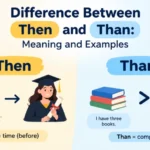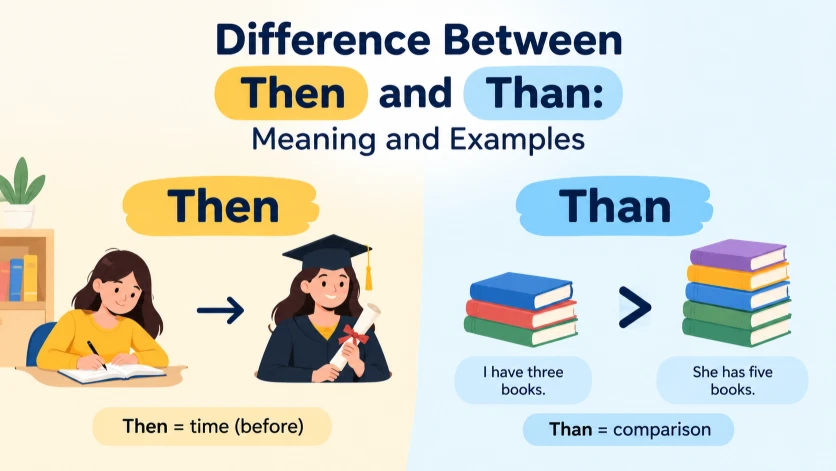
Have you ever written “I am taller then my brother” and wondered if then or than was correct? The difference between then and than is easy to understand once you know what each word does. Then usually refers to time, order, or what happens next, while than is used to compare two people, things, or ideas.
Many English learners confuse these words because they differ by only one letter and sound similar in some accents. This guide explains the difference between then and than with clear definitions, pronunciation tips, comparison tables, common mistakes, and real-life examples. You will also learn how to choose the correct word in emails, school assignments, business writing, and everyday conversations.
Quick Answer: Difference Between Then and Than
Then refers to a time, a sequence, or a result. Than introduces a comparison between two things.
- Then: Finish your homework, then watch TV.
- Than: This book is more interesting than that one.
Easy trick: Use then for time and order. Use than for comparisons.
Definitions of Then and Than
- Then: An adverb that commonly refers to a particular time, the next step in a sequence, or a result. Example: We ate dinner, then watched a movie.
- Than: A word used to introduce the second part of a comparison. Example: My new phone is faster than my old one.
These definitions cover the most common uses of both words. Although they look similar, they serve different purposes in a sentence.
Pronunciation
Then and than sound very similar, but their first vowel sounds are different in many varieties of English.
| Word | American English | British English | Stress |
| Then | /ðɛn/ | /ðen/ | One syllable |
| Than | /ðæn/ | /ðæn/ | One syllable |
In then, the vowel is similar to the sound in bed. In than, it is often similar to the vowel in cat. The exact sound can vary by accent, and some speakers pronounce the words more similarly than others.
Both words begin with the voiced “th” sound, as in this. Neither word has a separate stressed syllable because each has only one syllable.
Since pronunciation can vary, the most reliable way to distinguish them is to understand their meaning. Let’s look at how they work in everyday English.
Difference Between Then and Than: Comparison
| Feature | Then | Than |
| Main meaning | Refers to time, order, or result | Introduces a comparison |
| Common use | Describes what happened or happens next | Shows how things differ |
| Grammar | Usually an adverb; can also be a noun or adjective | A conjunction or preposition, depending on the grammatical analysis |
| Time reference | Yes, often | No, not by itself |
| Comparisons | Not used to introduce standard comparisons | Used with comparative words such as better and taller |
| Common phrases | Since then, back then, then again | Better than, more than, less than |
| Example | We finished work, then went home. | She is older than her brother. |
| Sentence purpose | Shows sequence or a result | Shows a difference between things |
Similarities and Differences Between Then and Than
| Feature | Then | Than | Similarity |
| Spelling | Contains E | Contains A | Both begin with TH |
| Pronunciation | Usually has the vowel in bed | Usually has the vowel in cat | Both have one syllable |
| Meaning | Time, sequence, or result | Comparison | Both help connect ideas |
| Grammar | Commonly an adverb | Commonly introduces a comparison | Both appear in many sentence structures |
| Formality | Used in formal and informal English | Used in formal and informal English | Both are standard English words |
| Common contexts | Stories, instructions, and timelines | Opinions, measurements, and evaluations | Both are used in everyday communication |
| Typical partner | Next, after, since, or back | Better, taller, more, or less | Both often appear alongside other words |
This table clearly shows the difference and similarity between then and than for quick understanding.
Key Differences Explained Between Then and Than
1. Then Refers to Time, While Than Shows Comparison
The biggest difference between then and than is their meaning.
Use then when talking about when something happened or what happened next. Use than when comparing two people, objects, places, or ideas.
Examples:
- Then: I lived in London then.
- Than: London is larger than my hometown.
The first sentence refers to a past period. The second compares two places.
2. Then Shows the Order of Events
When one action follows another, then helps readers understand the sequence.
Example: First, open the document. Then, save a copy.
This use is especially helpful in instructions, recipes, tutorials, and workplace procedures. The word makes it clear which action comes next.
3. Than Follows Comparative Words
The word than commonly follows comparative adjectives and adverbs, such as better, faster, taller, more, and less.
Examples:
- This route is shorter than the highway.
- She speaks more clearly than I do.
- The new system works faster than the old one.
Whenever a sentence compares two things using a comparative form, than is usually the correct choice.
4. Then Can Introduce a Result
Then can also connect a condition with its likely consequence.
Example: If the payment arrives today, then we can ship the order tomorrow.
Here, then introduces the result of the condition. In many sentences, it can be omitted without changing the basic meaning: “If the payment arrives today, we can ship the order tomorrow.”
5. Than Can Compare More Than Physical Objects
Comparisons are not limited to size, height, speed, or price. You can also compare opinions, choices, skills, and abstract ideas.
Example: Clear communication is more useful than complicated wording.
The sentence compares two approaches rather than two physical objects.
6. Then Appears in Expressions About the Past
Some common expressions use then to refer to an earlier period or an alternative possibility.
Examples:
- Back then, we did not have smartphones.
- Since then, the company has opened three new offices.
- Every now and then, I revisit my old notes.
In each expression, then relates to time or an occurrence within a period.
7. Than Can Follow “Other” in Comparisons
The word than is also used when distinguishing one thing from another.
Example: No one other than Sara knew about the meeting.
This means Sara was the only person who knew about it. The sentence does not compare her height, speed, or quality; it identifies someone beyond whom the statement does not apply.
When Should You Use Then?
Use then when your sentence refers to time, a sequence of events, a result, or a point in the past.
Use Then for the Next Step
Example: Log in to your account, then update your password.
The word tells the reader what to do after logging in.
Use Then to Describe Past Events
Example: I was living with my parents then.
The word refers to a specific time in the past.
Use Then to Explain a Result
Example: If you finish the report early, then you can leave before five.
The word introduces what follows from the condition.
Use Then in Storytelling
Example: The lights went out. Then, someone knocked at the door.
The word helps readers follow the sequence of events.
When Should You Use Than?
Use than when your sentence compares people, things, actions, quantities, or ideas.
Use Than With Comparative Adjectives
Example: This laptop is lighter than my previous one.
The sentence compares the weight of two laptops.
Use Than With More or Less
Example: The project took more time than we expected.
The sentence compares the actual time required with the expected amount.
Use Than When Comparing Choices
Example: I would rather walk than wait for another bus.
Here, than connects two alternatives. The sentence expresses a preference for walking over waiting.
Use Than in Questions About Differences
Example: Is this option better than the one we discussed yesterday?
The word introduces the second option in a comparison.
Common Mistakes With Then and Than
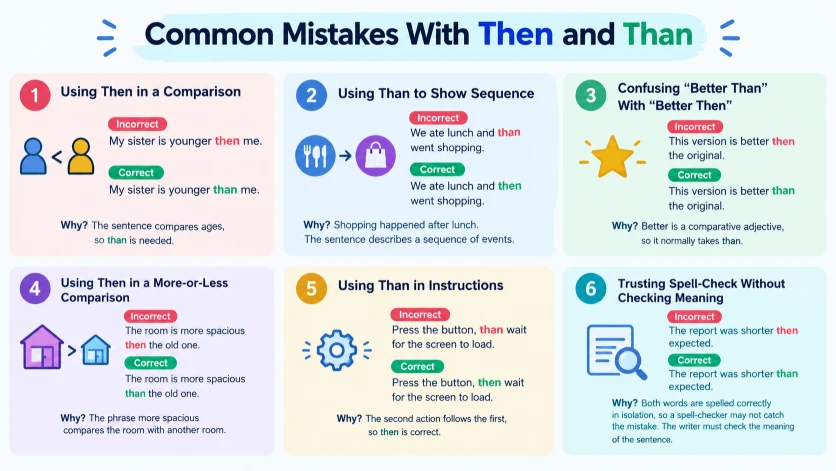
Many writers make these errors because they type quickly or rely on how a sentence sounds. A simple meaning check can prevent most of them.
Mistake 1: Using Then in a Comparison
Incorrect: My sister is younger then me.
Correct: My sister is younger than me.
Why? The sentence compares ages, so than is needed.
A more formal alternative is “My sister is younger than I am.”
Mistake 2: Using Than to Show Sequence
Incorrect: We ate lunch and than went shopping.
Correct: We ate lunch and then went shopping.
Why? Shopping happened after lunch. The sentence describes a sequence of events.
Mistake 3: Confusing “Better Than” With “Better Then”
Incorrect: This version is better then the original.
Correct: This version is better than the original.
Why? Better is a comparative adjective, so it normally takes than when introducing the thing being compared.
Mistake 4: Using Then in a More-or-Less Comparison
Incorrect: The room is more spacious then the old one.
Correct: The room is more spacious than the old one.
Why? The phrase more spacious compares the room with another room.
Mistake 5: Using Than in Instructions
Incorrect: Press the button, than wait for the screen to load.
Correct: Press the button, then wait for the screen to load.
Why? The second action follows the first, so then is correct.
Mistake 6: Trusting Spell-Check Without Checking Meaning
Incorrect: The report was shorter then expected.
Correct: The report was shorter than expected.
Why? Both words are spelled correctly in isolation, so a spell-checker may not catch the mistake. The writer must check the meaning of the sentence.
Real-Life Examples of Then and Than
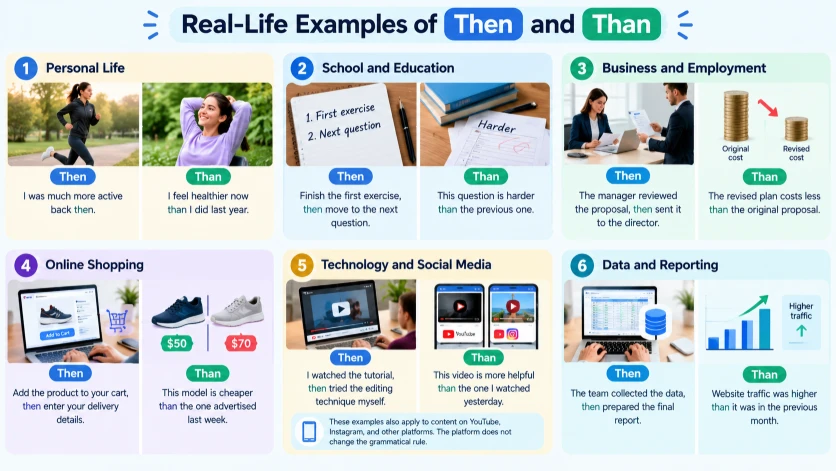
These examples show how the difference between then and than appears in personal conversations, education, business, and technology.
Example 1: Personal Life
Then: I was much more active back then.
Than: I feel healthier now than I did last year.
The first sentence refers to an earlier time. The second compares two periods of life.
Example 2: School and Education
Then: Finish the first exercise, then move to the next question.
Than: This question is harder than the previous one.
The first example gives an instruction. The second compares difficulty.
Example 3: Business and Employment
Then: The manager reviewed the proposal, then sent it to the director.
Than: The revised plan costs less than the original proposal.
The first sentence shows a sequence of workplace actions. The second compares costs.
Example 4: Online Shopping
Then: Add the product to your cart, then enter your delivery details.
Than: This model is cheaper than the one advertised last week.
The word choice depends on if you describe the next action or compare prices.
Example 5: Technology and Social Media
Then: I watched the tutorial, then tried the editing technique myself.
Than: This video is more helpful than the one I watched yesterday.
These examples also apply to content on YouTube, Instagram, and other platforms. The platform does not change the grammatical rule.
Example 6: Data and Reporting
Then: The team collected the data, then prepared the final report.
Than: Website traffic was higher than it was in the previous month.
The first sentence explains the order of work. The second compares two measurements.
How Can You Remember the Difference Between Then and Than?
The easiest memory trick is to connect each word to a simple question.
Then = When? What happens next?
Use then when you refer to a time, the next step, or a result.
Than = Compared with what?
Use than when you compare two things.
Try this quick test:
- I finished dinner, ___ watched a movie.
- This movie is better ___ the last one.
- Back ___, we lived near the beach.
- The new phone is smaller ___ my old phone.
Answers: 1. then; 2. than; 3. then; 4. than.
A useful extra trick is to look for comparative words such as better, worse, taller, faster, more, and less. These words often signal that than belongs in the sentence.
However, do not rely on this clue alone. A comparison can also involve phrases such as “rather than” and “other than.” Focus on the full meaning.
Why Do People Get Confused Between Then and Than?
Their Spellings Are Almost Identical
Both words contain four letters and begin with the same two letters. Only the vowel in the middle changes, making typing mistakes easy.
Their Sounds Can Overlap
In many accents, the difference between the vowel in then and the vowel in than is subtle. Some speakers may pronounce them more similarly than others.
Fast Typing Encourages Errors
When writing messages, comments, or emails quickly, people may select the wrong word without noticing. Since both words are valid English words, automated spelling tools may not identify the mistake.
Speech and Writing Use Different Clues
Listeners use context, tone, and pronunciation to understand meaning. Writers must also select the correct spelling. A person can understand both words when listening but still confuse them while typing.
Online Content Repeats the Same Errors
Posts, comments, captions, and informal messages can contain incorrect usage. Seeing a mistake repeatedly does not make it grammatically correct.
The solution is simple: understand the role of the word instead of memorizing spelling alone. Use time and sequence as clues for then, and comparison as the clue for than.
How Do Search Engines Understand Then and Than?
Search engines such as Google use language context to interpret the topic and purpose of a web page. An article about the difference between then and than can help users by providing definitions, examples, grammatical explanations, and answers to common questions.
For instance, headings about “then vs. than,” “how to use than in a sentence,” and “then meaning in English” cover closely related search needs. Examples showing time, sequence, and comparison make the distinction easier to understand.
However, keyword repetition alone does not guarantee better rankings. Google does not promise top placement simply because a page includes a comparison table, a particular number of headings, or a specific keyword density.
For WordeDiff, the most useful approach is to answer the reader’s question clearly, use accurate examples, and organize the information so readers can find the rule quickly. Natural language and genuine usefulness matter more than inserting unrelated brand names or repeating the same phrase.
Instagram, Meta, and YouTube are relevant as places where people read captions, comments, tutorials, and descriptions, but their recommendation systems do not work exactly like Google’s web-search ranking system. The grammar rule remains the same across all these platforms.
Expert Insight: A Reliable Way to Choose Then or Than
A practical editing technique is to check what relationship the sentence expresses.
If the sentence explains when something happened, what comes next, or what follows from a condition, then is usually correct.
If the sentence compares two things or introduces an alternative, than is usually correct.
Consider these examples:
- The team tested the new design, then released it.
- The new design performed better than the old one.
The first sentence describes a timeline. The second evaluates the difference between two designs.
This distinction is useful for students writing essays, professionals preparing reports, and content creators publishing articles or social media captions. It also helps when editing text generated by speech-to-text software or writing assistants, which may select the wrong word when context is unclear.
A strong editing habit is to read the complete sentence rather than checking spelling in isolation. Both then and than are correct English words, but only one will usually express the intended meaning.
Frequently Asked Questions
What Is the Main Difference Between Then and Than?
Then refers to time, order, or a result. Than introduces a comparison. For example, “We ate, then left” shows sequence, while “This is better than that” makes a comparison.
Is It Better Then or Better Than?
The correct phrase is better than when comparing two things. For example, “This method is better than the old one.”
How Do You Use Then and Than in a Sentence?
Use then to show what happens next: “Finish your work, then relax.” Use than to compare: “This task is easier than the last one.”
Why Do Then and Than Sound So Similar?
Both words have one syllable and begin with the same voiced “th” sound. Their vowel sounds differ in many accents, but the distinction may be subtle.
Is Then Related to Time?
Yes. Then often refers to a particular time or sequence. Examples include “back then,” “since then,” and “We arrived, then checked in.”
Can Than Be Used Without More or Less?
Yes. Than appears with many comparative expressions, including “taller than,” “rather than,” “other than,” and “different than” in varieties of English where that construction is used.
Is It First Then or First Than?
The correct phrase is generally first, then when describing the order of actions. For example, “First, save your file; then, close the program.”
What Is a Simple Trick to Remember Then vs. Than?
Remember then for time and sequence, and than for comparison. Ask yourself if the sentence answers “When or what next?” or “Compared with what?”
Is Then or Than Correct in “More Than One”?
The correct phrase is more than one. It expresses a quantity or comparison, so than is used. Example: “More than one student answered correctly.”
Conclusion
The difference between then and than comes down to two simple ideas: time and comparison. Use then when describing when something happened, what comes next, or what follows from a condition. Use than when comparing people, objects, actions, quantities, or ideas.
For example, “We finished the meeting, then went to lunch” describes a sequence. “The meeting was shorter than expected” compares its length with what people anticipated. These examples show why choosing the correct word matters, even though the spellings are almost identical.
When you are unsure, read the whole sentence and identify its purpose. If you are talking about time or order, then is usually the right choice. If you are comparing two things, than is generally correct.
This simple rule works in school assignments, workplace reports, emails, website content, and social media posts. With a little practice, you can recognize the difference between then and than without stopping to think about every sentence. Focus on meaning first, and correct spelling will become much easier.
READ MORE ABOUT!
- Difference Between Method and Technique: A Clear Guide
- Difference Between Goal and Objective: A Simple Guide

I am Emily Johnson, a USA-based content writer who creates easy-to-read blogs on language and daily life topics. I explain complex ideas in simple English for students and beginners so they can understand easily.