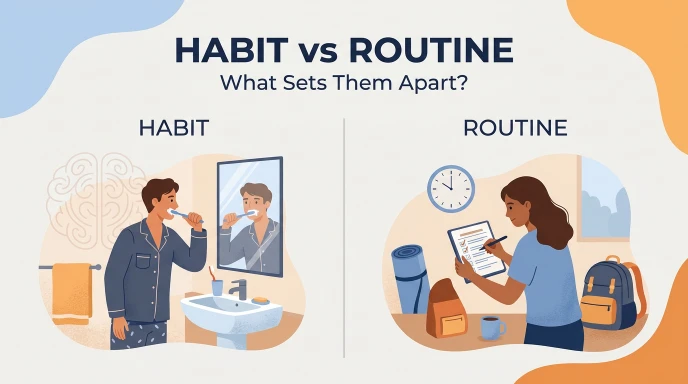
A habit is an action you do regularly, often with little thought, while a routine is a set of actions you follow in a planned order.
The difference between habit and routine becomes clear when you look at your daily life. Brushing your teeth may be a habit, while brushing your teeth, getting dressed, and eating breakfast can form a morning routine. Many people use these words as if they mean the same thing, but they describe different parts of everyday behavior.
Understanding the difference between habit and routine can help you build better habits, create a useful daily schedule, and reach your personal or professional goals. This guide explains their meanings, key differences, practical examples, and how to turn repeated actions into lasting habits.
Quick Answer: Difference Between Habit and Routine
A habit is a repeated behavior that often becomes automatic. A routine is a series of actions performed regularly, usually in a particular order.
Example: Drinking water after waking up can be a habit. Drinking water, exercising, showering, and eating breakfast in order can be part of a morning routine.
Definitions of Habit and Routine
- Habit: A behavior repeated often enough that it may become automatic in a familiar situation. Example: checking your phone whenever you hear a notification.
- Routine: A regular pattern or sequence of activities followed at a particular time or under certain conditions. Example: preparing lunch, checking your calendar, and starting work each morning.
Pronunciation
| Word | US pronunciation | UK pronunciation |
| Habit | HAB-it | HAB-it |
| Routine | roo-TEEN or roo-TEEN | roo-TEEN or roo-TEEN |
Pronunciation can vary slightly by speaker and accent, particularly for routine.
Now that the definitions are clear, let’s explore how habits and routines work together in everyday life.
Comparison: Habit vs. Routine
| Feature | Habit | Routine |
| Meaning | A behavior repeated regularly | A pattern or sequence of activities |
| Main purpose | Makes repeated actions easier | Organizes tasks and time |
| Awareness | May happen automatically | Often requires planning or attention |
| Structure | Usually one behavior or response | Often includes several actions |
| Flexibility | Can occur in response to a cue | Can be adjusted to fit a schedule |
| Formation | Develops through repetition and context | Can start with a deliberate plan |
| Example | Reading before bed | Finishing dinner, reading, and preparing for sleep |
| Main benefit | Reduces the need to think about an action | Creates order and consistency |
The main distinction is that a habit describes a repeated behavior, while a routine describes an organized pattern of activities. A routine can contain several habits, but it can also include tasks that still require effort and conscious planning.
Key Differences Explained Between Habit and Routine
1. A Habit Is a Behavior, While a Routine Is a Pattern
A habit usually refers to a specific action. A routine is the broader pattern in which one or more actions take place.
For example, putting your keys in the same bowl when you arrive home can become a habit. Arriving home, putting away your keys, changing clothes, and preparing dinner can make up an evening routine.
The key point: A habit is one part of behavior, while a routine can connect several behaviors.
2. Habits Can Become Automatic
When you repeat an action in a familiar situation, you may eventually do it with little conscious thought. This is one reason habits can save mental effort.
For instance, you might automatically fasten your seat belt when getting into a car. You do not need to make a fresh decision every time.
A routine, however, may still require attention. Following a morning schedule that includes checking your calendar, packing lunch, and taking medication requires you to remember and complete each step.
3. Routines Usually Have a Clear Structure
Routines often involve a time, order, or specific situation. A habit does not always need a fixed place in a larger schedule.
Consider these examples:
- Habit: Writing down one new word every day.
- Routine: Studying vocabulary, reviewing yesterday’s words, and completing a short quiz every evening.
The habit is the repeated action. The routine is the complete study plan.
4. You Can Build a Routine Before You Develop Habits
A routine can begin as a conscious plan. You do not have to wait for the activities to feel natural.
Suppose you want to exercise each morning. At first, you may need an alarm and a written schedule. Over time, putting on your workout clothes or starting your warm-up may become habitual.
This is a useful distinction for anyone trying to improve their daily life: you can plan a routine today, even if none of its actions feels automatic yet.
5. Habits and Routines Have Different Levels of Flexibility
A habit can continue across different schedules. Someone who habitually reads before bed may do so if they are at home or traveling.
A routine is often more sensitive to changes in time and circumstances. A 7 a.m. workout routine may need to move to the afternoon when work starts early.
Neither is necessarily better. Habits help maintain repeated behaviors, while routines help organize those behaviors around real-life demands.
6. Habits Can Be Helpful or Harmful
Not every habit supports your goals. Automatically scrolling through social media whenever you feel bored is also a habit.
Routines can include both helpful and unhelpful activities, too. An evening routine that involves staying up late watching videos may make it harder to get enough sleep.
The practical goal is not simply to repeat actions. It is to identify which behaviors are useful and build routines that support them.
Difference and Similarity Between Habit and Routine
Habits and routines overlap, which is why people often confuse them. Both involve repetition and can help make daily life more predictable, but their roles are different.
| Feature | Habit | Routine | Similarity |
| Core meaning | A repeated behavior | A regular pattern of activities | Both involve repeated actions |
| Planning | May develop without a formal plan | Often organized in advance | Both can be intentional |
| Automaticity | May become automatic | May require conscious effort | Both can become familiar |
| Time | Can happen at different times | Often follows a schedule | Both can fit daily life |
| Structure | Usually a specific behavior | Often a sequence of steps | Both create consistency |
| Change | Can be replaced through practice | Can be redesigned or rearranged | Both can change over time |
| Example | Stretching after waking | Stretching, showering, and getting dressed | Both can support well-being |
This table clearly shows the difference and similarity between habit and routine for quick understanding.
What Is the Relationship Between Habits and Routines?
Habits and routines often work together. A routine gives actions a place in your day, while repetition in a familiar context can help some of those actions become habits.
Imagine that you want to read more books.
At first, your routine might be:
- Finish dinner.
- Put your phone away.
- Read for 15 minutes.
- Mark your place before going to bed.
During the early days, you may need reminders to follow each step. After repeating the routine regularly, starting to read after dinner may begin to feel natural.
The reading behavior may become a habit, while the full sequence remains your evening routine.
However, this process is not guaranteed or identical for everyone. Habits form at different rates depending on the behavior, the situation, and how consistently it is repeated. There is no universal number of days that makes every habit automatic.
How Do Habits Form, and How Do Routines Work?
Understanding how these behaviors develop can make it easier to use them effectively.
How Habits Form
Habits often develop when a behavior is repeated in response to a familiar cue or situation. A cue might be a time of day, a place, an emotion, or an action that happens immediately beforehand.
For example, you might:
- Make tea after arriving home.
- Check your calendar when you open your laptop.
- Stretch briefly after finishing a workout.
Over time, the familiar cue can make the response easier to start. The behavior may require less deliberate effort than it did at first.
How Routines Work
Routines organize actions into a repeatable pattern. They can be built around time, priorities, or practical needs.
A workday routine might include reviewing emails, identifying the most important task, and planning meetings. The routine creates a framework, but individual steps may still require decisions.
This explains why a routine can be useful even when some actions have not become habits. Structure helps you remember what to do; habits can make particular steps easier to perform.
How Can You Make Them Work Together?
Start with a routine that is simple enough to repeat. Choose one behavior you want to practice, connect it to a reliable cue, and make the first step easy.
For example, place a book beside your bed and read two pages after brushing your teeth. The routine gives reading a clear place in your evening, and repeated practice may help it become a habit.
Common Mistakes With Habit and Routine
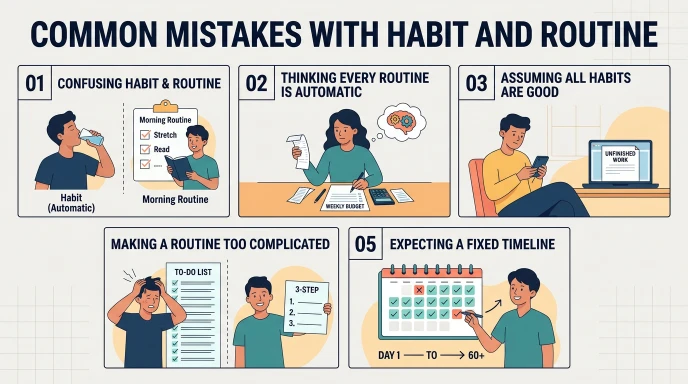
Knowing the definitions is helpful, but these common mistakes can still cause confusion.
Mistake 1: Using Habit and Routine as Exact Synonyms
Incorrect understanding: A habit and a routine always mean the same thing.
Correction: A habit is a repeated behavior that may become automatic. A routine is a regular pattern of activities.
Example: Drinking water after waking is a habit; getting up, drinking water, and preparing breakfast can form a routine.
Mistake 2: Thinking Every Routine Is Automatic
A routine can involve several steps that still need effort and attention.
For example, preparing a weekly budget every Sunday is a routine, but you may need to check receipts, calculate expenses, and make deliberate decisions each time.
Fix: Remember that repetition does not automatically mean a behavior has become a habit.
Mistake 3: Assuming All Habits Are Good
Habits can be helpful, neutral, or harmful.
Automatically reaching for your phone whenever you feel bored is a habit, but it may distract you from important work.
Fix: Ask if the behavior supports your goals before trying to reinforce it.
Mistake 4: Making a Routine Too Complicated
A morning plan with 15 different steps may be difficult to follow when you are tired or busy.
Fix: Start with two or three manageable actions. Add more only when the basic routine fits your life.
Mistake 5: Expecting a Habit to Form in a Fixed Number of Days
People sometimes expect every new behavior to become automatic after 21 or 30 days. Habit development varies with the behavior, repetition, and circumstances.
Fix: Focus on consistent practice rather than a strict deadline. Missing a day does not mean you have failed.
Real-Life Examples of Habit and Routine

These practical scenarios show how the two concepts work in different parts of life.
Example 1: Personal Health
Maya wants to become more active.
Her habit is taking a short walk after lunch. Her daily routine includes eating lunch, walking for 15 minutes, and preparing for the afternoon.
The routine gives her walking a regular place in the day. Repeating the walk after lunch may gradually make it easier to begin.
Example 2: Studying for School
A student wants to improve their grades.
- Habit: Reviewing five vocabulary words after breakfast.
- Routine: Reviewing vocabulary, completing homework, and testing themselves before dinner.
The habit focuses on one repeated learning behavior. The routine organizes several study activities.
Example 3: Running a Business
A small business owner wants to manage work more effectively.
Their habit is recording each expense immediately after a purchase. Their weekly routine includes reviewing expenses, checking invoices, and planning upcoming payments.
The habit helps keep records current, while the routine supports broader financial management.
Example 4: Workplace Productivity
An employee wants to spend less time deciding what to do next.
They develop a routine of checking their calendar, choosing three priorities, and reviewing deadlines at the start of the workday. Over time, opening the calendar at the start of work may become a habit.
This example shows that a routine can help create the conditions for a habit to develop.
Example 5: Digital Life
A content creator wants to publish videos consistently.
Their routine includes researching topics, writing scripts, recording clips, and scheduling posts. A smaller habit might be writing down one content idea whenever inspiration strikes.
Tools such as calendar apps and task managers can help organize the routine, but the tools themselves do not guarantee that the behavior will become habitual.
When Should You Focus on a Habit or a Routine?
The best choice depends on what you want to change.
| Your goal | Focus on | Practical example |
| Make an action feel natural | Habit | Read two pages every night |
| Organize several daily tasks | Routine | Plan, study, and review in a set order |
| Reduce forgetfulness | Both | Put keys in one place as part of your arrival-home routine |
| Improve work performance | Both | Review priorities every morning and develop a habit of starting with the hardest task |
| Build a fitness practice | Routine first, then habits | Schedule workouts and repeat a manageable warm-up |
| Reduce unwanted behavior | Habit change and routine redesign | Keep your phone away during focused work |
A helpful rule is to use a routine when you need structure and a habit when you want a repeated behavior to become easier to start. Many goals benefit from both.
Why Do People Get Confused About Habit and Routine?
There are three main reasons these words overlap in everyday language.
Both Depend on Repetition
A habit often involves repeated behavior, and a routine is also repeated. This shared feature makes the terms sound interchangeable.
For example, someone might say, “My morning habit is going to the gym,” when they really mean that going to the gym is part of their morning routine. The meaning is understandable, but the more precise term depends on what they want to describe.
A Routine Can Contain Habits
A person may have a morning routine that includes several established habits, such as brushing their teeth and making coffee. Since the behaviors occur together, it can be hard to separate each habit from the larger sequence.
Everyday Media Uses the Terms Broadly
Videos on Instagram and YouTube often use phrases such as “daily habits,” “morning routine,” and “healthy habits” to discuss similar self-improvement goals. These phrases are useful for everyday communication, but they do not always explain the behavioral distinction in detail.
Neither word is limited to a particular country or region. The main difference is how the terms are used to describe behavior, not a major difference between American and British English.
How Search Engines Understand Habit and Routine
When someone searches Google for “difference between habit and routine,” they are usually seeking a clear comparison, definitions, and examples. Other searches, such as “how to build a habit” or “how to create a daily routine,” suggest a practical self-improvement goal.
A useful explanation should match the question being asked:
- A comparison query needs a direct distinction and a table.
- A habit-building query needs practical steps and realistic expectations.
- A routine-planning query needs examples of how to organize activities.
- A behavior-change query needs guidance on cues, repetition, and managing obstacles.
Google’s search systems aim to connect queries with relevant, helpful information. Including related terms can help make a topic clear, but simply repeating keywords does not guarantee rankings. Instagram and YouTube are relevant as places where people discover self-improvement advice, not as authorities that determine the definitions of these words.
The strongest content answers the reader’s question accurately and gives examples they can apply in real life.
Expert Insight: Build a System, Not Just a List of Habits
A useful way to approach personal improvement is to stop treating every goal as a separate habit to master.
Start by identifying the outcome you want. Then create a realistic routine that gives the necessary actions a regular place in your day. Finally, focus on repeating one manageable behavior within that routine.
For example, someone who wants to sleep better could establish an evening routine that includes preparing for the next day, reducing screen time, and reading. One behavior, such as putting the phone away before reading, may become a habit with consistent practice.
It is also important to plan for disruptions. A routine that only works under perfect conditions may be difficult to maintain. Decide in advance what the shorter version will look like on a busy day.
This is a practical behavior-change strategy, not a guarantee of success. Progress depends on personal circumstances, the difficulty of the action, and consistency over time. A flexible routine paired with realistic habits is often more useful than an ambitious plan that is hard to sustain.
Frequently Asked Questions
What is the main difference between a habit and a routine?
A habit is a repeated behavior that may become automatic, while a routine is a regular sequence or pattern of activities. For example, stretching can be a habit, while a morning workout plan is a routine.
Can a routine become a habit?
Parts of a routine can become habits through repetition. For example, checking your planner at the start of every workday may eventually feel automatic, even though the full routine still requires attention.
Is brushing your teeth a habit or a routine?
Brushing your teeth can be a habit if you do it regularly with little thought. It can also be part of a routine that includes washing your face and getting ready for bed.
Which is better, a habit or a routine?
Neither is universally better. Habits help make repeated actions easier, while routines organize activities and provide structure. Using both can help you work toward personal and professional goals.
What is the difference between a daily habit and a daily routine?
A daily habit is a behavior you repeat each day, such as drinking water after waking up. A daily routine is a broader pattern of activities, such as exercising, showering, and eating breakfast.
How long does it take to develop a habit?
There is no fixed timeline for everyone. The time needed depends on the behavior, how often you practice it, and the circumstances surrounding it. Consistency matters more than following an arbitrary deadline.
Can you have a routine without habits?
Yes. You can follow a planned schedule even when every step requires conscious effort. For example, a new employee may use a written morning checklist before the workday becomes familiar.
How do you turn a routine into a habit?
Choose one small action, connect it to a reliable cue, and repeat it in a consistent setting. For example, read a few pages after brushing your teeth each night. Over time, the repeated behavior may become easier to start.
Conclusion
The difference between habit and routine lies in how we describe repeated behavior. A habit is an action that you repeat and may eventually perform automatically, while a routine is a regular pattern of activities that helps organize your day.
For example, drinking water after waking up can be a habit. Getting up, drinking water, exercising, and preparing breakfast can form a morning routine. The routine creates a structure for your day, while individual habits can make certain steps easier to perform.
Both concepts are useful for personal growth, studying, fitness, and workplace productivity. If you want to organize your time, begin by creating a simple routine. If you want a particular action to become easier and more natural, focus on repeating that behavior in a familiar situation.
You do not need to change your entire life at once. Start with one manageable action, make it part of a realistic schedule, and adjust the plan when necessary. Remember that habits do not develop at the same speed for everyone, and routines do not need to be perfect to be useful.
Ultimately, understanding the difference between habit and routine helps you make better choices about how you spend your time and how you build lasting patterns of behavior.
READ MORE ABOUT!
- Difference Between Passed and Past: Meaning and Examples
- Difference Between Among and Between: Easy Grammar Guide

I am James Carter, a professional content writer from the United States. I specialize in writing simple and clear comparison blogs that help students and readers understand difficult topics easily. My writing focuses on everyday language, education, science, and lifestyle topics. I believe that learning should be easy for everyone, so I use simple words and real-life examples in my articles.