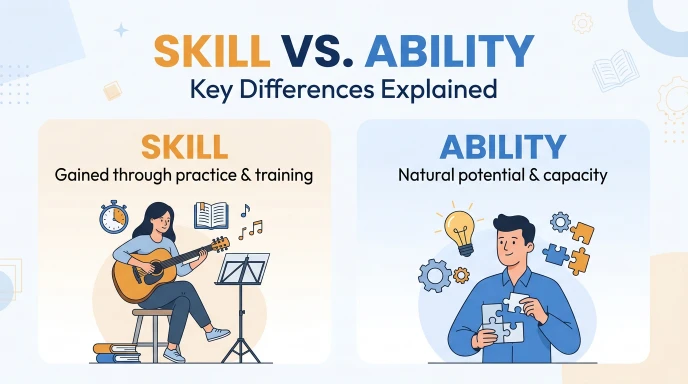
Have you ever wondered why one person learns a task quickly while another performs it better after practice? The difference between skill and ability explains this clearly. An ability is what a person can do or learn to do, while a skill is something they develop through practice, training, and experience.
Both matter in school, work, sports, and daily life. However, they are not the same. Understanding the difference between skill and ability helps you recognize your strengths, choose the right training, and improve your performance. In this guide, you will learn their meanings, key differences, practical examples, and when to use each term correctly.
Quick Answer: Difference Between Skill and Ability
Ability is a person’s capacity to perform or learn a task. Skill is the learned ability to perform a task well through practice and experience.
For example, a person may have a natural ability to understand numbers but develop accounting skills through education and practice.
Definition of Skill and Ability
- Skill: The learned capacity to perform a task effectively, usually developed through practice, training, and experience.
- Ability: The capacity or potential to perform a task or learn a particular activity. It may be natural, developed, or a combination of both.
Pronunciation
- Skill (US and UK): /skɪl/ sounds like “skil.”
- Ability (US and UK): /əˈbɪləti/ sounds like “uh-BIL-uh-tee.”
The pronunciation of these words is nearly the same in American and British English.
Now that we understand the basic meanings, let’s look at how skill and ability differ in everyday situations.
Comparison: Difference Between Skill and Ability
| Feature | Skill | Ability |
| Meaning | A learned way to perform a task. | The capacity to perform or learn a task. |
| Development | Usually improves through practice and training. | May be natural, developed, or both. |
| Main focus | What someone can do in practice. | What someone can do or has the potential to learn. |
| Experience | Often benefits from repeated experience. | Can exist before formal training. |
| Measurement | Can be assessed through practical tasks. | Can be assessed through suitable tests or observed performance. |
| Improvement | Improves with feedback and deliberate practice. | Can develop through learning, experience, and support. |
| Examples | Writing, coding, cooking, and driving. | Reasoning, coordination, learning capacity, and memory. |
| Workplace use | Shows how well someone performs a specific task. | Helps describe someone’s capacity to handle tasks or learn new ones. |
The main difference is that a skill describes learned performance, while an ability describes capacity or potential. In practice, they often work together.
Key Differences Explained Between Skill and Ability
1. Skill Is Learned, While Ability Can Be Natural
A skill usually develops when someone practices a task and learns better ways to complete it. An ability may be present early in life or develop over time.
For example, a child might show strong hand-eye coordination. With lessons and regular practice, that child may develop excellent basketball skills.
However, natural ability does not guarantee success. Without practice, even a talented person may struggle to perform well.
2. Ability Focuses on Potential, While Skill Focuses on Performance
Ability often describes what someone is capable of doing or learning. Skill describes how well they can perform a particular task.
Imagine two people starting a programming course. One understands logical patterns quickly, while the other needs more time. The first person may have an advantage in reasoning ability, but both can develop programming skills through consistent practice.
Remember: Potential can help you learn, but performance depends on several factors, including practice, knowledge, effort, and experience.
3. Skills Are Usually Task-Specific
A person can have many different skills, each related to a particular activity. Someone may be excellent at writing emails but struggle with public speaking.
Abilities can also be specific, such as spatial reasoning or fine motor coordination, but the same ability may support several different skills.
For example, good spatial reasoning may help someone learn architecture, technical drawing, or certain sports.
4. Skill Depends Heavily on Practice
Practice helps people improve accuracy, speed, consistency, and confidence. A beginner cook may follow every recipe step carefully. An experienced cook may prepare the same meal efficiently because repeated experience has improved their technique.
Ability can make learning easier, but it does not replace practice. Someone who learns quickly still needs to develop the skills required for reliable results.
5. Skills Are Often Easier to Demonstrate Directly
A person can demonstrate a typing skill by completing a typing test. A mechanic can show practical repair skills by diagnosing and fixing a problem.
Abilities may require broader assessment. For example, reasoning ability can be evaluated through structured tasks, but a single test cannot reveal everything a person can do.
This distinction matters in hiring, education, and personal development. Employers should consider both demonstrated performance and the potential to learn.
6. Both Can Improve Over Time
It is a mistake to assume that ability never changes. People can strengthen many abilities through education, practice, experience, and supportive environments.
Skills also develop with repeated training and useful feedback.
For example, someone who struggles with public speaking may gradually improve their confidence, communication ability, and presentation skills by speaking to small groups regularly.
What Is the Relationship Between Skill and Ability?
Skill and ability are closely connected, but neither guarantees the other.
A useful way to understand their relationship is:
Ability + learning + practice + feedback = stronger skill development.
This is a simple learning model, not a strict scientific formula. Results also depend on motivation, available resources, health, instruction, and the difficulty of the task.
Consider learning to play the piano. A person may have good auditory memory and finger coordination. These abilities may help them learn notes and movements. Yet playing a complete song smoothly requires specific skills developed through lessons and practice.
Someone with less initial aptitude can also become a skilled musician through effective instruction and sustained effort.
The important point is that ability can influence how someone learns, while skill reflects the performance they develop.
Difference Between Skill and Ability in the Workplace
Employers often use both terms when evaluating candidates, training employees, and planning career development.
What Does Skill Mean at Work?
A skill is a practical competency used to complete a job task. Examples include:
- Writing reports and business emails.
- Using spreadsheets and project management software.
- Negotiating with clients.
- Repairing equipment.
- Managing social media campaigns.
For example, a digital marketing specialist may have content skills, including keyword research, content optimization, and performance analysis.
What Does Ability Mean at Work?
Ability refers to a person’s capacity to handle tasks or learn new responsibilities. Examples include:
- Analytical reasoning.
- Learning new systems.
- Recognizing patterns.
- Adapting to changing situations.
- Coordinating complex tasks.
A candidate may not know a company’s specific software yet but may have the ability to learn it quickly.
Why Do Employers Need Both?
A resume can show existing skills, while interviews, work samples, and appropriate assessments may help employers understand a candidate’s broader capabilities.
For example, an applicant may already have strong spreadsheet skills and the ability to learn advanced data analysis. The first helps with immediate tasks, while the second may support future growth.
Employers should avoid assuming that a person lacks potential simply because they have not yet received an opportunity to develop a particular skill.
Difference Between Skill and Ability in Education
In education, ability and skill help explain different parts of the learning process.
A student may have a strong ability to recognize patterns but still need to learn algebraic rules. Another student may take longer to understand a concept but become highly skilled after guided practice.
Here are a few examples:
- Reading: Language-related abilities can support learning, while reading fluency develops through instruction and practice.
- Mathematics: Numerical reasoning may help a student understand relationships, while solving equations requires learned skills.
- Writing: Ideas and language knowledge contribute to writing, but organizing paragraphs and editing sentences require practice.
- Sports: Coordination may help a student learn movements, while passing, shooting, or serving requires specific training.
Teachers can use this distinction to identify if a student needs more practice, a different explanation, additional support, or an opportunity to build confidence.
A student’s current performance should not automatically be treated as a permanent measure of their potential.
Difference and Similarity Between Skill and Ability
| Feature | Skill | Ability | Similarity |
| Basic meaning | Learned competence. | Capacity or potential. | Both relate to what a person can do. |
| Learning | Developed through training and practice. | May be present naturally or develop over time. | Both can change with experience. |
| Performance | Often shown through a task. | May influence performance or learning. | Both can contribute to results. |
| Assessment | Practical demonstrations and work samples. | Relevant tests and observed behavior. | Both can be evaluated in suitable ways. |
| Examples | Editing, driving, and coding. | Reasoning, coordination, and learning capacity. | Both appear in daily life and work. |
| Development | Improved through practice and feedback. | Strengthened through learning and experience where possible. | Both benefit from suitable support. |
| Career value | Helps complete current job duties. | May support learning and future responsibilities. | Both matter for professional growth. |
This table clearly shows the difference and similarity between skill and ability for quick understanding.
Common Mistakes With Skill and Ability
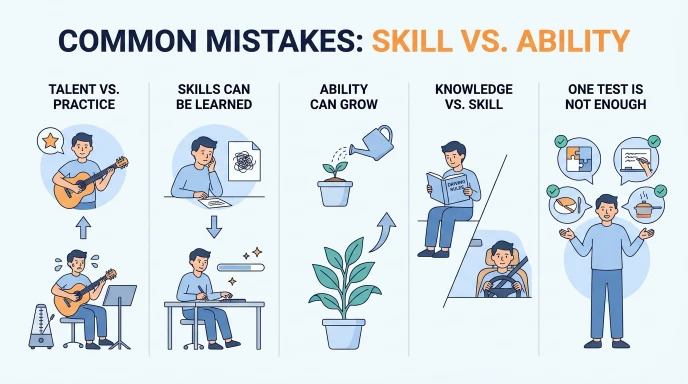
Many people use these terms interchangeably. Although they are related, the following mistakes can lead to unclear explanations.
Mistake 1: Assuming Natural Ability Guarantees Success
Incorrect idea: A talented person will automatically perform well.
Correction: Ability may make learning easier, but reliable performance usually requires practice, knowledge, and effort.
Mistake 2: Thinking Skills Cannot Be Learned
Incorrect idea: Someone who is not naturally good at writing can never become a good writer.
Correction: Writing is a skill that can improve through reading, instruction, revision, and feedback.
Mistake 3: Treating Ability as Completely Fixed
Incorrect idea: A person either has an ability or does not have it.
Correction: Many capacities develop over time. Learning opportunities, experience, and suitable support can make a difference.
Mistake 4: Confusing Knowledge With Skill
Incorrect idea: Knowing how a task works means you can perform it well.
Correction: Knowledge helps you understand a task, but practical experience helps you perform it. Knowing driving rules is different from being skilled at driving.
Mistake 5: Using One Test to Judge Everything
Incorrect idea: A single test can reveal someone’s complete ability.
Correction: Tests measure particular things under particular conditions. Work samples, observation, and repeated performance may provide a fuller picture.
Real-Life Examples of Skill and Ability
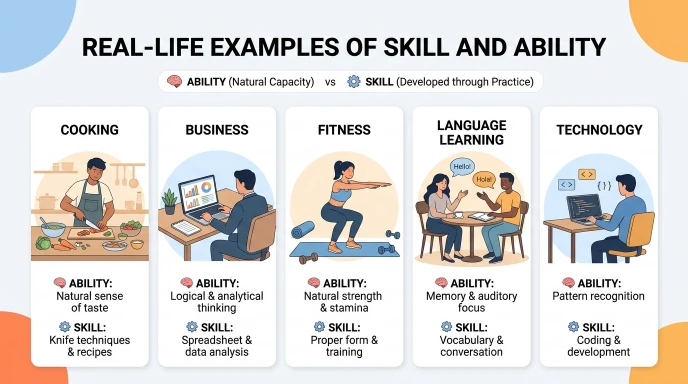
Example 1: Learning to Cook
Mia enjoys understanding how ingredients work together and learns recipes quickly. This may reflect her learning capacity and other relevant abilities.
After preparing meals regularly, she develops knife skills, timing, seasoning techniques, and food presentation skills.
Her abilities may help her learn, but practice builds her cooking skills.
Example 2: Developing a Career in Business
Daniel is comfortable working with numbers and identifying patterns. These abilities may help him understand business problems.
He then learns spreadsheet formulas, financial reporting, and data visualization. Those are practical skills he can demonstrate to an employer.
His career benefits from both his analytical capacity and his learned competencies.
Example 3: Improving Fitness
A beginner may have good coordination or endurance for a particular activity. However, performing a squat with proper technique or swimming efficiently requires learning and practice.
Fitness ability varies by activity, and it is not a single fixed trait. Training can improve strength, endurance, coordination, and the skills needed for particular movements.
Example 4: Learning a New Language
A person may find it easy to recognize sounds or remember words. These abilities can support language learning.
Speaking fluently, using correct grammar, and understanding conversations are skills developed through instruction, exposure, and repeated use.
Someone who initially struggles may still make strong progress with consistent practice.
Example 5: Working in Technology
A new employee may have the ability to solve logical problems but no experience with a particular programming language.
Through training and projects, the employee learns to write code, test software, and fix errors. These are specific technical skills.
The example shows why companies may consider both current competence and the capacity to learn.
When Should You Use Skill or Ability?
Choose the word that best matches what you want to describe.
Use “Skill” When You Mean Learned Performance
Use skill when discussing a specific task someone has learned to perform.
Examples:
- She has strong writing skills.
- He developed excellent negotiation skills.
- The job requires computer skills.
- Practicing daily improved her swimming skills.
These examples focus on demonstrated or developed competence.
Use “Ability” When You Mean Capacity or Potential
Use ability when describing what someone can do, understand, or learn.
Examples:
- She has the ability to solve complex problems.
- He demonstrated an ability to learn quickly.
- The role requires the ability to work under pressure.
- His ability to recognize patterns helped him understand the puzzle.
These examples focus on capacity rather than only a learned technique.
Can You Use Both Words in One Sentence?
Yes. Using both terms can make the relationship clearer.
For example: “Her analytical ability helped her learn data analysis skills.”
The sentence explains that her capacity supported the development of a specific competence.
Why Do People Get Confused About Skill and Ability?
There are several reasons these words are often mixed up.
First, they overlap in meaning. Both describe aspects of what a person can do, so everyday conversations do not always require a strict distinction.
Second, skills can reveal abilities. Someone who performs a difficult task well may demonstrate reasoning, coordination, or other underlying capacities. However, performance alone does not always tell us which abilities contributed to the result.
Third, workplaces use both terms broadly. A job advertisement might ask for the “ability to communicate clearly” or “strong communication skills.” Both phrases can be reasonable, but the first emphasizes capacity while the second emphasizes developed competence.
Finally, talent is often confused with ability. Talent usually suggests a particular aptitude or strength, while ability is a broader term. Neither means that success will happen without learning or effort.
The easiest solution is to consider the context. Are you describing someone’s potential, or are you describing a task they have learned to perform? That question usually identifies the right word.
How Do Search Engines Understand Skill and Ability?
Search engines such as Google use language and context to understand the purpose of a search. When someone searches for “difference between skill and ability,” the likely goal is to understand two related terms and learn how to use them correctly.
A useful article answers that goal with clear definitions, direct comparisons, practical examples, and related questions. It should also distinguish skill and ability from nearby concepts such as talent, knowledge, competence, and aptitude.
For instance, a reader searching for workplace examples needs different information from someone writing a school assignment. A complete guide can help both by explaining the general distinction and showing how it applies in different settings.
Google does not guarantee top rankings because an article includes a specific heading, word count, or number of keywords. Useful information, clear writing, accessibility, trustworthy explanations, and relevance to the searcher’s needs are more meaningful goals than repeating keywords.
The same distinction can also help people describe their work accurately on professional profiles and social platforms such as LinkedIn. Demonstrating a skill with a project or example is often clearer than simply claiming to possess an ability.
Expert Insight: How to Identify Your Skills and Abilities
A practical way to assess your strengths is to separate what you can already do from what you may be able to learn.
Start by listing three tasks you perform well. For each task, identify the specific skill involved and the practice or experience that helped you develop it.
Next, consider activities you learn quickly or problems you naturally enjoy solving. These may point toward relevant abilities, although self-observation alone cannot prove a particular aptitude.
Finally, choose one skill to improve. Set a clear goal, practice regularly, ask for feedback, and track your results. For example, someone who wants better presentation skills could record a short talk each week and review clarity, pacing, and organization.
This method avoids the common mistake of treating ability as a limit. It also turns the distinction between skill and ability into a practical tool for learning and career growth.
Frequently Asked Questions
What is the main difference between skill and ability?
A skill is a learned competence developed through practice, while an ability is the capacity or potential to perform or learn a task.
Is ability natural or learned?
Ability can be natural, developed, or influenced by both inherited characteristics and experience. Many abilities can improve through learning and practice.
Can a skill become an ability?
A skill does not simply turn into an ability. Instead, developing a skill can strengthen related capacities, and abilities can support the development of new skills.
What is an example of skill and ability?
A person may have the ability to recognize patterns and develop the skill of analyzing business data through training and practice.
Which is more important, skill or ability?
Neither is always more important. Skills help people perform tasks now, while abilities may support learning and future development. The best balance depends on the situation.
What is the difference between skill, ability, and talent?
A skill is learned competence, ability is the capacity to perform or learn something, and talent usually refers to a natural or notable aptitude in a particular area.
Is knowledge a skill or an ability?
Knowledge is information or understanding a person has gained. A skill is the ability to apply knowledge effectively in a task. Knowing a rule and using it correctly are not the same thing.
How can I improve my skills and abilities?
Practice specific tasks, seek useful feedback, learn from mistakes, and gradually increase the difficulty of your work. These steps can improve skills and may strengthen related abilities.
Why do employers look for both skills and abilities?
Employers need people who can handle current responsibilities and adapt to future demands. Skills show existing competence, while abilities can indicate capacity for learning and development.
Conclusion
The difference between skill and ability comes down to learned performance versus capacity or potential. A skill is something you develop through practice, training, and experience. An ability is what you are capable of doing or learning, if that capacity is natural, developed, or influenced by both.
For example, a person may have an ability to understand numbers and develop accounting skills through education and practical work. Another person may need more time to learn the same tasks but become equally competent with effective training.
Both concepts matter in education, business, sports, and personal development. Ability can influence how someone approaches a task, while skill shows how well they have learned to perform it. Neither should be treated as a complete measure of a person’s future potential.
When choosing between the words, think about your main point. Use skill when discussing learned performance, and use ability when discussing capacity or potential. Understanding this simple distinction makes your writing more accurate and helps you explain people’s strengths more clearly.
READ MORE ABOUT!
- Difference Between Borrow and Lend: Simple Guide
- Difference Between Elicit and Illicit: Meaning and Usage

I am Emily Johnson, a USA-based content writer who creates easy-to-read blogs on language and daily life topics. I explain complex ideas in simple English for students and beginners so they can understand easily.