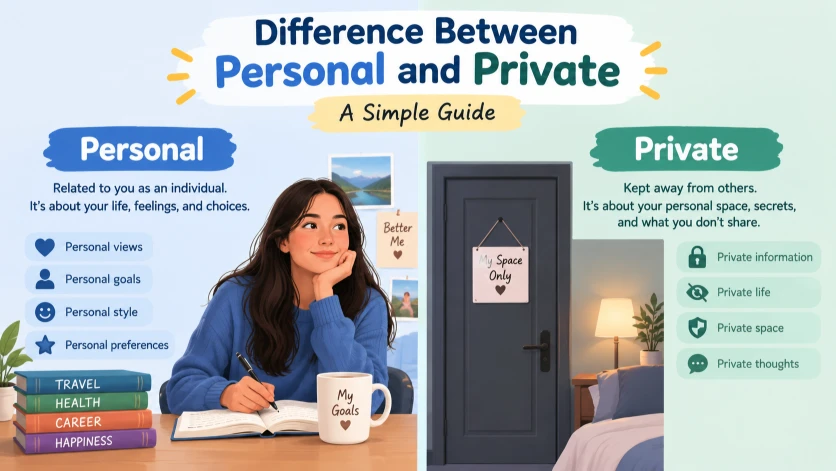
The difference between personal and private is that personal relates to an individual, while private refers to something that is not meant for everyone to know, see, or access. For example, your personal goals are about your life, but your private messages are meant to stay between you and the intended recipient.
Many people use these words as if they mean the same thing, yet they have different uses. Understanding the difference between personal and private helps you choose the right word in conversations, workplace communication, relationships, and online settings. This guide explains both meanings, gives clear examples, and shows when to use each word naturally.
Quick Answer: Difference Between Personal and Private
Personal means related to a particular person, their life, feelings, or needs. Private means personal or other information that is restricted from public view or access.
- Personal: I have a personal goal to learn Spanish.
- Private: I keep my diary private because it contains personal thoughts.
Definitions of Personal and Private
- Personal: Relating to an individual, their experiences, feelings, preferences, or affairs.
- Private: Belonging to or intended for an individual or a limited group, rather than the public.
In simple words, something can be personal without being private. Your personal opinion about a popular film, for example, can be shared publicly.
Pronunciation
| Word | US pronunciation | UK pronunciation |
| Personal | PUR-suh-nuhl | PUR-suh-nuhl |
| Private | PRY-vuht | PRY-vuht |
Pronunciation can vary slightly by accent, but these guides represent common American and British English speech.
Now, let’s explore how the words differ in meaning and everyday use.
Difference Between Personal and Private: Comparison
| Feature | Personal | Private |
| Main meaning | Related to an individual | Not open to the public |
| Main focus | The person | Access, secrecy, or boundaries |
| Information | Personal opinions or details | Confidential messages or records |
| Public sharing | Can be shared publicly | Usually restricted or limited |
| Relationships | Personal feelings or experiences | Private conversations or matters |
| Workplace | Personal goals or preferences | Private meetings or confidential files |
| Online use | Personal account or profile | Private account or restricted content |
| Common question | Whose or what person’s? | Who is allowed to see or know? |
The key distinction is that personal describes a connection to someone, while private describes a limit on who can access something.
Key Differences Explained Between Personal and Private
1. Personal Is About You, While Private Is About Access
The word personal connects something to a particular person. The word private tells you that something is not open to everyone.
For example:
- Personal: This is my personal notebook.
- Private: Please do not read my private notes.
A notebook can be personal because it belongs to you. Its contents are private when you do not want other people reading them.
2. Personal Information Is Not Always Private
Your personal information includes details about your life, interests, preferences, and experiences. However, not every personal detail must remain secret.
Examples:
- Your personal interest in football can be public.
- Your private medical records should only be accessible to authorized people.
This distinction matters when filling out forms, sharing information online, or deciding what to tell others.
3. Private Usually Suggests a Boundary
When someone calls something private, they often mean that other people should not enter, view, or discuss it without permission.
Examples:
- This is a private conversation.
- The office has a private meeting room.
- She keeps her phone password private.
By contrast, a personal conversation may simply be about someone’s life or feelings. It is not necessarily confidential.
4. Personal Can Describe Preferences and Opinions
People often use personal to explain that something reflects their own views or choices.
Examples:
- This is my personal opinion.
- Choosing a career is a personal decision.
- Everyone has personal preferences.
These things can be discussed openly. The word personal does not automatically mean secret.
5. Private Can Describe Places and Property
The word private is also used for places, facilities, and property that are not open to everyone.
Examples:
- They live on a private road.
- The company has a private office.
- She booked a private room for the meeting.
In these cases, private describes access or ownership rather than personal feelings.
6. Personal and Private Have Different Uses at Work
In professional settings, personal often describes an employee’s needs, goals, or circumstances. Private often describes information or spaces with restricted access.
Examples:
- Personal: He has a personal goal to improve his communication skills.
- Private: The manager keeps employee salary records private.
The difference is useful because calling something personal does not automatically make it confidential.
7. Personal and Private Can Describe the Same Thing
Sometimes both words are correct, but each highlights a different aspect.
For example:
“My personal diary is private.”
- Personal means the diary relates to your own life.
- Private means you do not want everyone reading it.
This is one of the easiest ways to remember how the words work together.
What Is the Difference Between Personal and Private Information?
Personal information identifies someone or relates to their life. Private information is information that a person or organization restricts from others.
The two categories overlap, but they are not identical.
Personal information
Examples of details connected to an individual
- Favorite music or hobbies
- Personal opinions
- Career goals
- A public biography
Private information
Examples of information with restricted access
- Private messages
- Confidential business records
- Medical records shared with authorized providers
- Account passwords
Some information belongs in both categories. Your home address, for example, is personal information and may also be private information that you do not want to share publicly.
The exact legal meaning of personal information and privacy varies by jurisdiction and context. In data protection laws, personal data can have a specific definition, and information does not have to be secret to qualify as personal data.
Difference Between Personal and Private in Real-Life Situations
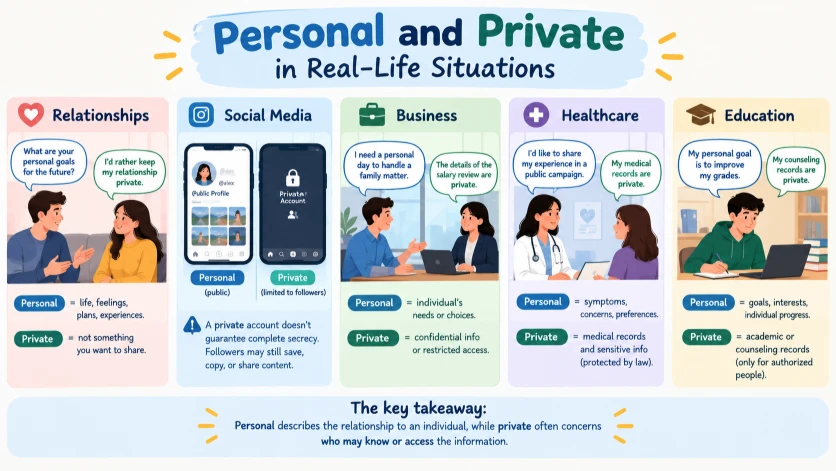
The best way to understand these words is to see how they work in different situations.
Personal vs. Private in Relationships
A personal question relates to someone’s life, feelings, or experiences. A private matter is one the person may prefer not to share.
For example:
- “What are your personal goals for the future?” asks about someone’s plans.
- “I’d rather keep my relationship private” sets a boundary around what others may know.
A question can be personal without being inappropriate. If it is welcome depends on the relationship, situation, and person’s comfort.
Personal vs. Private on Social Media
On platforms such as Instagram, Facebook, and other services owned by Meta, personal and private describe different things.
A personal profile may represent you as an individual. A private account restricts who can see certain content, depending on the platform’s settings.
For example:
- A personal Instagram account may have a public profile.
- A private Instagram account generally limits posts to approved followers.
Important: A private account does not guarantee complete secrecy. Followers may still save, copy, or share content. Always review the platform’s current privacy settings before sharing sensitive details.
Personal vs. Private in Business
In a workplace, a personal matter might involve an employee’s family plans or career choices. A private matter might involve confidential discussions, financial records, or restricted company information.
Examples:
- “I need a personal day to handle a family matter.”
- “The details of the salary review are private.”
The first sentence explains an individual’s need. The second sets a limit on access to information.
Personal vs. Private in Healthcare
A patient’s personal experience may include their symptoms, concerns, and treatment preferences. Their medical records may be private and protected under applicable laws.
For example, a patient can discuss their personal experience with a condition in a public awareness campaign. That does not mean every detail of their medical history should be shared.
The central issue is consent, access, and the rules that apply to sensitive health information.
Personal vs. Private in Education
A student might have a personal goal to improve their grades. Their private academic or counseling records may be accessible only to authorized people, subject to the relevant rules.
These examples show why context matters: personal describes the relationship to an individual, while private often concerns who may know or access the information.
Difference and Similarity Between Personal and Private
| Feature | Personal | Private | Similarity |
| Meaning | Related to an individual | Restricted from public access | Both can relate to an individual |
| Main purpose | Shows personal connection | Shows a boundary or limit | Both clarify the nature of something |
| Information | Personal interests or opinions | Confidential messages or records | Both can describe information |
| Public visibility | May be public or private | Usually has limited access | Both apply to communication |
| Relationships | Personal feelings or experiences | Matters kept within a chosen circle | Both can involve relationships |
| Property | Personal belongings | Property with restricted access | Both can describe ownership or use |
| Workplace | Individual goals or needs | Confidential company matters | Both appear in professional settings |
| Online use | A profile representing an individual | An account with restricted visibility | Both describe digital activity |
This table clearly shows the difference and similarity between personal and private for quick understanding.
Common Mistakes With Personal and Private
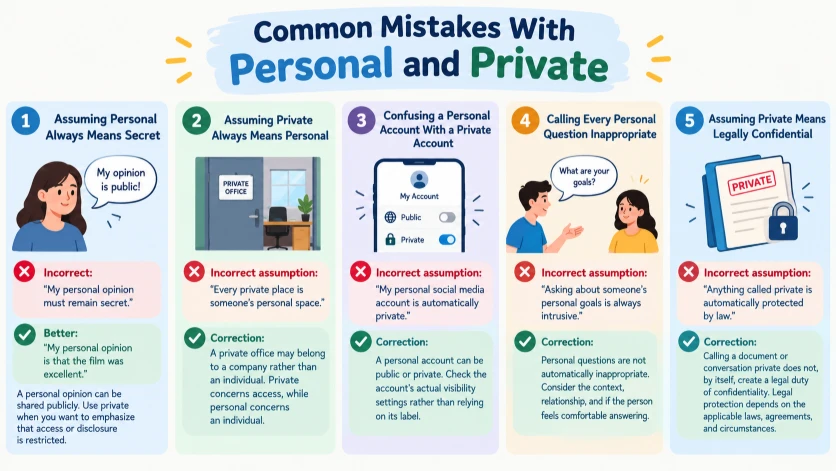
Many people use these words interchangeably because they often appear in the same situations. Here are five mistakes to avoid.
Mistake 1: Assuming Personal Always Means Secret
Incorrect: “My personal opinion must remain secret.”
Better: “My personal opinion is that the film was excellent.”
A personal opinion can be shared publicly. Use private when you want to emphasize that access or disclosure is restricted.
Mistake 2: Assuming Private Always Means Personal
Incorrect assumption: “Every private place is someone’s personal space.”
Correction: A private office may belong to a company rather than an individual. Private concerns access, while personal concerns an individual.
Mistake 3: Confusing a Personal Account With a Private Account
Incorrect assumption: “My personal social media account is automatically private.”
Correction: A personal account can be public or private. Check the account’s actual visibility settings rather than relying on its label.
Mistake 4: Calling Every Personal Question Inappropriate
Incorrect assumption: “Asking about someone’s personal goals is always intrusive.”
Correction: Personal questions are not automatically inappropriate. Consider the context, relationship, and if the person feels comfortable answering.
Mistake 5: Assuming Private Means Legally Confidential
Incorrect assumption: “Anything called private is automatically protected by law.”
Correction: Calling a document or conversation private does not, by itself, create a legal duty of confidentiality. Legal protection depends on the applicable laws, agreements, and circumstances.
When Should You Use Personal or Private?
Use personal when you want to show that something relates to an individual’s life, feelings, choices, or needs.
Use private when you want to show that something is restricted, not public, or intended for a limited audience.
| Situation | Use personal | Use private |
| Sharing an opinion | My personal view | A private discussion |
| Discussing goals | Personal goals | Not usually needed |
| Protecting a message | Not enough on its own | Private message |
| Describing a room | Personal workspace, if it is yours | Private room with restricted access |
| Talking about records | Personal details | Private records |
| Setting a boundary | Personal preference | Keep this private |
A useful writing tip is to ask what you want the reader to understand. Are you emphasizing whose experience it is, or who is allowed to access it? That question usually makes the correct word clear.
Why Do People Get Confused About Personal and Private?
Their Meanings Often Overlap
A private diary is usually personal, and personal thoughts may be private. Because the same thing can fit both descriptions, people may assume the words mean exactly the same thing.
However, overlap does not mean they are interchangeable.
Everyday Speech Blurs the Difference
People often say, “That’s personal,” when they mean they do not want to discuss a subject. In that situation, personal can imply a boundary even though private expresses restricted access more directly.
For example, “That’s personal” can politely end a conversation without explaining if the information is secret.
Technology Makes the Distinction More Important
Online, a personal profile describes the type of account or the person it represents. Privacy settings determine who can view or interact with certain content.
Google accounts, YouTube channels, and Meta platforms offer different visibility and sharing controls. Their features vary, so users should not assume that a personal account, a private message, and confidential information offer the same level of protection.
The same distinction matters in business software, cloud storage, and workplace messaging systems. A file can concern a personal matter without being technically access-restricted.
How Search Engines Understand Personal and Private
When someone searches Google for the difference between personal and private, they usually want a clear definition, examples, and help choosing the correct word in a sentence.
A useful explanation should distinguish between the words’ meanings and show how context changes their use. For instance, a search about a private Instagram account may concern visibility settings, while a search about personal information may concern data, identity, or everyday English.
Search engines use query context to help determine which information is relevant. They do not treat every occurrence of personal and private as having the same meaning.
For content creators, this means an article should answer the actual question, use natural examples, and explain related terms without forcing keywords into every heading. Including Google, Instagram, or YouTube as examples is useful only when they genuinely help explain the topic.
No particular keyword density or article structure guarantees a top ranking. Clear answers, factual accuracy, and a useful reading experience are better goals than repeating the same phrase.
Expert Insight: The Simplest Way to Remember the Difference
Think of personal as a connection and private as a boundary.
A personal letter relates to your life or is written by you. A private letter is one you intend only certain people to read. The same letter can be both personal and private, but neither word automatically guarantees the other.
This distinction is useful in communication, digital privacy, and professional writing. It also prevents a common misunderstanding: something does not have to be secret to be personal, and something does not have to belong to an individual to be private.
When handling sensitive information, go one step further. Do not rely only on labels such as “personal” or “private.” Check the intended audience, access permissions, consent, and any applicable confidentiality rules.
That approach is more reliable than treating the two words as synonyms.
Frequently Asked Questions
Is private the same as personal?
No, private and personal have different meanings. Personal relates to an individual, while private refers to something that is not meant to be shared with everyone.
What is the difference between personal and private information?
Personal information identifies or relates to a person, such as their name or birthday. Private information is sensitive or confidential information that a person does not want others to access, such as passwords or private messages.
What is the difference between private life and personal life?
Private life refers to aspects of life kept away from public attention, while personal life includes someone’s relationships, family, hobbies, and experiences outside work.
What does it mean if a person is private?
A private person prefers to keep personal details, feelings, and experiences to themselves rather than sharing them openly with others.
What is the difference between private and personal?
Personal means related to someone individually, while private means restricted to a person or a limited group and not open to public access.
What is an example of personal?
An example of personal is a personal opinion: “My personal opinion is that everyone deserves a fair chance.” The opinion belongs to the individual expressing it.
What does private mean?
Private means intended for an individual or a limited group rather than the general public. For example, a private conversation is meant to be shared only with the people involved.
What does “it’s personal” mean?
“It’s personal” means something relates to someone’s private feelings, experiences, or relationships. It can also mean that a person does not want to discuss the matter with others.
Conclusion
The difference between personal and private is mainly about connection versus access. Personal describes something related to an individual’s life, feelings, opinions, or needs. Private describes something that is not open to everyone or is intended to remain within a limited circle.
For example, your personal opinion about a movie can be shared publicly, while a private message is intended for a particular recipient. Similarly, a personal goal relates to your own plans, whereas a private meeting limits who can participate or hear the discussion.
Remember that the two words can describe the same thing. Your personal diary may also be private because it contains your thoughts and you choose not to share them. However, personal does not automatically mean secret, and private does not always mean that something belongs to one individual.
When choosing between personal and private, consider what you want to emphasize. If you mean that something relates to a person, use personal. If you mean that access or disclosure is restricted, use private. This simple distinction will help you communicate more clearly in everyday conversations, professional writing, relationships, and online settings.
READ MORE ABOUT!
- Difference Between Pardon and Commutation: A Clear Guide
- Difference Between Estar and Ser: Easy Spanish Guide

I am Emily Johnson, a USA-based content writer who creates easy-to-read blogs on language and daily life topics. I explain complex ideas in simple English for students and beginners so they can understand easily.