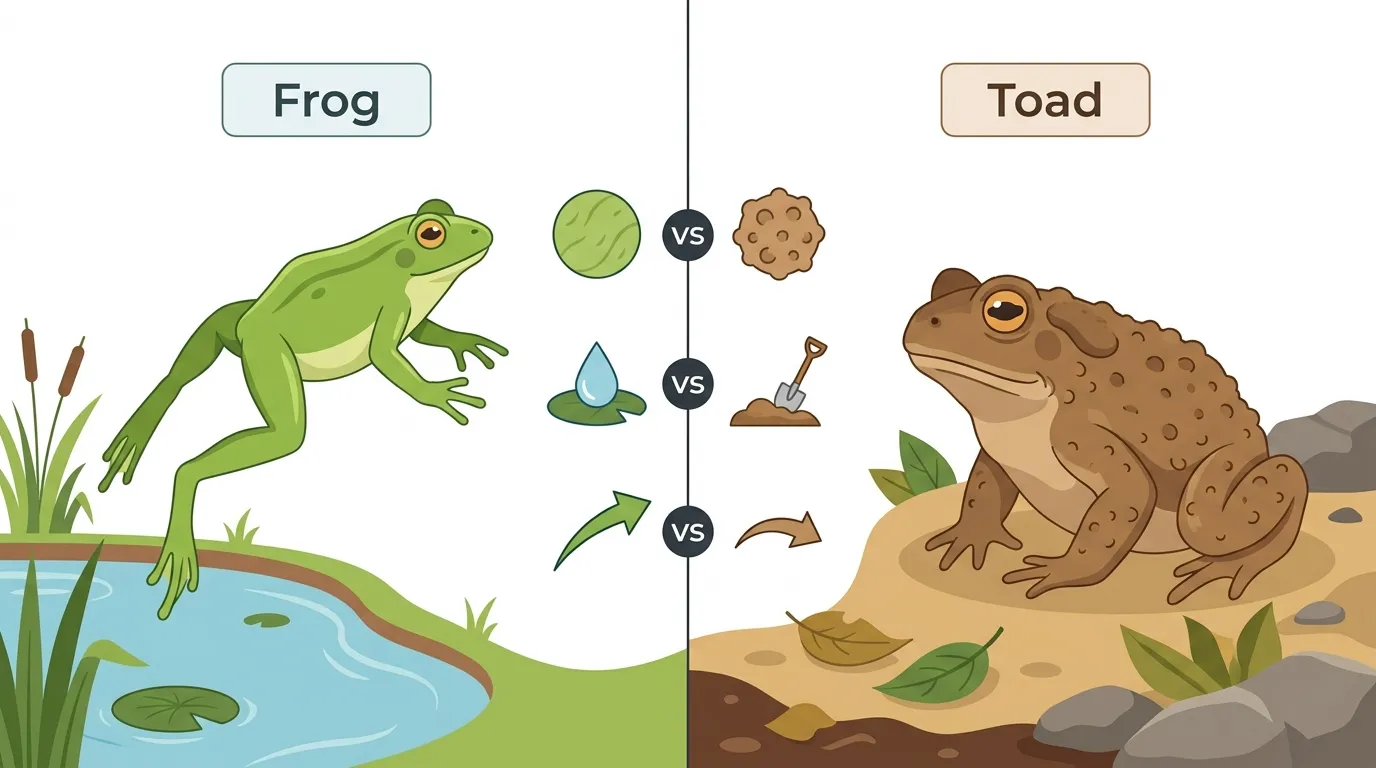
Frogs are smooth-skinned, water-loving amphibians, while toads are dry-skinned, land-dwelling amphibians 🐸🌿
The difference between frogs and toads is one of the most searched biology topics because many people confuse these two amphibians in real life, movies, and even school studies.
At first glance, frogs and toads may look almost identical, but when we study the difference between frogs and toads, we discover major variations in their skin, habitat, behavior, and survival techniques.
In simple words, frogs are usually more water-loving and smooth-skinned, while toads are more land-based with rough, dry skin. This difference between frogs and toads is not just biological it also affects how they live, hunt, and survive in nature.
Many users search “what is the difference between frogs and toads” or “how frogs and toads are different” because visually they seem the same, but scientifically they are not.
In this guide, you will clearly understand:
✔ What frogs are
✔ What toads are
✔ Key biological differences
✔ Real-life examples
✔ Why people often confuse them
Let’s break the confusion in a simple, expert, and easy way.
🟢 Difference Between Frogs and Toads
Frogs are smooth-skinned amphibians that live mostly near water, while toads have dry, bumpy skin and prefer land.
Example: A frog jumps into a pond, while a toad stays in a garden or dry area.
🟢 Definition of Frogs and Toads
- Frogs: Amphibians with smooth, moist skin, long legs, and strong jumping ability that usually live near water.
- Toads: Amphibians with dry, rough skin, shorter legs, and a preference for living on land in dry environments.
🟢 Pronunciation
- Frog → /frɒɡ/ (UK), /frɑːɡ/ (US)
- Toad → /təʊd/ (UK), /toʊd/ (US)
Now let’s understand the difference between frogs and toads in more depth.
Key Differences Between Frogs and Toads
| Feature | Frogs | Toads |
| Skin | Smooth & moist | Dry & bumpy |
| Habitat | Near water | Mostly land |
| Movement | Long jumps | Short hops |
| Eggs | Cluster in water | Long chains |
| Body shape | Slim & athletic | Short & wide |
| Eyes | Bulging & round | Smaller & dull |
| Toxins | Rare | Often present in skin |
| Behavior | Active in day/night | Mostly nocturnal |
This table clearly shows the difference between frogs and toads in a quick and scannable format.
🧠 Key Differences Explained Between Frogs and Toads
1. Skin Texture Difference
Frogs have smooth, wet skin that helps them absorb water easily. Toads have dry, rough skin that helps them survive in dry environments.
✔ Example: Frogs near lakes stay moist, while toads survive in gardens.
2. Habitat Preference
Frogs are water-dependent animals. Toads prefer land and only visit water for breeding.
✔ Real-life insight: You will mostly find frogs near ponds and rivers.
3. Movement Style
Frogs have long, powerful legs for jumping far distances. Toads have shorter legs, so they move by walking or short hops.
✔ Example: Frogs escape predators quickly with long jumps.
4. Reproduction Differences
Frogs lay eggs in clusters, while toads lay eggs in long chains.
✔ This is a major biological clue in identifying them.
5. Toxicity Level
Toads often produce mild toxins in their skin as defense. Frogs usually do not.
✔ This helps toads survive predators on land.
🧪 Why Frogs and Toads Exist Differently in Nature
Nature designs organisms based on survival needs. Frogs evolved for aquatic life, while toads adapted for dry land. This is why the difference between frogs and toads is so important in ecology.
✔ Frogs = water specialists
✔ Toads = land specialists
This separation helps both survive without competing directly.
🌍 Real-Life Examples
✔ A frog jumping into a pond after rain
✔ A toad sitting in a garden at night
✔ Frogs in rice fields in Asia
✔ Toads found in dry forests or lawns
These examples make the difference between frogs and toads easier to understand in daily life.
🧠 When to Use Frogs vs Toads Identification
You can identify them based on:
✔ Skin texture (wet vs dry)
✔ Location (water vs land)
✔ Movement style (jumping vs crawling)
✔ Body shape (slim vs round)
Why People Get Confused Between Frogs and Toads
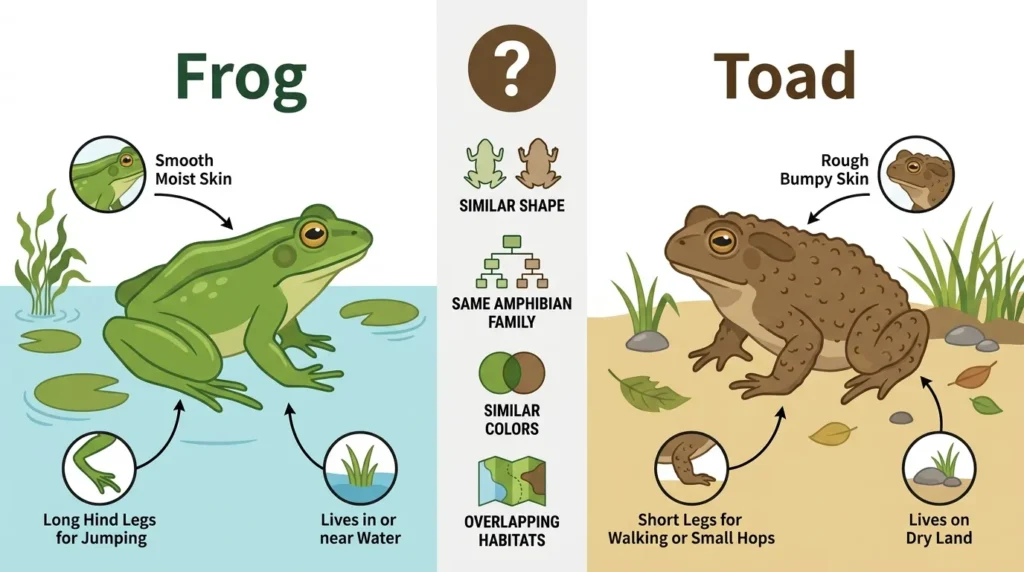
Many users confuse frogs and toads because:
✔ Both are amphibians
✔ Both live in similar regions
✔ Both appear green or brown
✔ Media often mixes their names
In reality, the difference between frogs and toads is clear when studied scientifically.
🔍 How Google Understands Frogs vs Toads Queries
Search engines like Google analyze user intent such as:
- “What is the difference between frogs and toads?”
- “Frog vs toad comparison”
- “Are frogs and toads same?”
Google shows comparison tables, definitions, and biology explanations because users want quick clarity + deep understanding.
🧠 Expert Insight
In biological classification, frogs and toads belong to the same order Anura, but different families. This is why they look similar but behave differently. In real ecological studies, scientists use skin texture, habitat, and reproductive behavior to classify them.
Most beginners only focus on appearance, but experts always analyze environment + physiology for accurate identification.
⚠️ Common Mistakes with Frogs and Toads
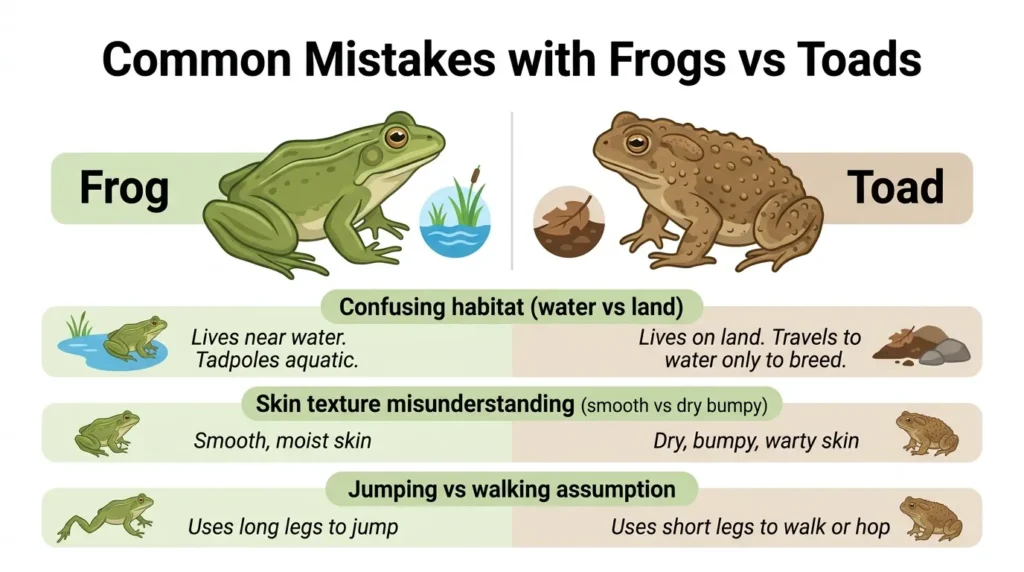
❌Thinking frogs and toads are the same animal
✔They belong to different families
❌Identifying only by color
✔Skin texture and habitat matter more
❌Assuming all toads are dangerous
✔ Only some have mild toxins
❌ Ignoring habitat clues
✔ Water vs land is a key factor
🌍 Real-Life Applications
✔ Biology education in schools
✔ Wildlife identification
✔ Environmental research
✔ Photography of amphibians
✔ Ecosystem studies
Understanding the difference between frogs and toads is important for students and nature lovers.
🧠 Similarities Between Frogs and Toads
✔ Both are amphibians
✔ Both lay eggs in water
✔ Both eat insects
✔ Both undergo metamorphosis
✔ Both are cold-blooded
Even though they are different, they share many biological traits.
🧾 Comparison: Differences and Similarities
| Feature | Frog | Toad | Similarity |
| Classification | Amphibian | Amphibian | Same class |
| Skin | Smooth | Rough | Both protective |
| Habitat | Water | Land | Both need moisture |
| Diet | Insects | Insects | Carnivorous |
| Life cycle | Metamorphosis | Metamorphosis | Same process |
| Eggs | Cluster | Chain | Reproduction in water |
| Movement | Jumping | Walking | Both mobile |
🧠 Why This Difference Matters
The difference between frogs and toads is not just academic it helps in:
✔ Understanding ecosystems
✔ Protecting biodiversity
✔ Studying evolution
✔ Wildlife conservation
❓ FAQs
1. What is the main difference between frogs and toads?
Frogs live near water with smooth skin, while toads live on land with rough skin.
2. Are frogs and toads the same?
No, they belong to different families.
3. Where do frogs live?
Mostly in ponds, lakes, and wetlands.
4. Where do toads live?
Mostly on land like gardens and forests.
5. Which is more poisonous?
Toads can have mild toxins in their skin.
6. Can frogs live on land?
Yes, but they prefer water environments.
7. Why do frogs jump more?
They have longer, stronger legs.
8. Why do toads walk instead of jump?
Their legs are shorter and built for crawling.
🧾 Conclusion
The difference between frogs and toads is a classic example of how nature adapts animals to different environments. While both belong to the amphibian family and share similar life cycles, they are very different in appearance, behavior, and habitat.
Frogs are smooth-skinned, water-loving jumpers, while toads are rough-skinned, land-dwelling crawlers. Understanding the difference between frogs and toads helps students, researchers, and nature lovers correctly identify them in real life.
In conclusion, the key takeaway is simple: frogs and toads are related, but not the same. Their differences are essential for survival, ecology, and biological classification. Once you understand these distinctions clearly, you will never confuse them again.
Read more about!
Difference Between Concealer and Foundation: Complete Guide
Difference Between Diffusion and Osmosis: Complete Guide

I am Emily Johnson, a USA-based content writer who creates easy-to-read blogs on language and daily life topics. I explain complex ideas in simple English for students and beginners so they can understand easily.