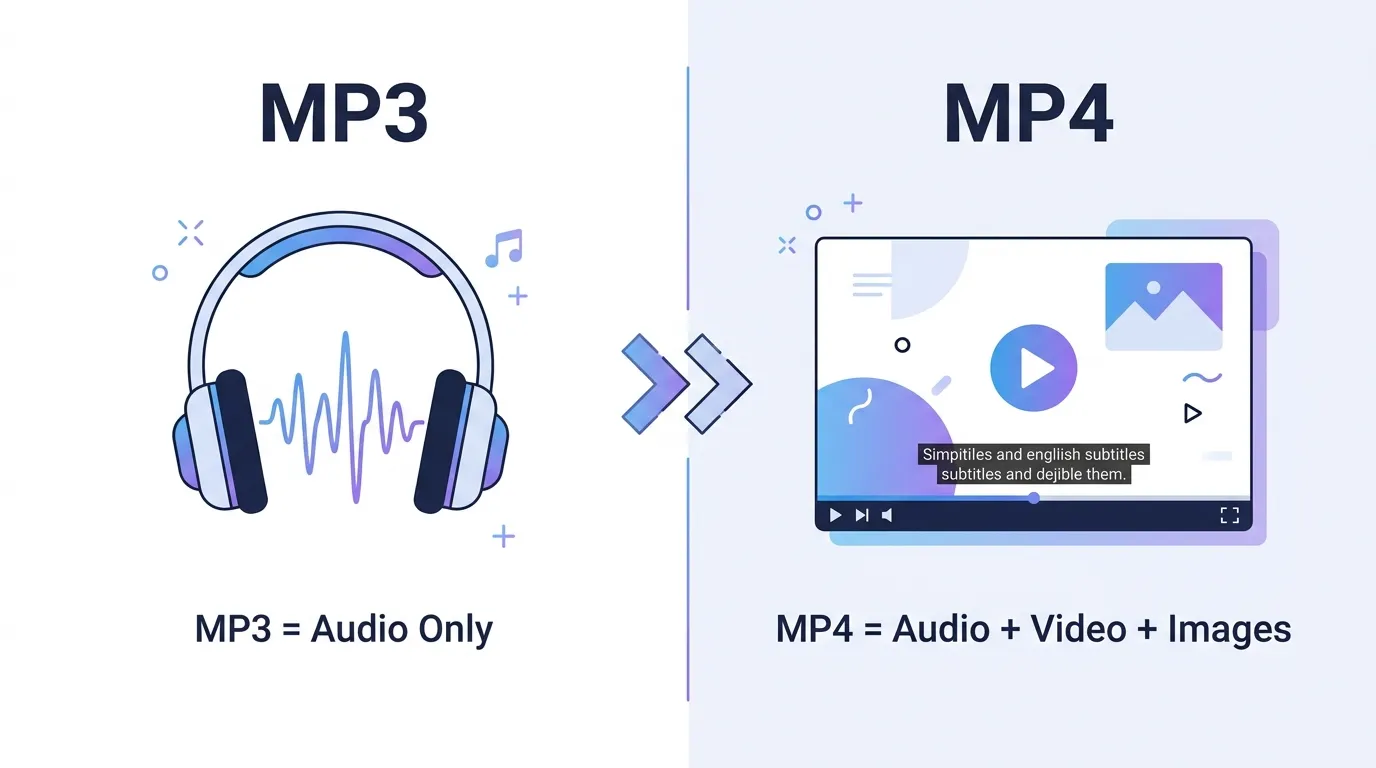
🎵 The difference between MP3 and MP4 is that MP3 is mainly an audio file format, while MP4 can store audio, video, images, and subtitles in one multimedia file.
Many users get confused about the difference between MP3 and MP4 because both are popular digital media formats used for music, videos, and online content.
In simple words, MP3 is mainly designed for audio files, while MP4 can store video, audio, subtitles, images, and more in one container format.
The difference between MP3 and MP4 matters more today than ever because platforms like YouTube, Google, Meta, and Instagram rely heavily on compressed media formats for streaming and content delivery.
If you have ever asked:
- “Which format is better for music?”
- “Can MP4 play audio only?”
- “Why is MP4 larger than MP3?”
- “Should I convert MP4 to MP3?”
then this complete guide will answer everything clearly. You will learn definitions, similarities, technical differences, real-life uses, friendly explanations, practical examples, and expert insights without confusing jargon.
Difference Between MP3 and MP4
The difference between MP3 and MP4 is simple:
- MP3 is an audio-only file format mainly used for music and podcasts.
- MP4 is a multimedia container format that can store video, audio, subtitles, and images together.
Real Example
A song downloaded from a music app is usually an MP3 file, while a video uploaded to YouTube is commonly stored as MP4.
Definition of Difference Between MP3 and MP4
- MP3: A compressed digital audio format designed to reduce file size while keeping acceptable sound quality.
- MP4: A multimedia container format that stores video, audio, captions, and other media data in one file.
Simple Example
MP3 is like an audio cassette for digital music, while MP4 is like a digital movie box that can carry multiple media elements together.
Pronunciation
| Term | US Pronunciation | UK Pronunciation |
| MP3 | EM-PEE-THREE | EM-PEE-THREE |
| MP4 | EM-PEE-FOUR | EM-PEE-FOUR |
Now let’s understand the real-world logic behind these two popular media formats.
Difference Between MP3 and MP4
| Feature | MP3 | MP4 |
| Main Purpose | Audio playback | Multimedia playback |
| Supports Video | No | Yes |
| File Size | Smaller | Usually larger |
| Audio Quality | Good compressed audio | Can support higher-quality audio |
| Media Type | Audio only | Audio + video + subtitles |
| Streaming Usage | Music streaming | Video streaming |
| Common Platforms | Music apps, podcasts | YouTube, Instagram Reels |
| Device Compatibility | Extremely wide | Very wide |
| Compression Type | Audio compression | Multimedia container |
| Best Use | Songs and podcasts | Videos and multimedia |
Key Differences Explained Between MP3 and MP4
1. MP3 Is Audio Only While MP4 Supports Video
This is the biggest difference.
MP3 files contain only sound, while MP4 files can hold:
- Video
- Audio
- Captions
- Images
- Metadata
Real-Life Example
Spotify music downloads are often MP3-based, while YouTube videos commonly use MP4.
2. MP4 Is More Advanced Than MP3
MP4 was developed later to support modern multimedia needs.
Today’s digital world relies heavily on MP4 because social media platforms require video-friendly formats.
Example
Instagram Reels and Facebook videos use MP4 because they need synchronized audio and video.
3. MP3 Files Are Smaller
MP3 files are lightweight because they only store compressed audio.
That makes them ideal for:
- Music downloads
- Podcasts
- Audiobooks
- Voice recordings
Practical Insight
Most beginners choose MP3 when storage space matters.
4. MP4 Delivers Better Multimedia Experience
MP4 supports:
- HD video
- 4K content
- Subtitles
- Streaming optimization
This is why platforms like Meta and YouTube heavily depend on MP4 technology.
5. MP3 Loads Faster for Audio Streaming
Music apps optimize MP3 because smaller files reduce bandwidth usage.
Example
Online radio stations and podcasts often prioritize MP3 for smooth playback on slow internet connections.
6. MP4 Is Better for Content Creators
Video editors, influencers, educators, and marketers prefer MP4 because it combines audio and visuals in one file.
Real Scenario
A YouTube tutorial creator records video in MP4 format for editing and uploading.
7. MP3 Is Easier for Simple Devices
Older devices, car stereos, and basic MP3 players may not fully support MP4 video playback.
That is why MP3 still remains extremely popular even in 2026.
How Do MP3 and MP4 Work?
How MP3 Works
MP3 uses lossy audio compression.
This means unnecessary sound frequencies are removed to reduce file size while preserving acceptable listening quality.
Why It Exists
The internet originally had slower speeds. MP3 became popular because it allowed faster music downloads.
How MP4 Works
MP4 acts as a container format.
It stores:
- Video codecs
- Audio tracks
- Subtitle files
- Images
- Metadata
inside one organized multimedia structure.
Why It Exists
Modern streaming platforms needed a flexible multimedia format that works across smartphones, TVs, websites, and apps.
Difference and Similarity Between MP3 and MP4
| Feature | MP3 | MP4 | Similarity |
| Main Content | Audio only | Video + audio | Both store digital media |
| Compression | Audio compression | Multimedia container | Both reduce storage usage |
| Internet Streaming | Music streaming | Video streaming | Both support online delivery |
| Compatibility | High device support | High device support | Both widely supported |
| Usage | Podcasts, songs | Movies, tutorials | Both used daily online |
| File Extension | .mp3 | .mp4 | Both are digital file formats |
| User Purpose | Listening | Watching + listening | Both deliver entertainment |
| Popularity | Music-focused | Multimedia-focused | Both dominate digital media |
This table clearly shows the difference and similarity between MP3 and MP4 for quick understanding.
Why Does MP4 Usually Have Larger File Sizes?
Many users wonder why MP4 files consume more storage.
The answer is simple:
MP4 often includes:
- Video frames
- Multiple audio tracks
- Subtitle data
- Metadata
- High-resolution graphics
Meanwhile, MP3 only stores compressed sound.
Example
A 3-minute MP3 song may be only 5 MB, while a 3-minute HD MP4 video could exceed 80 MB.
Which Is Better: MP3 or MP4?
The answer depends on user intent.
Choose MP3 If You Need:
- Music playback
- Podcasts
- Audiobooks
- Small file sizes
- Fast downloads
Choose MP4 If You Need:
- Video content
- Tutorials
- Movies
- Social media uploads
- Multimedia presentations
Expert Insight
In practical use, neither format is universally “better.” They solve different digital media problems.
Common Mistakes With MP3 and MP4
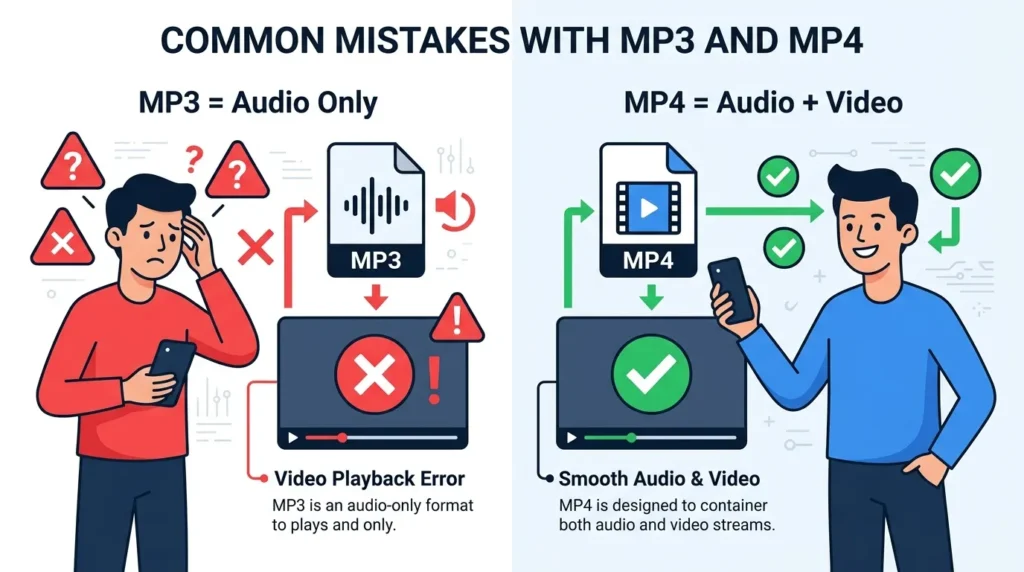
1. Thinking MP4 Is Only for Video
Many beginners assume MP4 always contains video.
Actually, MP4 can also store audio-only content.
2. Assuming MP3 Has Better Quality
Higher file size does not always mean worse quality.
Modern MP4 audio codecs can deliver excellent sound quality.
3. Confusing File Format With Codec
This is extremely common.
- MP3 = audio codec and format
- MP4 = container format
These concepts are related but not identical.
4. Renaming Extensions Instead of Converting Files
Changing “.mp4” to “.mp3” manually does not truly convert the media.
Real conversion requires encoding software.
5. Believing MP3 Is Outdated
MP3 is still heavily used worldwide because of compatibility and efficiency.
Real Life Examples With MP3 and MP4
Personal Use
A student downloads MP3 lectures to save mobile storage.
Social Media Content
Creators upload MP4 videos to Instagram Reels and Facebook.
Podcast Industry
Most podcasts distribute episodes in MP3 format because downloads remain lightweight.
Online Learning
Educational platforms use MP4 for video lessons with subtitles and audio.
Business Marketing
Companies create MP4 advertisements for websites and social campaigns.
When To Use Each Format
| Situation | Best Choice |
| Listening to music | MP3 |
| Watching videos | MP4 |
| Uploading social media content | MP4 |
| Saving phone storage | MP3 |
| Podcast distribution | MP3 |
| Online video tutorials | MP4 |
Simple Rule
If it is mainly sound, choose MP3.
If it includes video or multimedia, choose MP4.
Why People Get Confused Between MP3 and MP4
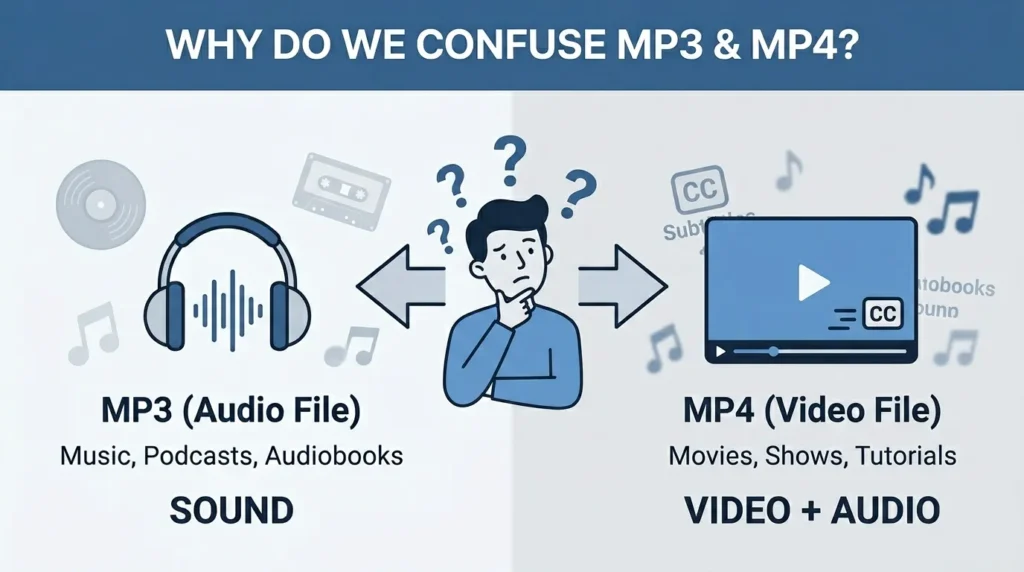
Many users assume MP4 is simply a newer version of MP3 because the names look similar.
But technically, they serve different purposes.
Main Reasons for Confusion
1. Similar Naming Structure
Both formats use “MP,” making beginners think they belong to the same upgrade system.
2. Media Apps Use Both Formats
Platforms like YouTube and Instagram process both audio and video content, which mixes terminology for users.
3. File Conversion Tools
Online converters frequently advertise:
“Convert MP4 to MP3.”
This creates the impression that both formats are directly interchangeable.
4. Streaming Culture
Modern users consume mixed media constantly, so audio and video formats blur together.
How Search Engines Understand Difference Between MP3 and MP4
Search engines like Google analyze user intent using NLP, semantic relationships, and behavioral signals.
When users search:
- “mp3 vs mp4”
- “what is mp4”
- “difference between audio and video formats”
- “which is better mp3 or mp4”
Google understands that users want:
- Clear comparison
- File format explanation
- Practical recommendations
- Conversion guidance
Why This Matters
Helpful content ranks better when it:
- Explains technical concepts simply
- Uses real-world examples
- Answers beginner confusion directly
- Covers semantic relationships naturally
Expert Insight
In real scenarios, MP3 remains dominant for portable audio because of universal support and efficient compression. Meanwhile, MP4 powers the modern creator economy, including online education, streaming services, gaming content, and short-form social media.
Most beginners focus only on file extensions, but professionals understand the deeper difference:
MP3 is optimized for listening efficiency, while MP4 is optimized for multimedia flexibility.
As internet speeds improve and video consumption grows globally, MP4 usage continues increasing rapidly. However, MP3 still survives because audio-focused experiences remain essential in podcasts, fitness apps, car entertainment systems, and voice-based platforms.
FAQs
Is MP4 better quality than MP3?
Not always. MP4 supports advanced codecs and multimedia, but MP3 can still provide excellent audio quality.
Can MP4 play only audio?
Yes. MP4 files can contain only audio without video.
Why are MP3 files smaller?
Because they only store compressed audio data.
Is MP3 outdated in 2026?
No. MP3 is still widely used for music, podcasts, and portable audio.
Which format works best for YouTube?
MP4 is best for YouTube because it supports video and audio together.
Can I convert MP4 to MP3?
Yes. Many media converters can extract audio from MP4 files into MP3 format.
Which is better for podcasts?
MP3 is usually preferred because of smaller file size and compatibility.
Does MP4 support subtitles?
Yes. MP4 can include subtitle tracks and captions.
Conclusion
Understanding the difference between MP3 and MP4 becomes easy once you see their real purpose. MP3 is designed mainly for audio compression and efficient music playback, while MP4 is a multimedia container capable of storing video, audio, subtitles, and interactive data together.
In practical use, MP3 remains ideal for songs, podcasts, audiobooks, and lightweight audio streaming. MP4, on the other hand, dominates modern video platforms, online learning systems, social media content, and multimedia entertainment.
Many users get confused because the names look similar, but their functions are quite different. MP3 focuses on listening experiences, while MP4 supports full multimedia interaction.
As digital media continues evolving in 2026 and beyond, both formats remain highly relevant. Choosing the right one depends entirely on your goal:
- Use MP3 for audio simplicity and smaller files.
- Use MP4 for video and advanced multimedia content.
Once you understand this difference, selecting the right format becomes much easier for personal, professional, and online content needs.
Read more about!
Difference Between Gene and Allele: Simple Guide
Difference Between Parfum and Toilette: Complete Guide

I am Emily Johnson, a USA-based content writer who creates easy-to-read blogs on language and daily life topics. I explain complex ideas in simple English for students and beginners so they can understand easily.