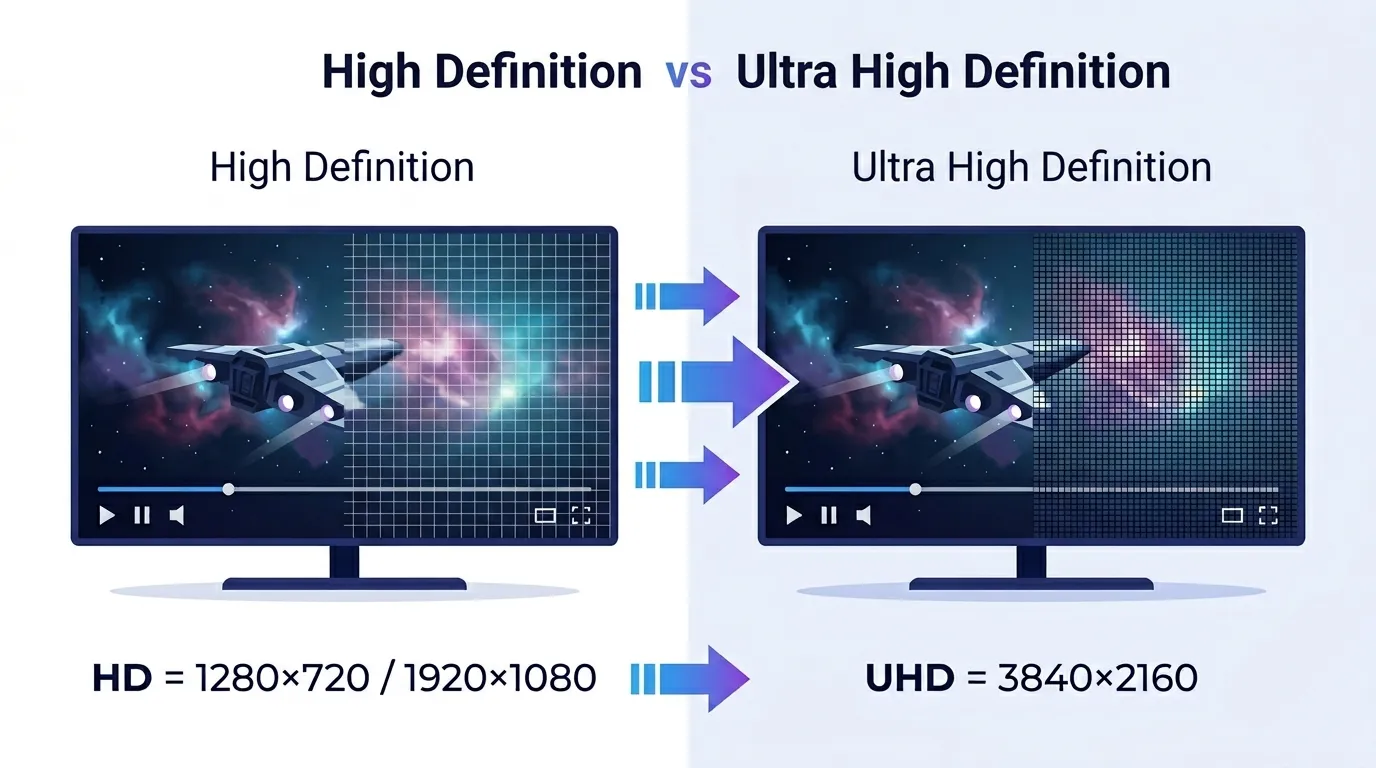
The difference between UHD and HD is that UHD (Ultra High Definition) has much higher resolution and sharper detail than HD (High Definition).
Many people get confused about the difference between UHD and HD when buying a TV, smartphone, monitor, or streaming subscription.
In simple words, HD offers good picture quality, while UHD provides much sharper detail, higher resolution, and a more realistic viewing experience.
The difference between UHD and HD matters because modern entertainment platforms like YouTube, Netflix, and Disney+ now support higher-quality video streaming. Many users search terms like:
- “What is UHD?”
- “What is HD?”
- “UHD vs HD”
- “Which is better UHD or HD?”
- “Is UHD worth it?”
If you have ever looked at TV specifications and wondered why one screen looks sharper than another, this guide will explain everything clearly.
You will learn definitions, resolutions, differences, similarities, real-life examples, buying advice, and expert insights in very simple language.
Difference Between UHD and HD
The difference between UHD and HD is mainly about screen resolution and picture detail.
- HD (High Definition) usually means 1280 × 720 pixels or 1920 × 1080 pixels.
- UHD (Ultra High Definition) usually means 3840 × 2160 pixels, also called 4K UHD.
Simple Example
Watching a football match in HD looks clear, but watching it in UHD shows sharper grass texture, player details, and smoother visuals.
Definition of Difference Between UHD and HD
- HD: A video or screen resolution with higher quality than standard definition, commonly 720p or 1080p.
- UHD: Ultra High Definition resolution with four times more pixels than Full HD, usually 3840 × 2160.
Easy Example
A Full HD TV gives clear visuals, while a UHD TV makes movies and games look more realistic and detailed.
Pronunciation
| Term | US Pronunciation | UK Pronunciation |
| UHD | Yoo-Eich-Dee | Yoo-Eich-Dee |
| HD | Eich-Dee | Eich-Dee |
Now let’s understand why these display technologies exist and how they affect your everyday viewing experience.
Difference Between UHD and HD
| Feature | UHD | HD |
| Full Form | Ultra High Definition | High Definition |
| Resolution | 3840 × 2160 | 1280 × 720 or 1920 × 1080 |
| Pixel Count | About 8.3 million pixels | About 2 million pixels |
| Sharpness | Very sharp | Good clarity |
| Viewing Experience | More realistic | Standard modern quality |
| Best Screen Size | Large TVs and monitors | Small to medium screens |
| Streaming Requirement | Faster internet needed | Lower internet usage |
| Gaming Experience | Better detail and immersion | Good for casual gaming |
| Cost | Usually more expensive | More affordable |
| Common Name | 4K UHD | 720p or 1080p |
Key Differences Explained Between UHD and HD
1. UHD Has More Pixels Than HD
The biggest difference between UHD and HD is pixel count.
UHD contains about four times more pixels than Full HD. More pixels create sharper images and finer detail.
Real-Life Example
In UHD, facial details in movies appear more natural and realistic compared to HD.
2. UHD Looks Better on Large Screens
Large TVs benefit greatly from UHD resolution.
HD can sometimes appear less sharp on very large displays because pixels become more visible.
Example
A 65-inch UHD TV usually looks clearer than a 65-inch HD TV.
3. UHD Improves Gaming Experience
Modern gaming systems like Sony PlayStation and Xbox support UHD gaming.
This provides:
- Better textures
- Sharper environments
- Improved immersion
4. HD Uses Less Internet Data
HD streaming requires less bandwidth.
That is why many users with slower internet still prefer HD video quality.
Example
Watching videos on mobile data often works better in HD than UHD.
5. UHD Supports Modern Streaming Platforms
Platforms like Netflix and YouTube now heavily promote UHD content because viewers spend more time watching high-quality visuals.
6. UHD Usually Costs More
UHD TVs, monitors, and cameras generally cost more due to advanced display technology.
However, prices have become more affordable in recent years.
7. Viewing Distance Matters
If you sit far from the screen, the difference between UHD and HD becomes less noticeable.
But at closer distances, UHD looks significantly sharper.
What Is HD?
HD stands for High Definition.
It replaced older low-quality standard-definition television systems.
Common HD Formats
| Format | Resolution |
| HD Ready | 1280 × 720 |
| Full HD | 1920 × 1080 |
1920×10801920 \times 10801920×1080
Why HD Became Popular
HD improved:
- Image sharpness
- Color quality
- Screen clarity
- Sports and movie viewing
For many users, Full HD still provides excellent quality today.
What Is UHD?
UHD means Ultra High Definition.
It is commonly known as 4K UHD.
UHD Resolution
3840×21603840 \times 21603840×2160
This resolution contains over 8 million pixels.
Why UHD Exists
As screen sizes became larger, people wanted:
- More detail
- Better realism
- Cinema-like viewing
UHD solved this problem by dramatically increasing pixel density.
Difference Between UHD and 4K
Many users think UHD and 4K are exactly the same.
In practical consumer electronics, they are almost used interchangeably.
However:
- UHD resolution = 3840 × 2160
- Professional cinema 4K = 4096 × 2160
Most TVs marketed as 4K are actually UHD TVs.
Difference and Similarity Between UHD and HD
| Feature | UHD | HD | Similarity |
| Video Quality | Extremely detailed | Clear and smooth | Both improve viewing over SD |
| Technology | Advanced display format | Standard modern format | Both used in TVs and monitors |
| Streaming Use | Premium streaming | Common streaming | Both supported online |
| Gaming Support | High-end gaming | Casual gaming | Both support consoles |
| Screen Types | Large displays | Smaller displays | Both available on TVs |
| Content Availability | Growing rapidly | Widely available | Both supported by media apps |
| Internet Need | Higher bandwidth | Lower bandwidth | Both need internet for streaming |
| Entertainment Use | Cinematic experience | Everyday watching | Both used for movies and sports |
This table clearly shows the difference and similarity between UHD and HD for quick understanding.
Why UHD Exists in Modern Technology
Many beginners ask:
“Why not just keep HD forever?”
The answer is simple.
Modern devices now have:
- Larger screens
- Better cameras
- Faster internet
- Advanced graphics processors
Because of this, users expect more visual realism.
Companies like Samsung, LG, and Sony push UHD technology to improve user experience and market competition.
How UHD and HD Work
Both UHD and HD work using pixels.
Pixels are tiny colored dots that create images on screens.
Simple Logic
More pixels = more detail.
HD has fewer pixels.
UHD has many more pixels packed tightly together.
This creates:
- Sharper text
- Better textures
- Cleaner edges
- Improved depth perception
Real Life Examples With UHD and HD
Watching Movies
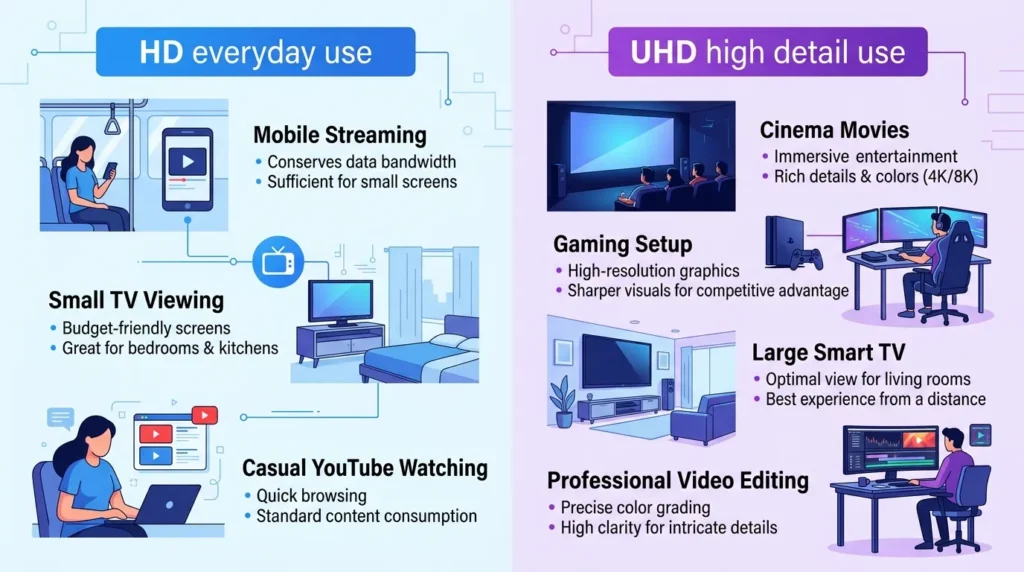
UHD provides cinema-like detail, especially on large TVs.
HD still looks good for normal viewing.
Gaming
Competitive gamers often prefer UHD for immersive graphics.
However, HD may provide smoother performance on weaker hardware.
Smartphone Streaming
Many users stream videos in HD to save mobile data.
Video Editing
Professional creators use UHD because editing requires maximum detail.
Business Presentations
Large conference displays often use UHD for sharper charts and text.
Common Mistakes With UHD and HD
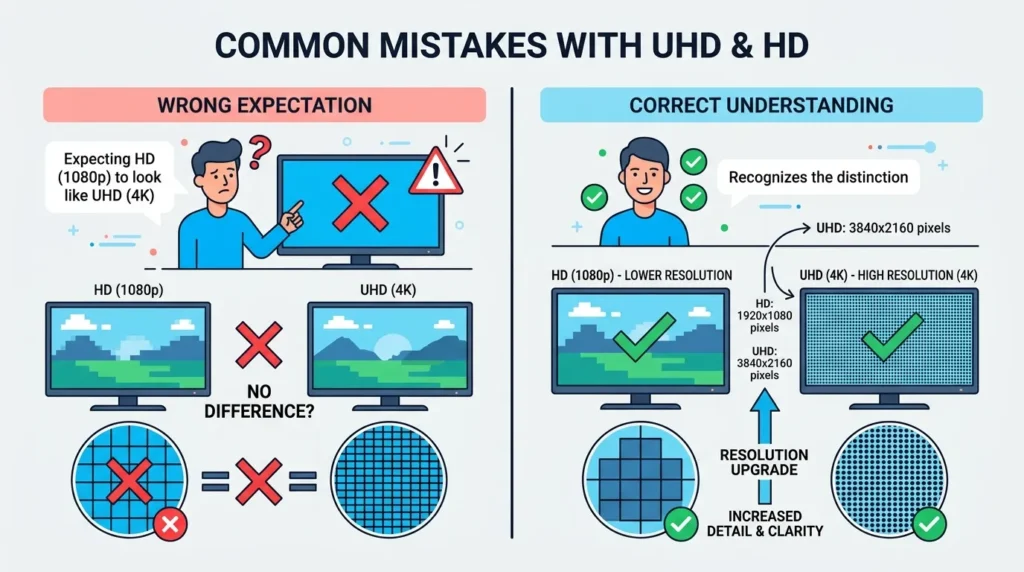
1. Thinking UHD Always Looks Better
If content was originally recorded in HD, UHD screens cannot magically create perfect detail.
2. Ignoring Internet Speed
Streaming UHD requires strong internet.
Slow connections may buffer constantly.
3. Buying UHD for Very Small Screens
On tiny displays, the visual difference may be hard to notice.
4. Confusing UHD With OLED
OLED is display technology.
UHD is resolution.
They are different concepts.
5. Assuming All 4K Content Is True UHD
Some videos are upscaled rather than natively recorded in UHD.
When To Use UHD vs HD
Use UHD When:
- You have a large TV
- You watch movies often
- You play modern games
- You want maximum detail
- You have fast internet
Use HD When:
- You want lower costs
- You use smaller screens
- You have slower internet
- You mainly watch casual content
Why People Get Confused Between UHD and HD
1. Marketing Terms
TV companies use many labels:
- UHD
- 4K
- Full HD
- QLED
- OLED
This confuses buyers.
2. Similar Everyday Appearance
On smaller screens, HD and UHD may look similar.
3. Streaming Compression
Sometimes streaming apps reduce video quality automatically.
This hides UHD benefits.
4. Retail Store Settings
Store demo TVs often use exaggerated settings that confuse customers.
How Search Engines Understand UHD and HD User Intent
Search systems like Google understand that users searching:
- “UHD vs HD”
- “Which is better HD or UHD?”
- “What does UHD mean?”
- “Should I buy UHD TV?”
usually want:
- Buying advice
- Technical comparison
- Streaming guidance
- Gaming recommendations
Platforms like YouTube and Meta also optimize video delivery based on screen resolution and user internet speed.
Expert Insight
In practical use, most average users notice the biggest UHD improvement on screens larger than 50 inches. On smaller devices, HD still performs very well.
Another important insight many articles miss is this:
resolution alone does not guarantee better quality.
Factors like:
- HDR
- contrast
- color accuracy
- refresh rate
- content source
also greatly affect viewing experience.
A good Full HD display can sometimes look better than a low-quality UHD display.
FAQs
What is the main difference between UHD and HD?
UHD has much higher resolution and more pixels than HD.
Is UHD better than HD?
Yes, UHD generally provides sharper and more detailed visuals.
Is UHD the same as 4K?
Almost. Most consumer 4K TVs are UHD TVs.
Does UHD need faster internet?
Yes. UHD streaming requires more bandwidth.
Can I watch HD content on a UHD TV?
Yes. UHD TVs can display HD content.
Is UHD worth buying in 2026?
Yes, especially for gaming, movies, and large screens.
Which is better for gaming: UHD or HD?
UHD offers better detail, but HD may run smoother on weaker systems.
Why does UHD look more realistic?
Because higher pixel density improves image sharpness and detail.
Conclusion
Understanding the difference between UHD and HD helps you choose the right screen, streaming quality, and viewing experience. HD provides clear and reliable picture quality for everyday use, while UHD delivers sharper visuals, more detail, and a more immersive experience.
For casual users, HD may still be enough. But for movie lovers, gamers, content creators, and users with large TVs, UHD offers noticeable improvements that feel more modern and cinematic.
The most important thing to remember is that resolution is only one part of display quality. Internet speed, screen size, HDR support, and content quality also matter.
In simple words:
- HD = great standard quality
- UHD = ultra-sharp premium quality
As streaming platforms, gaming systems, and smart TVs continue improving in 2026 and beyond, UHD is becoming the new standard for premium entertainment.
Read more about!
Difference Between Gas and Diesel: Complete Guide
Difference Between PNG and JPG: Complete Guide

I am James Carter, a professional content writer from the United States. I specialize in writing simple and clear comparison blogs that help students and readers understand difficult topics easily. My writing focuses on everyday language, education, science, and lifestyle topics. I believe that learning should be easy for everyone, so I use simple words and real-life examples in my articles.