An engine produces power by burning fuel, while a motor converts electrical energy into motion ⚙️🚗
If you’ve ever searched for the difference between motor and engine, you are not alone. Many students, drivers, and even engineers get confused because both terms are often used interchangeably in daily life.
In reality, the difference between motor and engine is very clear once you understand how each one works and where it is used.
In simple words, an engine produces power by burning fuel, while a motor converts electrical energy into mechanical motion. This core distinction is the foundation of the entire difference between motor and engine concept.
People often mix them up in cars, machines, and even in everyday language, especially on platforms like YouTube, Google searches, and automotive blogs.
In this detailed guide, we will break down the difference between motor and engine in a very simple, human-friendly way. You will learn definitions, working principles, real-life examples, comparisons, common mistakes, and expert insights.
By the end, you will clearly understand what is a motor, what is an engine, and how they are different in real-world applications.
🟢 Difference Between Motor and Engine
The difference between motor and engine is simple: an engine produces power by burning fuel (like petrol or diesel), while a motor uses electricity to produce motion.
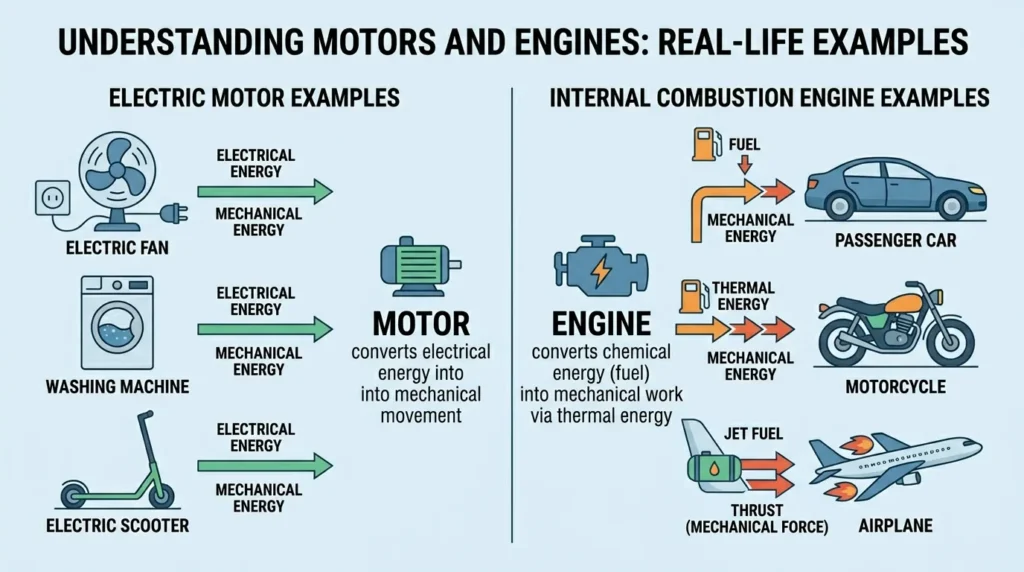
Example: A car uses an engine, while an electric fan uses a motor.
🟢 Definition of Motor and Engine
- Engine: A machine that converts fuel energy (petrol, diesel, gas) into mechanical energy through combustion.
- Motor: A device that converts electrical energy into mechanical energy to produce motion.
🟢 Pronunciation
- Motor (US/UK): /ˈmoʊtər/
- Engine (US/UK): /ˈɛndʒɪn/
Now let’s deeply explore the difference between motor and engine in a structured way.
🟢 Motor vs Engine Comparison
| Feature | Motor | Engine | Similarity |
| Energy Source | Electricity | Fuel (petrol/diesel) | Both produce motion |
| Working Method | Electromagnetic force | Combustion | Both convert energy |
| Pollution | Zero emissions | Produces emissions | Used in machines |
| Maintenance | Low | Higher | Mechanical system |
| Usage | Fans, EVs, machines | Cars, bikes, generators | Industrial use |
| Efficiency | High | Moderate | Energy conversion devices |
| Noise Level | Low | High | Mechanical operation |
👉 This table clearly shows the difference between motor and engine for quick understanding.
🟢 Key Differences Explained Between Motor and Engine
1. Energy Source Difference
A motor runs on electricity, while an engine runs on fuel like petrol or diesel.
Example: Tesla cars use motors, while Toyota Corolla uses an engine.
2. Working Principle
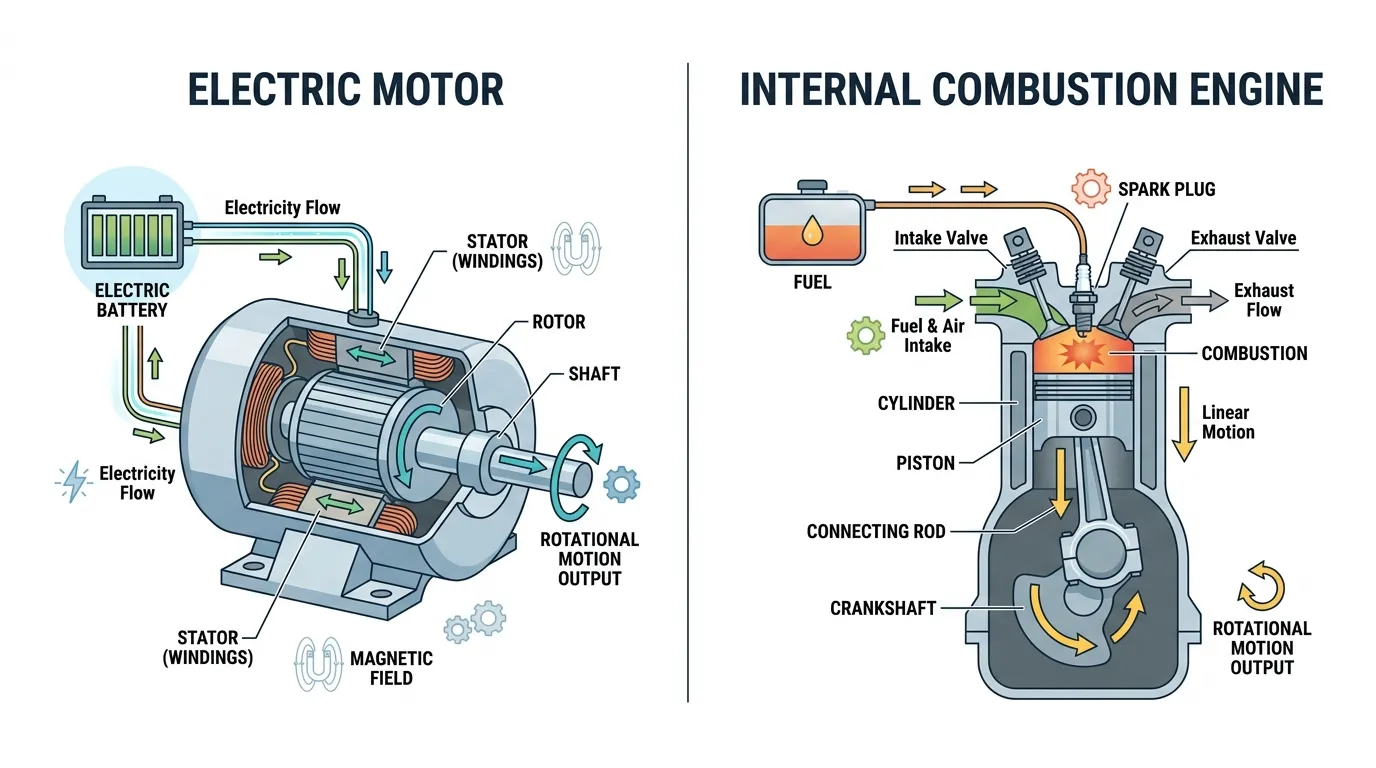
Motors use electromagnetic induction, while engines use internal combustion.
This is the most important difference between motor and engine.
3. Environmental Impact
Motors are eco-friendly and produce zero emissions. Engines release CO₂ gases.
4. Efficiency Level
Motors are more energy-efficient because they waste less energy as heat.
5. Maintenance Requirement
Engines require oil changes and servicing. Motors require less maintenance.
6. Usage in Real Life
Motors are used in appliances and EVs. Engines are used in transportation and heavy machinery.
7. Noise Production
Engines are noisy due to combustion. Motors run quietly.
🟢 What is an Engine and How Does It Work?
An engine works by burning fuel inside a chamber. This combustion creates pressure that moves pistons and generates mechanical power.
Modern engines are widely used in:
- Cars (Toyota, Honda)
- Motorcycles (Yamaha, Suzuki)
- Aircraft systems
Search engines like Google categorize this topic under automotive engineering because users often want mechanical comparisons.
🟢 What is a Motor and How Does It Work?
A motor works using electricity and magnetic fields. When electric current flows, it creates a rotating force that produces motion.
Motors are used in:
- Electric vehicles (Tesla, BYD)
- Home appliances (fans, washing machines)
- Industrial machines
Platforms like YouTube and Instagram Reels often show motor-based innovations in EV technology.
🟢 Real-Life Examples of Motor and Engine
🚗 Cars
- Engine: Petrol/diesel cars
- Motor: Electric cars (EVs)
🏠 Home Use
- Motor: Fans, AC compressors
- Engine: Generators
🏭 Industry
- Motor: Conveyor belts
- Engine: Heavy construction machines
🟢 When to Use Motor vs Engine
Use Motor When:
- You need clean energy
- You want low maintenance
- You prefer quiet operation
Use Engine When:
- You need high power output
- Electricity is not available
- You work in heavy industries
🟢 Why People Get Confused Between Motor and Engine
Many users confuse the difference between motor and engine because:
- In casual language, both are called “machine”
- Car engines are sometimes called motors
- Media and movies mix the terms
- Lack of basic mechanical knowledge
Even platforms like Meta (Facebook) and YouTube often use the terms loosely.
🟢 How Search Engines Understand Motor vs Engine
Google uses NLP and semantic search to understand that users searching difference between motor and engine want:
- Mechanical comparison
- Working principles
- Real-life usage
- Buying or educational intent
That’s why top-ranking pages include tables, examples, and FAQs.
🟢 Expert Insight
From an engineering perspective, motors represent the future of transportation due to electrification trends. Engines still dominate industries where fuel-based energy is necessary.
In real engineering practice, hybrid systems combine both motor and engine technologies for maximum efficiency.
Frequent Mistakes People Make with Motor and Engine
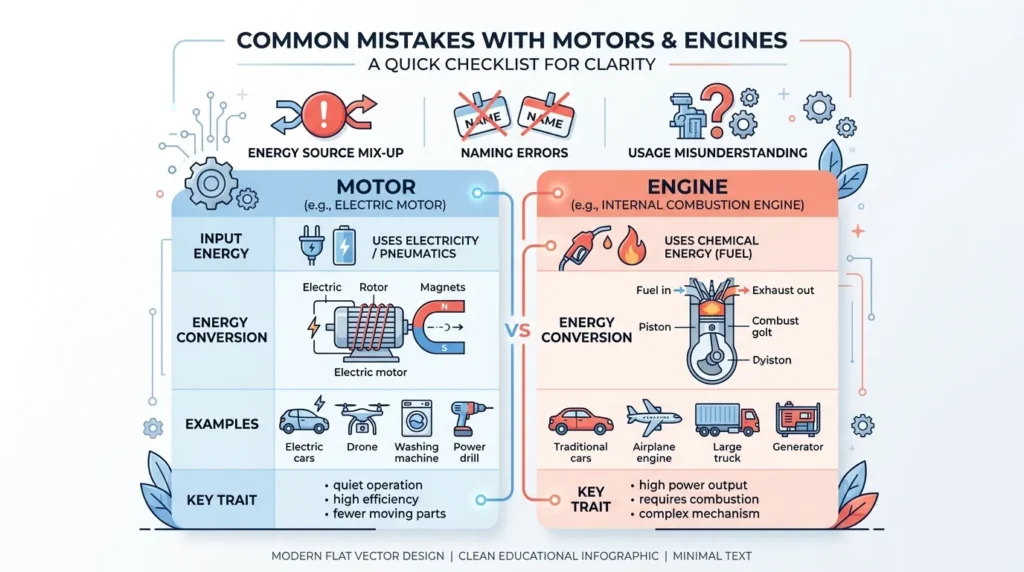
- Thinking both are same
- Calling electric car engine a motor incorrectly
- Confusing fuel generators with motors
- Ignoring energy source differences
- Mixing industrial terms without understanding
🟢 Real-World Uses of Motors and Engines
- Electric scooters use motors
- Petrol bikes use engines
- Washing machines use motors
- Trucks use diesel engines
- Elevators use motors
- Construction machines use engines
🟢 Why Motors and Engines Are Used
- Motors: clean, efficient, modern systems
- Engines: powerful, traditional energy systems
Both solve different engineering problems depending on energy availability.
🟢 How Search Engines Rank This Topic
Google prioritizes:
- Clear comparisons
- Tables and structured content
- Real-world examples
- User intent satisfaction
That’s why articles explaining difference between motor and engine with visuals rank higher.
🟢 FAQs
1. What is the main difference between motor and engine?
Motor uses electricity; engine uses fuel.
2. Is an electric car motor or engine?
Electric cars use motors.
3. Can motor and engine be the same?
No, they work on different energy systems.
4. Which is more powerful motor or engine?
Engines are generally more powerful.
5. Do motors use fuel?
No, motors use electricity.
6. Which is better for environment?
Motors are more eco-friendly.
🟢 Conclusion
Understanding the difference between motor and engine is important for students, engineers, and everyday users. While both produce mechanical motion, their energy sources and working principles are completely different. Motors use electricity and are cleaner, quieter, and more efficient. Engines use fuel and provide higher power output but produce emissions.
In real-world applications, both technologies are essential. Motors are shaping the future of electric mobility, while engines still dominate heavy industries. The difference between motor and engine becomes very clear when you compare their energy source, usage, and efficiency.
If you remember just one thing, it should be this: motor = electricity, engine = fuel. That simple rule removes all confusion instantly.
Read more about!
Difference Between Cognac and Brandy: Complete Guide
Difference Between Octopus and Squid: Simple Guide

I am Emily Johnson, a USA-based content writer who creates easy-to-read blogs on language and daily life topics. I explain complex ideas in simple English for students and beginners so they can understand easily.