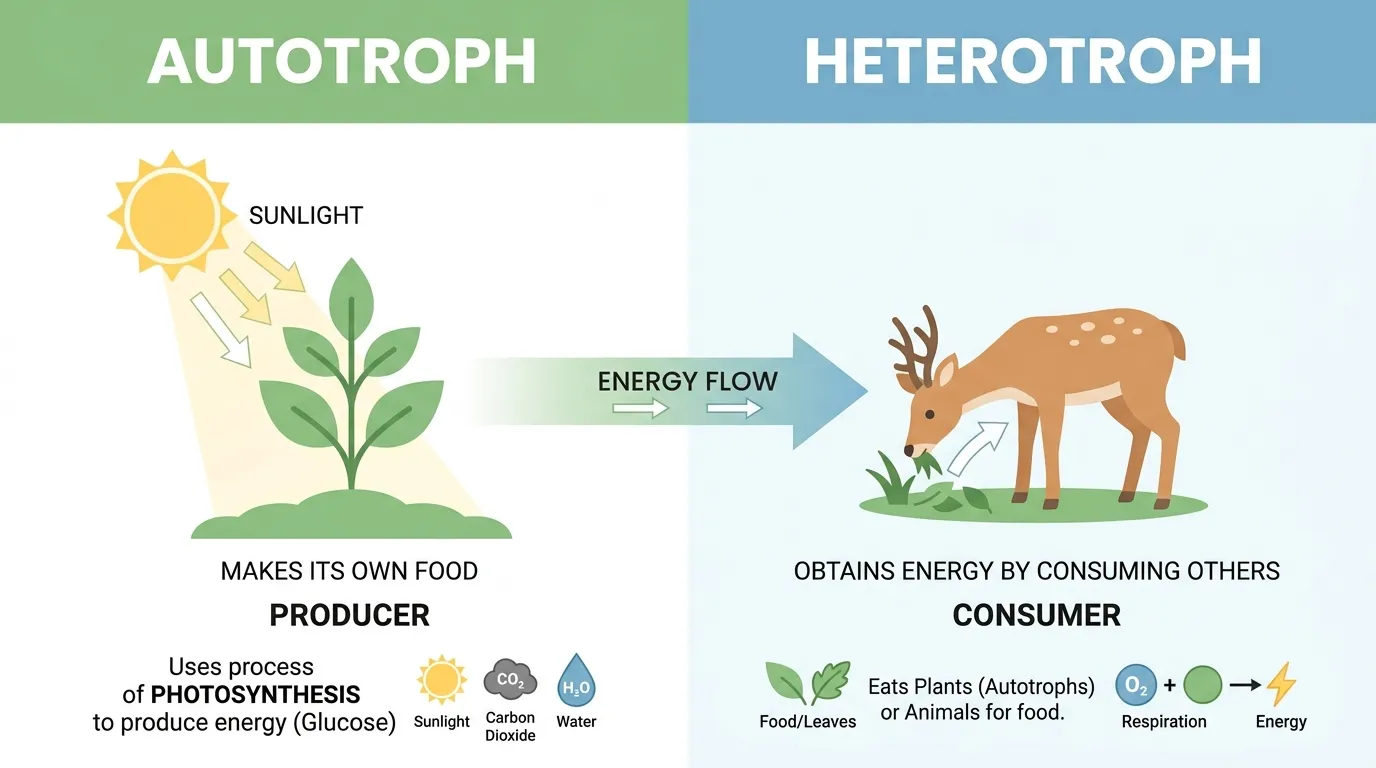
Autotroph 🌱 make their own food using sunlight or chemicals, while Heterotroph 🍖 cannot make food and depend on other organisms for energy.
Many users get confused when learning biology terms like autotroph and heterotroph. The names sound technical, but the concept is actually very simple.
The difference between autotroph and heterotroph is all about how living organisms get their food and energy.
In simple words, autotrophs make their own food, while heterotrophs depend on others for food. This basic difference builds the entire food chain and ecosystem.
That’s why people search for the difference between autotroph and heterotroph to understand how life on Earth works.
In this complete guide, you’ll learn:
- What autotrophs and heterotrophs are
- How they function in real life
- Why this difference matters in ecosystems
- Clear examples and practical understanding
Let’s understand this clearly.
Difference Between Autotroph and Heterotroph
The difference between autotroph and heterotroph is that autotrophs produce their own food using sunlight or chemicals, while heterotrophs depend on other organisms for nutrition.
👉 Example: Plants make food through photosynthesis, while humans eat plants or animals.
Definition of Difference Between Autotroph and Heterotroph
- Autotroph: An organism that makes its own food using sunlight or chemical energy.
- Heterotroph: An organism that cannot make its own food and depends on others for energy.
👉 Example: Green plants are autotrophs; humans and animals are heterotrophs.
Pronunciation
- Autotroph (US/UK): /ˈɔːtəˌtroʊf/
- Heterotroph (US/UK): /ˈhɛtəroʊˌtroʊf/
Now that you know how to say them, let’s dive deeper.
Comparison: Autotroph vs Heterotroph
| Feature | Autotroph | Heterotroph | Explanation |
| Food Source | Makes own food | Depends on others | Core difference |
| Energy Method | Photosynthesis or chemosynthesis | Consumes organic matter | Energy acquisition |
| Examples | Plants, algae | Humans, animals | Real-life clarity |
| Role in Ecosystem | Producers | Consumers | Food chain roles |
| Dependency | Independent | Dependent | Survival strategy |
| Chlorophyll | Present (mostly) | Absent | Needed for photosynthesis |
| Trophic Level | First level | Higher levels | Food chain structure |
| Survival | Self-sustaining | Needs external food | Biological behavior |
Key Differences Explained Between Difference Between Autotroph and Heterotroph
1. Food Production vs Consumption
Autotrophs produce their own food, heterotrophs consume others.
👉 Example: Trees vs humans.
2. Energy Source
Autotrophs use sunlight or chemicals, heterotrophs use organic food.
👉 Example: Plants use sunlight; animals eat plants.
3. Role in Food Chain
Autotrophs are producers, heterotrophs are consumers.
👉 Example: Grass feeds herbivores.
4. Independence Level
Autotrophs are independent, heterotrophs rely on others.
👉 Example: Plants grow without eating others.
5. Biological Structure
Autotrophs often contain chlorophyll; heterotrophs do not.
6. Ecosystem Impact
Autotrophs support life; heterotrophs maintain balance.
What Is the Difference Between Autotroph and Heterotroph in Biology?
In biology, the difference between autotroph and heterotroph explains how energy flows through life systems.
Autotrophs convert:
- Sunlight → chemical energy (photosynthesis)
- Chemicals → energy (chemosynthesis)
Heterotrophs:
- Eat plants or animals
- Break down food into energy
👉 Insight: Without autotrophs, life would not exist because they start the food chain.
Why Does This Difference Exist in Nature?
Nature works in a system of balance.
- Autotrophs create energy
- Heterotrophs use energy
This creates a cycle:
- Plants grow
- Animals eat plants
- Decomposers break down waste
👉 Real insight: This cycle maintains ecosystems and biodiversity.
How Does the Ecosystem Depend on Autotrophs and Heterotrophs?
In real scenarios, ecosystems rely heavily on this relationship.
Autotrophs:
- Produce oxygen
- Create food
Heterotrophs:
- Control population
- Maintain balance
👉 Example: Forest ecosystems depend on plants for survival of animals.
What Are Types of Autotrophs and Heterotrophs?
Types of Autotrophs
- Photoautotrophs (use sunlight)
- Chemoautotrophs (use chemicals)
Types of Heterotrophs
- Herbivores (eat plants)
- Carnivores (eat animals)
- Omnivores (eat both)
👉 Example: Humans are omnivores.
Difference Between Autotroph and Heterotroph in Food Chain
The food chain starts with autotrophs.
Flow:
Autotroph → Herbivore → Carnivore → Decomposer
👉 Example: Grass → Deer → Lion
This shows how energy transfers step by step.
Difference and Similarity Between Autotroph and Heterotroph
| Feature | Autotroph | Heterotroph | Similarity |
| Meaning | Makes own food | Eats others | Both need energy |
| Energy Source | Sunlight/chemicals | Organic food | Energy conversion |
| Role | Producer | Consumer | Part of ecosystem |
| Survival | Independent | Dependent | Both adapt to environment |
| Examples | Plants | Animals | Living organisms |
| Process | Photosynthesis | Digestion | Maintain life |
| Function | Start food chain | Continue food chain | Linked roles |
This table clearly shows the difference and similarity between difference between autotroph and heterotroph for quick understanding.
Common Mistakes with Autotroph and Heterotroph
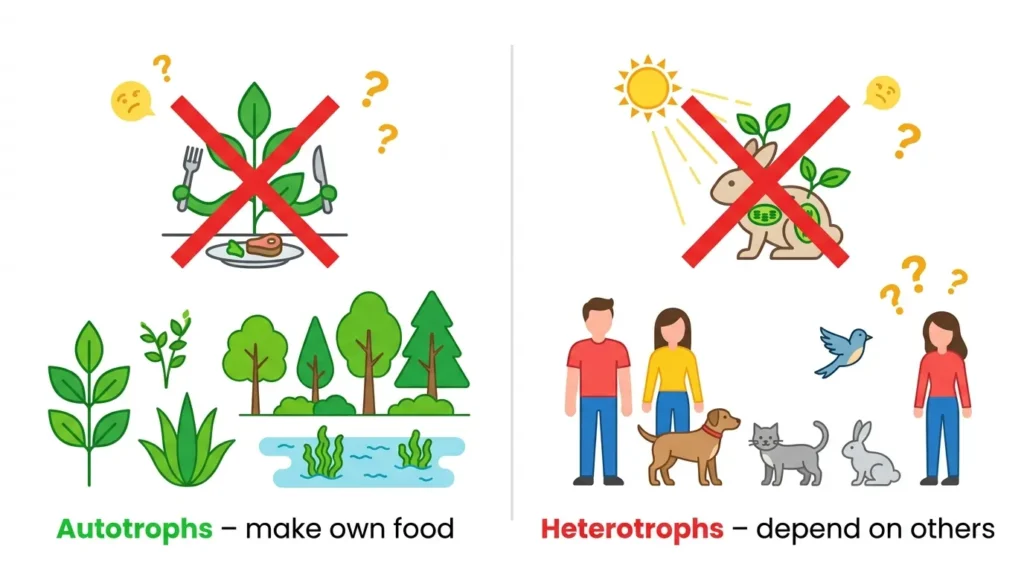
❌ Thinking all plants are autotrophs
✔ Some plants depend on others
❌ Believing heterotrophs are weaker
✔ They play a critical role in ecosystems
❌ Ignoring microorganisms
✔ Many bacteria are autotrophs or heterotrophs
❌ Confusing food chain roles
✔ Producers vs consumers must be clear
Real Life Examples with Difference Between Autotroph and Heterotroph
1. Personal Life
Humans eat food → heterotroph behavior
2. Nature
Trees produce oxygen → autotroph role
3. Agriculture
Farm crops are autotrophs feeding humans
4. Marine Life
Algae produce food → fish consume it
When to Use Each
Use autotroph when:
- Talking about plants or producers
Use heterotroph when:
- Talking about animals or consumers
👉 Tip: If it makes food → autotroph; if it eats → heterotroph.
Why People Get Confused Between Autotroph and Heterotroph
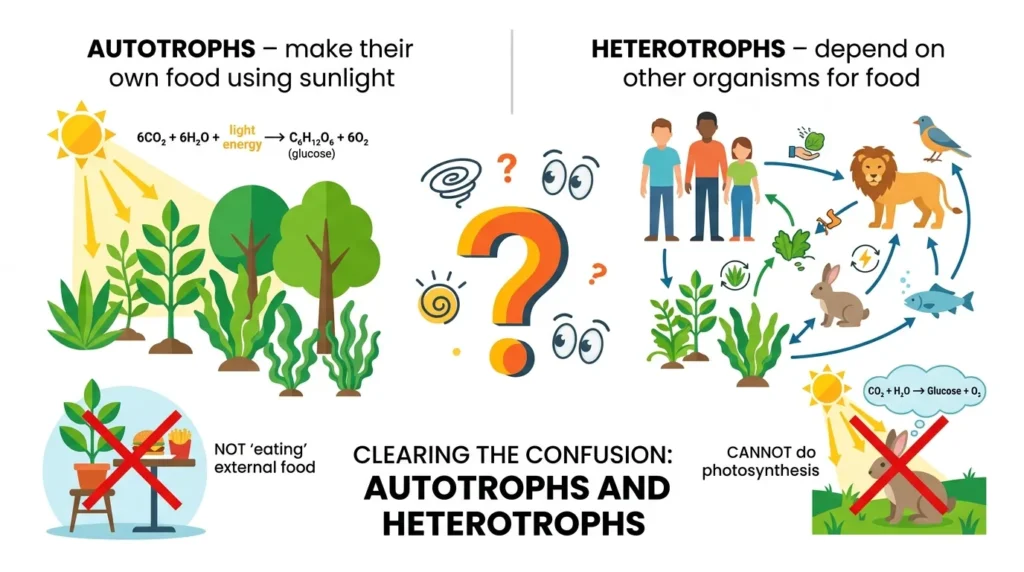
- Scientific terms sound complex
- Lack of clear examples
- Similar suffix “-troph”
- Basic biology misunderstanding
Many beginners struggle because they don’t connect theory with real life.
How Search Engines Understand Difference Between Autotroph and Heterotroph
Search engines like Google analyze queries like:
- “what is autotroph vs heterotroph”
- “examples of autotroph and heterotroph”
Platforms like YouTube and Meta promote educational content explaining food chains and ecosystems.
👉 Insight: Content that simplifies complex biology ranks higher because it matches user intent.
Expert Insight
From an educational perspective, the difference between autotroph and heterotroph is one of the most foundational biology concepts.
In practical teaching:
- Students understand faster with real examples
- Visual learning improves retention
👉 Professional insight: Linking theory with daily life (plants vs humans) makes the concept unforgettable.
FAQs
1. What is the main difference between autotroph and heterotroph?
Autotrophs make their own food; heterotrophs depend on others.
2. Are humans autotrophs or heterotrophs?
Humans are heterotrophs.
3. Why are plants called autotrophs?
Because they produce food using sunlight.
4. Can an organism be both?
Some organisms show mixed behavior, but mostly one type.
5. What is photosynthesis?
A process where plants make food using sunlight.
6. Why are autotrophs important?
They start the food chain and provide energy.
7. What are examples of heterotrophs?
Animals, fungi, and humans.
8. Do autotrophs need sunlight?
Most do, but some use chemicals.
Conclusion
The difference between autotroph and heterotroph is simple yet powerful. Autotrophs are the producers of life, creating energy from sunlight or chemicals, while heterotrophs are the consumers that depend on this energy to survive. Together, they form the backbone of every ecosystem on Earth.
Understanding this concept helps you see how nature works as a connected system. From plants growing in your backyard to animals in the wild, everything follows this basic rule of energy flow. In real scenarios, this difference explains food chains, environmental balance, and even global survival.
So whenever you think about life on Earth, remember this: autotrophs create, heterotrophs consume and both are essential for balance.
Read more about!
Difference Between UPS and USPS: Complete Guide
Difference Between PNG and JPG: Complete Guide

I am James Carter, a professional content writer from the United States. I specialize in writing simple and clear comparison blogs that help students and readers understand difficult topics easily. My writing focuses on everyday language, education, science, and lifestyle topics. I believe that learning should be easy for everyone, so I use simple words and real-life examples in my articles.