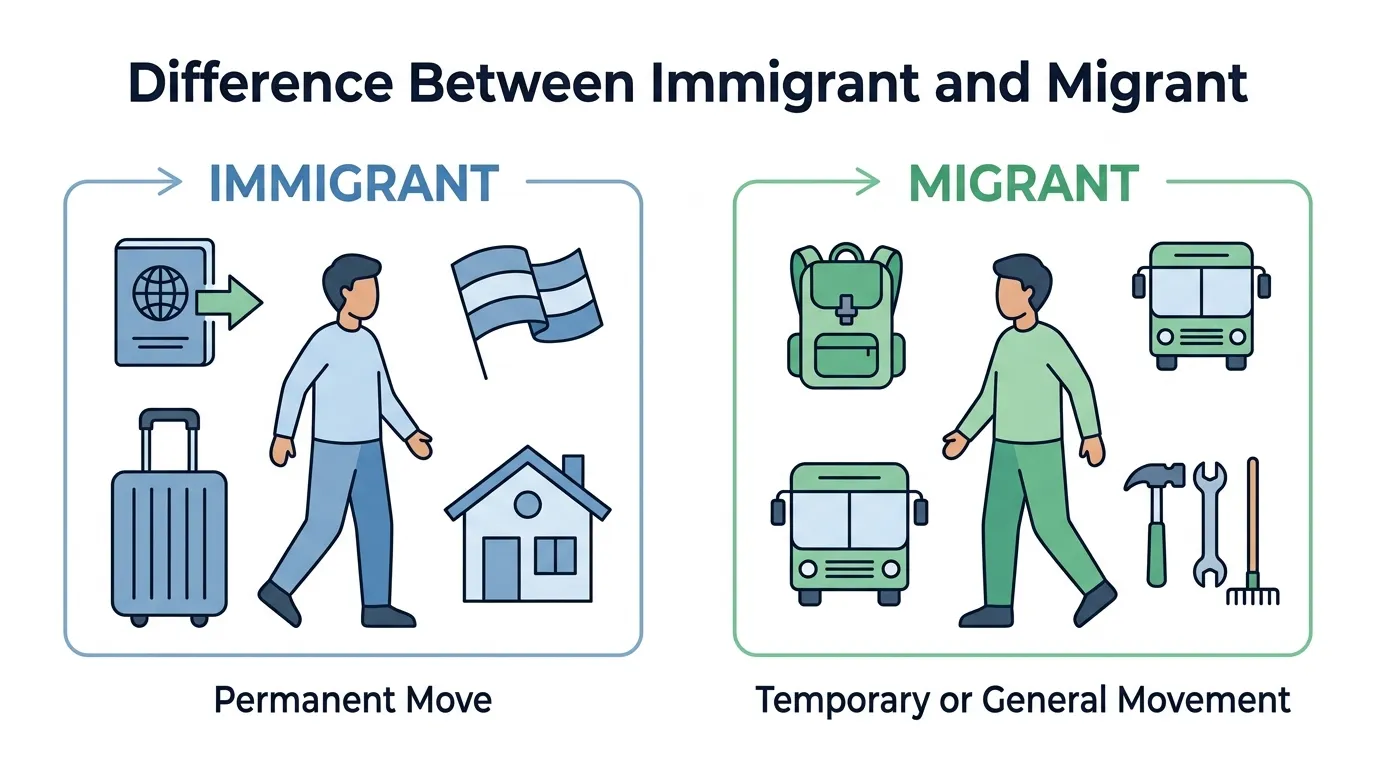
🌍 An immigrant moves to another country permanently, while a migrant moves from one place to another temporarily or permanently for work, safety, or better opportunities.
Many people get confused when they hear the terms “immigrant” and “migrant.” In news reports, social media discussions, and even government policies, these words are often used interchangeably.
However, the difference between immigrant and migrant is important because both terms describe different types of movement and legal situations.
In simple words, an immigrant is someone who moves to another country to live permanently, while a migrant is someone who moves from one place to another, either temporarily or permanently, usually for work, safety, or better opportunities.
Understanding the difference between immigrant and migrant helps people better understand global migration, labor systems, border policies, and social discussions happening worldwide.
Today, platforms like Google, Meta, YouTube, and Instagram frequently show discussions about immigration, migration crises, refugee systems, and labor movement. That is why users search for clear explanations online.
In this guide, you will learn:
- What immigrant and migrant mean
- Key differences and similarities
- Real-world examples
- Common mistakes people make
- How search engines understand this topic
- When to use each term correctly
Difference Between Immigrant and Migrant
An immigrant is a person who moves to another country with the intention of living there permanently. A migrant is a broader term used for someone who moves from one place to another for work, education, safety, or seasonal reasons.
Real Example:
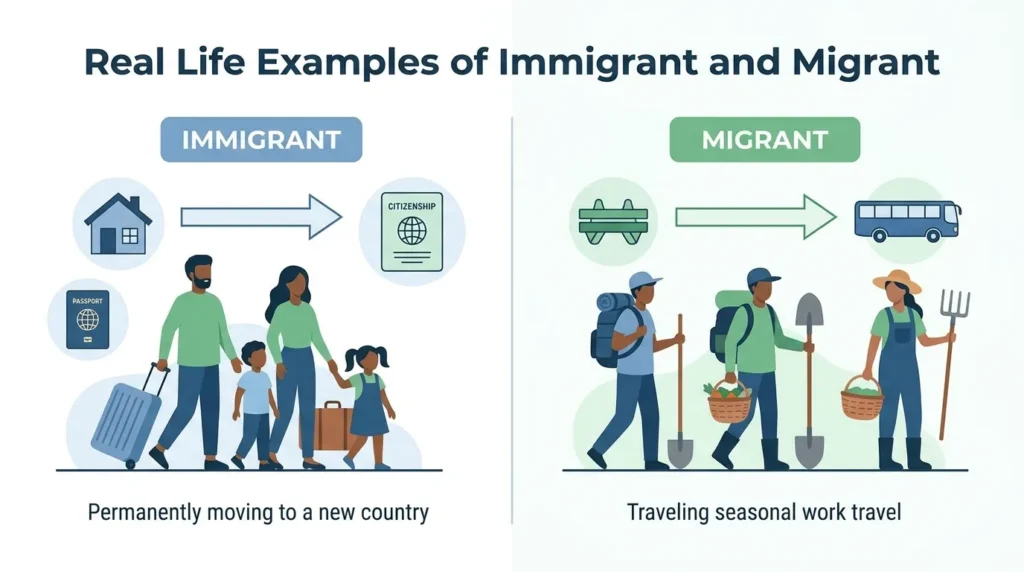
- A person moving from Mexico to Canada permanently is an immigrant.
- A worker traveling between cities or countries for temporary farm work is a migrant.
Definition of Immigrant and Migrant
Immigrant:
A person who moves to another country to live there permanently.
Migrant:
A person who moves from one place to another, temporarily or permanently, for work, education, safety, or better living conditions.
Simple Example:
An engineer moving permanently to Australia is an immigrant, while a seasonal worker traveling for harvest jobs is a migrant.
Pronunciation
| Word | US Pronunciation | UK Pronunciation |
| Immigrant | IM-uh-grunt | IM-uh-grunt |
| Migrant | MY-grunt | MY-grunt |
Although the pronunciations sound similar, the meanings and legal contexts are different. Let’s understand this clearly through detailed comparisons and real-life usage.
Difference Between Immigrant and Migrant
| Feature | Immigrant | Migrant |
| Main Meaning | Moves permanently to another country | Moves from one place to another |
| Duration | Usually long-term or permanent | Temporary or permanent |
| Legal Status | Often connected to citizenship or residency | May not involve citizenship |
| Purpose | Permanent settlement | Work, education, safety, seasonal jobs |
| Border Crossing | Usually international | Can be local or international |
| Government Policies | Immigration laws apply | Labor and migration policies apply |
| Social Identity | Seen as new permanent resident | Seen as mobile worker or mover |
| Common Use | Immigration discussions | Workforce and movement discussions |
| Example | Family moving permanently to the US | Construction worker moving for projects |
Key Differences Explained Between Immigrant and Migrant
1. Purpose of Movement
Immigrants usually move to settle permanently. Migrants may move temporarily for employment or seasonal opportunities.
Example:
A software developer relocating permanently to Germany is an immigrant. A farm worker traveling for harvest season is a migrant.
2. Legal Connection
Immigration often involves visas, permanent residency, and citizenship pathways. Migration may not involve permanent legal status.
Example:
Most countries have immigration departments specifically handling immigrant applications.
3. Time Duration
Migrants can move for short periods, while immigrants generally plan long-term settlement.
Many users searching “difference between immigrant and migrant” mainly want to understand this time factor.
4. Economic Role
Migrants often fill labor shortages in industries like agriculture, construction, and transportation.
Immigrants may build permanent careers, businesses, and families in the new country.
5. Public Perception
Media platforms and social discussions sometimes mix these terms, creating confusion.
For example, viral discussions on YouTube and Instagram often label all movers as immigrants even when many are temporary migrants.
6. Geographic Movement
Migration can happen inside the same country. Immigration usually refers to entering another country.
Example:
A worker moving from rural Punjab to Lahore is a migrant but not an immigrant.
7. Government Systems
Countries create immigration laws for permanent settlers and migration policies for labor movement and temporary workers.
Why Does Migration Exist?
Migration has existed throughout human history. People move because of:
- Better jobs
- Economic opportunities
- Climate changes
- Wars and conflicts
- Education
- Family reunification
- Safety and survival
In modern economies, migration supports industries that depend on flexible labor systems.
For example:
- Construction industries rely heavily on migrant workers.
- Tech industries attract skilled immigrants globally.
What Is an Immigrant in Modern Society?
An immigrant usually becomes part of a country’s long-term population system.
Immigrants often:
- Apply for residency
- Pay taxes
- Build businesses
- Raise families
- Join social systems
Countries like Canada, Australia, and the United States actively use immigration systems to attract skilled workers.
What Is a Migrant Worker?
A migrant worker moves mainly for employment.
Common industries include:
- Agriculture
- Delivery services
- Manufacturing
- Hospitality
- Construction
In practical use, migrant workers may travel repeatedly between regions depending on job availability.
Difference and Similarity Between Immigrant and Migrant
| Feature | Immigrant | Migrant | Similarity |
| Meaning | Permanent mover | General mover | Both involve relocation |
| Purpose | Settlement | Work or movement | Both seek better opportunities |
| Duration | Long-term | Temporary or long-term | Both may stay for extended periods |
| Legal Process | Immigration laws | Migration policies | Both may require documents |
| Work Impact | Long-term careers | Temporary labor | Both affect economies |
| Geography | Mostly international | Local or international | Both involve movement |
| Social Impact | Cultural integration | Workforce mobility | Both influence societies |
| Media Usage | Political discussions | Labor discussions | Both appear in global news |
This table clearly shows the difference and similarity between immigrant and migrant for quick understanding.
Common Mistakes with Immigrant and Migrant
1. Using Both Words as Synonyms
Many beginners assume immigrant and migrant mean exactly the same thing.
Correction:
Immigrant is more specific and usually permanent.
2. Thinking Migration Only Means International Movement
Migration can happen within the same country.
Example:
A student moving from one city to another is also a migrant.
3. Assuming All Migrants Want Citizenship
Many migrants only move temporarily for work or education.
4. Confusing Refugees with Immigrants
Refugees flee danger or conflict, while immigrants usually choose to relocate voluntarily.
5. Ignoring Legal Context
Government systems treat immigration and migration differently.
This legal difference matters in policy discussions and visa systems.
Real Life Examples with Immigrant and Migrant
Example 1: Tech Industry
An Indian software engineer permanently relocating to Canada becomes an immigrant.
Example 2: Seasonal Farming
Workers traveling during harvest season are migrant workers.
Example 3: Internal Migration
A family moving from a small town to Karachi for better jobs is experiencing migration.
Example 4: Education
A student studying abroad temporarily may be considered a migrant student but not necessarily an immigrant.
Example 5: Healthcare Industry
Many hospitals worldwide rely on immigrant doctors and migrant healthcare workers.
When to Use Each Term
Use “Immigrant” When:
- Permanent settlement is involved
- Citizenship or residency matters
- Discussing immigration policies
- Talking about long-term relocation
Use “Migrant” When:
- Movement may be temporary
- Discussing labor systems
- Talking about internal relocation
- Referring to seasonal workers
Why People Get Confused Between Immigrant and Migrant
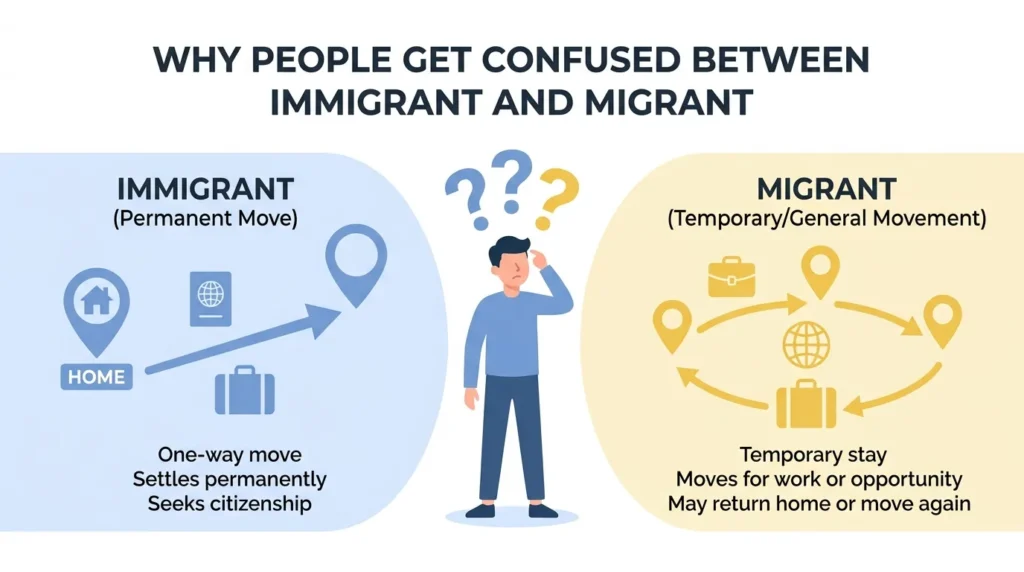
1. Media Usage
News channels often use both terms loosely.
2. Political Discussions
Political debates sometimes intentionally blur the meanings.
3. Social Media Simplification
Platforms like Instagram and Meta favor short content, which reduces explanation depth.
4. Language Differences
Some languages use one word for both concepts.
5. Globalization
Modern movement patterns are more complex than before.
People now move for hybrid reasons:
- Remote work
- Temporary contracts
- Education
- International freelancing
How Search Engines Understand Immigrant vs Migrant
Search engines like Google analyze user intent carefully when someone searches “difference between immigrant and migrant.”
Google understands that users usually want:
- Simple definitions
- Legal differences
- Real-world examples
- Easy comparison tables
- Beginner-friendly explanations
Modern systems also analyze:
- Content clarity
- Semantic relevance
- User engagement
- Topical authority
- Helpful explanations
That is why articles ranking in 2026 focus more on user satisfaction than keyword repetition.
Platforms like YouTube also recommend videos explaining migration topics because educational content has high engagement.
Expert Insight
In real-world policy discussions, the distinction between immigrant and migrant is extremely important. Governments use immigration systems for long-term population planning, while migration policies often focus on labor shortages and workforce movement.
Most beginners misunderstand these terms because everyday conversations simplify them too much. However, legal experts, journalists, economists, and global organizations use these definitions carefully because they influence laws, public opinion, and economic planning.
In practical use, understanding the difference helps people communicate more accurately and avoid misinformation.
FAQ
What is the simple difference between immigrant and migrant?
An immigrant moves permanently to another country, while a migrant may move temporarily or permanently.
Can a migrant become an immigrant?
Yes. A temporary migrant can later settle permanently and become an immigrant.
Is every immigrant a migrant?
Yes. Every immigrant is technically a migrant because they moved locations.
Are refugees immigrants?
Not exactly. Refugees flee danger or persecution, while immigrants usually relocate voluntarily.
Why do countries need migrants?
Many industries depend on migrant workers for labor shortages and seasonal work.
Why is the term immigrant politically sensitive?
Immigration affects citizenship, borders, jobs, and national policies, making it a major political topic.
Can migration happen inside one country?
Yes. Internal migration happens when people move between cities or regions.
Why does Google show both terms together?
Because many users search for comparisons, and search engines recognize confusion between the terms.
Conclusion
Understanding the difference between immigrant and migrant is important in today’s global world. Although both terms involve movement, their meanings, legal systems, and social contexts are different. An immigrant usually moves permanently to another country, while a migrant may move temporarily or permanently for work, education, safety, or opportunity.
Many people get confused because media discussions, political debates, and social platforms often use these words interchangeably. However, learning the correct meaning improves communication and helps people better understand global migration systems.
In real scenarios, governments, businesses, labor industries, and international organizations carefully separate immigration from migration because each affects policies, economies, and societies differently.
If you remember one simple idea, remember this:
- Immigrant = permanent settlement
- Migrant = movement from one place to another
That single distinction makes the entire topic much easier to understand.
Read more about!
Difference Between Quartz and Granite: Complete Guide
Difference Between Parfum and Toilette: Complete Guide

I am James Carter, a professional content writer from the United States. I specialize in writing simple and clear comparison blogs that help students and readers understand difficult topics easily. My writing focuses on everyday language, education, science, and lifestyle topics. I believe that learning should be easy for everyone, so I use simple words and real-life examples in my articles.