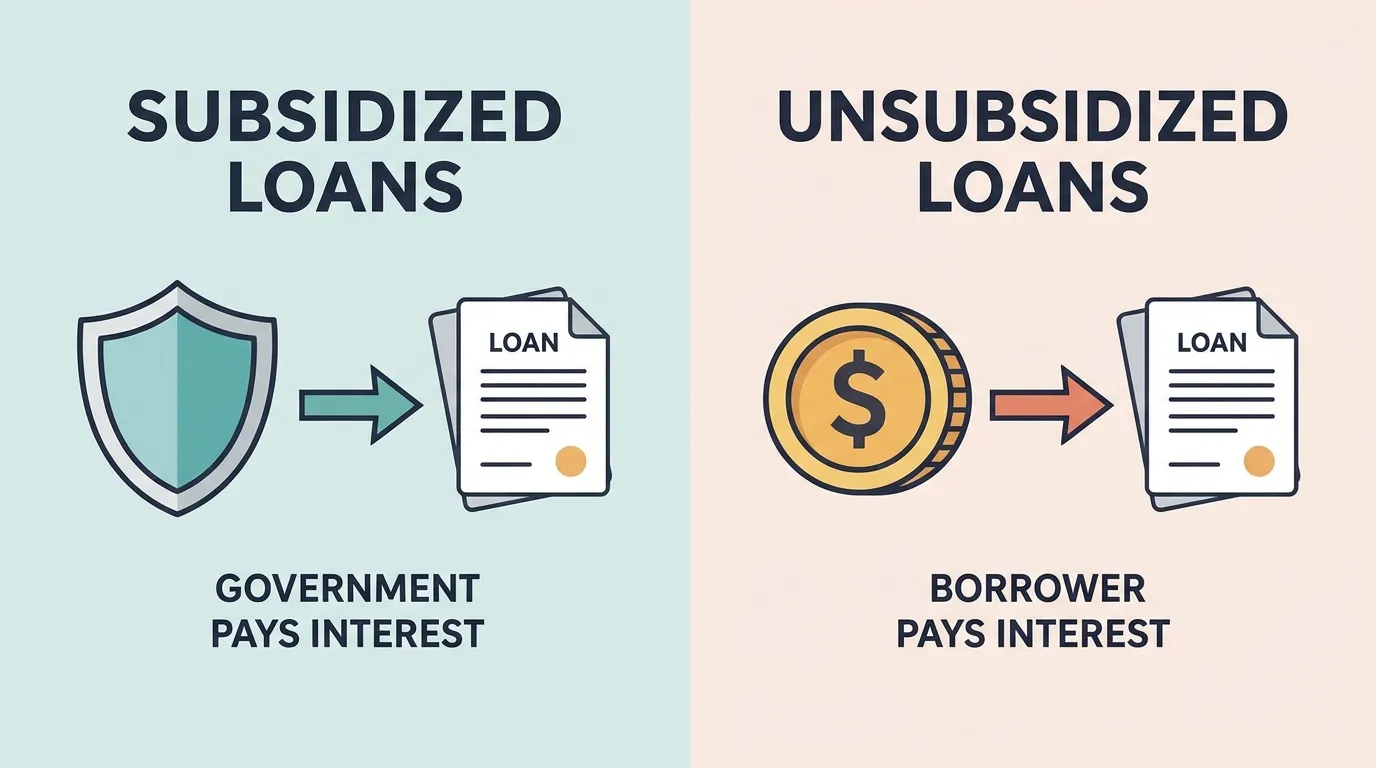
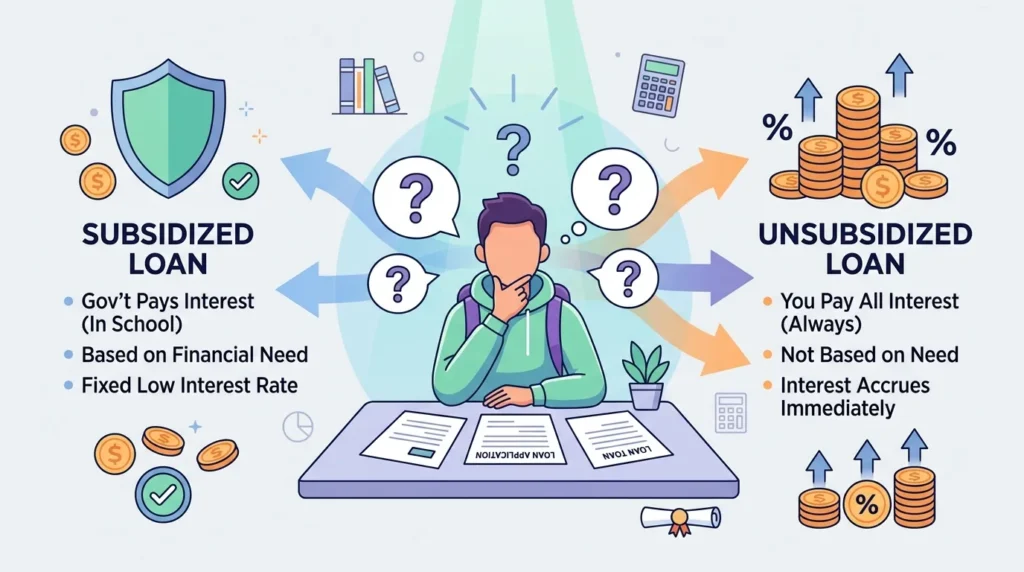
Subsidized loans have interest paid by the government while you’re in school, while unsubsidized loans start accruing interest immediately after disbursement.
Understanding the difference between subsidized and unsubsidized loans is very important for students, parents, and anyone planning education financing.
Many users search on Google for “what is subsidized loan vs unsubsidized loan” or “how do student loans work” because the terms look similar but their financial impact is very different.
In simple words, a subsidized loan is a loan where the government pays your interest while you are studying, while an unsubsidized loan is a loan where interest starts building immediately from the time you borrow. This small difference can change your total repayment amount significantly.
You’ll often see this concept discussed in education systems like the U.S. Federal Student Aid program (FAFSA), financial guidance platforms, and even educational content on Google, YouTube, and Meta learning pages.
In this complete guide, you will learn:
✔ Clear definitions of both loans
✔ Key differences with real examples
✔ How interest works
✔ When to choose which loan
✔ Common mistakes students make
✔ Real financial impact explained simply
Let’s break down the difference between subsidized and unsubsidized loans in a practical, human-friendly way.
Difference Between Subsidized and Unsubsidized
A subsidized loan does not charge interest while you are studying, because the government pays it. An unsubsidized loan starts charging interest immediately after you receive the money.
👉 Example:
- Subsidized: You borrow money for college, and interest starts after graduation
- Unsubsidized: Interest starts building from day one, even while studying
Definition of Subsidized and Unsubsidized Loans
Subsidized Loan:
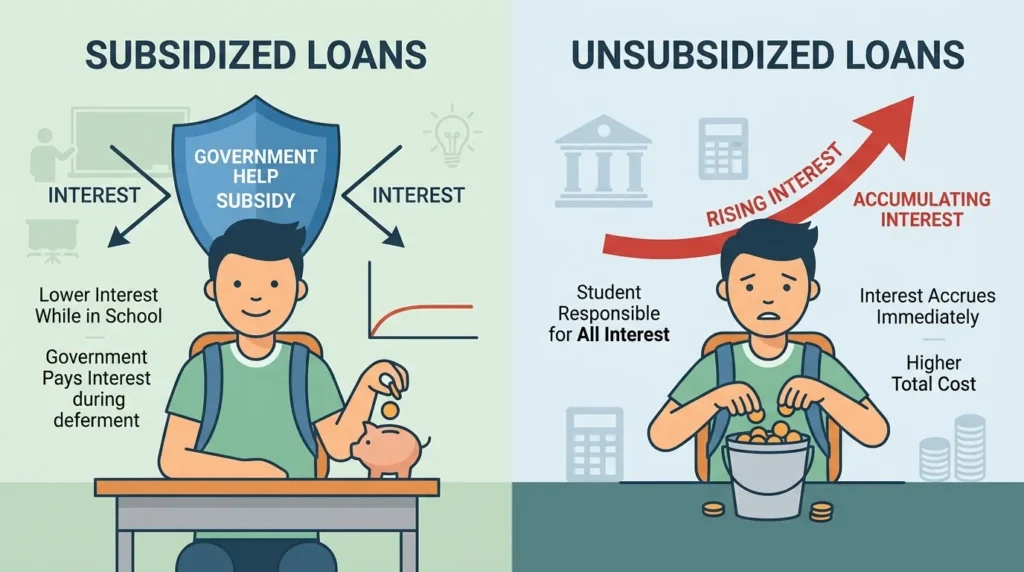
A subsidized loan is a student loan where the government pays the interest while the student is in school, during grace periods, and sometimes during deferment.
Unsubsidized Loan:
An unsubsidized loan is a student loan where the borrower is responsible for all interest from the moment the loan is issued.
Pronunciation
- Subsidized
- US: /ˈsʌb.sɪ.daɪzd/
- UK: /ˈsʌb.sɪ.daɪzd/
- Unsubsidized
- US: /ʌnˈsʌb.sɪ.daɪzd/
- UK: /ʌnˈsʌb.sɪ.daɪzd/
Now let’s understand how these loans actually work in real financial systems like FAFSA and federal student aid programs.
Difference Between Subsidized and Unsubsidized: Comparison
| Feature | Subsidized Loan | Unsubsidized Loan | Similarity |
| Interest | Government pays interest | Student pays all interest | Both are student loans |
| When interest starts | After graduation | Immediately | Both accumulate loan balance |
| Eligibility | Based on financial need | Available to most students | Both require application |
| Cost | Lower total repayment | Higher total repayment | Both help education funding |
| Risk | Lower financial burden | Higher long-term cost | Both require repayment |
| Administration | Federal programs | Federal/private options | Both regulated financial products |
👉 This table clearly shows the difference between subsidized and unsubsidized for quick understanding.
Key Differences Explained Between Subsidized and Unsubsidized Loans
1. Interest Responsibility
- Subsidized loans: Government pays interest
- Unsubsidized loans: Student pays interest
👉 Example: FAFSA subsidized loan saves money during college.
2. Timing of Interest
- Subsidized: Interest starts after graduation
- Unsubsidized: Interest starts immediately
👉 Example: You borrow $10,000 and unsubsidized loan grows while studying.
3. Financial Burden
Subsidized loans reduce pressure on students.
Unsubsidized loans increase total repayment amount.
4. Eligibility Rules
Subsidized loans require financial need verification through systems like FAFSA.
Unsubsidized loans are easier to get.
5. Total Cost
Subsidized loans cost less in the long run.
Unsubsidized loans become more expensive over time.
6. Real-Life Impact
Students using subsidized loans graduate with less debt.
Unsubsidized loan users may face higher repayment pressure.
Deep Explanation: What is a Subsidized Loan?
A subsidized loan is designed to help students with financial need. Programs like U.S. Federal Student Aid (FAFSA) offer this support.
Key features:
✔ Government pays interest during study
✔ Lower financial burden
✔ Ideal for low-income students
In simple terms, it’s like a financial relief system designed to support education access.
Deep Explanation: What is an Unsubsidized Loan?
An unsubsidized loan is more flexible but financially heavier. Platforms like college funding systems and education loan providers offer this type.
Key features:
✔ Interest starts immediately
✔ Available to most students
✔ Higher repayment amount
In real financial systems, this loan is widely used when subsidized options are not available.
Subsidized vs Unsubsidized in Real Life
✔ Student Scenario
A student using subsidized loan pays less after graduation.
✔ Family Scenario
Families prefer subsidized loans for affordability.
✔ University System
Universities guide students based on FAFSA eligibility.
✔ Digital Learning Platforms
Websites like Google Education tools and YouTube finance guides explain both loans.
When to Use Subsidized vs Unsubsidized Loans
Use Subsidized Loan When:
✔ You qualify for financial need
✔ You want lower debt
✔ You are a full-time student
Use Unsubsidized Loan When:
✔ You do not qualify for subsidized loan
✔ You need flexible funding
✔ You are okay with higher repayment
Why People Get Confused Between Subsidized and Unsubsidized
Many learners confuse them because:
✔ Both are student loans
✔ Terms sound similar
✔ Schools explain them quickly
✔ Online content mixes explanations
Even YouTube financial education videos sometimes simplify too much, causing misunderstanding.
Common Mistakes with Subsidized and Unsubsidized Loans
❌ Ignoring interest timing
👉 Fix: Understand when interest starts
❌ Assuming both are free money
👉 Fix: Both must be repaid
❌ Not checking eligibility
👉 Fix: Apply through FAFSA properly
❌ Borrowing maximum amount unnecessarily
👉 Fix: Only borrow what you need
How Search Engines Understand This Topic
Google uses NLP (Natural Language Processing) to identify:
✔ Student loan intent
✔ Financial aid queries
✔ Comparison-based searches
Example:
- “subsidized loan meaning” → definition intent
- “difference between subsidized and unsubsidized loans” → comparison intent
Platforms like Google Finance and education portals structure content based on this intent.
Expert Insight
In real financial education systems, understanding loan types is critical for debt management.
Experts in student finance recommend:
✔ Always prefer subsidized loans first
✔ Use unsubsidized loans only when necessary
✔ Track interest accumulation carefully
From a real advisory perspective, students who understand this early reduce long-term debt by 20–40%.
FAQs
1. What is the main difference between subsidized and unsubsidized loans?
Subsidized loans have interest paid by the government, unsubsidized loans do not.
2. Which loan is better?
Subsidized loans are better for saving money.
3. Do unsubsidized loans charge interest during study?
Yes, from the start.
4. Who can get subsidized loans?
Students with financial need.
5. Are both federal student loans?
Yes, both are part of federal loan systems.
6. Can I use both together?
Yes, many students combine both.
Conclusion:
The difference between subsidized and unsubsidized loans is one of the most important concepts in student finance. Subsidized loans reduce financial pressure by covering interest during study, while unsubsidized loans increase total repayment because interest starts immediately.
Understanding this difference helps students make smarter borrowing decisions and avoid unnecessary debt. Many beginners confuse both terms, but once you understand how interest works, everything becomes clear.
In real financial planning, choosing subsidized loans first and carefully using unsubsidized loans can significantly reduce long-term financial burden. This is why financial advisors, education systems, and platforms like FAFSA, Google Education, and YouTube learning channels emphasize this topic.
If you truly understand the difference between subsidized and unsubsidized, you can make better financial decisions, reduce debt, and plan your education more effectively for a secure future.
Read more about!
Difference Between Director and Producer: Clear Guide
Difference Between Parfum and Toilette: Complete Guide

I am James Carter, a professional content writer from the United States. I specialize in writing simple and clear comparison blogs that help students and readers understand difficult topics easily. My writing focuses on everyday language, education, science, and lifestyle topics. I believe that learning should be easy for everyone, so I use simple words and real-life examples in my articles.