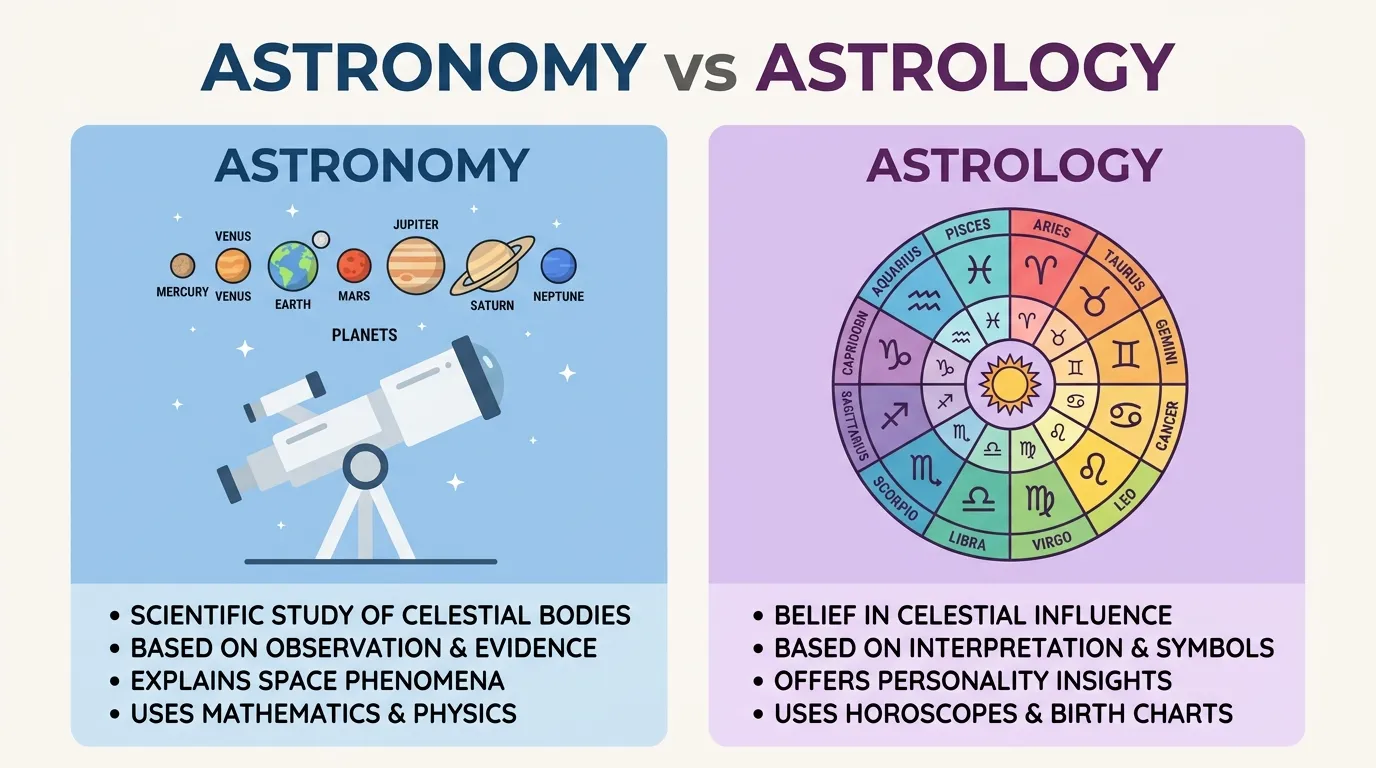
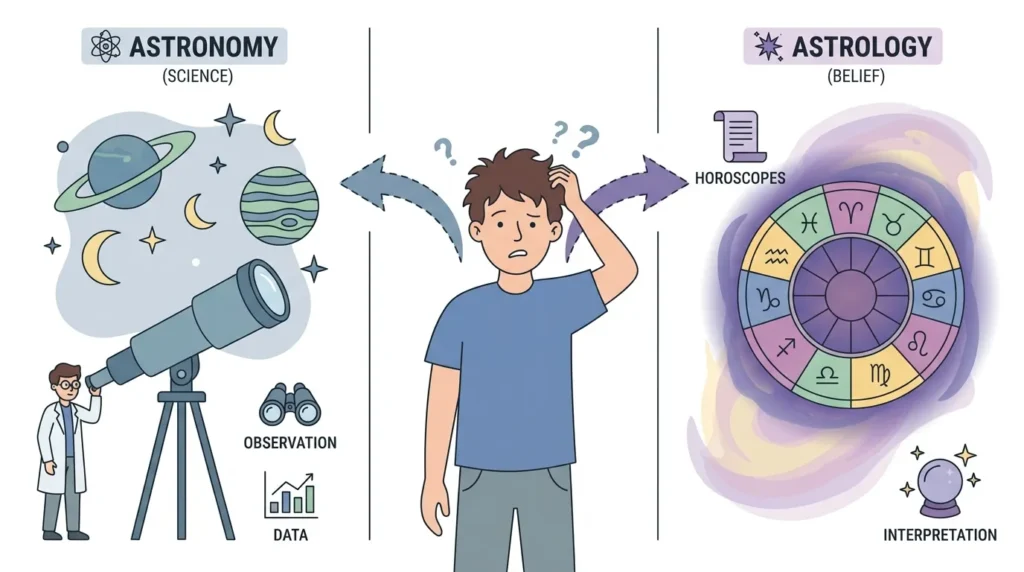
Astronomy is the scientific study of space, stars, and planets 🔭, while astrology is a belief system that links celestial positions to human life and personality ✨.
Many users get confused about the difference between astronomy and astrology because both deal with stars, planets, and the universe.
At first glance, they look similar but they are completely different in purpose and approach. The difference between astronomy and astrology is actually about science vs belief.
In simple words, astronomy is a scientific study of space, while astrology is a belief system that connects celestial movements with human life. That’s why people often search “what is astronomy vs astrology” or “how are astronomy and astrology different.”
In this complete guide, you’ll fully understand the difference between astronomy and astrology, how each works, and why mixing them up can lead to confusion. Let’s break it down clearly.
Difference Between Astronomy and Astrology
The difference between astronomy and astrology is simple:
- Astronomy is a science that studies stars, planets, and space.
- Astrology is a belief system that claims celestial bodies influence human life.
👉 Example:
Astronomers study galaxies using telescopes, while astrologers create horoscopes based on star positions.
Definition of Difference Between Astronomy and Astrology
- Astronomy: A scientific field that studies celestial objects like stars, planets, and galaxies using observation and research.
- Astrology: A belief system that interprets positions of celestial bodies to predict human behavior and future events.
Pronunciation
- Astronomy → /əˈstrɒnəmi/ (UK), /əˈstrɑːnəmi/ (US)
- Astrology → /əˈstrɒlədʒi/ (UK), /əˈstrɑːlədʒi/ (US)
👉 The words sound similar, which adds to confusion but their meanings are very different. Let’s go deeper.
Astronomy vs Astrology: Comparison
| Feature | Astronomy | Astrology |
| Nature | Science | Belief system |
| Purpose | Study universe | Predict human life |
| Method | Observation, data, research | Interpretation, symbols |
| Accuracy | Evidence-based | Not scientifically proven |
| Tools | Telescopes, satellites | Birth charts, zodiac signs |
| Example | Studying black holes | Reading horoscopes |
| Field | Physics and space science | Spiritual/traditional belief |
| Acceptance | Scientific community | Cultural and personal belief |
Key Differences Explained Between Astronomy and Astrology
1. Science vs Belief
Astronomy is science, while astrology is belief.
👉 Example: Astronomers rely on data; astrologers rely on interpretations.
2. Purpose
Astronomy aims to understand the universe. Astrology aims to predict life events.
3. Methods Used
Astronomy uses scientific tools. Astrology uses zodiac charts.
4. Real-World Application
Astronomy helps build satellites and space missions.
Astrology is used for personal guidance or entertainment.
5. Accuracy and Evidence
Astronomy is proven and tested. Astrology is not scientifically verified.
6. User Intent Insight
Most users search this topic to separate fact from belief.
What Is Astronomy?
Astronomy is a branch of Physics that studies space and everything in it.
What It Covers
- Stars
- Planets
- Galaxies
- Black holes
Real-World Use
Organizations like NASA use astronomy to explore space and develop technology.
👉 In real scenarios, astronomy helps us understand the universe and even improves GPS and communication systems.
What Is Astrology?
Astrology connects human life with celestial positions.
What It Includes
- Zodiac signs
- Horoscopes
- Birth charts
Real-World Use
People check horoscopes on platforms like Google or Instagram for guidance or entertainment.
👉 In practical use, astrology is more about personal belief than science.
Why Does the Difference Between Astronomy and Astrology Exist?
Historically, astronomy and astrology were once connected. Over time:
- Astronomy became a science based on evidence
- Astrology remained a belief system
👉 This separation happened because science requires proof, while belief does not.
Difference and Similarity: Astronomy vs Astrology
| Feature | Astronomy | Astrology | Similarity |
| Focus | Universe study | Human life prediction | Both involve celestial bodies |
| Method | Scientific research | Symbolic interpretation | Use stars and planets |
| Accuracy | Proven | Not proven | Both study sky objects |
| Purpose | Knowledge | Guidance | Interest in cosmos |
| Tools | Telescopes | Charts | Use celestial data |
| Field | Science | Belief | Ancient origins |
This table clearly shows the difference and similarity between astronomy and astrology for quick understanding.
Common Mistakes with Astronomy and Astrology
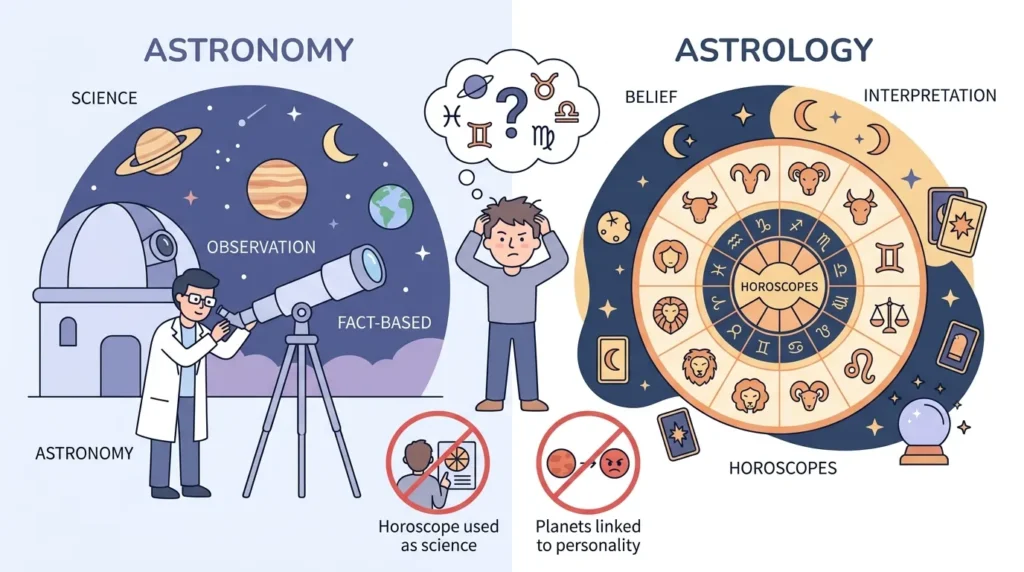
1. Thinking both are science
Only astronomy is scientific.
2. Using terms interchangeably
They have completely different meanings.
3. Believing astrology is proven
It lacks scientific evidence.
4. Ignoring historical context
They were once linked but are now separate.
Real-Life Examples with Astronomy and Astrology
1. Personal Use
Checking horoscope = astrology
Watching stars with telescope = astronomy
2. Education
Students study astronomy in science classes.
3. Industry Use
Space agencies rely on astronomy.
4. Social Media
Astrology content trends on YouTube and Meta platforms.
When to Use Each
Use astronomy when:
- Talking about science
- Studying space
- Discussing planets and galaxies
Use astrology when:
- Talking about horoscopes
- Discussing zodiac signs
- Referring to beliefs
👉 Simple rule:
Science = Astronomy
Belief = Astrology
Why People Get Confused in Astronomy vs Astrology
1. Similar Names
Both start with “astro.”
2. Shared History
They were once connected.
3. Media Influence
Horoscopes are widely popular.
4. Lack of Scientific Awareness
Many people don’t distinguish science from belief.
How Search Engines Understand Astronomy vs Astrology
Search engines like Google analyze:
- Search intent (science vs horoscope)
- User behavior
- Content relevance
For example:
- “What is astronomy?” → scientific results
- “Daily horoscope” → astrology content
👉 This helps deliver accurate results based on user intent.
Expert Insight
From a science and content perspective, understanding the difference between astronomy and astrology is essential.
In real scenarios:
- Astronomy drives innovation and technology
- Astrology influences culture and personal beliefs
As someone experienced in educational content, I’ve seen how confusing these terms can mislead learners. Clear understanding builds both knowledge and credibility.
FAQs
1. What is the main difference between astronomy and astrology?
Astronomy is science; astrology is a belief system.
2. Is astrology scientifically proven?
No, it lacks scientific evidence.
3. Can astronomy predict the future?
No, it studies space, not human life.
4. Why do people believe in astrology?
For guidance, culture, or entertainment.
5. Is NASA related to astrology?
No, it works in astronomy.
6. Are zodiac signs part of astronomy?
No, they belong to astrology.
7. Which is more reliable?
Astronomy is scientifically reliable.
8. Why are names so similar?
They share historical roots.
Conclusion
The difference between astronomy and astrology is clear once you understand the core idea. Astronomy is a scientific study of the universe, while astrology is a belief system that connects celestial movements with human life.
Although both involve stars and planets, their purpose, methods, and reliability are completely different. Astronomy is based on evidence and research, while astrology depends on interpretation and belief.
To remember easily:
👉 Astronomy = Science
👉 Astrology = Belief
Now you have a complete understanding. If you’re studying, writing, or just curious, you won’t confuse these terms again.
Read more about!
Difference Between Retinol and Retinoid: Simple Guide
Difference Between Bourbon and Scotch: Complete Guide

I am James Carter, a professional content writer from the United States. I specialize in writing simple and clear comparison blogs that help students and readers understand difficult topics easily. My writing focuses on everyday language, education, science, and lifestyle topics. I believe that learning should be easy for everyone, so I use simple words and real-life examples in my articles.