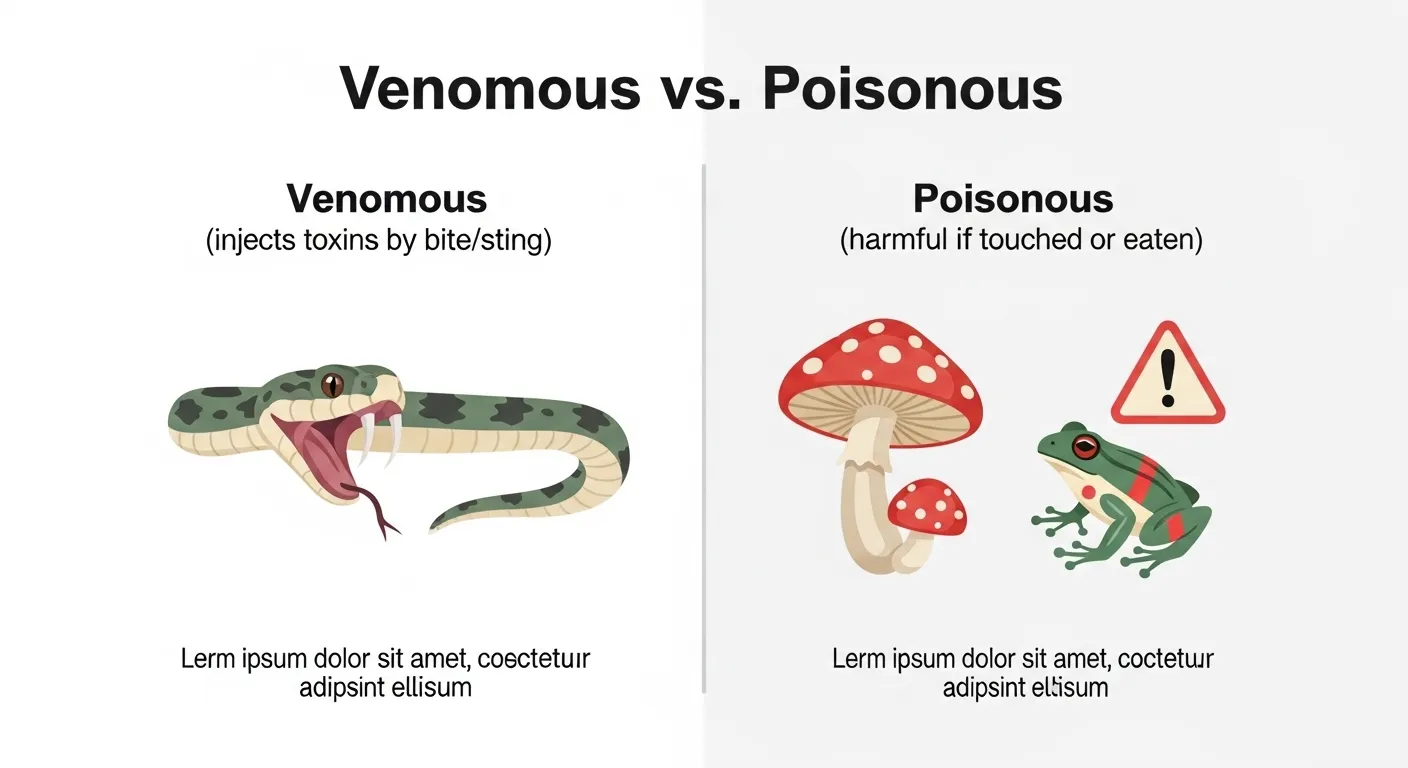
Venomous animals inject toxins by biting or stinging, while poisonous organisms harm you when you touch or eat them ☠️🦂🍄
Many people get confused when they hear terms like venomous animals and poisonous animals, especially when watching nature documentaries on YouTube, National Geographic, or even short videos on Instagram.
The difference between venomous and poisonous is actually very simple, but it is often misunderstood because both involve toxins and danger.
In simple words, the difference between venomous and poisonous depends on how the toxin enters the body. Some animals inject poison, while others are harmful only when eaten or touched.
This small detail completely changes the meaning, and that’s why learners often search: what is venomous, what is poisonous, and how are they different?
Understanding the difference between venomous and poisonous is important not only for students but also for hikers, travelers, wildlife lovers, and even medical professionals. In real life, knowing this difference can help you react correctly during animal encounters.
In this detailed guide, you will learn everything about venomous vs poisonous animals, real examples, scientific explanation, and easy memory tricks so you never get confused again.
Difference Between Venomous and Poisonous
Venomous animals inject toxins into others through bites or stings, while poisonous animals release toxins when touched or eaten.
👉 Example:
- Snake = venomous (injects venom)
- Poison dart frog = poisonous (toxic when touched or eaten)
Definition of Venomous and Poisonous
- Venomous: Animals that deliver toxins through bites, stings, or spines into another organism.
- Poisonous: Organisms that are harmful when touched, eaten, or absorbed.
✔ Venomous = injects toxin
✔ Poisonous = harmful when consumed or contacted
Pronunciation
Understanding pronunciation helps learners remember the difference between venomous and poisonous in real conversations:
- Venomous → /ˈven.ə.məs/ (VEN-uh-muhs)
- Poisonous → /ˈpɔɪ.zə.nəs/ (POY-zuh-nuhs)
These terms are commonly used in Google search results, wildlife documentaries, YouTube biology channels, and Meta educational content.
Comparison: Venomous vs Poisonous
| Feature | Venomous | Poisonous | Similarity |
| Toxin method | Injected via bite/sting | Harmful when eaten/touched | Both contain toxins |
| Interaction type | Active attack | Passive defense | Both dangerous |
| Examples | Snake, scorpion | Frog, plants | Both found in nature |
| Human risk | Bite/sting danger | Touch/eating danger | Both can harm humans |
| Treatment | Antivenom required | Detox/support care | Both need medical attention |
| Purpose | Hunting/defense | Protection | Both survival mechanisms |
| Exposure | Direct injection | External contact | Both involve toxins |
👉 This table clearly shows the difference between venomous and poisonous for quick understanding.
Key Differences Explained Between Venomous and Poisonous
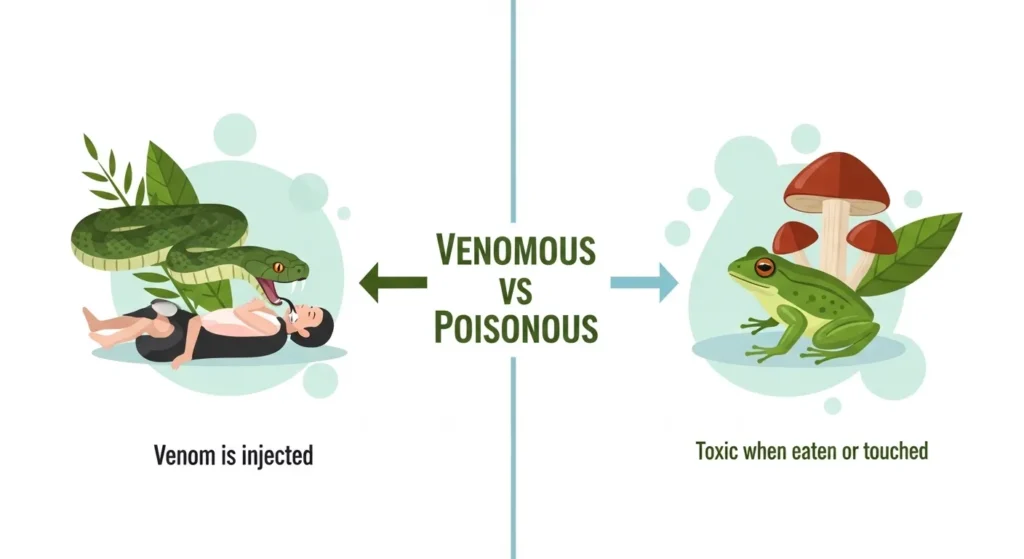
1. Method of Delivery
- Venom is injected into the body
- Poison is absorbed or eaten
✔ Example: snake bite vs touching poison dart frog
2. Active vs Passive Defense
- Venomous animals actively attack
- Poisonous organisms defend passively
✔ Example: spider bite vs toxic mushroom
3. Human Interaction Risk
- Venomous: danger from bite or sting
- Poisonous: danger from ingestion or contact
✔ Example: bee sting vs eating toxic berries
4. Biological Purpose
- Venom helps in hunting prey
- Poison helps in defense
✔ Example: snake uses venom to catch prey
5. Medical Treatment Difference
- Venom requires antivenom
- Poison requires detoxification or supportive care
✔ Example: snakebite treatment vs food poisoning
6. Evolutionary Role
- Venom evolved for attack efficiency
- Poison evolved for protection
✔ Example: scorpions vs toxic frogs
Why Venomous and Poisonous Exist in Nature
Nature uses toxins as survival tools. The difference between venomous and poisonous exists because animals evolved different strategies:
✔ Venom helps predators hunt
✔ Poison helps weak species survive
Platforms like Google Knowledge Graph, National Geographic, YouTube wildlife documentaries, and Meta science pages explain these differences clearly for education and awareness.
When To Be Careful With Venomous Animals
✔ Snakes
✔ Spiders
✔ Scorpions
👉 Risk comes from bite or sting, not touch.
When To Be Careful With Poisonous Animals/Plants
✔ Poison dart frogs
✔ Toxic mushrooms
✔ Certain plants
👉 Risk comes from eating or touching.
Why People Get Confused Between Venomous and Poisonous
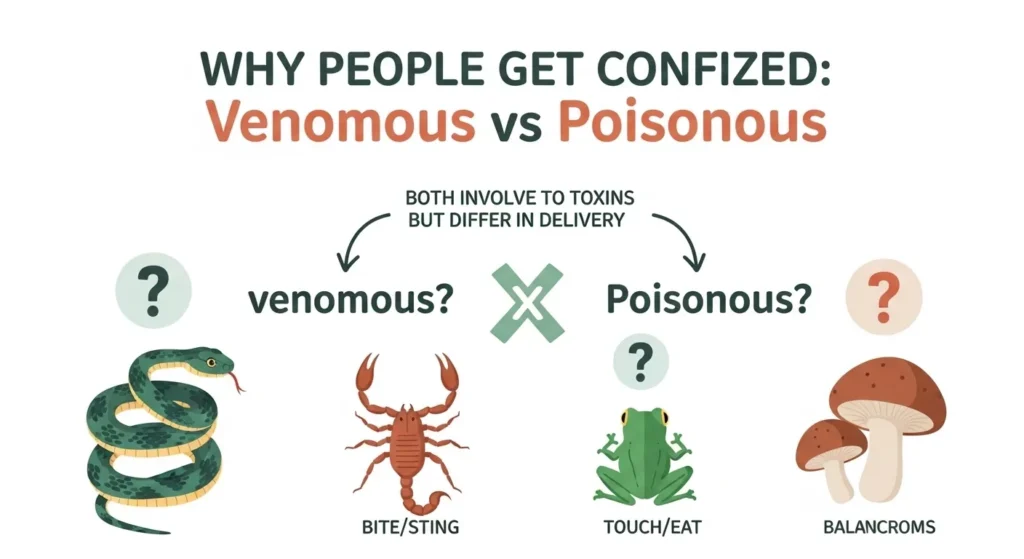
✔ Both involve toxins
✔ Both can cause death
✔ Movies and media misuse terms
✔ Lack of biological understanding
✔ Similar scary appearance
This is why the difference between venomous and poisonous is one of the most searched biology topics.
Real Life Examples
Wildlife Scenario:
- Snake bite = venomous danger
- Frog skin contact = poisonous danger
Survival Situation:
- Hiking in forest (avoid snakes)
- Avoid unknown berries (poison risk)
Education Context:
- Biology students study toxin types
- YouTube science channels explain behavior
Media Example:
- National Geographic shows venomous snakes
- Discovery Channel shows poisonous plants
Common Mistakes with Venomous and Poisonous
- Thinking all dangerous animals are venomous
- Calling snakes poisonous
- Touching unknown frogs or insects
- Eating wild plants without knowledge
- Confusing bite vs ingestion danger
✔ Fix: Always remember “inject vs ingest/touch”
How Search Engines Understand This Topic
Google and AI systems analyze:
✔ Wildlife safety queries
✔ Medical emergency searches
✔ Educational intent
✔ User curiosity about nature
Platforms like YouTube, Instagram reels, and Meta science pages increase visibility of accurate biological explanations.
Expert Insight
From a biological perspective, the difference between venomous and poisonous is a key survival classification in nature. Wildlife experts explain that venom is an active biological weapon, while poison is a passive defense mechanism.
In real-world field studies, researchers use this classification to understand animal behavior, ecosystem roles, and human safety risks. This distinction is essential for medical treatment and wildlife education.
FAQs
1. What is the main difference between venomous and poisonous?
Venomous injects toxins, poisonous harms when eaten or touched.
2. Are snakes poisonous or venomous?
Snakes are venomous.
3. Are frogs poisonous?
Some frogs are poisonous.
4. Can venomous animals be touched safely?
Yes, but biting/stinging is dangerous.
5. Which is more dangerous?
Both can be dangerous depending on exposure.
6. Is poison always deadly?
Not always, depends on type and amount.
7. Can plants be venomous?
No, plants are usually poisonous.
8. What is an example of venomous animal?
Snake and scorpion.
Conclusion
The difference between venomous and poisonous is simple but very important for understanding nature and staying safe. Venomous animals inject toxins through bites or stings, while poisonous organisms are harmful when eaten or touched.
Many people confuse both terms, but once you understand the basic rule inject vs ingest the concept becomes very clear. This knowledge is useful for students, travelers, hikers, and wildlife lovers because it helps identify danger correctly.
In real life, recognizing the difference between venomous and poisonous can prevent accidents and improve awareness of nature. Venom is active and delivered directly, while poison is passive and works through contact or consumption. Understanding this distinction is not just educationalit is a life-saving skill in certain situations.
Read more about!
Difference Between Pneumonia and Bronchitis: Explained Simply
Difference Between Latte and Mocha: Complete Guide

I am James Carter, a professional content writer from the United States. I specialize in writing simple and clear comparison blogs that help students and readers understand difficult topics easily. My writing focuses on everyday language, education, science, and lifestyle topics. I believe that learning should be easy for everyone, so I use simple words and real-life examples in my articles.