A passport is an official ID for international travel, while a visa is permission granted by another country to enter, stay, or work there.
If you’re planning to travel abroad, you’ve probably asked: Do I need a visa or a passport? This is where the difference between visa and passport becomes very important
. Many users search on Google for “what is passport vs visa”, “how travel documents work”, or “why do I need both visa and passport” because the terms are often used together but serve completely different purposes.
In simple words, a passport is your identity document issued by your country, while a visa is permission given by another country to enter, stay, or travel there. Understanding the difference between visa and passport helps avoid travel problems, delays, and even entry denial.
You’ll often see this topic explained across platforms like Google, YouTube, and Meta, where travelers share tips but many still miss the basics.
In this complete guide, you will learn:
✔ What passport and visa really mean
✔ Key differences with real-life examples
✔ When you need each document
✔ Travel rules and systems explained
✔ Common mistakes to avoid
Let’s clearly understand the difference between visa and passport in the simplest and most practical way.
Difference Between Visa and Passport
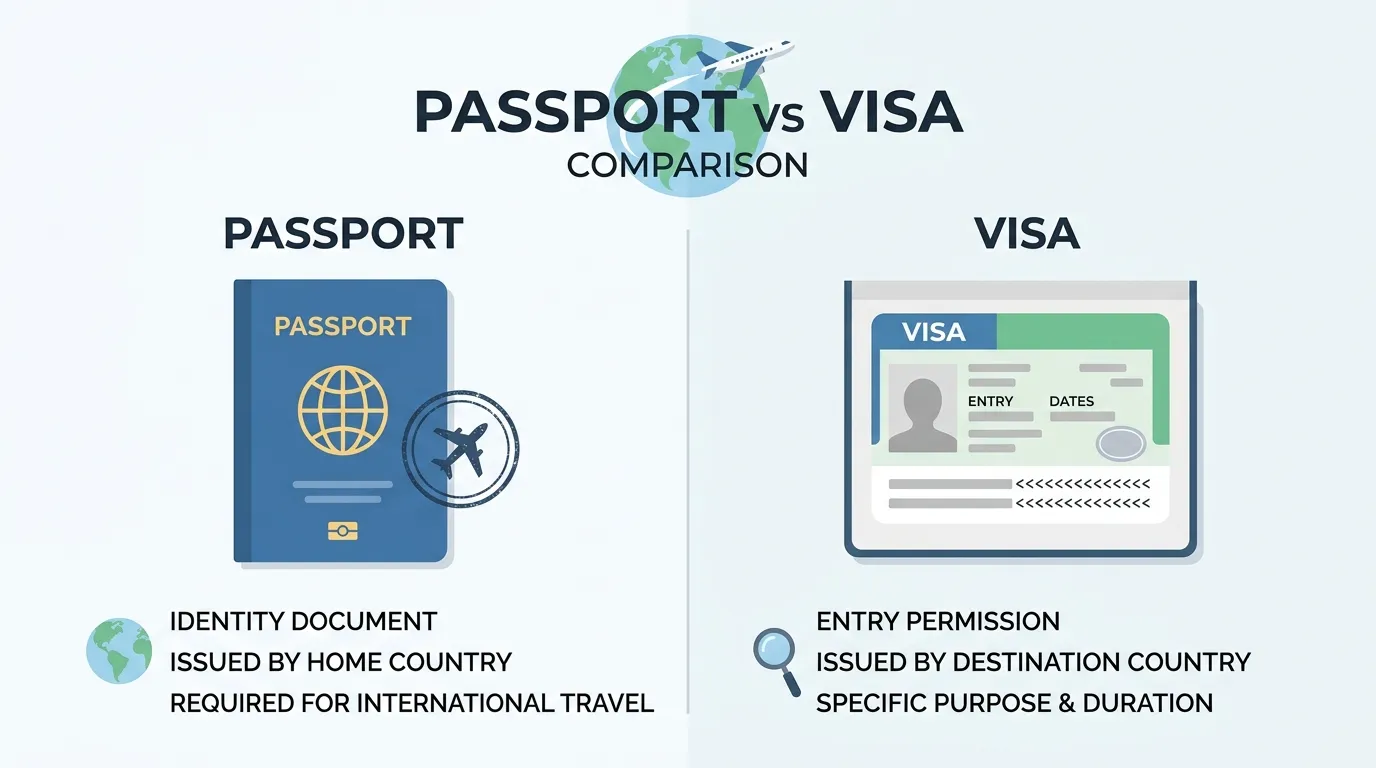
A passport is an official identity document issued by your home country, while a visa is an authorization from another country allowing you to enter or stay there.
👉 Example:
- Passport: Your ID for international travel
- Visa: Permission to enter a specific country
Definition of Visa and Passport
- Passport: A government-issued document that proves your identity and citizenship for international travel.
- Visa: An official approval (stamp or document) from a foreign country allowing you to enter, stay, or transit.
Pronunciation
- Visa
- US: /ˈviː.zə/
- UK: /ˈviː.zə/
- Passport
- US: /ˈpæs.pɔːrt/
- UK: /ˈpɑːs.pɔːt/
Now let’s move deeper into how both documents actually work in real-world travel systems.
Difference Between Visa and Passport: Comparison
| Feature | Passport | Visa | Similarity |
| Meaning | Identity document | Entry permission | Both required for travel |
| Issued By | Your home country | Foreign country | Both government-issued |
| Purpose | Proves identity & nationality | Allows entry/stay | Both used internationally |
| Validity | Long-term (5–10 years) | Short-term or specific | Both have expiry dates |
| Requirement | Mandatory for travel | Needed for some countries | Both part of travel process |
| Form | Booklet | Stamp or sticker | Both official documents |
| Control | Your country controls it | Destination country controls it | Both verified at borders |
👉 This table clearly shows the difference between visa and passport for quick understanding.
Key Differences Explained Between Visa and Passport
1. Purpose
Passport = identity proof
Visa = travel permission
👉 Example: You need a passport to leave your country and a visa to enter another.
2. Issuing Authority
Passports are issued by your own country.
Visas are issued by the country you want to visit.
3. Usage
Passport is used everywhere internationally.
Visa is used only for specific countries.
4. Validity Period
Passport lasts many years.
Visa is often short-term.
5. Entry Control
Visa determines if you can enter a country.
Passport proves who you are.
6. Travel Flexibility
Passport allows global travel.
Visa restricts travel to specific countries.
What is a Passport and Why It Exists?
A passport is your global identity card. Without it, you cannot travel internationally.
It includes:
✔ Your name and photo
✔ Nationality
✔ Unique passport number
In real scenarios:
- Airports scan passports for identity
- Immigration checks nationality
👉 In practical use, a passport is your “travel identity”.
What is a Visa and How Does It Work?
A visa is permission granted by another country.
Types of visas:
✔ Tourist visa
✔ Student visa
✔ Work visa
✔ Transit visa
Example:
- You may need a visa to visit the USA
- Some countries offer visa-free entry
👉 In real life, a visa controls how long you can stay and what you can do.
Difference Between Visa and Passport
| Feature | Passport | Visa | Similarity |
| Function | Identity verification | Entry approval | Both required at border |
| Issuance | By home government | By foreign embassy | Both official documents |
| Necessity | Always required | Conditional | Both important for travel |
| Format | Booklet | Stamp/sticker | Both attached to travel |
| Validity | Long-term | Short-term | Both expire |
| Control | Home country | Destination country | Both regulated |
👉 This table clearly shows the difference and similarity between visa and passport for quick understanding.
Common Mistakes with Visa and Passport
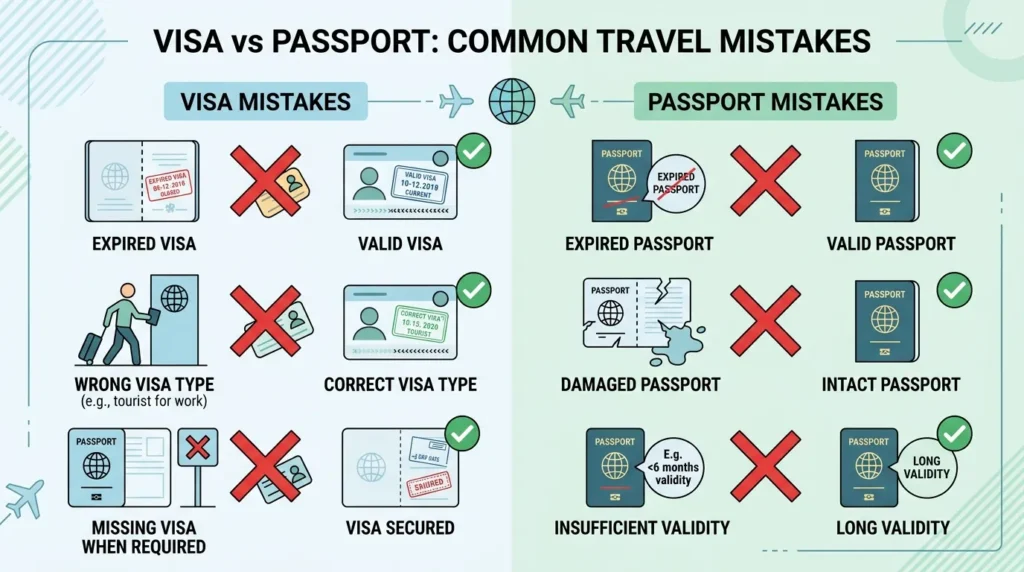
❌ Thinking passport alone is enough
👉 Fix: Some countries require visas
❌ Confusing visa with passport
👉 Fix: Remember roles clearly
❌ Ignoring visa expiry
👉 Fix: Check duration carefully
❌ Applying late
👉 Fix: Apply visa early before travel
Real-Life Examples with Visa and Passport
✔ Personal Travel
A traveler uses a passport to fly and a visa to enter a country.
✔ Student Scenario
Students need passports and study visas.
✔ Business Travel
Companies arrange work visas for employees.
✔ Tourism Industry
Travel agencies handle both passport and visa processes.
When to Use Visa vs Passport
Use Passport When:
✔ Traveling internationally
✔ Proving identity abroad
✔ Passing airport security
Use Visa When:
✔ Entering restricted countries
✔ Staying for long periods
✔ Working or studying abroad
Why People Get Confused Between Visa and Passport
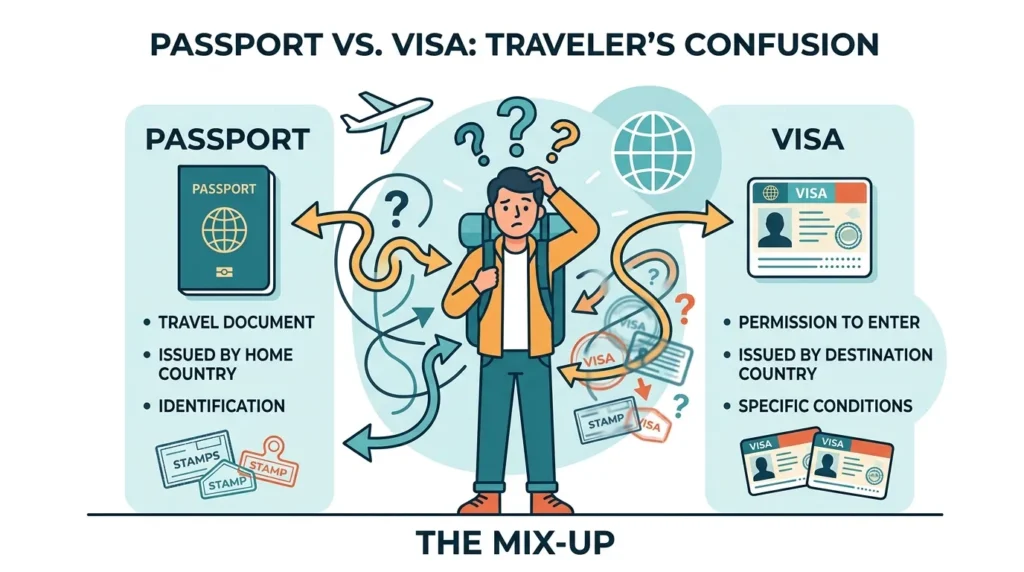
Many users get confused because:
✔ Both are travel documents
✔ Often used together
✔ Travel agencies mention both quickly
✔ Lack of awareness
Even on platforms like YouTube and Instagram, content creators simplify explanations too much.
How Search Engines Understand “Visa vs Passport”
Search engines like Google analyze:
✔ Travel intent
✔ Documentation queries
✔ Country-specific rules
Example:
- “Do I need visa?” → conditional search
- “passport requirements” → identity search
Expert Insight
From a professional travel perspective:
👉 Passport = who you are
👉 Visa = where you’re allowed to go
In real immigration systems:
✔ Passport is always required
✔ Visa depends on country rules
✔ Some countries offer visa-free travel
Experts recommend:
✔ Always check visa requirements before booking
✔ Keep passport valid for at least 6 months
FAQs
1. What is the main difference between visa and passport?
Passport proves identity; visa allows entry.
2. Do I need both visa and passport?
Yes, for many countries.
3. Can I travel without a visa?
Yes, if the country offers visa-free entry.
4. Who issues a passport?
Your home country government.
5. Who issues a visa?
The country you want to visit.
6. Which is more important?
Both are important for international travel.
Conclusions
The difference between visa and passport is simple but essential for anyone planning international travel. A passport is your official identity document that proves who you are and where you belong, while a visa is permission granted by another country allowing you to enter and stay for a specific purpose.
Many travelers confuse these two because they are used together, but understanding their roles helps avoid serious travel issues. In real-world travel systems, your passport gets you to the border, but your visa decides if you can cross it.
By clearly understanding the difference between visa and passport, you can plan your trips better, avoid delays, and travel confidently. If you are traveling for tourism, study, or work, mastering this concept is essential for smooth international travel in 2026 and beyond.
Read more about!
Difference Between Ethics and Morals: Simple Guide
Difference Between Octopus and Squid: Simple Guide

I am Emily Johnson, a USA-based content writer who creates easy-to-read blogs on language and daily life topics. I explain complex ideas in simple English for students and beginners so they can understand easily.