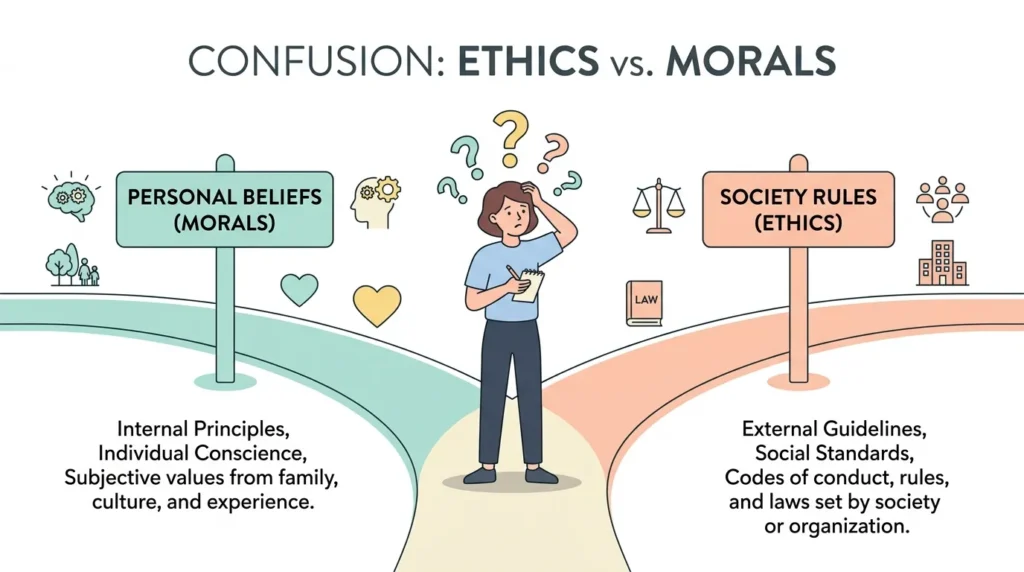
The difference between ethics and morals is that morals are your personal beliefs about right and wrong, while ethics are external rules or guidelines set by society or professions ⚖️
Many users get confused when they hear the difference between ethics and morals. They sound similar, and in everyday conversation, people often use them interchangeably. But in reality, there is a clear distinction.
The difference between ethics and morals matters in real-life decisions if you’re working in a company, posting on social media, or making personal choices.
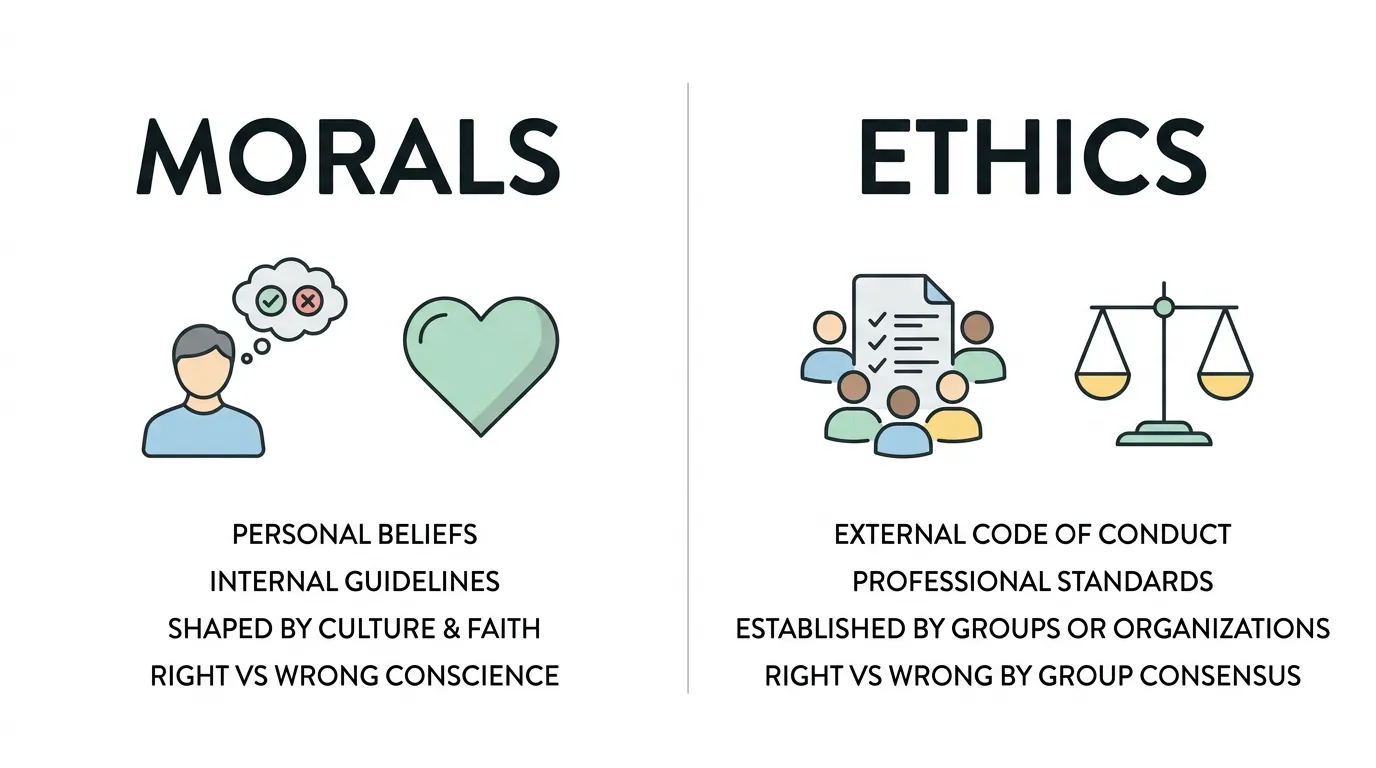
In simple words, the difference between ethics and morals is about where your values come from. Morals are personal beliefs about right and wrong, while ethics are external rules set by society or professions.
People search for this topic because they want clarity especially in situations where personal beliefs and professional rules clash. In this guide, you’ll learn everything: definitions, examples, real-life use, and expert insights so you won’t need another article.
🟢 Difference Between Ethics and Morals
The difference between ethics and morals is simple:
👉 Morals are your personal values about right and wrong, while ethics are rules created by society or professions.
Example: You may personally believe lying is wrong (moral), but a lawyer may ethically defend a client even if they know the truth is complex (ethics).
🟢 Definition of Difference Between Ethics and Morals
- Morals: Personal beliefs about what is right or wrong, shaped by culture, religion, or upbringing.
- Ethics: Rules or standards set by groups, professions, or society to guide behavior.
🟢 Pronunciation
- Ethics → US: /ˈeθɪks/ | UK: /ˈeθɪks/
- Morals → US: /ˈmɔːrəlz/ | UK: /ˈmɒrəlz/
Now that you know how to say them, let’s clearly understand how they actually differ in real life.
🟢 Comparison: Ethics vs Morals
| Feature | Ethics | Morals | Real-Life Insight |
| Source | External (society, profession) | Internal (personal beliefs) | Ethics come from rules; morals come from heart |
| Flexibility | Can change by profession | Usually stable | Doctors vs lawyers may have different ethics |
| Enforcement | Enforced by organizations | Self-enforced | Breaking ethics may cost your job |
| Nature | Formal guidelines | Informal beliefs | Ethics are written, morals are felt |
| Scope | Professional or social systems | Personal life | Morals guide private decisions |
| Example | Medical ethics in hospitals | Belief that stealing is wrong | Both guide behavior differently |
| Variation | Varies across industries | Varies across cultures | Ethics differ between companies |
| Focus | What society expects | What you believe | External vs internal guidance |
🟢 Key Differences Explained Between Ethics and Morals
1. Source of Values
Ethics come from external systems like laws or workplaces. Morals come from your upbringing.
👉 Example: A company policy vs your personal belief about honesty.
2. Personal vs Professional
Morals guide personal life, while ethics guide professional behavior.
👉 Example: A doctor following medical ethics even if personal feelings differ.
3. Flexibility
Ethics can change depending on context. Morals are more stable.
👉 Example: Business ethics evolve with trends, but your belief in kindness stays.
4. Enforcement
Ethics are enforced by rules. Morals depend on self-control.
👉 Example: Breaking ethics may lead to job loss; breaking morals leads to guilt.
5. Cultural Influence
Morals vary by culture. Ethics vary by profession.
👉 Example: Social norms differ across countries.
6. Written vs Unwritten
Ethics are often documented. Morals are not written down.
👉 Example: Company guidelines vs personal conscience.
🟢 What is Ethics and Why Does It Exist?
Ethics exist to create order in society and professions. Without ethics, systems like healthcare, business, or technology would become chaotic.
For example, companies like Google and Meta follow strict ethical guidelines to protect user data and ensure fair use.
👉 In simple words: Ethics help large systems run smoothly.
🟢 What are Morals and How Do They Develop?
Morals develop from family, religion, and life experiences. They shape how you see right and wrong.
👉 For example:
- A person raised to value honesty will avoid lying
- Cultural traditions influence moral beliefs
Morals are deeply personal and often emotional.
🟢 Ethics vs Morals in Real Life Decision-Making
In real scenarios, ethics and morals sometimes clash.
👉 Example:
A content moderator on YouTube may remove harmful content (ethical duty), even if they personally feel bad for the creator (moral emotion).
This is where understanding the difference becomes powerful.
🟢 Difference and Similarity Between Ethics and Morals
| Feature | Ethics | Morals | Similarity |
| Meaning | External rules | Personal beliefs | Both guide behavior |
| Origin | Society/profession | Individual upbringing | Influenced by culture |
| Usage | Professional decisions | Personal choices | Affect actions |
| Flexibility | Context-based | Stable | Can evolve over time |
| Enforcement | External penalties | Internal guilt | Encourage right behavior |
| Documentation | Written policies | Unwritten values | Both shape judgment |
| Scope | Social systems | Individual mindset | Work together |
| Purpose | Maintain order | Define character | Promote good actions |
This table clearly shows the difference and similarity between ethics and morals for quick understanding.
🟢 Common Mistakes with Ethics and Morals
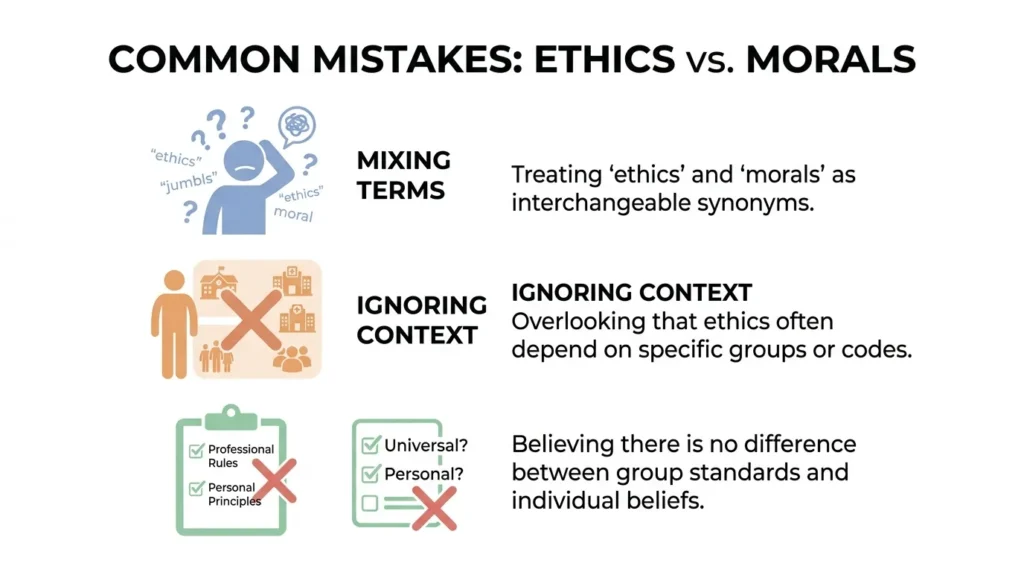
❌Thinking they are the same
✔ They are related but different
❌Using them interchangeably
✔ Use ethics for rules, morals for beliefs
❌Ignoring context
✔ Ethics depend on situation
❌Assuming morals are universal
✔ They vary by culture
🟢 Real Life Examples with Ethics and Morals
- Personal Life: Choosing not to lie (moral belief)
- Business: Following company policies (ethical rules)
- Social Media: Content moderation on Instagram
- Healthcare: Doctors following medical ethics
- Technology: Data privacy rules in apps
🟢 When to Use Ethics vs Morals
👉 Use morals when talking about personal beliefs
👉 Use ethics when talking about professional or social rules
Quick Tip:
If it’s about you → morals
If it’s about system → ethics
🟢 Why People Get Confused in Ethics vs Morals
- Similar meanings
- Used interchangeably in media
- Cultural overlap
- Lack of clear explanation
Many beginners mix them because both deal with right and wrong.
🟢 How Search Engines Understand Ethics and Morals
Search engines like Google analyze user intent behind queries like:
- “what is ethics”
- “difference between ethics and morals”
They rank content based on:
✔ clarity
✔ depth
✔ user satisfaction
Platforms like Instagram and YouTube also enforce ethical guidelines to maintain safe environments.
👉 This shows how ethics operate even in digital systems.
🟢 Expert Insight
In real-world professional environments, ethics act as a framework that keeps systems fair and functional. Morals, on the other hand, influence decision-making at a personal level.
From experience, most beginners struggle when their personal morals conflict with professional ethics. The key is balance understanding both and applying them wisely.
🟢 FAQs
1. What is the main difference between ethics and morals?
Ethics are external rules; morals are personal beliefs.
2. Can ethics and morals conflict?
Yes, especially in professional situations.
3. Are ethics universal?
No, they vary by profession and society.
4. Are morals the same everywhere?
No, they differ by culture and upbringing.
5. Why are ethics important?
They maintain order and fairness in systems.
6. Can a person have strong morals but break ethics?
Yes, especially when personal beliefs differ from rules.
🟢 Conclusion
Understanding the difference between ethics and morals is essential in today’s world. While both guide behavior, they come from different sources and serve different purposes. Ethics are structured rules created by society or professions, while morals are personal beliefs shaped by upbringing and culture.
In real scenarios, you’ll often use both together. Ethics help maintain order in systems like companies, healthcare, and digital platforms, while morals shape your personal character.
The key takeaway is simple:
👉 Ethics = external rules
👉 Morals = internal values
Once you understand this, decision-making becomes much clearer if in personal life or professional environments. The difference between ethics and morals is not just academic it’s practical, powerful, and essential.
Read more about!
Difference Between Whey and Isolate: Complete Guide
Difference Between PNG and JPG: Complete Guide

I am James Carter, a professional content writer from the United States. I specialize in writing simple and clear comparison blogs that help students and readers understand difficult topics easily. My writing focuses on everyday language, education, science, and lifestyle topics. I believe that learning should be easy for everyone, so I use simple words and real-life examples in my articles.