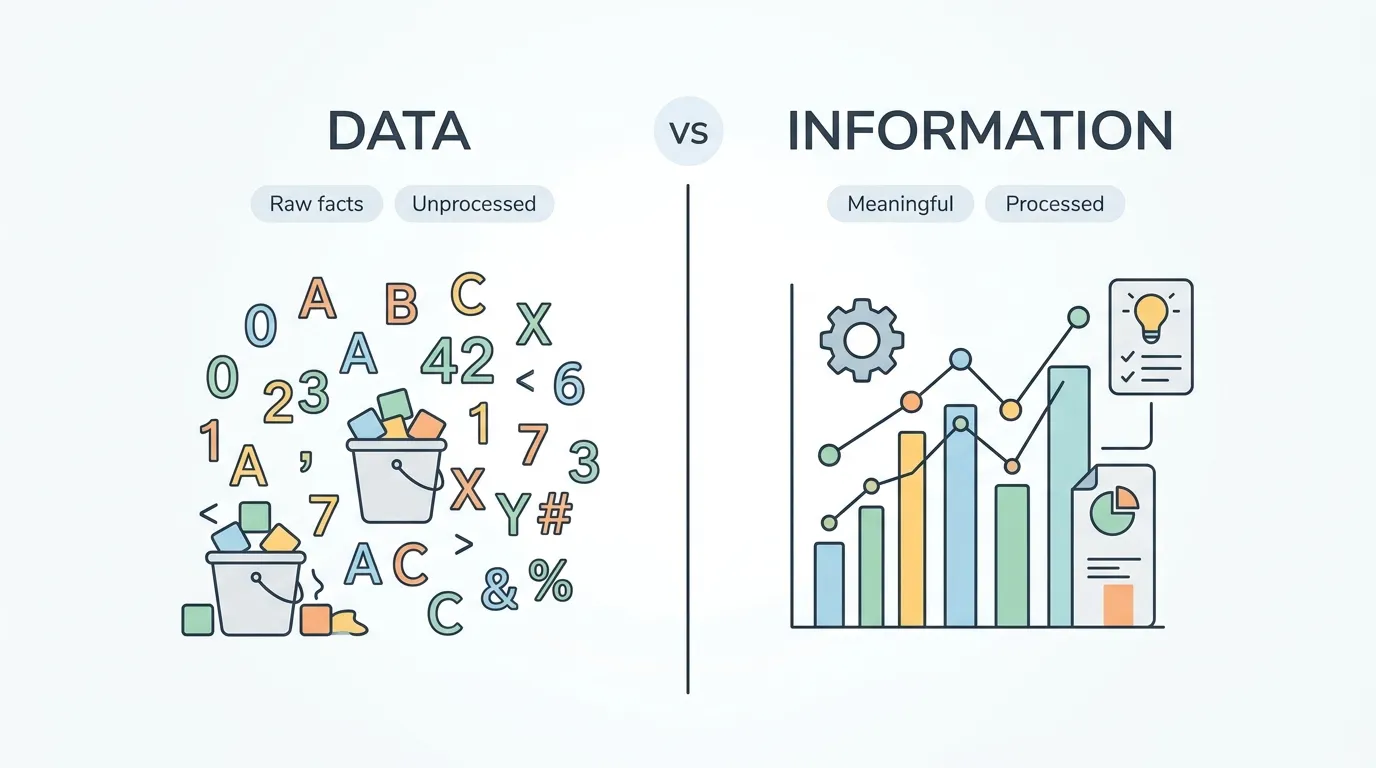
The difference between data and information is that data is raw, unprocessed facts, while information is organized and meaningful data that helps in understanding 📊✨
Many users get confused when they hear the terms data and information. At first glance, they feel the same but they are not.
The difference between data and information is one of the most important concepts in today’s digital world, especially when using platforms like Google, Instagram, or Meta.
In simple words, data is raw and unprocessed, while information is meaningful and organized. People search for the difference between data and information because they want clarity if for studies, business decisions, or understanding how systems work.
In this complete guide, you’ll learn what data and information really mean, how they work, why they exist, and how they are used in real life. By the end, you won’t need another article.
🟢 Difference Between Data and Information
The difference between data and information is simple:
- Data = raw facts (numbers, text, symbols)
- Information = processed data with meaning
👉 Example:
“100, 200, 300” = Data
“Sales increased from 100 to 300” = Information
🟢 Definition of Data and Information
- Data: Raw, unorganized facts or figures without context.
- Information: Processed and structured data that provides meaning and insight.
🟢 Pronunciation
- Data: /ˈdeɪ.tə/ (US), /ˈdɑː.tə/ (UK)
- Information: /ˌɪn.fɚˈmeɪ.ʃən/ (US), /ˌɪn.fəˈmeɪ.ʃən/ (UK)
Now that you know how they sound, let’s understand them deeply.
🟢 Comparison: Data vs Information
| Feature | Data | Information |
| Meaning | Raw facts | Processed meaning |
| Structure | Unorganized | Organized |
| Use | Input for systems | Output for decisions |
| Example | Numbers like 50, 60 | “Sales increased by 10%” |
| Context | No context | Has context |
| Value | Low value alone | High value |
| Human Understanding | Hard to understand | Easy to understand |
| Role | Foundation | Final result |
🟢 Key Differences Explained Between Data and Information
1. Raw vs Processed
Data is raw, while information is processed.
👉 Example: A spreadsheet full of numbers vs a report summary.
2. Meaning
Data has no meaning alone. Information always has meaning.
👉 Example: “45” vs “45 students attended class.”
3. Purpose
Data is collected; information is used for decisions.
👉 Businesses analyze data to create useful insights.
4. Complexity
Data is simple but scattered. Information is structured and clear.
5. Use in Technology
Platforms like YouTube collect user data and convert it into recommendations (information).
6. Human Understanding
Data confuses beginners. Information helps users understand quickly.
🟢 What is Data and Why Does It Exist?
Data exists because systems need raw input. Every click, search, and action creates data.
In real scenarios:
- When you search on Google, your query is data
- When results appear, that’s information
Data is everywhere phones, apps, websites. Without data, systems cannot function.
🟢 What is Information and How Does It Work?
Information is created when data is processed, analyzed, and organized.
👉 Example:
Fitness apps track your steps (data) and show calories burned (information).
This transformation is what makes technology useful.
🟢 Difference Between Data and Information in Real Systems
In platforms like Meta and Instagram:
- Likes, clicks, views = Data
- User behavior insights = Information
This is how companies improve user experience and engagement.
🟢 Why Understanding the Difference Between Data and Information Matters
Let’s understand this clearly this concept is not just theory.
- Businesses use it for decision-making
- Students use it for learning
- Developers use it to build systems
Without understanding the difference between data and information, you cannot fully understand how modern technology works.
🟢 DIFFERENCE + SIMILARITY: Data vs Information
| Feature | Data | Information | Similarity |
| Meaning | Raw facts | Meaningful output | Both are related |
| Role | Input | Output | Work together |
| Format | Numbers/text | Structured form | Both digital |
| Usage | Collection | Decision making | Used in systems |
| Context | No context | Has context | Both require processing |
| Value | Low alone | High value | Important in analysis |
| Understanding | Difficult | Easy | Both informative |
This table clearly shows the difference and similarity between data and information for quick understanding.
🟢 Common Mistakes with Data and Information
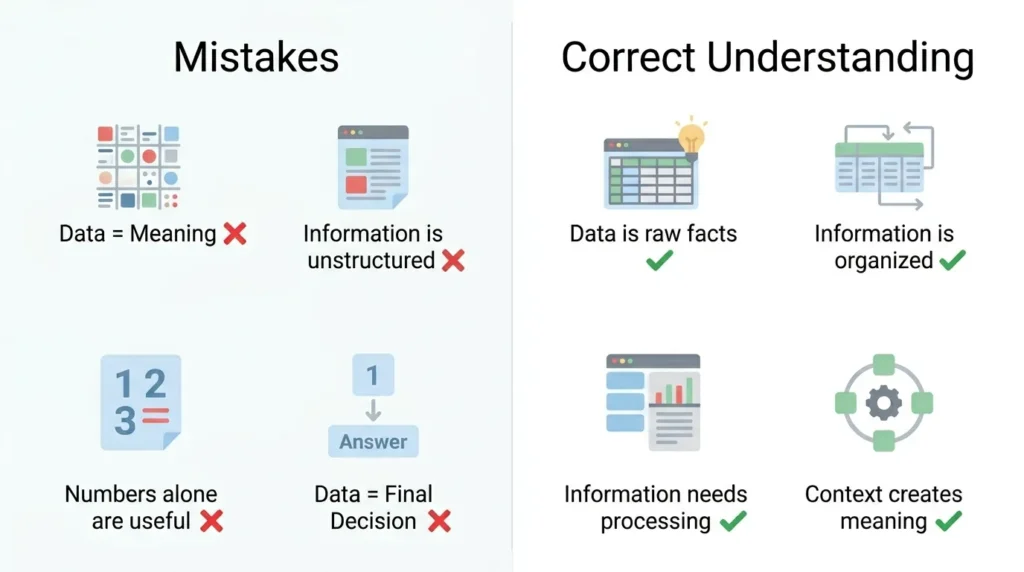
❌Thinking both are the same
✔ They are different stages
❌Believing data has meaning
✔ Data needs processing
❌Ignoring context
✔ Context creates information
❌Using raw numbers in decisions
✔ Always convert to information first
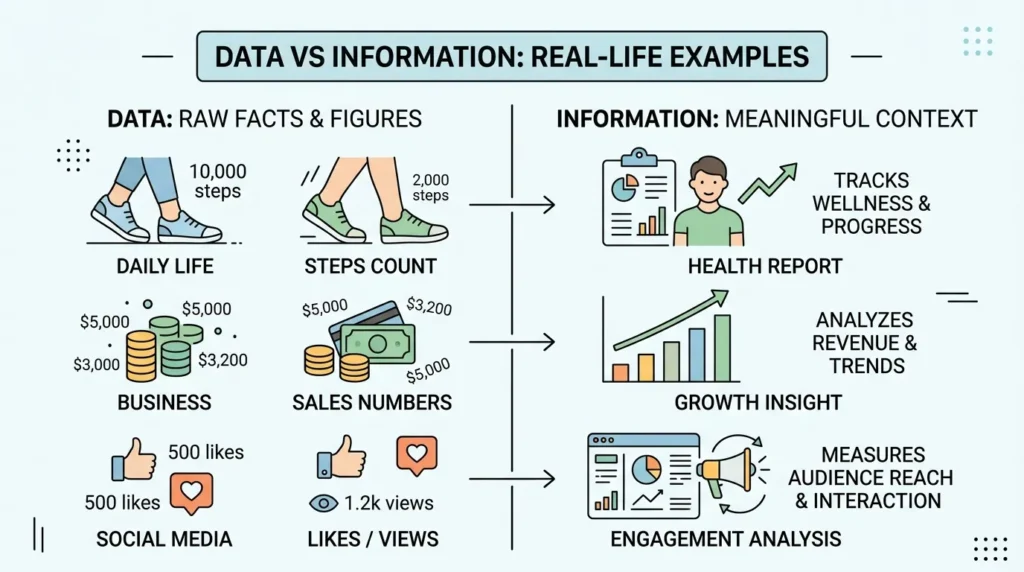
🟢 Real Life Examples with Data and Information
1. Personal Use
Your daily steps = Data
Health report = Information
2. Business Use
Sales numbers = Data
Growth analysis = Information
3. Social Media
Likes and views = Data
Engagement insights = Information
4. Education
Marks = Data
Performance evaluation = Information
🟢 When to Use Data vs Information
Use data when:
- Collecting facts
- Recording inputs
Use information when:
- Making decisions
- Understanding trends
👉 In practical use, both work together.
🟢 Why People Get Confused in Data vs Information
Many users get confused because:
- Terms are used interchangeably
- Both are closely related
- Technology hides the processing
Also, media and apps show only results (information), not raw data.
🟢 How Search Engines Understand Data and Information
Search engines like Google:
- Collect user queries (data)
- Analyze behavior patterns
- Deliver relevant results (information)
They use AI systems to convert massive data into useful information. This is why search results feel accurate.
🟢 EXPERT INSIGHT
In real-world systems, data alone is useless without interpretation. As someone working with digital systems, I’ve seen that the real value comes from transforming data into actionable information.
Most beginners focus too much on collecting data but professionals focus on understanding it. That’s where the real power lies.
🟢 FAQs
1. What is the main difference between data and information?
Data is raw facts; information is processed data with meaning.
2. Can data become information?
Yes, when processed and organized.
3. Why is data important?
It is the foundation for creating information.
4. Is information more valuable than data?
Yes, because it helps in decision-making.
5. How do companies use data and information?
They collect data and convert it into insights for growth.
6. Is data useless without information?
Mostly yes it needs context to be useful.
🟢 Conclusion
The difference between data and information is simple but powerful. Data is raw, unprocessed facts, while information is meaningful and structured output. This transformation from data to information is what drives modern technology, businesses, and digital platforms.
Understanding this concept helps you think clearly, make better decisions, and understand how systems like Google or Instagram actually work behind the scenes.
In simple words:
👉 Data is the starting point
👉 Information is the final result
Once you understand this, everything in the digital world starts to make more sense.
Read more about!
Difference Between Acid and Base: Simple Guide
Difference Between Octopus and Squid: Simple Guide

I am James Carter, a professional content writer from the United States. I specialize in writing simple and clear comparison blogs that help students and readers understand difficult topics easily. My writing focuses on everyday language, education, science, and lifestyle topics. I believe that learning should be easy for everyone, so I use simple words and real-life examples in my articles.