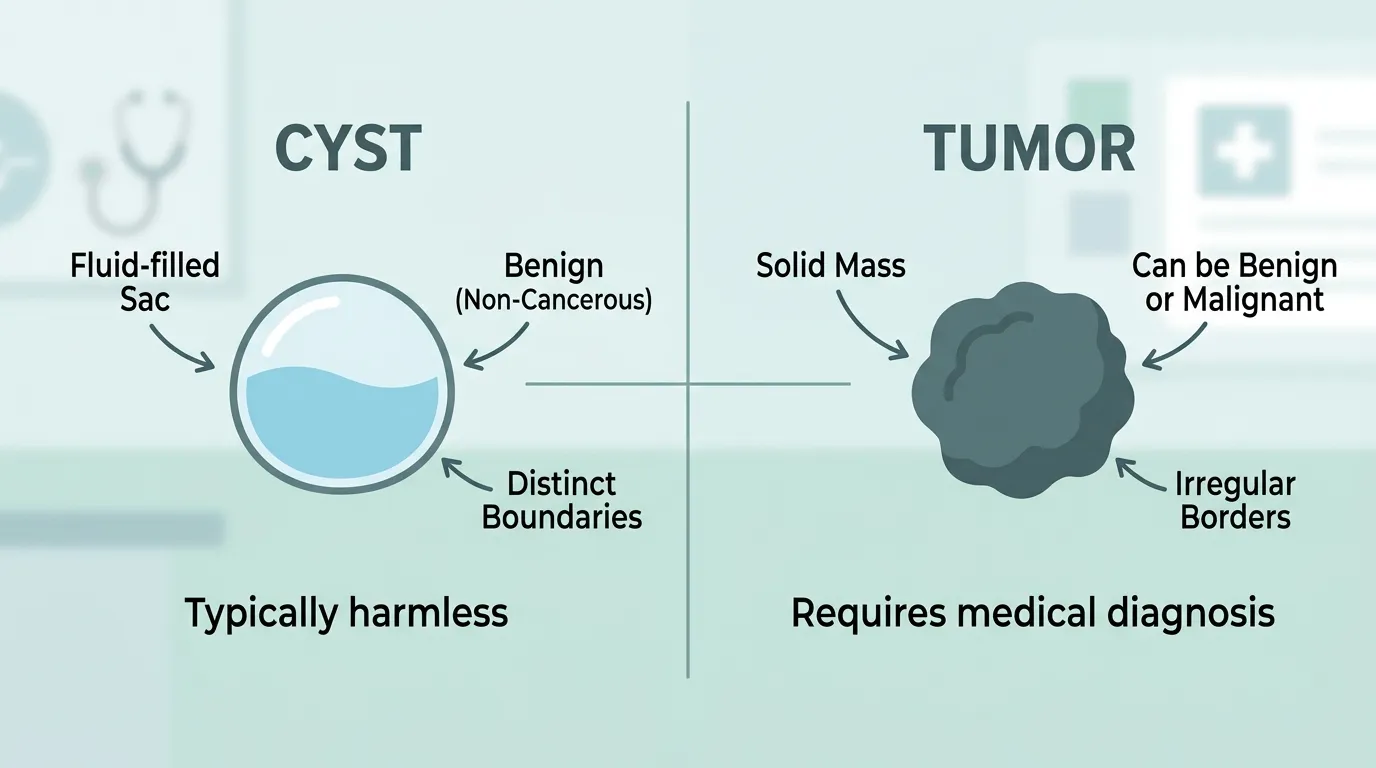
A cyst is a usually harmless, fluid-filled sac, while a tumor is a solid growth that can be benign or cancerous.
Hearing the words cyst or tumor can be stressful, and many people immediately think of serious disease. That’s why the difference between cyst and tumor is one of the most searched health questions on Google. People often ask: “what is a cyst vs tumor?”, “is a cyst dangerous?”, or “how do I know if it’s a tumor?”
In simple words, a cyst is usually a fluid-filled sac that is often harmless, while a tumor is an abnormal growth of cells that can be benign or cancerous. This confusion happens frequently because both can appear as lumps in the body.
You may even see discussions about this on platforms like Google, YouTube, or Meta, where health content is widely shared but not always clearly explained.
In this complete guide, you’ll learn:
✔ What cysts and tumors really are
✔ Key differences with real examples
✔ Symptoms, causes, and risks
✔ When to worry and when not
✔ Real-life medical insights
Let’s understand the difference between cyst and tumor in a clear, calm, and expert way.
Difference Between Cyst and Tumor
A cyst is a fluid-filled sac that is usually non-cancerous, while a tumor is a solid mass of abnormal cells that can be benign or cancerous.
👉 Example:
- Cyst: A small fluid-filled lump under the skin
- Tumor: A solid growth that may require testing
Definition of Cyst and Tumor
- Cyst: A closed sac filled with fluid, air, or semi-solid material, usually harmless and slow-growing.
- Tumor: An abnormal growth of cells that forms a solid mass, which can be benign (non-cancerous) or malignant (cancerous).
Pronunciation
- Cyst
- US: /sɪst/
- UK: /sɪst/
- Tumor (Tumour in UK spelling)
- US: /ˈtuː.mɚ/
- UK: /ˈtjuː.mə/
Now that you know how they sound, let’s clearly understand how they differ in medical terms.
Difference Between Cyst and Tumor: Comparison
| Feature | Cyst | Tumor | Similarity |
| Structure | Fluid-filled sac | Solid mass of cells | Both can form lumps |
| Nature | Usually benign | Benign or malignant | Both need medical check |
| Growth | Slow growth | Can grow fast or slow | Both vary in size |
| Pain | Often painless | May cause pain | Both can cause discomfort |
| Risk Level | Low risk | Can be serious | Both require diagnosis |
| Cause | Blocked glands, infection | Abnormal cell growth | Both linked to body changes |
| Treatment | Often no treatment needed | May need surgery/therapy | Both treated medically |
👉 This table clearly shows the difference between cyst and tumor for quick understanding.
Key Differences Explained Between Cyst and Tumor
1. Structure (Fluid vs Solid)
A cyst is filled with fluid, while a tumor is made of solid tissue.
👉 Example: A pimple-like lump is often a cyst, while a hard lump may be a tumor.
2. Risk Level
Cysts are mostly harmless, but tumors can sometimes be cancerous.
👉 Example: Many skin cysts go away on their own.
3. Growth Pattern
Cysts grow slowly and stay stable. Tumors may grow quickly.
4. Causes
Cysts often form due to blockage or infection. Tumors form due to abnormal cell growth.
5. Medical Concern
Doctors usually monitor cysts but investigate tumors more deeply.
6. Treatment Approach
Cysts may need no treatment. Tumors may require surgery, biopsy, or therapy.
What is a Cyst and Why Does It Form?
A cyst forms when fluid, pus, or other material gets trapped in tissue. Common causes include:
✔ Blocked oil glands
✔ Infection
✔ Injury
✔ Hormonal changes
In real scenarios, most people experience harmless cysts like:
- Skin cysts
- Ovarian cysts
- Sebaceous cysts
👉 In practical use, doctors often just monitor cysts unless they cause pain or infection.
What is a Tumor and How Does It Develop?
A tumor develops when cells grow uncontrollably. This can happen due to:
✔ Genetic mutations
✔ Environmental factors
✔ Lifestyle risks
Tumors are of two types:
- Benign tumor: Non-cancerous
- Malignant tumor: Cancerous
👉 Not all tumors are dangerous, but they always need proper diagnosis.
Difference Between Cyst and Tumor
| Feature | Cyst | Tumor | Similarity |
| Meaning | Fluid-filled sac | Solid abnormal growth | Both are abnormal lumps |
| Content | Liquid or semi-solid | Cells/tissue | Both occur inside body |
| Cancer Risk | Rarely cancerous | May be cancerous | Both need evaluation |
| Detection | Often visible/swollen | May need scans | Both found via exams |
| Treatment | Simple or none | Complex sometimes | Both treatable |
| Pain | Usually mild | Can be severe | Both vary in symptoms |
| Diagnosis | Ultrasound | Biopsy, scans | Both need medical check |
👉 This table clearly shows the difference and similarity between cyst and tumor for quick understanding.
Common Mistakes with Cyst and Tumor
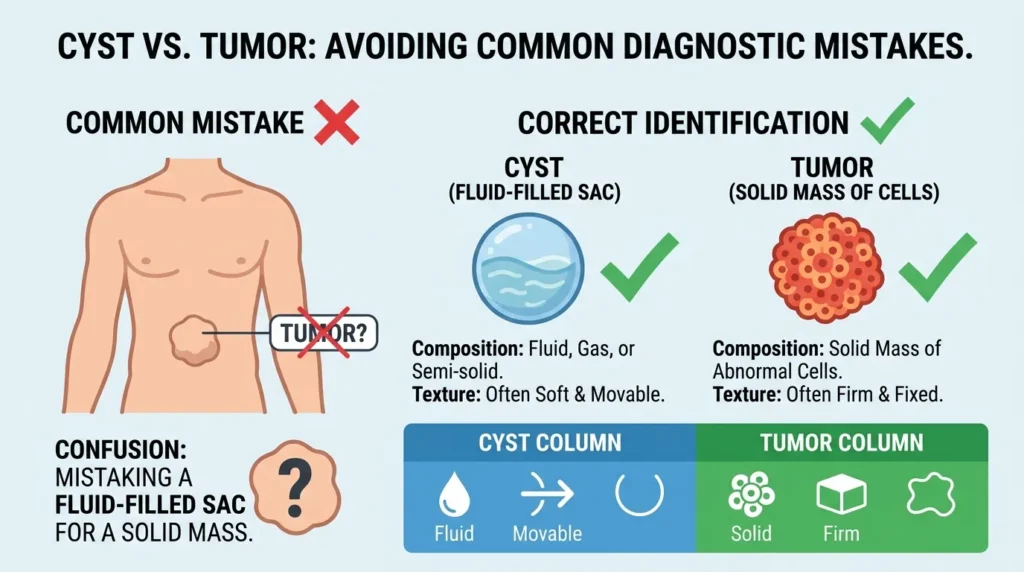
❌ Thinking every lump is cancer
👉 Fix: Many lumps are harmless cysts
❌ Ignoring painful swelling
👉 Fix: Always consult a doctor
❌ Self-diagnosing via internet
👉 Fix: Use medical advice, not guesses
❌ Assuming cysts never need treatment
👉 Fix: Some infected cysts need care
Real-Life Examples with Cyst and Tumor
✔ Personal Use
A person finds a soft lump under the skin → usually a cyst.
✔ Medical Scenario
A doctor finds a solid lump → may require biopsy.
✔ Women’s Health
Ovarian cysts are common and often harmless.
✔ Oncology Case
Tumors detected via scans need evaluation.
When to Use Each Term
Use “Cyst” When:
✔ Lump is fluid-filled
✔ Soft and movable
✔ Usually painless
Use “Tumor” When:
✔ Growth is solid
✔ Increasing in size
✔ Needs medical testing
Why People Get Confused Between Cyst and Tumor
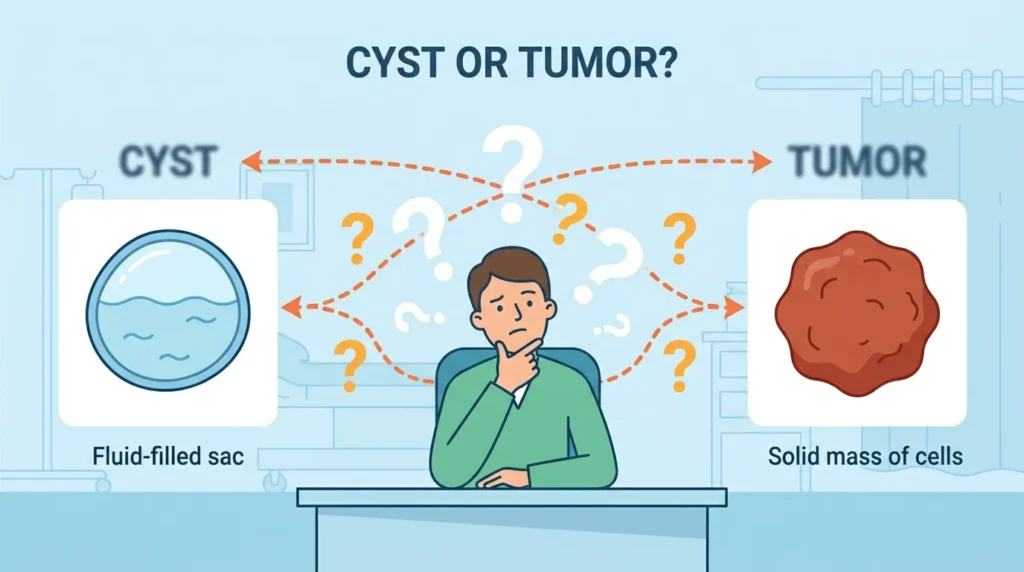
Many users get confused because:
✔ Both appear as lumps
✔ Both sound medical and serious
✔ Media often uses “tumor” dramatically
✔ Lack of medical awareness
Even on platforms like YouTube or Instagram, health videos can oversimplify or exaggerate.
How Search Engines Understand “Cyst vs Tumor”
Search engines like Google use NLP to understand:
✔ Health concern intent
✔ Symptom-based queries
✔ Comparison-based searches
Example:
- “Is cyst dangerous?” → informational
- “tumor vs cyst difference” → comparison
This helps show accurate medical articles.
Expert Insight
From a clinical perspective, the key rule is simple:
👉 Not every lump is dangerous, but every lump should be checked.
In real medical practice:
✔ Most cysts are harmless
✔ Some tumors are benign
✔ Early diagnosis improves outcomes
Doctors rely on:
✔ Ultrasound
✔ MRI scans
✔ Biopsy tests
FAQs
1. What is the main difference between cyst and tumor?
Cyst is fluid-filled, tumor is solid.
2. Is a cyst dangerous?
Usually no, but depends on type.
3. Are all tumors cancerous?
No, many are benign.
4. How can I tell if it’s a cyst or tumor?
Only medical tests can confirm.
5. Should I worry about a lump?
Consult a doctor to be safe.
6. Can a cyst turn into a tumor?
Rare, but possible in some cases.
Conclusion
The difference between cyst and tumor is simple but very important for health awareness. A cyst is typically a harmless, fluid-filled sac, while a tumor is a solid growth that may or may not be cancerous. Many people panic when they feel a lump, but understanding this difference helps reduce fear and guide proper action.
In real life, most cysts are not dangerous and often go away on their own. Tumors, however, require proper medical evaluation to determine if they are benign or malignant. The key takeaway is not to self-diagnose but to seek professional medical advice when needed.
By clearly understanding the difference between cyst and tumor, you can make informed decisions, avoid unnecessary anxiety, and take the right steps for your health.
Read more about!
Difference Between Urban and Suburban: Complete Guide
Difference Between Diffusion and Osmosis: Complete Guide

I am James Carter, a professional content writer from the United States. I specialize in writing simple and clear comparison blogs that help students and readers understand difficult topics easily. My writing focuses on everyday language, education, science, and lifestyle topics. I believe that learning should be easy for everyone, so I use simple words and real-life examples in my articles.