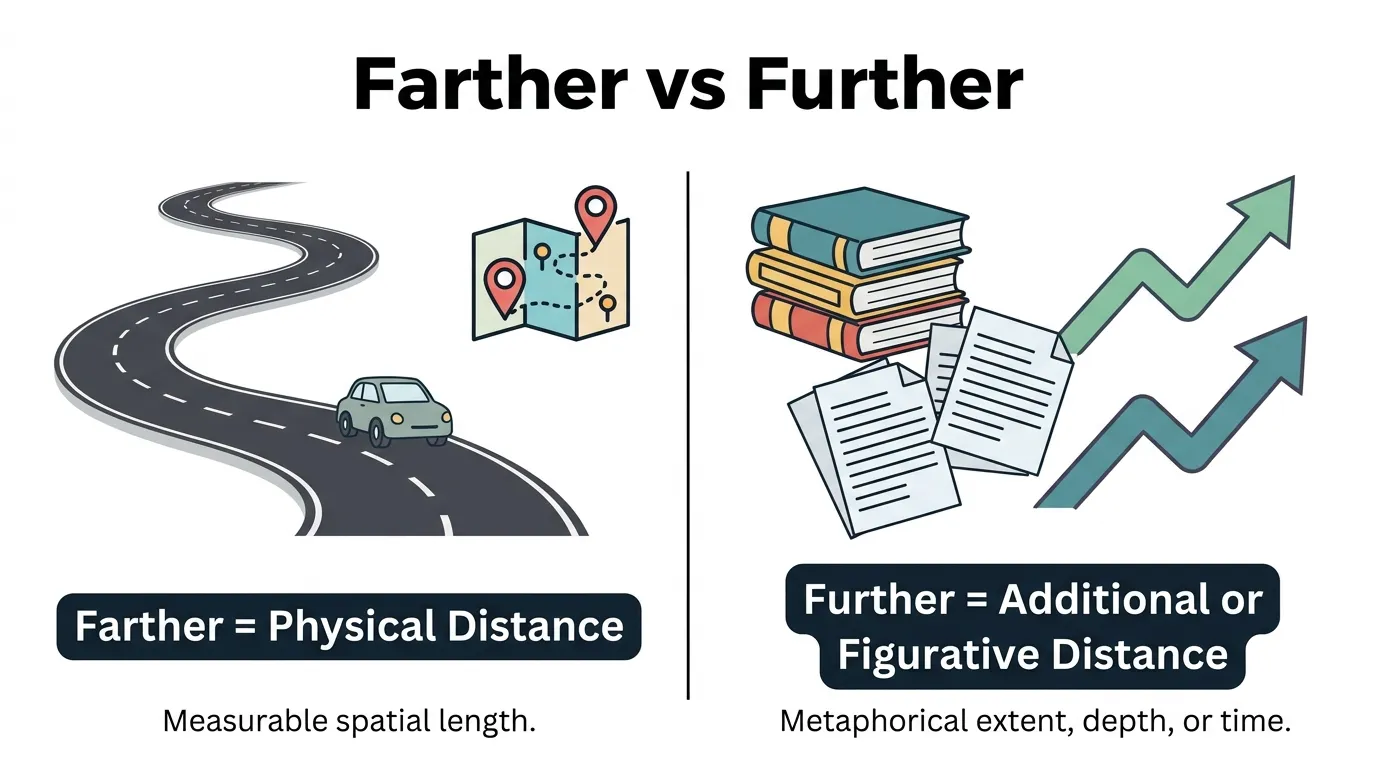
Farther refers to a greater physical distance, while further usually means additional, more, or figurative distance.
Many English learners and even native speakers get confused about the difference between farther and further. The reason is simple: both words often relate to distance, and in everyday conversation people sometimes use them interchangeably.
If you have ever wondered if you should say “walk farther” or “walk further,” you are not alone. Understanding the difference between farther and further can improve your writing, make your communication clearer, and help you avoid common grammar mistakes.
In simple words, farther usually refers to physical distance, while further often refers to figurative, abstract, or additional distance. However, modern English usage has made the distinction slightly more flexible.
In this guide, you’ll learn definitions, pronunciation, comparisons, real-life examples, common mistakes, expert insights, and practical usage tips so you never confuse these words again.
Difference Between Farther and Further
Farther is generally used for measurable physical distance.
Further is usually used for figurative distance, additional information, progress, or advancement.
Example:
- The park is farther down the road.
- For further information, visit the website.
Definition of Farther and Further
- Farther: A word used to describe a greater physical distance between two places or objects.
- Further: A word used to describe additional information, greater progress, advancement, or figurative distance.
Example:
- We drove farther than expected.
- We need further discussion before making a decision.
Pronunciation
| Word | US Pronunciation | UK Pronunciation |
| Farther | FAR-thər | FAH-thə |
| Further | FUR-thər | FUR-thə |
Although they sound different, many people still confuse them because they are closely related in meaning.
Now let’s understand the distinction in greater detail.
Difference Between Farther and Further
| Feature | Farther | Further |
| Main Meaning | Physical distance | Figurative or additional distance |
| Usage | Measurable locations | Abstract ideas and progress |
| Common Context | Travel and geography | Education, business, discussion |
| Question Answered | How far physically? | To what extent? |
| Formal Writing | Less common | More common |
| Additional Meaning | No | Yes |
| Business Use | Rare | Very common |
| Everyday Speech | Sometimes interchangeable | Often preferred |
Key Differences Explained Between Farther and Further
1. Physical vs Abstract Distance
Farther focuses on actual measurable distance.
Example:
The school is farther from my house than the library.
Further focuses on non-physical ideas.
Example:
We need further research.
2. Additional Information
Further can mean “more.”
Example:
For further details, contact customer support.
Farther cannot be used this way.
3. Business Communication
In professional emails and reports, further appears frequently.
Example:
Further discussion is required.
4. Travel and Navigation
Farther is commonly associated with maps and locations.
Example:
The hotel is farther north.
5. Academic Writing
Universities often use further when discussing studies.
Example:
Further investigation is necessary.
6. Figurative Progress
Further can describe advancement.
Example:
The project moved further ahead.
7. Measurement
Farther usually implies measurable units such as miles or kilometers.
Example:
We traveled five miles farther.
Why Do Farther and Further Exist?
English evolved from Germanic languages and absorbed influences from many linguistic traditions.
Historically, farther developed as a variation specifically linked to physical distance. Further retained broader meanings that included distance, progression, and extension.
As English changed over time, both words remained in use, creating today’s distinction.
How Does the Difference Between Farther and Further Work in Modern English?
Modern dictionaries often acknowledge overlap.
Many style guides recommend:
- Use farther for physical distance.
- Use further for figurative distance and additional information.
This rule provides clarity and helps readers understand your meaning immediately.
When Should You Use Farther?
Use farther when discussing actual geographical or measurable distance.
Examples
- The gas station is farther away.
- She ran farther than anyone else.
- Our destination is farther east.
- The mountain appears farther from here.
Real-World Situations
Navigation apps like Google Maps calculate physical distance. In those contexts, farther fits naturally.
When Should You Use Further?
Use further when discussing:
- Additional information
- Progress
- Development
- Advancement
- Figurative distance
Examples
- Further study is required.
- For further information, visit the website.
- The company plans further expansion.
- Further improvements are needed.
Real-World Situations
Businesses, universities, and organizations frequently use further in reports, emails, and presentations.
Can Farther and Further Be Interchangeable?
Sometimes, yes.
When discussing physical distance, many modern speakers use either word.
Examples:
- We walked farther.
- We walked further.
Both may be accepted, although traditional grammar prefers farther.
However, when meaning “additional” or “more,” only further is correct.
Correct:
Further information is available.
Incorrect:
Farther information is available.
Difference and Similarity Between Farther and Further
| Feature | Farther | Further | Similarity |
| Part of Speech | Adjective/Adverb | Adjective/Adverb | Both function similarly |
| Distance Meaning | Physical distance | Can include distance | Both relate to movement |
| Additional Meaning | No | Yes | Both extend ideas |
| Common Usage | Travel | Business and education | Both common in English |
| Formal Writing | Moderate | High | Both appear in writing |
| Spoken English | Common | Common | Both widely understood |
| Grammar Category | Comparative form | Comparative form | Same grammatical family |
| Modern Flexibility | Some overlap | Some overlap | Often interchangeable in distance contexts |
This table clearly shows the difference and similarity between farther and further for quick understanding.
Common Mistakes with Farther and Further
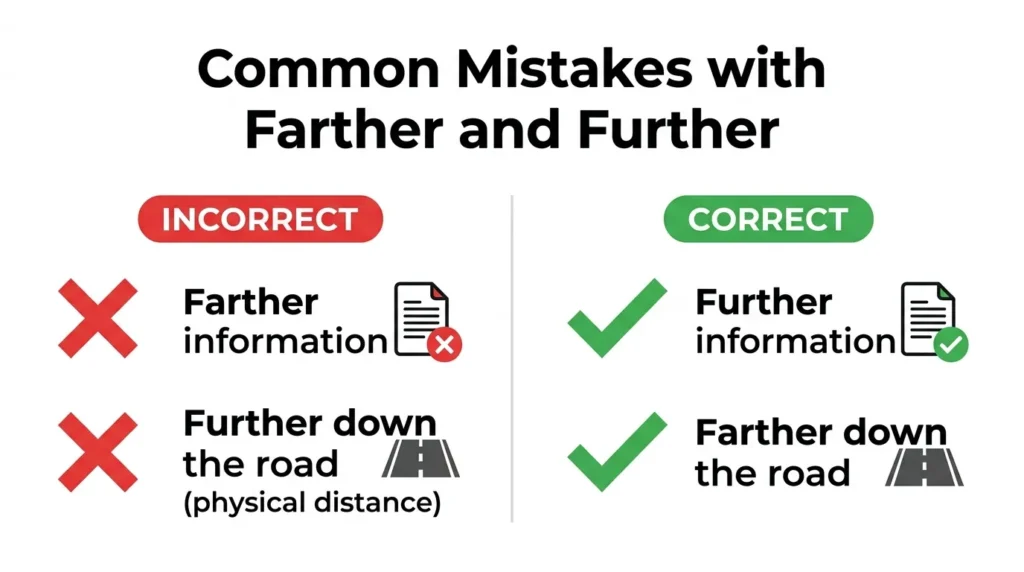
Mistake 1: Using Farther for Additional Information
❌ Farther details are available.
✔ Further details are available.
Mistake 2: Ignoring Physical Distance
❌ The airport is further away.
✔ The airport is farther away.
Mistake 3: Assuming They Are Always Identical
Although overlap exists, they are not always interchangeable.
Mistake 4: Using Farther in Business Writing
Professional communication usually prefers further.
Mistake 5: Confusing Literal and Figurative Meanings
Ask yourself:
“Am I talking about actual distance or an idea?”
Real-Life Examples with Farther and Further
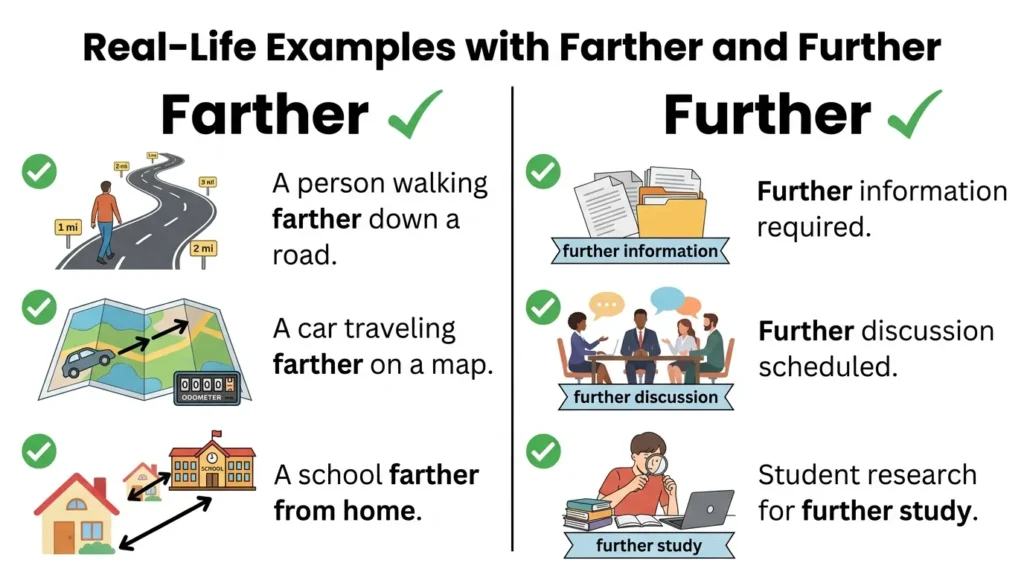
Personal Use
The supermarket is farther from my home than the pharmacy.
Education
Students require further explanation before the exam.
Business
The company announced further investments.
Travel Industry
Tourists traveled farther into the countryside.
Research
Scientists conducted further testing.
Technology
Software developers performed further updates before launch.
When to Use Each
Use Farther When:
- Talking about miles
- Talking about roads
- Discussing locations
- Measuring distance
Use Further When:
- Giving extra information
- Discussing progress
- Talking about development
- Referring to future advancement
Quick rule:
Physical distance = Farther
Everything else = Further
Why People Get Confused Between Farther and Further
Several reasons contribute to the confusion.
Similar Meanings
Both relate to movement and extension.
Historical Overlap
English speakers have used them interchangeably for centuries.
Modern Usage
Many media sources blur the distinction.
Regional Differences
American and British English sometimes show slightly different preferences.
Everyday Conversation
People rarely notice the difference in casual speech.
How Search Engines Understand Farther and Further and User Intent
Search engines such as Google analyze user intent rather than only matching keywords.
When someone searches:
- “difference between farther and further”
- “farther vs further”
- “when to use farther”
- “when to use further”
Google recognizes that the user wants a grammar comparison.
Educational platforms, dictionaries, and language-learning websites often rank because they provide:
- Clear definitions
- Examples
- Comparison tables
- User-friendly explanations
Similarly, platforms like YouTube and Instagram frequently feature language-learning content explaining these grammar distinctions through visual examples and short lessons.
The search intent is primarily informational, so comprehensive educational content tends to perform best.
Expert Insight
From a language and writing perspective, the easiest way to remember the distinction is this:
Think of the word far inside farther. It naturally connects to physical distance.
Think of further as meaning more.
In practical use, most beginners benefit from following this simple rule because it works correctly in nearly every situation.
Professional editors, academic writers, and content creators often use this approach to maintain consistency and clarity.
FAQs
Is farther or further correct?
Both can be correct depending on context.
What is the main difference between farther and further?
Farther refers mainly to physical distance, while further usually refers to additional or figurative distance.
Can I use further for physical distance?
Yes, modern English sometimes allows it, although farther is traditionally preferred.
Can I use farther for additional information?
No. Use further instead.
Which word is more common in business writing?
Further.
Is farther used in American English?
Yes, especially for physical distance.
Is further more formal?
Generally, yes.
How can I remember the difference?
Farther contains “far,” which helps you remember physical distance.
Do dictionaries accept both for distance?
Many modern dictionaries do.
Which should students use in exams?
Follow the traditional rule: farther for physical distance and further for figurative meanings.
Conclusion
Understanding the difference between farther and further becomes much easier once you focus on the type of distance being discussed. If you’re talking about a measurable, physical distance such as roads, miles, locations, or travel, farther is usually the best choice. If you’re referring to additional information, progress, development, advancement, or figurative distance, further is generally the correct word.
Many users get confused because modern English sometimes allows both words in distance-related contexts. However, following the traditional distinction creates clearer communication and stronger writing. In real-world scenarios, you will often see farther in navigation and travel discussions, while further dominates business, academic, and professional communication.
The simplest memory trick is this: farther = physical distance; further = more or additional. Once you apply this rule consistently, choosing the correct word becomes almost automatic.
If you’re writing emails, academic papers, blog posts, business reports, or everyday messages, understanding the difference between farther and further helps you communicate with greater accuracy and confidence.
Read more about!
Difference Between PA and MD: Complete Guide
Difference Between Zucchini and Cucumber: Complete Guide

I am Emily Johnson, a USA-based content writer who creates easy-to-read blogs on language and daily life topics. I explain complex ideas in simple English for students and beginners so they can understand easily.