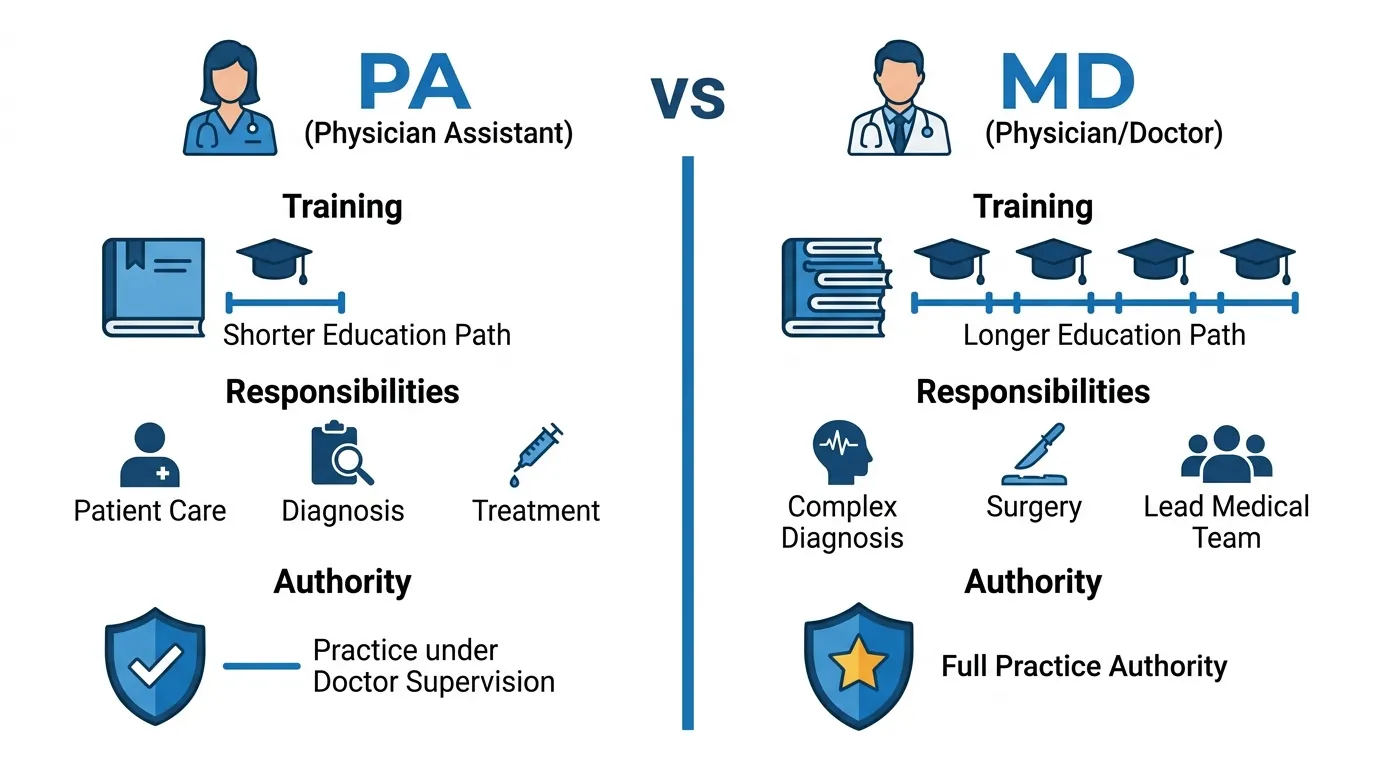
PA (Physician Assistant) and MD (Medical Doctor) differ mainly in training level and responsibilities, with MDs having more extensive education and independent authority to diagnose and treat patients.
When students explore medical careers, one of the most confusing topics is the difference between PA and MD. Many people search the difference between PA and MD because both roles work in hospitals, both treat patients, and both are part of the healthcare system.
This creates a natural confusion, especially for students planning to enter medicine or healthcare careers.
In simple words, the difference between PA and MD is that a Physician Assistant (PA) works under a supervising physician and provides medical care with a shorter training path, while a Medical Doctor (MD) is a fully licensed physician who diagnoses, treats, and manages patients independently after completing extensive medical education.
In this complete guide, you will learn what PA and MD mean, how they differ, where they work, why they exist as separate roles, real-world examples, and how healthcare systems like hospitals and platforms such as Google Health, YouTube medical education channels, and hospital systems use both roles effectively.
Difference Between PA and MD
A PA is a licensed medical professional who works under a doctor, while an MD is a fully trained physician who independently diagnoses and treats patients.
Example:
A PA may assist in treating a patient with flu symptoms, while an MD handles complex diagnosis and treatment plans.
Definition of PA and MD
- PA (Physician Assistant): A medical professional trained to diagnose, treat, and assist doctors under supervision.
- MD (Medical Doctor): A fully qualified physician who completes medical school and residency to independently practice medicine.
Pronunciation
- PA: “Pee-Ay”
- MD: “Em-Dee”
Now let’s understand how these two roles differ in real medical practice.
Comparison: Difference Between PA and MD
| Feature | PA (Physician Assistant) | MD (Medical Doctor) | Similarity |
| Education | 2–3 years master’s program | 7–11 years medical training | Both require medical education |
| Responsibility | Works under supervision | Works independently | Both treat patients |
| Scope of Practice | Limited by law/state | Full medical authority | Both diagnose and treat |
| Specialization | General medical support | Can specialize (surgery, cardiology) | Both work in specialties |
| Decision Power | Shared with physician | Full clinical decision-making | Both follow medical ethics |
| Work Setting | Hospitals, clinics | Hospitals, private practice | Both work in healthcare systems |
| Salary Level | Moderate | Higher | Both are well-paid careers |
This table clearly shows the difference and similarity between PA and MD for quick understanding.
Key Differences Explained Between PA and MD
1. Education Length Difference
PA programs take around 2–3 years, while MD programs take over 7 years including residency.
Example: A PA enters clinical work faster than an MD.
2. Level of Authority
MDs can practice independently. PAs require supervision in most cases.
3. Clinical Responsibilities
MDs handle complex surgeries and diagnoses. PAs assist and manage routine cases.
4. Career Flexibility
MDs can specialize deeply. PAs often work in general practice or assist specialists.
5. Patient Load
MDs often handle critical cases, while PAs support patient flow in hospitals.
6. Training Focus
PA training is fast and practical. MD training is deep and research-based.
7. Licensing System
MDs undergo longer licensing exams and residency. PAs follow certification boards.
What is a PA (Physician Assistant)?
A Physician Assistant is a healthcare professional trained to diagnose illnesses, assist surgeries, prescribe medication (depending on country laws), and support doctors.
They are essential in modern healthcare systems because they increase efficiency and reduce workload for physicians.
What is an MD (Medical Doctor)?
A Medical Doctor is a fully trained physician who completes medical school and residency. MDs can diagnose, treat, prescribe, and perform surgeries independently.
They represent the highest level of clinical authority in medicine.
Why PA and MD Roles Exist in Healthcare
Healthcare systems are complex. Hospitals and institutions like Google Health research systems, global hospital networks, and medical training platforms like YouTube medical education channels highlight the need for:
- Faster patient care (PA role)
- Deep medical expertise (MD role)
This balance ensures better healthcare access and efficiency.
How PA and MD Work Together in Real Hospitals
In real medical environments:
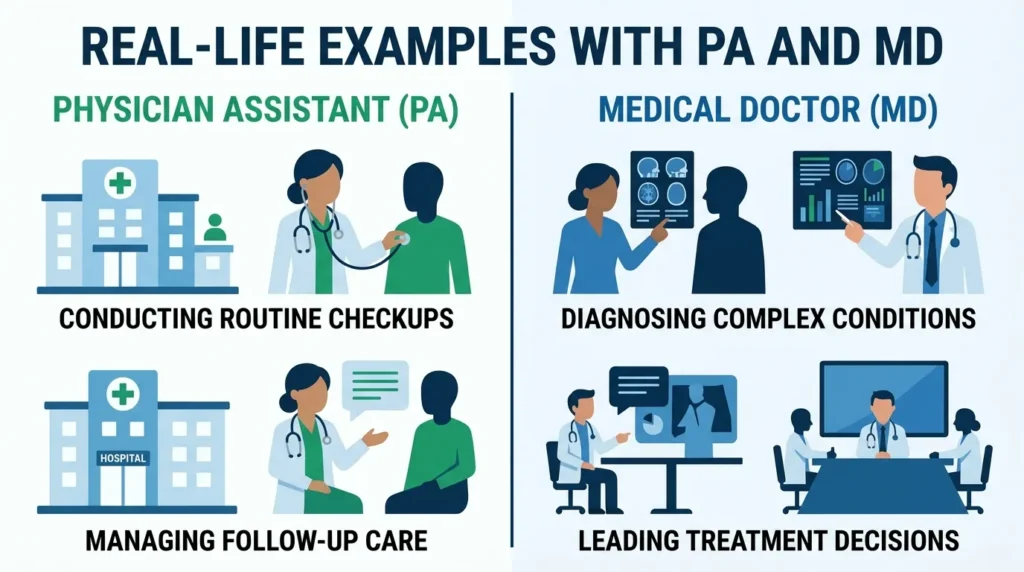
- MDs handle complex diagnosis and treatment plans
- PAs handle patient follow-ups, routine care, and support tasks
Example:
In an emergency room, an MD may handle critical surgery decisions while a PA manages stable patients.
Real-Life Examples with PA and MD
1. Emergency Room
MD handles trauma cases
PA manages minor injuries
2. Family Clinic
MD diagnoses complex conditions
PA handles routine checkups
3. Surgery Team
MD performs surgery
PA assists during procedures
4. Cardiology Department
MD interprets advanced heart scans
PA monitors patient recovery
5. Rural Healthcare
PA provides primary care
MD visits periodically for complex cases
6. Telemedicine Platforms
MD provides expert consultation
PA supports follow-up care
Common Mistakes with PA and MD
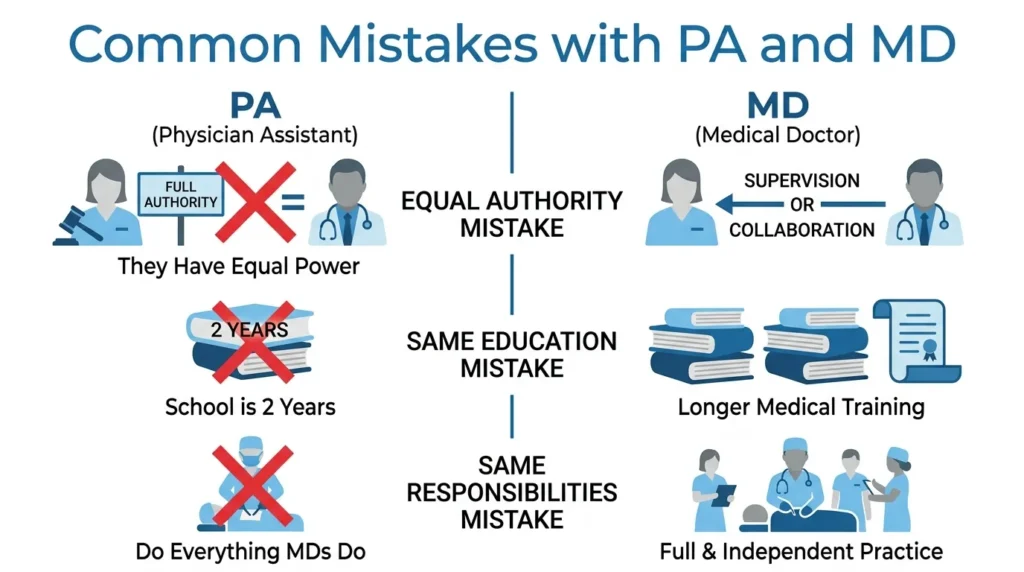
1. Thinking PA and MD Are Same
Fix: They have different training and authority levels.
2. Assuming PAs Are Junior Doctors
Fix: PAs are separate licensed professionals.
3. Believing MDs Do Everything Alone
Fix: Healthcare is teamwork-based.
4. Underestimating PA Role
Fix: PAs are critical in modern healthcare systems.
5. Thinking PA Career Is Limited
Fix: PAs have wide opportunities in many specialties.
When to Choose PA vs MD Path
- Choose PA if you want faster entry into healthcare
- Choose MD if you want full medical authority and specialization
- Choose PA if you prefer teamwork-based care
- Choose MD if you aim for independent practice
Why People Get Confused Between PA and MD
- Both work in hospitals
- Both treat patients
- Similar responsibilities in daily practice
- Media and social platforms like Instagram medical pages and YouTube healthcare content often blur the differences
How Search Engines Understand PA vs MD Queries
When users search “difference between PA and MD,” Google analyzes intent such as:
- Career comparison
- Salary difference
- Education requirements
- Job roles in hospitals
Platforms like YouTube prioritize educational videos, while Google search results highlight structured comparison content like tables and FAQs.
Expert Insight
From a healthcare workforce perspective, PA and MD roles are designed to solve different system needs. MDs provide deep diagnostic expertise, while PAs increase accessibility and reduce workload pressure in hospitals.
In real clinical environments, both roles function as a team. Experienced healthcare administrators often design workflows where PAs handle volume care and MDs focus on complex decision-making. This improves efficiency and patient outcomes.
FAQs
Is a PA a doctor?
No, a PA is not a doctor but a licensed medical professional.
Can PAs prescribe medicine?
Yes, in many regions they can under supervision.
Is MD higher than PA?
Yes, MD has more training and authority.
Can a PA become an MD?
Yes, but they must complete medical school.
Who earns more, PA or MD?
MDs generally earn more.
Do PA and MD work together?
Yes, they often collaborate in hospitals.
Is PA a good career choice?
Yes, it offers fast entry into healthcare.
Conclusion
The difference between PA and MD is mainly based on education, authority, and responsibility in healthcare systems. A PA is a trained healthcare provider who works under supervision, while an MD is a fully qualified physician who practices independently.
Understanding the difference between PA and MD helps students, career planners, and healthcare enthusiasts choose the right path based on their goals. Both roles are essential in modern medicine and work together to improve patient care, hospital efficiency, and healthcare access.
In simple terms, MDs lead medical decision-making, while PAs support and enhance healthcare delivery. Both are valuable, both are respected, and both are crucial in today’s medical world.
Read more about!
Difference Between Prokaryotic and Eukaryotic Cells: Complete Guide
Difference Between Horror and Thriller: Complete Guide

I am James Carter, a professional content writer from the United States. I specialize in writing simple and clear comparison blogs that help students and readers understand difficult topics easily. My writing focuses on everyday language, education, science, and lifestyle topics. I believe that learning should be easy for everyone, so I use simple words and real-life examples in my articles.