Prokaryotic cells lack a nucleus and membrane-bound organelles, while eukaryotic cells have a true nucleus and specialized organelles.
If you have ever studied biology, you have likely encountered the question: what is the difference between prokaryotic and eukaryotic cells? Many students, researchers, and science enthusiasts search for the difference between prokaryotic and eukaryotic cells because these two cell types form the foundation of all living organisms.
In simple words, prokaryotic cells are smaller and lack a true nucleus, while eukaryotic cells contain a well-defined nucleus and specialized organelles.
Understanding the difference between prokaryotic and eukaryotic cells is essential for learning genetics, microbiology, evolution, and human biology.
This guide explains the topic from every angle, including definitions, structures, functions, examples, similarities, key differences, and real-world applications.
Difference Between Prokaryotic and Eukaryotic
The difference between prokaryotic and eukaryotic cells is that prokaryotic cells do not have a membrane-bound nucleus, while eukaryotic cells do.
For example, bacteria are prokaryotic organisms, whereas humans, animals, plants, and fungi are made of eukaryotic cells.
Definition of Difference Between Prokaryotic and Eukaryotic
Prokaryotic Cell
Prokaryotic Cell: A simple cell that lacks a true nucleus and membrane-bound organelles. Its genetic material floats freely in the cytoplasm.
Eukaryotic Cell
Eukaryotic Cell: A complex cell containing a membrane-bound nucleus and specialized organelles that perform different cellular functions.
Example: A bacterium is prokaryotic, while a human skin cell is eukaryotic.
Pronunciation
| Term | US Pronunciation | UK Pronunciation |
| Prokaryotic | pro-kair-ee-OT-ik | pro-kair-ee-OT-ik |
| Eukaryotic | yoo-kair-ee-OT-ik | yoo-kair-ee-OT-ik |
Now that the definitions are clear, let’s understand how these cells differ in structure, function, and biological importance.
Difference Between Prokaryotic and Eukaryotic Cells Comparison
| Feature | Prokaryotic Cells | Eukaryotic Cells |
| Nucleus | Absent | Present |
| Cell Size | Smaller | Larger |
| DNA Structure | Circular DNA | Linear DNA |
| Organelles | No membrane-bound organelles | Many membrane-bound organelles |
| Cell Division | Binary fission | Mitosis and meiosis |
| Complexity | Simple | Complex |
| Examples | Bacteria and Archaea | Plants, Animals, Fungi, Protists |
| Evolution | Older cell type | More advanced cell type |
Key Differences Explained Between Prokaryotic and Eukaryotic
Presence of a Nucleus
The most important difference is the nucleus.
Prokaryotic cells have no true nucleus. Eukaryotic cells store DNA inside a membrane-bound nucleus.
Example: Human cells protect DNA within a nucleus, while bacterial DNA remains free in the cytoplasm.
Cell Size
Prokaryotic cells are generally much smaller.
Example: Most bacteria are microscopic, whereas plant and animal cells are significantly larger.
Internal Organization
Eukaryotic cells contain specialized compartments.
Prokaryotes perform most functions in the cytoplasm without separate organelles.
DNA Arrangement
Prokaryotic DNA is usually circular.
Eukaryotic DNA is organized into chromosomes.
Reproduction Method
Prokaryotes reproduce through binary fission.
Eukaryotes reproduce through mitosis and meiosis.
Complexity
Prokaryotic organisms are structurally simple.
Eukaryotic organisms can form highly complex multicellular life.
Evolutionary Development
Scientists believe prokaryotic cells appeared billions of years before eukaryotic cells.
What Are Prokaryotic Cells and Why Do They Exist?
Structure of Prokaryotic Cells
Prokaryotic cells contain:
- Cell membrane
- Cytoplasm
- Ribosomes
- DNA
- Cell wall (in most species)
Despite their simplicity, they perform all essential life functions.
Why Prokaryotic Cells Are Important
Prokaryotes play critical roles in:
- Nutrient recycling
- Soil fertility
- Digestion
- Biotechnology
- Medicine
Examples of Prokaryotic Organisms
- Bacteria
- Archaea
Many beneficial bacteria live inside the human digestive system.
What Are Eukaryotic Cells and How Do They Work?
Structure of Eukaryotic Cells
Eukaryotic cells contain:
- Nucleus
- Mitochondria
- Endoplasmic reticulum
- Golgi apparatus
- Lysosomes
- Cytoskeleton
These structures allow efficient cellular functions.
Why Eukaryotic Cells Are More Complex
Each organelle performs a specialized task.
This division of labor increases efficiency and supports complex life forms.
Examples of Eukaryotic Organisms
- Humans
- Animals
- Plants
- Fungi
- Protists
Difference Between Prokaryotic and Eukaryotic in DNA Organization
Prokaryotic DNA
DNA exists as a single circular chromosome.
Eukaryotic DNA
DNA is divided into multiple linear chromosomes inside the nucleus.
Why This Matters
Complex DNA organization allows advanced regulation of genes and cellular processes.
Difference Between Prokaryotic and Eukaryotic in Cell Division
Binary Fission in Prokaryotes
The cell copies its DNA and splits into two identical cells.
Mitosis in Eukaryotes
Cells undergo multiple stages to ensure accurate chromosome distribution.
Meiosis and Sexual Reproduction
Only eukaryotic organisms perform meiosis to create reproductive cells.
Why Did Eukaryotic Cells Evolve from Prokaryotic Ancestors?
The Endosymbiotic Theory
One of biology’s most accepted theories suggests that ancient prokaryotic cells engulfed smaller bacteria.
These bacteria eventually evolved into organelles such as mitochondria.
Evidence Supporting the Theory
- Mitochondria contain their own DNA.
- Mitochondria reproduce independently.
- Their structure resembles ancient bacteria.
Why Evolution Favored Complexity
Complex cells could perform specialized functions more efficiently.
This advantage helped multicellular organisms evolve.
Difference Between Prokaryotic and Eukaryotic in Real-World Applications
Medicine
Scientists study bacterial prokaryotic cells to develop antibiotics.
Agriculture
Plant growth depends on eukaryotic cellular functions.
Biotechnology
Many industrial processes rely on bacterial metabolism.
Genetics Research
Human genetic studies focus primarily on eukaryotic cells.
Difference and Similarity
| Feature | Prokaryotic | Eukaryotic | Similarity |
| Cell Membrane | Present | Present | Both require protection |
| DNA | Circular | Linear | Both contain genetic material |
| Ribosomes | Present | Present | Both produce proteins |
| Cytoplasm | Present | Present | Both support cell activity |
| Nucleus | Absent | Present | Both manage genetic information |
| Reproduction | Binary fission | Mitosis/meiosis | Both reproduce |
| Energy Production | Simpler process | Organelles involved | Both generate energy |
| Life Functions | Basic but complete | Complex and specialized | Both sustain life |
This table clearly shows the difference and similarity between prokaryotic and eukaryotic for quick understanding.
Common Mistakes with Prokaryotic and Eukaryotic
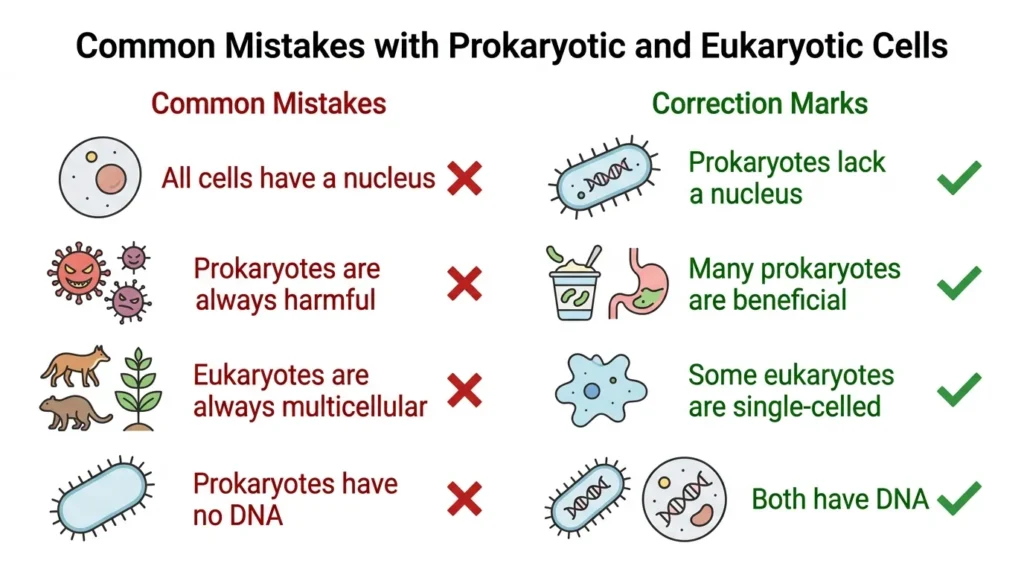
Mistake 1: Thinking All Cells Have a Nucleus
Prokaryotic cells do not possess a true nucleus.
Mistake 2: Assuming Bacteria Are Eukaryotic
All bacteria are prokaryotic organisms.
Mistake 3: Believing Larger Cells Are Always Better
Complexity does not necessarily mean superiority.
Mistake 4: Confusing Organelles with Cell Parts
Not all cell structures are membrane-bound organelles.
Mistake 5: Ignoring Similarities
Both cell types share many basic biological functions.
Real Life Examples with Prokaryotic and Eukaryotic
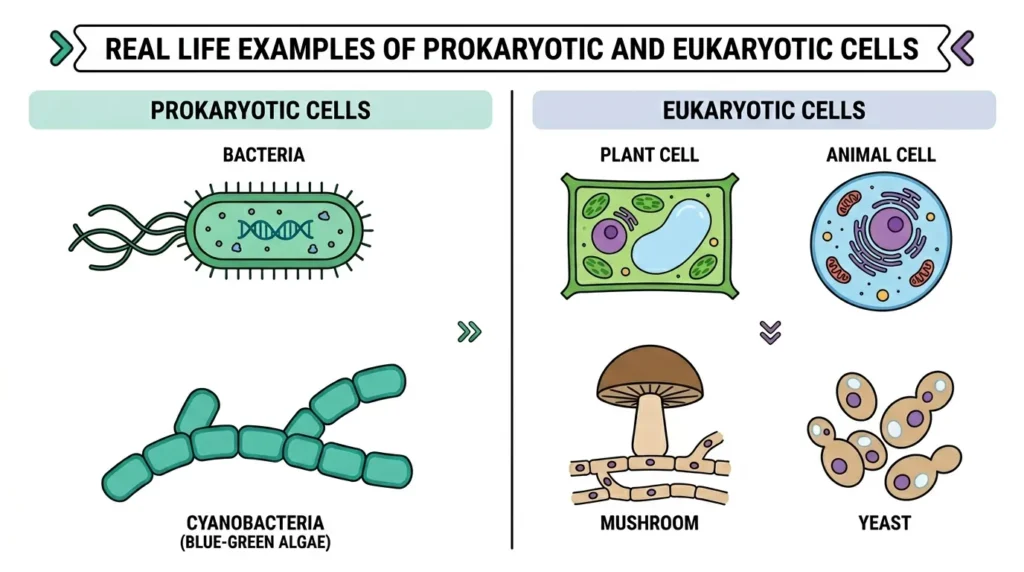
Human Body Example
Human cells are eukaryotic because they contain nuclei and organelles.
Digestive System Example
Helpful bacteria in the gut are prokaryotic.
Agriculture Example
Plant root cells are eukaryotic.
Medical Research Example
Scientists study bacterial cells to understand infections.
Biotechnology Example
Industries use bacterial prokaryotes to produce medicines and enzymes.
When to Use Each Concept
When Studying Microbiology
Focus on prokaryotic cells when learning about bacteria and archaea.
When Studying Human Biology
Focus on eukaryotic cells because all human tissues consist of them.
In Genetics Research
Understanding both cell types helps explain evolution and gene regulation.
Why People Get Confused Between Prokaryotic and Eukaryotic
Similar Biological Functions
Both perform respiration, reproduction, and protein synthesis.
Scientific Terminology
The names sound similar, causing confusion among beginners.
Shared Cell Components
Both contain DNA, ribosomes, and cytoplasm.
Educational Challenges
Many students memorize differences without understanding underlying biology.
How Search Engines Understand Difference Between Prokaryotic and Eukaryotic and User Intent
Search engines such as Google recognize that users searching for the difference between prokaryotic and eukaryotic cells typically want educational explanations, exam preparation material, comparison tables, and biology study resources.
Educational videos on YouTube often demonstrate cell structures visually, while science communities on Instagram and Meta share educational graphics that simplify cellular biology concepts.
Search algorithms prioritize content that clearly explains definitions, comparisons, examples, and practical applications because these satisfy user intent most effectively.
Expert Insight
One unique way to understand this topic is to think of a prokaryotic cell as a small workshop where everything happens in one room. A eukaryotic cell is more like a modern factory with specialized departments handling different tasks.
In real scientific research, complexity is not about being “better.” Prokaryotic cells remain incredibly successful organisms and continue to dominate many ecosystems on Earth. Their simplicity often makes them highly adaptable and efficient.
FAQs
What is the main difference between prokaryotic and eukaryotic cells?
Prokaryotic cells lack a nucleus, while eukaryotic cells have one.
Are bacteria prokaryotic or eukaryotic?
Bacteria are prokaryotic organisms.
Do prokaryotic cells have DNA?
Yes, they contain DNA, but it is not enclosed within a nucleus.
Which cells are larger?
Eukaryotic cells are generally larger.
Do both cell types have ribosomes?
Yes, both contain ribosomes for protein synthesis.
Why are eukaryotic cells more complex?
They contain specialized organelles that perform different functions.
Can prokaryotic organisms survive without organelles?
Yes, they efficiently perform life functions without membrane-bound organelles.
Which appeared first in evolution?
Prokaryotic cells appeared billions of years before eukaryotic cells.
Conclusion
Understanding the difference between prokaryotic and eukaryotic cells is one of the most important concepts in biology. While both cell types share essential components such as DNA, ribosomes, and cytoplasm, they differ significantly in structure, organization, and complexity.
Prokaryotic cells are smaller, simpler, and lack a true nucleus. Eukaryotic cells are larger, more organized, and contain specialized organelles that support advanced biological functions. These differences explain why bacteria function differently from plants, animals, fungi, and humans.
The key takeaway is simple: prokaryotes represent the simpler foundation of life, while eukaryotes represent a more complex evolutionary development. By understanding how these cells work, students and researchers gain deeper insight into genetics, evolution, medicine, and the living world itself.
Read more about!
Difference Between Guilt and Shame: Complete Guide
Difference Between Adderall and Ritalin: Complete Guide

I am James Carter, a professional content writer from the United States. I specialize in writing simple and clear comparison blogs that help students and readers understand difficult topics easily. My writing focuses on everyday language, education, science, and lifestyle topics. I believe that learning should be easy for everyone, so I use simple words and real-life examples in my articles.