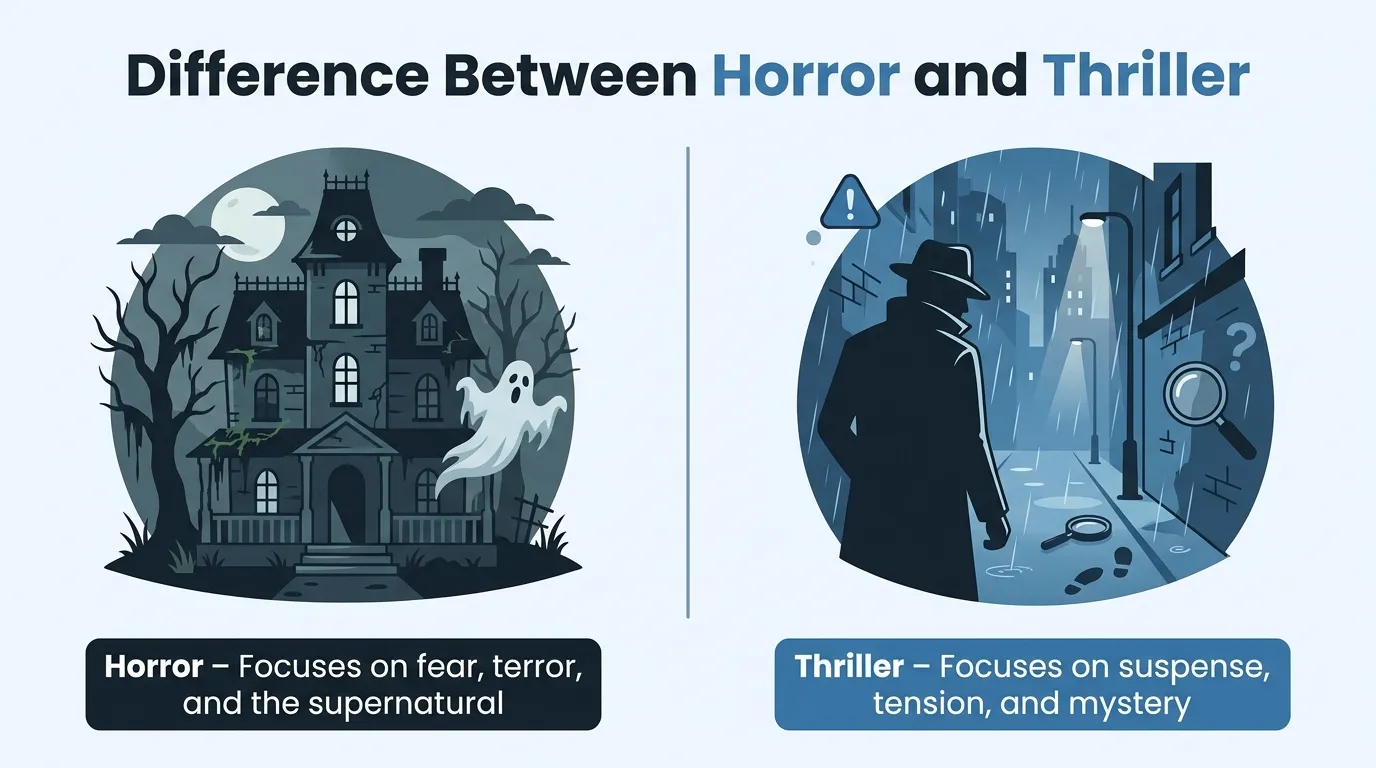
Horror aims to scare and disturb the audience, while thriller focuses on building suspense, tension, and anticipation.
Have you ever watched a movie that kept you on the edge of your seat and wondered if it was a horror film or a thriller? Many viewers search for the difference between horror and thriller because the two genres often overlap.
However, they are designed to create very different emotional experiences. The difference between horror and thriller comes down to the audience’s primary emotion: horror aims to create fear, while thriller aims to create suspense and tension.
Understanding the difference between horror and thriller helps movie lovers, writers, content creators, and even casual viewers choose the right type of entertainment.
In this guide, you’ll discover what each genre means, how they work, why people confuse them, and which films best represent each category.
Difference Between Horror and Thriller
The difference between horror and thriller is simple: horror tries to scare you, while thriller tries to keep you in suspense.
For example, a haunted house movie filled with supernatural creatures is usually horror. A story about a detective chasing a dangerous criminal is usually a thriller.
Definition of Horror and Thriller
What Is Horror?
Horror: A genre designed to evoke fear, dread, shock, or terror through supernatural elements, monsters, psychological threats, or disturbing situations.
What Is Thriller?
Thriller: A genre focused on suspense, tension, uncertainty, and anticipation, often involving crime, mystery, espionage, or psychological conflict.
Example:
A ghost hunting a family is horror.
A serial killer mystery where viewers try to identify the culprit is thriller.
Pronunciation
| Word | US Pronunciation | UK Pronunciation |
| Horror | HOR-er | HOR-uh |
| Thriller | THRIL-er | THRIL-uh |
Now that the definitions are clear, let’s understand why these genres trigger different emotional responses.
Difference Between Horror and Thriller: Comparison
| Feature | Horror | Thriller |
| Main Goal | Create fear | Create suspense |
| Audience Emotion | Terror and dread | Tension and anticipation |
| Common Villains | Monsters, ghosts, demons | Criminals, spies, killers |
| Story Focus | Survival from danger | Solving or preventing danger |
| Pacing | Often shock-based | Often tension-based |
| Ending Style | Can be tragic or terrifying | Usually resolves conflict |
| Psychological Impact | Fear response | Curiosity and suspense |
| Viewer Experience | Feeling scared | Feeling anxious and engaged |
Key Differences Explained Between Horror and Thriller
Horror Prioritizes Fear
Horror exists to frighten the audience.
Example: A haunted asylum filled with supernatural entities.
Thriller Prioritizes Suspense
Thrillers build tension and uncertainty.
Example: A detective racing against time to stop a serial killer.
Horror Often Uses Supernatural Elements
Many horror stories feature ghosts, demons, curses, and monsters.
Thrillers Usually Stay Grounded in Reality
Most thrillers involve believable threats such as crime, espionage, or psychological manipulation.
Horror Relies on Dread
Viewers expect frightening scenes and emotional shock.
Thriller Relies on Mystery
Viewers want answers and remain invested in uncovering the truth.
Horror Focuses on Survival
Characters often struggle simply to stay alive.
Thriller Focuses on Resolution
Characters typically work toward solving a problem or stopping a threat.
What Is Horror and Why Does It Exist?
How Horror Triggers Fear
Horror activates primal fears that humans have carried for centuries. Fear of darkness, death, isolation, and the unknown often appears in horror stories.
Why Audiences Enjoy Being Scared
Interestingly, many people enjoy horror because it allows them to experience fear in a safe environment.
Common Horror Subgenres
- Supernatural Horror
- Psychological Horror
- Body Horror
- Slasher Horror
- Gothic Horror
- Survival Horror
Popular Horror Examples
- The Exorcist
- Halloween
- The Conjuring
What Is Thriller and How Does It Create Suspense?
How Thrillers Build Tension
Thrillers create uncertainty. Viewers constantly wonder what will happen next.
Why Suspense Keeps Audiences Engaged
Unlike horror, thrillers often rely on puzzles, secrets, and high-stakes decisions.
Common Thriller Subgenres
- Psychological Thriller
- Crime Thriller
- Political Thriller
- Spy Thriller
- Legal Thriller
- Action Thriller
Popular Thriller Examples
- Se7en
- Gone Girl
- The Silence of the Lambs
Difference Between Horror and Thriller in Movies
Story Structure Differences
Horror often follows a survival narrative.
Thrillers frequently follow investigation, pursuit, or problem-solving narratives.
Character Goals
In horror, characters often want to escape danger.
In thrillers, characters often seek answers.
Audience Expectations
Horror fans expect scares.
Thriller fans expect suspense and surprises.
Difference Between Horror and Thriller in Books and Literature
Horror Literature
Authors focus on fear, darkness, and unsettling atmospheres.
Thriller Literature
Authors emphasize suspense, twists, and tension.
Famous Literary Examples
Many bestselling authors blend these genres, creating hybrid stories that appeal to broad audiences.
Why Do Horror and Thriller Often Overlap?
Shared Elements
Both genres use tension, danger, uncertainty, and conflict.
Hybrid Genres
Some stories combine horror and thriller elements.
Examples include psychological horror-thrillers and crime horror stories.
Why Classification Can Be Difficult
Many modern films intentionally blur genre boundaries to appeal to wider audiences.
Difference and Similarity
| Feature | Horror | Thriller | Similarity |
| Purpose | Create fear | Create suspense | Both engage emotions |
| Main Emotion | Terror | Tension | Both create intensity |
| Villains | Monsters or supernatural threats | Human or realistic threats | Both involve danger |
| Story Goal | Survival | Resolution | Both feature conflict |
| Atmosphere | Dark and frightening | Suspenseful and uncertain | Both create unease |
| Viewer Reaction | Fear | Anxiety | Both keep viewers engaged |
| Common Themes | Death, evil, survival | Mystery, crime, pursuit | Both explore risk |
| Entertainment Value | Adrenaline through fear | Adrenaline through suspense | Both provide excitement |
This table clearly shows the difference and similarity between horror and thriller for quick understanding.
Common Mistakes with Horror and Thriller
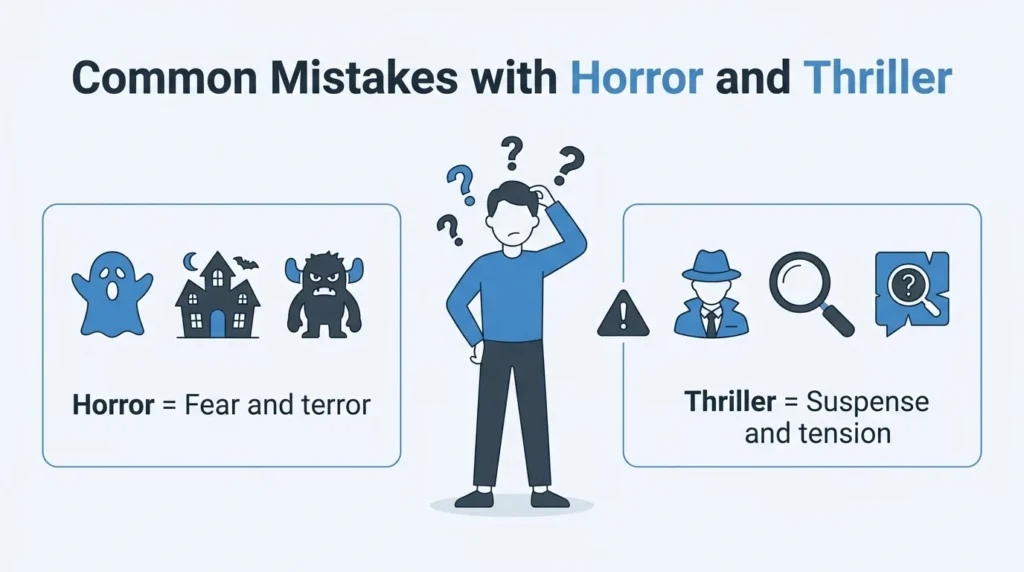
Mistake #1: Thinking Every Scary Movie Is Horror
Some suspenseful films are thrillers, not horror.
Mistake #2: Assuming Thrillers Cannot Be Frightening
Many thrillers contain frightening scenes without becoming horror films.
Mistake #3: Ignoring Genre Hybrids
Many successful stories combine elements from both genres.
Mistake #4: Confusing Suspense with Fear
Suspense and fear are related but not identical emotions.
Mistake #5: Judging a Genre by One Scene
A single scary scene does not automatically make a film horror.
Real Life Examples with Horror and Thriller
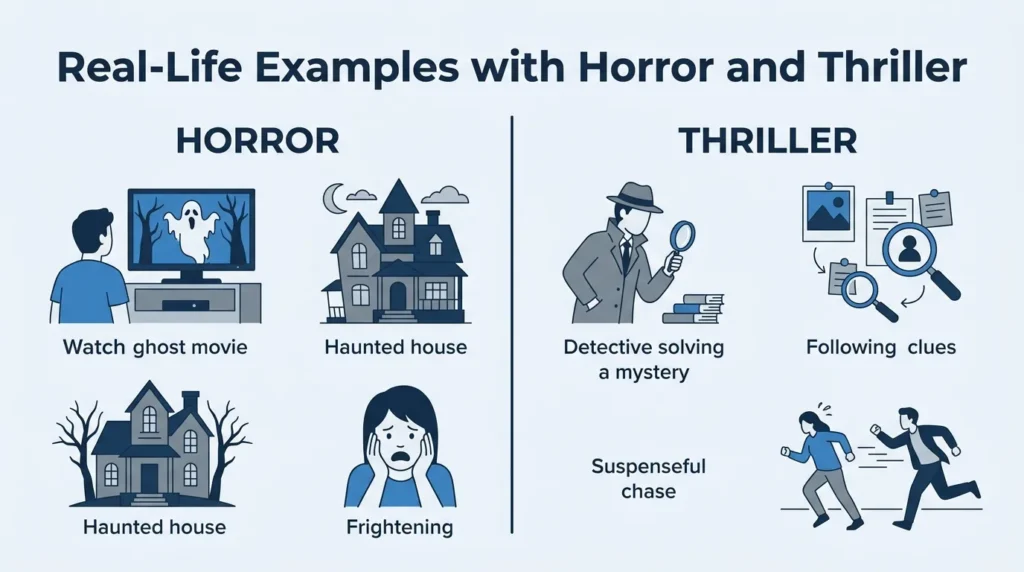
Personal Entertainment Example
A viewer chooses horror for a Halloween movie night.
Streaming Platform Example
A user searching for suspenseful content selects a thriller series.
Film Industry Example
Studios market horror and thriller films differently because audience expectations differ.
Content Creator Example
A YouTube reviewer may analyze if a movie focuses more on fear or suspense.
Business Example
Streaming services categorize horror and thriller separately to improve user recommendations.
When to Use Each
When to Watch Horror
Choose horror if you enjoy fear, supernatural themes, and shocking moments.
When to Watch Thriller
Choose thriller if you enjoy mysteries, suspense, investigations, and psychological tension.
For Writers and Creators
Use horror when fear is the primary goal.
Use thriller when suspense drives the narrative.
Why People Get Confused Between Horror and Thriller
Similar Emotional Reactions
Both genres create intense feelings.
Shared Story Elements
Danger, conflict, and uncertainty exist in both.
Marketing Strategies
Studios sometimes market films as both horror and thriller.
Streaming Platform Labels
Genre labels are not always consistent across platforms.
Hybrid Productions
Modern films often blend multiple genres together.
How Search Engines Understand Difference Between Horror and Thriller and User Intent
Why Google Associates These Genres
Google understands that users frequently compare entertainment genres when choosing movies, books, and TV shows.
How User Intent Shapes Search Results
Search engines prioritize comparison guides, genre explanations, and recommendation articles.
The Role of Social Platforms
Content creators on YouTube, Instagram, and Meta discuss movie genres, influencing audience understanding and search behavior.
Why Genre Understanding Matters
Better genre classification helps users find content that matches their preferences.
Expert Insight
One of the biggest misconceptions is that horror and thriller are defined by story events. In reality, they are defined by emotional intent.
A serial killer can appear in both genres. The difference is how the audience is meant to feel. If the goal is fear, the story leans toward horror. If the goal is suspense and anticipation, it leans toward thriller.
This emotional-design perspective is often how filmmakers, screenwriters, and critics distinguish the two genres.
FAQs
What is the main difference between horror and thriller?
Horror aims to create fear, while thriller aims to create suspense.
Can a movie be both horror and thriller?
Yes. Many films combine elements of both genres.
Which genre is scarier?
Horror is generally designed to be scarier.
Is psychological horror a thriller?
Sometimes. Psychological horror often overlaps with psychological thriller.
Why do people confuse horror and thriller?
Because both involve danger, tension, and emotional intensity.
Is a serial killer movie always a thriller?
No. It can be horror, thriller, or both depending on the story’s focus.
Which genre is more popular?
Popularity varies depending on trends and audience preferences.
Are horror and thriller books different?
Yes. Horror books emphasize fear, while thriller books emphasize suspense.
Conclusion
Understanding the difference between horror and thriller helps viewers, readers, and creators appreciate storytelling on a deeper level. Although both genres create tension and excitement, they achieve this through different emotional goals. Horror seeks to provoke fear, dread, and terror, while thriller focuses on suspense, uncertainty, and anticipation.
Many people assume the genres are interchangeable because they often share villains, danger, and dramatic situations. However, the audience’s emotional experience is what truly separates them. Horror asks, “How frightening can this become?” Thriller asks, “What will happen next?”
If you enjoy supernatural scares, psychological tension, crime mysteries, or suspenseful investigations, recognizing the difference between horror and thriller can help you choose the right entertainment and better understand how stories are designed to affect emotions.
Read more about!
Difference Between Adderall and Ritalin: Complete Guide
Difference Between Their and There: Easy Guide

I am Emily Johnson, a USA-based content writer who creates easy-to-read blogs on language and daily life topics. I explain complex ideas in simple English for students and beginners so they can understand easily.