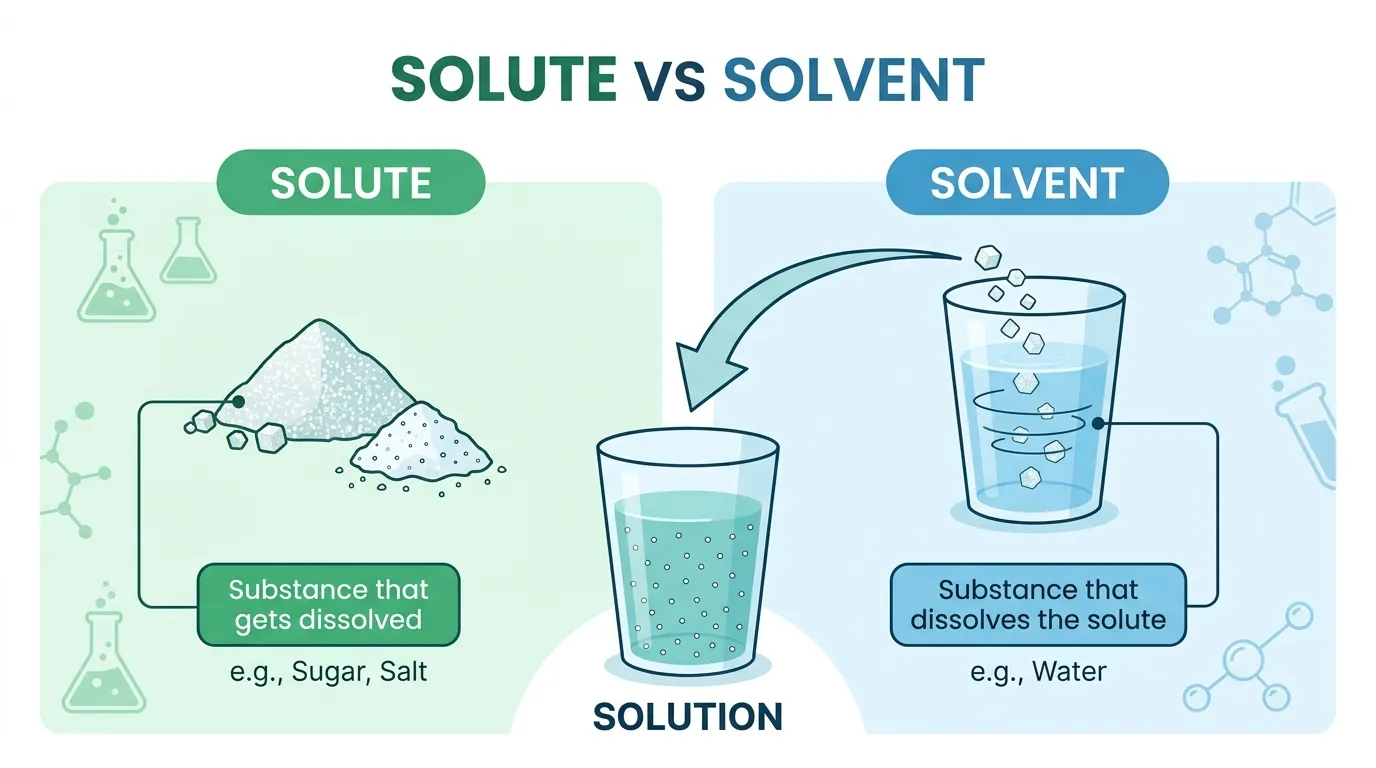
A solute is the substance that gets dissolved, while a solvent is the substance that dissolves it to form a solution.
When students start learning chemistry, one of the most confusing topics is the difference between solute and solvent.
Many learners search for the difference between solute and solvent because both terms appear together in every solution-related concept, especially in school experiments and real-life mixtures like salt water, sugar tea, and soft drinks.
In simple words, the difference between solute and solvent is that the solute is the substance that gets dissolved, while the solvent is the substance that does the dissolving. This concept is very important in chemistry, biology, medicine, and even daily life products.
In this complete guide, you will understand what solute and solvent mean, how they interact, why they are important, real-life examples, key differences, common mistakes, and how scientists use these terms in real-world systems like laboratories and industries.
Difference Between Solute and Solvent
The solute is the substance that dissolves in a solution, while the solvent is the substance that dissolves the solute.
Example:
In salt water, salt is the solute and water is the solvent.
Definition of Solute and Solvent
- Solute: The substance that is dissolved in a solution, usually in smaller quantity.
- Solvent: The substance that dissolves the solute, usually in larger quantity.
Pronunciation
- Solute: “SOL-yoot”
- Solvent: “SOL-vent”
Now that the basics are clear, let’s understand how these two work together in real life and chemistry systems.
Comparison: Difference Between Solute and Solvent
| Feature | Solute | Solvent | Similarity |
| Definition | Substance being dissolved | Substance doing the dissolving | Both form a solution |
| Quantity | Present in smaller amount | Present in larger amount | Both are parts of mixture |
| Role | Gets dissolved | Dissolves solute | Both interact chemically/physically |
| State | Can be solid, liquid, or gas | Usually liquid (but can vary) | Both exist in same solution |
| Example | Salt in water | Water in salt solution | Both form saltwater |
| Function | Added substance | Base medium | Both essential for solution formation |
| Identification | Disappears in solution | Remains dominant | Both cannot be separated visually easily |
This table clearly shows the difference and similarity between solute and solvent for quick understanding.
Key Differences Between Solute and Solvent
1. Role in Solution Formation
Solute is dissolved, solvent dissolves it.
Example: Sugar dissolves in tea.
2. Quantity Difference
Solute is smaller in amount, solvent is larger.
Example: A small amount of salt in a large glass of water.
3. Physical State
Solute can be solid, liquid, or gas, while solvent is mostly liquid.
Example: Carbon dioxide in soda water.
4. Visibility in Solution
Solute becomes invisible after dissolving, solvent remains dominant.
5. Chemical Interaction
Solute particles spread evenly in solvent molecules.
Example: Ink spreading in water.
6. Real-Life Importance
Solutes determine taste, color, or effect, solvents determine structure.
7. Industrial Use
Solvents are widely used in pharmaceuticals and cleaning products.
What is a Solute?
A solute is the substance that dissolves in a solvent to form a solution. It is usually present in a smaller amount.
Example:
Salt in seawater.
Solutes are important in chemistry reactions, medicine formulation, and food preparation.
What is a Solvent?
A solvent is the substance that dissolves a solute. It is usually present in a larger amount.
Example:
Water in saltwater.
Water is called the “universal solvent” because it dissolves many substances.
Why Solute and Solvent Concept Exists
This concept helps scientists understand how substances mix at molecular levels.
In real-world science, understanding solute and solvent helps in:
- Drug formulation in medicine
- Chemical reactions in labs
- Food and beverage production
- Environmental science studies
How Solute and Solvent Work Together
When a solute is added to a solvent, its particles break apart and spread evenly.
Example:
Sugar dissolving in water happens because water molecules surround sugar particles and separate them.
This process is called dissolution.
Real-Life Examples with Solute and Solvent
1. Tea or Coffee
Sugar = solute
Water = solvent
2. Salt Water
Salt = solute
Water = solvent
3. Soft Drinks
Carbon dioxide = solute
Water = solvent
4. Medicine Syrup
Medicine compounds = solute
Alcohol/water = solvent
5. Air (Gas Solution)
Oxygen = solute
Nitrogen = solvent
Common Mistakes with Solute and Solvent
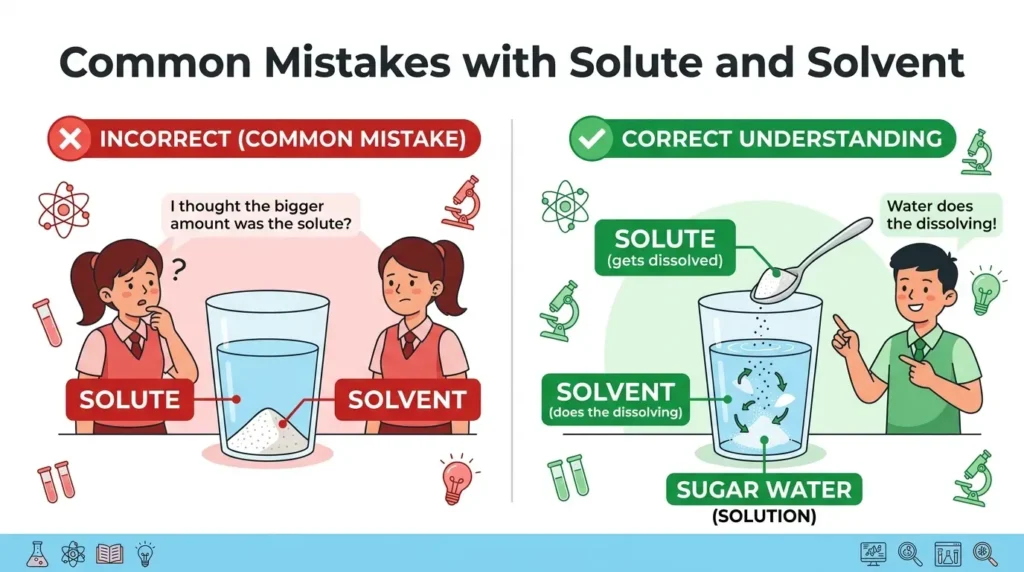
1. Thinking Both Are Always Liquids
Fix: Solutes can be solid, liquid, or gas.
2. Confusing Quantity Role
Fix: Solvent is usually in larger amount.
3. Assuming Solute Disappears
Fix: It only dissolves, not disappears.
4. Thinking Water is Always Solvent
Fix: Water is common but not always the solvent.
5. Mixing Up Definitions
Fix: Remember solute is dissolved, solvent dissolves.
Real-Life Importance of Solute and Solvent
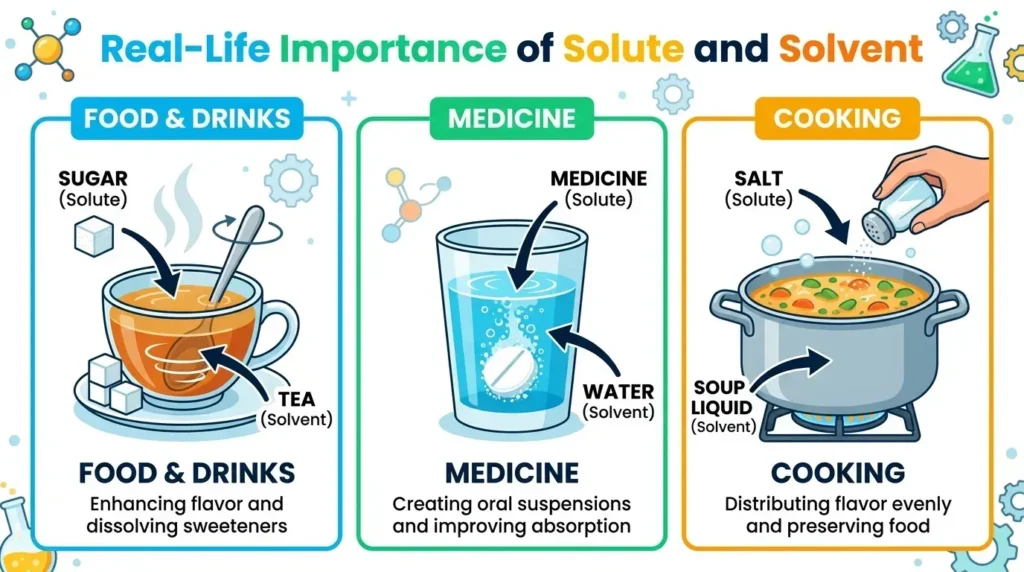
1. Personal Use
Making tea, juice, or homemade drinks.
2. Medical Industry
Drugs are dissolved in solvents for better absorption.
3. Food Industry
Flavoring, coloring, and preservation processes.
4. Environmental Science
Understanding pollution in water and air.
5. Chemical Manufacturing
Producing paints, cleaners, and fuels.
When to Use Solute and Solvent Concept
- While studying solutions in chemistry
- While mixing substances in labs
- While preparing medicines
- While analyzing environmental samples
Why People Get Confused
- Both terms are always taught together
- Real-life examples overlap
- Some substances act as both solute and solvent depending on context
- Textbooks use complex explanations
How Search Engines Understand This Topic
Search engines like Google analyze queries such as:
- What is solute?
- What is solvent?
- Difference between solute and solvent
- Examples of solute and solvent
Platforms like YouTube and educational content on Instagram also categorize this under chemistry learning topics.
They prioritize content that includes:
- Clear definitions
- Real-life examples
- Tables and comparisons
- Simple explanations
Expert Insight
In practical chemistry and industrial applications, solute and solvent behavior is studied at molecular level. Professionals working in pharmaceuticals and chemical engineering always consider solubility, concentration, and interaction forces before creating solutions.
In real scenarios, even small changes in solvent type can change how a solute behaves. That’s why experts never treat this concept as simple memorization it is a foundation of chemistry understanding.
FAQs
Is water always a solvent?
No, but it is the most common solvent.
Can a solute be a gas?
Yes, gases like oxygen can act as solutes.
Can one substance be both solute and solvent?
Yes, depending on the mixture.
Why is solute important?
It determines the properties of a solution.
What is the main role of solvent?
To dissolve other substances.
Can liquids act as solutes?
Yes, liquids can also be solutes.
What is a solution?
A mixture of solute and solvent.
Why is this concept important in chemistry?
It explains how substances interact at molecular level.
Conclusion
The difference between solute and solvent is a fundamental chemistry concept that explains how solutions are formed. The solute is the substance that gets dissolved, while the solvent is the substance that dissolves it. This relationship is essential in science, medicine, food, and daily life.
Understanding the difference between solute and solvent helps students build a strong chemistry foundation and apply this knowledge in real-world situations like making drinks, studying reactions, or working in laboratories.
In simple terms, every solution in the world is built on this basic interaction between solute and solvent, making it one of the most important concepts in chemistry.
Read more about!
Difference Between UI and UX: Complete Guide
Difference Between Autism and ADHD: Complete Guide

I am Emily Johnson, a USA-based content writer who creates easy-to-read blogs on language and daily life topics. I explain complex ideas in simple English for students and beginners so they can understand easily.