Autism affects social communication and behavior patterns, while ADHD mainly affects attention, impulse control, and activity levels.
Many people search for the difference between autism and ADHD because the two conditions can look similar on the surface. A child who struggles to focus may also have social challenges.
An adult who seems distracted might also prefer routines and specific interests. Because of these overlaps, understanding the difference between autism and ADHD can be confusing.
The difference between autism and ADHD is that autism primarily affects social communication, behavior patterns, and sensory processing, while ADHD mainly affects attention, impulse control, and hyperactivity. However, some people can have both conditions at the same time.
In this guide, you will learn what autism and ADHD are, how they differ, why people confuse them, real-life examples, common mistakes, and practical insights based on current understanding.
Difference Between Autism and ADHD
Autism and ADHD are both neurodevelopmental conditions, but they affect the brain differently.
- Autism mainly influences social communication, sensory experiences, and repetitive behaviors.
- ADHD mainly affects attention, focus, organization, impulse control, and activity levels.
Example
A child with ADHD may interrupt conversations because of impulsivity.
A child with autism may struggle to understand social cues and body language even when paying attention.
Definition of Difference Between Autism and ADHD
- Autism (Autism Spectrum Disorder – ASD): A neurodevelopmental condition that affects communication, social interaction, sensory processing, and behavior patterns.
- ADHD (Attention-Deficit/Hyperactivity Disorder): A neurodevelopmental condition that affects attention regulation, impulse control, executive functioning, and activity levels.
Pronunciation
Autism
- US: AW-tiz-um
- UK: OR-tiz-um
ADHD
- US: A-D-H-D
- UK: A-D-H-D
Now that we know the basic definitions, let’s explore how these conditions differ in everyday life.
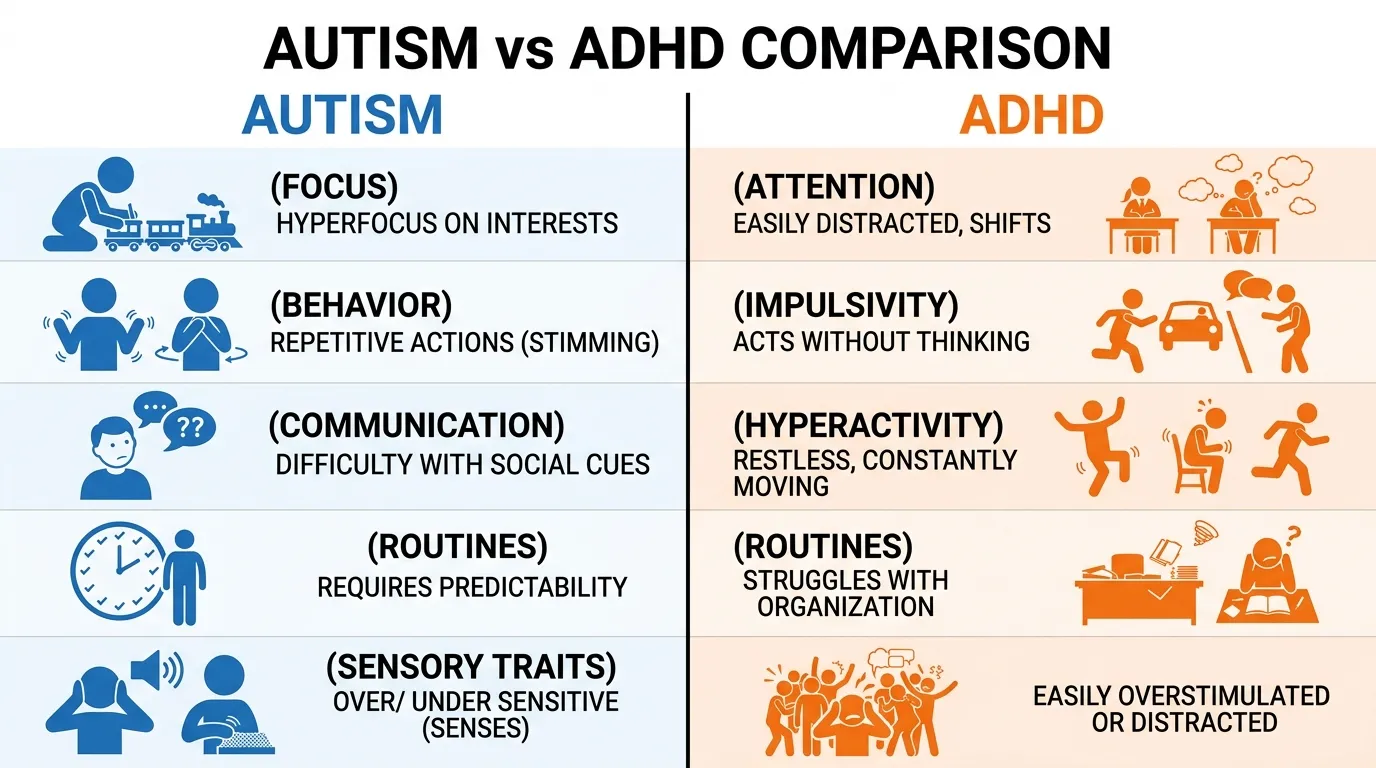
Autism vs ADHD Comparison
| Feature | Autism | ADHD |
| Main Challenge | Social communication and behavior patterns | Attention and impulse control |
| Social Skills | Often struggles with social cues | Usually understands cues but may miss them due to distraction |
| Focus | Intense focus on specific interests | Difficulty maintaining focus |
| Routine | Prefers predictable routines | Often seeks novelty and change |
| Communication | May interpret language literally | May talk excessively or interrupt |
| Sensory Processing | Frequently highly sensitive | Can be sensitive but less central |
| Impulsivity | Less common core feature | Major symptom |
| Hyperactivity | Not always present | Common symptom |
| Organization | Varies greatly | Often struggles with organization |
| Diagnosis | Autism Spectrum Disorder | Attention-Deficit/Hyperactivity Disorder |
Key Differences Explained Between Autism and ADHD
1. Social Communication
People with autism often find social interactions difficult because understanding facial expressions, tone, or unwritten social rules can be challenging.
People with ADHD usually understand these rules but may forget or overlook them due to distraction.
Real Example
An autistic child may not recognize sarcasm. A child with ADHD may understand sarcasm but miss it because they were not paying attention.
2. Attention Patterns
Many people think autism means poor attention, but that is not always true.
Autistic individuals may become deeply focused on specific interests for long periods.
People with ADHD often struggle to sustain attention unless the activity is highly stimulating.
3. Routines and Structure
Autistic individuals often feel comfortable with predictable routines.
People with ADHD may become bored by repetitive routines and seek variety.
4. Impulsivity
Impulsivity is one of the defining characteristics of ADHD.
Autism may involve behavioral challenges, but impulsivity is generally not the primary issue.
5. Sensory Experiences
Autistic individuals frequently experience strong reactions to sounds, lights, textures, or smells.
While sensory issues can occur in ADHD, they are typically more prominent in autism.
6. Special Interests
Autism is often associated with deep and highly focused interests.
ADHD may involve intense interests as well, but they often change more frequently.
7. Executive Functioning
Both conditions can affect planning, organization, and task completion.
However, executive function challenges are often a central feature of ADHD.
What Is Autism and How Does It Affect Daily Life?
Autism exists on a spectrum, meaning experiences vary widely.
Common characteristics include:
- Difficulty understanding social cues
- Strong interests in specific topics
- Preference for routines
- Sensory sensitivities
- Literal interpretation of language
In real scenarios, an autistic student may excel in mathematics but struggle with group discussions because interpreting social dynamics requires extra effort.
What Is ADHD and How Does It Affect Daily Life?
ADHD affects how the brain manages attention and self-regulation.
Common signs include:
- Forgetfulness
- Distractibility
- Hyperactivity
- Impulsiveness
- Difficulty completing tasks
In practical use, an employee with ADHD may have excellent ideas but struggle to meet deadlines because staying organized is challenging.
Can Someone Have Both Autism and ADHD?
Yes.
Modern diagnostic guidelines recognize that autism and ADHD can occur together.
Research shows many autistic individuals also display ADHD traits.
When both conditions occur:
- Social communication challenges may exist.
- Attention difficulties may also be present.
- Support strategies often need to address both areas.
This overlap explains why many users get confused when comparing autism and ADHD.
Difference and Similarity Between Autism and ADHD
| Feature | Autism | ADHD | Similarity |
| Brain Development | Neurodevelopmental condition | Neurodevelopmental condition | Both affect brain development |
| Attention | Often focused intensely | Often easily distracted | Attention can differ from typical patterns |
| Social Interaction | Core challenge | Secondary challenge | Both may affect relationships |
| Communication | Frequently affected | Sometimes affected | Communication issues can occur |
| Sensory Processing | Common | Possible | Sensory differences may appear |
| School Performance | Varies greatly | Varies greatly | Both can affect learning |
| Emotional Regulation | Can be challenging | Can be challenging | Emotional support may help |
| Lifelong Impact | Usually lifelong | Usually lifelong | Both continue into adulthood |
This table clearly shows the difference and similarity between autism and ADHD for quick understanding.
Common Mistakes with Autism and ADHD
Mistake 1: Thinking They Are the Same Condition
Although they share some symptoms, they are distinct diagnoses.
Fix
Focus on the underlying reason behind behaviors.
Mistake 2: Assuming Every Autistic Person Has ADHD
Many do, but not all.
Fix
Evaluate each condition independently.
Mistake 3: Believing ADHD Only Means Hyperactivity
ADHD also affects focus, memory, planning, and emotional regulation.
Fix
Understand the inattentive and combined presentations.
Mistake 4: Ignoring Sensory Differences
Sensory challenges can significantly affect daily life.
Fix
Consider sensory experiences during assessment.
Mistake 5: Expecting Everyone to Show the Same Symptoms
Both conditions exist on a spectrum of experiences.
Fix
Avoid one-size-fits-all assumptions.
Real-Life Examples with Autism and ADHD
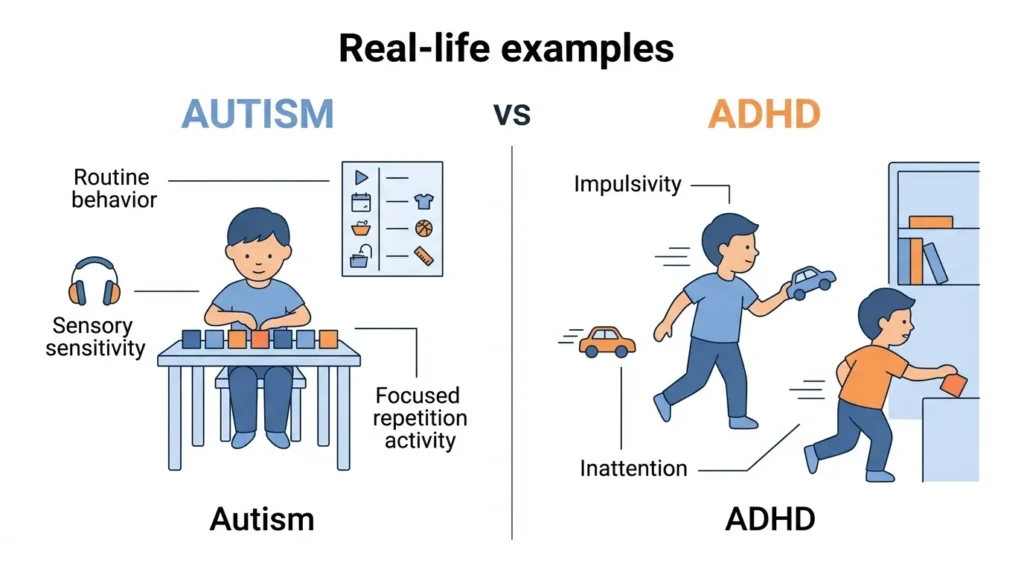
Scenario 1: School
An autistic student may struggle with group projects because social interaction is difficult.
A student with ADHD may struggle because they lose focus during instructions.
Scenario 2: Workplace
An autistic employee may prefer predictable routines.
An employee with ADHD may thrive in dynamic environments.
Scenario 3: Social Events
An autistic person may find large gatherings overwhelming due to sensory input.
A person with ADHD may enjoy the event but become distracted during conversations.
Scenario 4: Personal Interests
An autistic individual may spend years mastering a specific topic.
Someone with ADHD may enthusiastically pursue several hobbies over time.
When to Use Each Understanding
Understanding autism is particularly important when discussing:
- Social communication differences
- Sensory processing
- Behavioral patterns
- Specialized interests
Understanding ADHD is particularly important when discussing:
- Focus
- Productivity
- Organization
- Impulse control
For educators, employers, parents, and healthcare professionals, recognizing the distinction improves support and outcomes.
Why People Get Confused Between Autism and ADHD
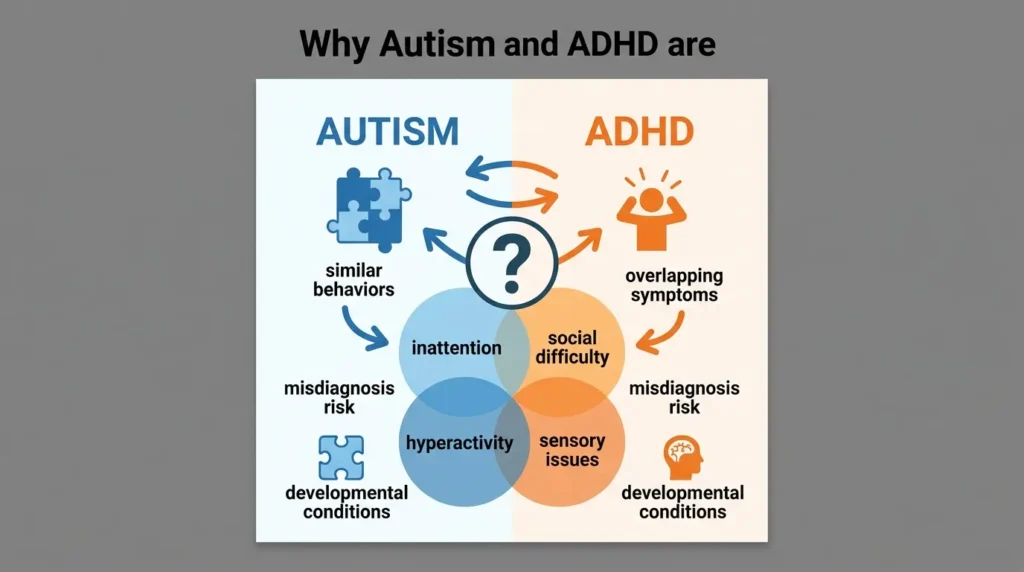
Several reasons contribute to confusion:
Symptom Overlap
Both can involve attention difficulties and emotional regulation challenges.
Shared Neurodevelopmental Origins
Both conditions affect brain development.
Co-Occurrence
Many individuals experience both autism and ADHD.
Media Representation
Social media platforms such as Instagram, YouTube, and discussions across online communities sometimes oversimplify symptoms, leading to misunderstandings.
How Search Engines Understand Autism and ADHD and User Intent
Search engines such as Google analyze user intent behind searches like:
- What is autism?
- What is ADHD?
- Difference between autism and ADHD
- Autism vs ADHD symptoms
- Can autism and ADHD occur together?
Google attempts to provide content that directly answers these questions while demonstrating expertise, trustworthiness, and relevance.
Users searching this topic typically want:
- Quick definitions
- Symptom comparisons
- Diagnosis information
- Real-life examples
- Practical guidance
Content that satisfies these needs generally performs better because it matches user intent.
Expert Insight
From a professional perspective, the most important thing to remember is that autism and ADHD are not simply labels. They describe different patterns of brain functioning.
In real-world assessments, clinicians rarely focus on a single symptom. Instead, they evaluate communication, attention, sensory processing, executive functioning, behavior patterns, and daily-life impact together.
Most beginners focus on visible behaviors. Experts focus on the reasons behind those behaviors. That distinction often leads to a more accurate understanding and better support strategies.
FAQs
Is autism the same as ADHD?
No. Autism and ADHD are separate neurodevelopmental conditions with different core characteristics.
Can a person have both autism and ADHD?
Yes. Many individuals meet diagnostic criteria for both conditions.
Which is more common, autism or ADHD?
ADHD is generally diagnosed more frequently than autism.
Does autism always involve social difficulties?
Social communication differences are a core feature of autism, though experiences vary.
Does ADHD always involve hyperactivity?
No. Some people primarily experience inattentive symptoms.
Can adults have autism and ADHD?
Yes. Both conditions can continue throughout adulthood.
Are sensory issues only found in autism?
No. ADHD can also involve sensory sensitivities, but they are generally more central in autism.
Can treatment be the same for both?
Support strategies may overlap, but treatment plans are often tailored to individual needs.
Why do autism and ADHD overlap so much?
Both involve neurodevelopmental differences and can affect executive functioning.
Can someone be diagnosed later in life?
Yes. Many adults receive diagnoses after recognizing lifelong patterns.
Conclusion
Understanding the difference between autism and ADHD is important because the two conditions share certain traits while remaining fundamentally different. Autism primarily affects social communication, sensory experiences, and behavioral patterns. ADHD primarily affects attention regulation, impulsivity, organization, and executive functioning.
The overlap between autism and ADHD often causes confusion, especially when symptoms appear similar. However, the underlying reasons behind those behaviors are frequently different. Some individuals experience only autism, some experience only ADHD, and others have both conditions simultaneously.
By learning the definitions, comparison points, similarities, common mistakes, and real-life examples discussed in this guide, you can better understand how each condition affects daily life. If you are a parent, teacher, employer, student, or simply curious, recognizing the true difference between autism and ADHD helps create more informed conversations and better support for neurodivergent individuals.
Read more about!
Difference Between Parsley and Cilantro: Complete Guide
Difference Between Imperfect and Preterite: Easy Guide

I am Emily Johnson, a USA-based content writer who creates easy-to-read blogs on language and daily life topics. I explain complex ideas in simple English for students and beginners so they can understand easily.