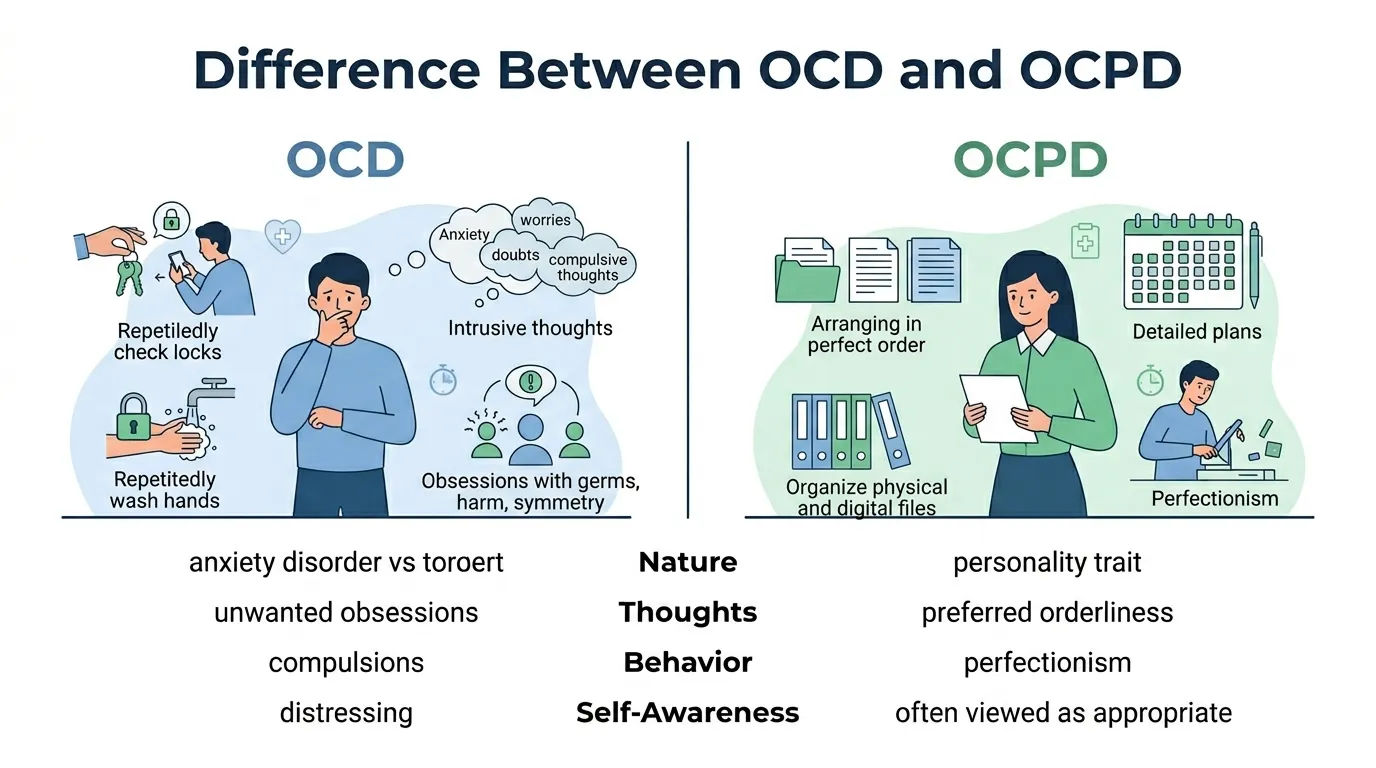
OCD involves unwanted obsessive thoughts and repetitive behaviors, while OCPD is a personality pattern marked by perfectionism, control, and rigid adherence to rules.
Many people search for the difference between OCD and OCPD because the two conditions sound similar and both involve perfectionism, rules, or repetitive behaviors.
However, they are actually different mental health conditions with distinct causes, symptoms, and treatment approaches.
The difference between OCD and OCPD is important because misunderstanding them can lead to confusion about diagnosis, treatment, and daily life challenges.
In simple words, OCD involves unwanted obsessions and compulsions that cause distress, while OCPD is a personality pattern centered around perfectionism, control, and rigid thinking.
In this guide, you’ll learn what OCD and OCPD are, how they differ, why people confuse them, real-world examples, treatment options, and expert insights that help make this complex topic easy to understand.
Difference Between OCD and OCPD
OCD (Obsessive-Compulsive Disorder) is a mental health condition involving intrusive thoughts and repetitive behaviors performed to reduce anxiety. OCPD (Obsessive-Compulsive Personality Disorder) is a personality disorder characterized by excessive perfectionism, orderliness, and a need for control.
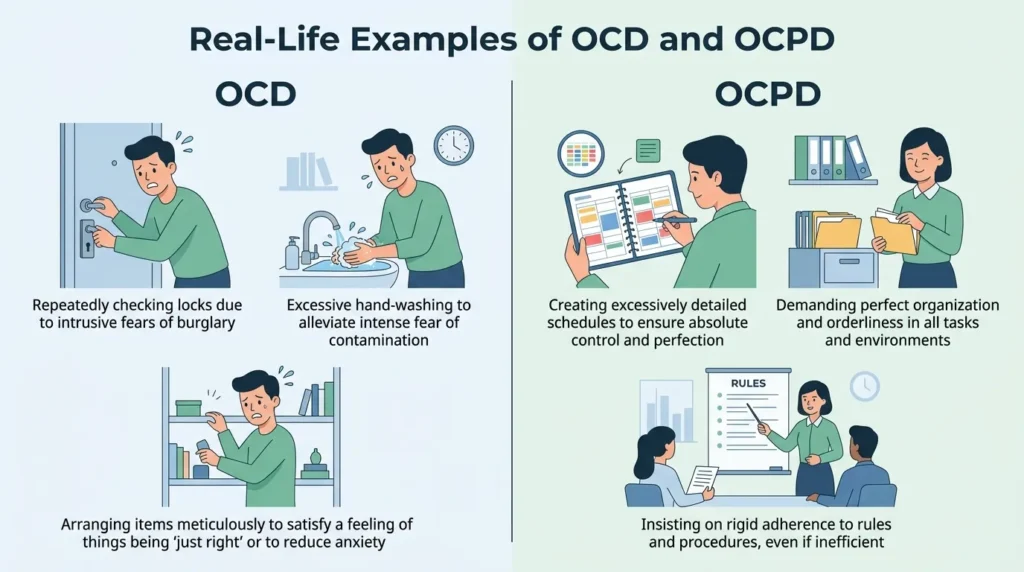
Example: A person with OCD may repeatedly check locks because of anxiety, while a person with OCPD may insist everything must be done according to their exact standards.
Definition of OCD and OCPD
- OCD (Obsessive-Compulsive Disorder): A mental health disorder involving unwanted thoughts (obsessions) and repetitive actions (compulsions) aimed at reducing distress.
- OCPD (Obsessive-Compulsive Personality Disorder): A personality disorder involving rigid perfectionism, excessive control, and strict adherence to rules and order.
Example: OCD may involve repeatedly washing hands due to contamination fears, while OCPD may involve organizing everything perfectly because it feels “right.”
Pronunciation
| Term | US Pronunciation | UK Pronunciation |
| OCD | Oh-See-Dee | Oh-See-Dee |
| OCPD | Oh-See-Pee-Dee | Oh-See-Pee-Dee |
Now that we know the basic definitions, let’s understand what truly separates these two commonly confused conditions.
Difference Between OCD and OCPD Comparison
| Feature | OCD | OCPD |
| Condition Type | Anxiety-related disorder | Personality disorder |
| Core Issue | Intrusive thoughts and compulsions | Perfectionism and control |
| Self-Awareness | Usually recognizes symptoms as unwanted | Often views behavior as appropriate |
| Distress Source | Obsessions cause anxiety | Frustration when standards are not met |
| Flexibility | Wants relief from symptoms | Often prefers existing behaviors |
| Daily Impact | Time-consuming rituals | Relationship and work difficulties |
| Treatment Approach | Therapy and sometimes medication | Primarily psychotherapy |
| Insight Level | Often high | Often limited |
Key Differences Explained Between OCD and OCPD
1. Intrusive Thoughts vs Personality Traits
The biggest difference is that OCD involves unwanted intrusive thoughts.
People with OCPD generally do not experience obsessive thoughts in the same way.
Example: Someone with OCD may fear germs constantly. Someone with OCPD may simply prefer strict cleanliness standards.
2. Anxiety Drives OCD
OCD compulsions are often performed to reduce anxiety.
With OCPD, behaviors are usually driven by perfectionism and a desire for control rather than fear.
3. Self-Perception
Many people with OCD recognize that their behaviors may be excessive.
People with OCPD often believe their methods are correct and necessary.
4. Relationship Impact
OCPD commonly creates interpersonal challenges because rigid standards affect family, coworkers, and friends.
OCD can affect relationships too, but usually through anxiety-related behaviors.
5. Need for Perfection
Perfectionism is central to OCPD.
While OCD can involve perfection-related obsessions, perfectionism is not always present.
6. Emotional Experience
OCD often causes significant distress.
People with OCPD may experience frustration when others fail to meet expectations.
7. Treatment Goals
Treatment for OCD focuses on reducing obsessions and compulsions.
For OCPD, therapy often aims to increase flexibility and improve relationships.
What Is OCD and How Does It Work?
OCD is a recognized mental health condition involving a cycle of obsessions and compulsions.
Common Obsessions
- Fear of contamination
- Fear of harm
- Need for certainty
- Intrusive unwanted thoughts
- Fear of making mistakes
Common Compulsions
- Excessive hand washing
- Repeated checking
- Counting rituals
- Reassurance seeking
- Repeating actions
In practical use, these behaviors are not enjoyable. They are often performed to temporarily reduce anxiety.
What Is OCPD and How Does It Work?
OCPD is a personality disorder characterized by:
- Perfectionism
- Rigidity
- Excessive attention to detail
- Need for control
- Difficulty delegating tasks
Unlike OCD, these traits are often deeply integrated into a person’s personality.
Many individuals with OCPD may not see their behavior as problematic.
Difference Between OCD and OCPD in Daily Life
Understanding daily life examples makes the distinction easier.
OCD Example
A person checks the stove 20 times before leaving because they fear causing a fire.
OCPD Example
A person insists family members follow strict household rules and becomes frustrated when routines change.
The behavior may look similar externally, but the motivation behind it is very different.
Why Does the Difference Between OCD and OCPD Matter Clinically?
Correct diagnosis affects treatment.
A therapist treating OCD often focuses on reducing compulsions and anxiety.
A therapist treating OCPD may focus more on personality patterns, interpersonal relationships, and flexibility.
This distinction helps mental health professionals develop effective treatment plans.
Can Someone Have Both OCD and OCPD?
Yes.
Although they are separate conditions, some individuals meet criteria for both.
When this occurs, symptoms may overlap and create additional challenges.
Professional assessment is important because treatment strategies may need adjustment.
What Causes OCD and OCPD?
Possible OCD Factors
- Brain circuitry differences
- Genetics
- Anxiety sensitivity
- Environmental influences
- Stressful life events
Possible OCPD Factors
- Personality development
- Family influences
- Learned behaviors
- Genetic predisposition
- Early life experiences
Researchers continue studying how biological and environmental factors interact.
How Are OCD and OCPD Treated?
OCD Treatment
- Cognitive Behavioral Therapy (CBT)
- Exposure and Response Prevention (ERP)
- Medication when appropriate
- Anxiety management strategies
OCPD Treatment
- Psychotherapy
- Cognitive restructuring
- Interpersonal skills development
- Emotional awareness training
Treatment plans vary based on individual needs and professional evaluation.
Difference and Similarity Between OCD and OCPD
| Feature | OCD | OCPD | Similarity |
| Mental Health Condition | Yes | Yes | Both affect daily life |
| Perfectionism | Sometimes | Core feature | Can appear in both |
| Anxiety | Major component | Less central | Emotional distress possible |
| Repetitive Behaviors | Common | Possible | Behavior patterns may overlap |
| Relationships | Can be affected | Often affected | Social challenges possible |
| Professional Treatment | Often needed | Often needed | Therapy may help |
| Long-Term Management | Common | Common | Improvement is possible |
| Diagnosis | Clinical evaluation | Clinical evaluation | Requires professional assessment |
This table clearly shows the difference and similarity between OCD and OCPD for quick understanding.
Common Mistakes with OCD and OCPD
Mistake 1: Assuming They Are the Same Disorder
Correction: They are separate diagnoses with different characteristics.
Mistake 2: Calling Every Organized Person “OCD”
Correction: OCD is a clinical disorder, not simply neatness.
Mistake 3: Confusing Perfectionism with OCD
Correction: Perfectionism alone does not mean someone has OCD.
Mistake 4: Ignoring Emotional Distress
Correction: OCD often causes significant anxiety and suffering.
Mistake 5: Self-Diagnosing Through Social Media
Correction: Professional evaluation provides the most reliable diagnosis.
Real-Life Examples with OCD and OCPD
Personal Life Example
Someone with OCD repeatedly checks door locks before sleeping.
Workplace Example
An employee with OCPD struggles to delegate tasks because others may not meet their standards.
Family Example
Rigid household routines create tension due to OCPD traits.
Healthcare Example
Mental health professionals carefully distinguish between OCD and OCPD before treatment planning.
Educational Example
Students with OCD may spend excessive time checking assignments due to fear of mistakes.
When to Use Each Term Correctly
Use OCD When Referring To:
- Obsessions
- Compulsions
- Anxiety-driven rituals
- Intrusive thoughts
- Clinical obsessive-compulsive disorder
Use OCPD When Referring To:
- Rigid perfectionism
- Personality traits
- Excessive control
- Need for order
- Personality disorder diagnosis
Using the correct term improves understanding and reduces stigma.
Why People Get Confused Between OCD and OCPD
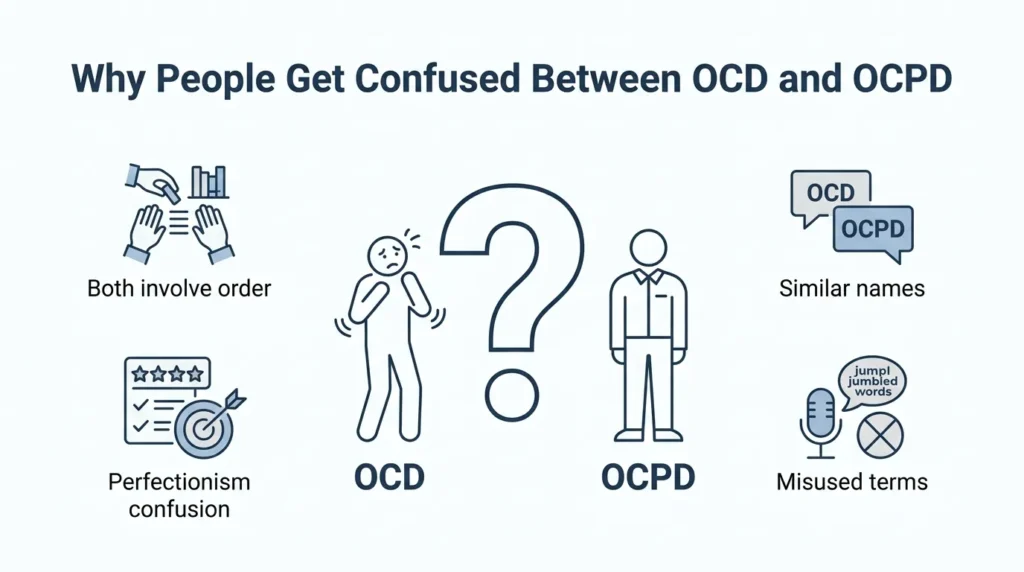
Several factors contribute to confusion:
- Similar names
- Shared focus on order and perfection
- Media oversimplification
- Social media misuse of “OCD”
- Lack of mental health education
Many users searching online assume they are simply different versions of the same condition.
How Search Engines Understand OCD and OCPD User Intent
When users search “difference between OCD and OCPD,” search engines such as Google identify comparison and educational intent.
People usually want to know:
- What is OCD?
- What is OCPD?
- Which condition involves perfectionism?
- Can someone have both?
- How are they treated?
Educational videos on YouTube, awareness posts on Instagram, and mental health discussions across Meta platforms often address these questions because they are commonly misunderstood topics.
Search engines prioritize content that explains the distinction clearly and responsibly.
Expert Insight
From a mental health education perspective, one of the most important distinctions is motivation.
In real scenarios, people with OCD often feel trapped by unwanted thoughts and behaviors they wish would stop. Individuals with OCPD may be more focused on maintaining standards, structure, and control.
This difference in personal experience is often more important than the outward behavior itself. Two people may appear equally organized, yet their underlying motivations can be entirely different.
FAQs
Is OCD the same as OCPD?
No. OCD is an anxiety-related disorder, while OCPD is a personality disorder.
Which condition involves intrusive thoughts?
OCD commonly involves intrusive thoughts.
Is perfectionism always OCD?
No. Perfectionism is more strongly associated with OCPD.
Can someone have both OCD and OCPD?
Yes, although they remain separate diagnoses.
Which condition causes more anxiety?
OCD typically involves significant anxiety related to obsessions.
Is OCPD a mental illness?
Yes. OCPD is recognized as a personality disorder.
Can therapy help OCD and OCPD?
Yes. Different therapy approaches may benefit both conditions.
Why do people say “I’m so OCD”?
Many people incorrectly use OCD to describe neatness or organization.
How is OCD diagnosed?
Mental health professionals evaluate symptoms, severity, and impact on functioning.
How is OCPD diagnosed?
Diagnosis involves assessing long-term personality patterns and behaviors.
Conclusion
Understanding the difference between OCD and OCPD is essential because these conditions may appear similar on the surface but function very differently. OCD centers on intrusive thoughts and compulsive behaviors that often create anxiety and distress. OCPD focuses on perfectionism, control, and rigid personality traits that shape how a person approaches work, relationships, and daily life.
Many people mistakenly use the terms interchangeably, but accurate understanding helps improve communication, diagnosis, treatment, and awareness. While both conditions can affect daily functioning, the motivations behind behaviors are often very different.
In practical terms, OCD is usually driven by anxiety and unwanted obsessions, whereas OCPD is driven by deeply rooted personality patterns and a strong desire for order and control. Recognizing this distinction is the key to understanding the difference between OCD and OCPD.
If symptoms significantly affect daily life, seeking guidance from a qualified mental health professional is the most reliable next step.
Read more about!
Difference Between Adderall and Ritalin: Complete Guide
Difference Between Their and There: Easy Guide

I am James Carter, a professional content writer from the United States. I specialize in writing simple and clear comparison blogs that help students and readers understand difficult topics easily. My writing focuses on everyday language, education, science, and lifestyle topics. I believe that learning should be easy for everyone, so I use simple words and real-life examples in my articles.