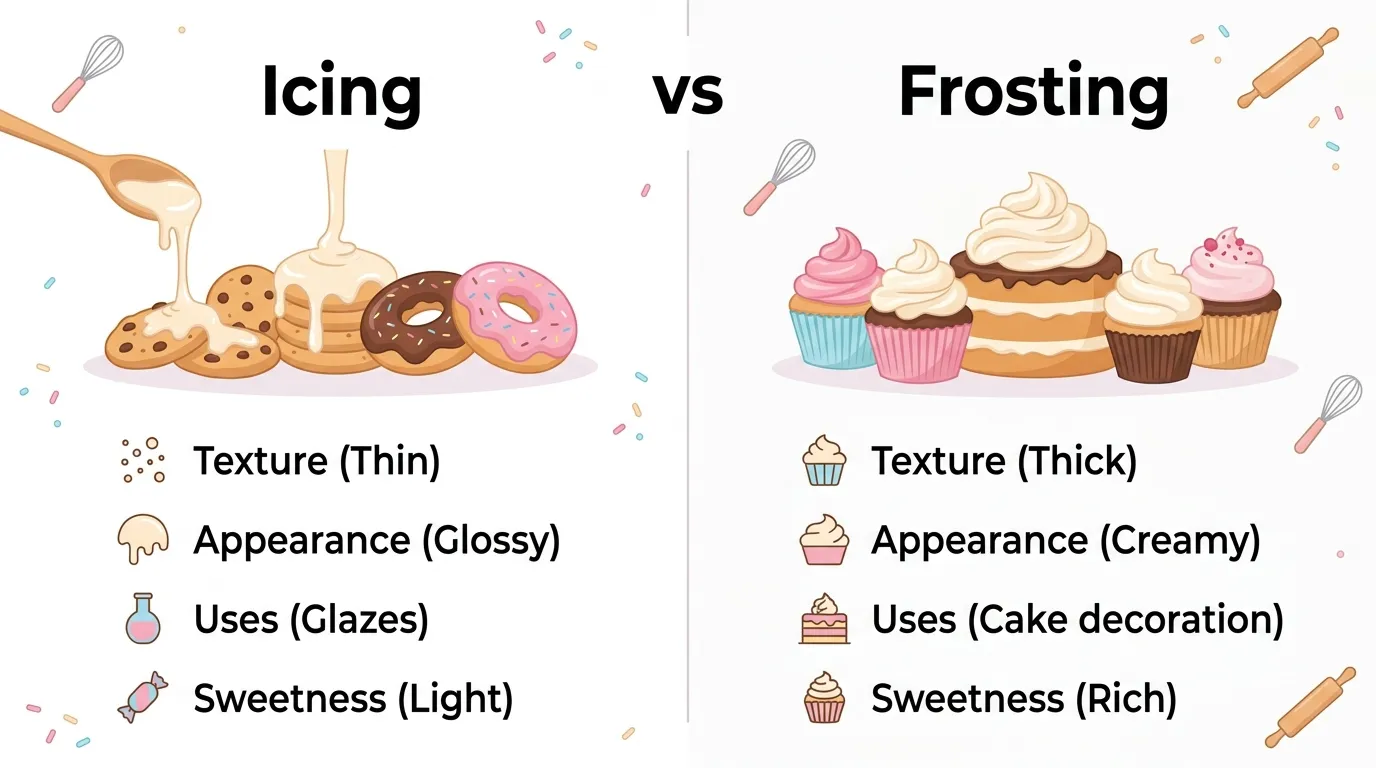
Icing is thinner and smoother for glazing or decorating, while frosting is thicker, fluffier, and used to coat and fill cakes and cupcakes.
If you’ve ever watched a cake decorating video or followed a baking recipe, you’ve probably wondered about the difference between icing and frosting.
Many people use the terms interchangeably, but professional bakers often treat them as two different toppings with distinct textures, ingredients, and purposes.
The difference between icing and frosting mainly comes down to consistency and application. Frosting is usually thick, fluffy, and spreadable, while icing is thinner and often poured or drizzled.
Understanding the difference between icing and frosting can help you choose the perfect finish for cakes, cookies, cupcakes, donuts, and pastries.
In this guide, you’ll learn what icing and frosting are, how they differ, when to use each, common mistakes, real-world examples, and expert baking insights that make choosing the right topping easy.
Difference Between Icing and Frosting
Frosting is thick, creamy, and spreadable, while icing is thinner, smoother, and often used as a glaze or drizzle. Frosting adds volume and decoration, whereas icing creates a shiny finish.
Example: A birthday cake is commonly covered with buttercream frosting, while cinnamon rolls are often topped with a sweet icing glaze.
Definition of Icing and Frosting
- Icing: A sweet topping made from powdered sugar and liquid that creates a smooth, thin coating or glaze.
- Frosting: A thick, creamy topping typically made with butter, sugar, cream, or similar ingredients for spreading and decorating baked goods.
Example: Royal icing is used on decorated cookies, while buttercream frosting is commonly used on cakes.
Pronunciation
| Term | US Pronunciation | UK Pronunciation |
| Icing | EYE-sing | EYE-sing |
| Frosting | FRAW-sting | FROS-ting |
Now that we know the definitions, let’s explore what truly separates icing and frosting in baking.
Difference Between Icing and Frosting Comparison
| Feature | Icing | Frosting |
| Texture | Thin and smooth | Thick and fluffy |
| Application | Drizzled or poured | Spread or piped |
| Main Ingredients | Sugar and liquid | Butter, sugar, cream |
| Appearance | Glossy finish | Rich, creamy appearance |
| Decoration Use | Fine details and glazes | Cake covering and designs |
| Sweetness | Often sweeter | Balanced sweetness |
| Stability | Hardens more easily | Remains soft |
| Typical Use | Cookies, donuts, pastries | Cakes and cupcakes |
Key Differences Explained Between Icing and Frosting
1. Texture
The biggest difference is texture.
Icing flows easily and creates a smooth coating. Frosting holds its shape and can be piped into decorative designs.
Example: Cookie decorations often use icing, while cupcake swirls use frosting.
2. Thickness
Frosting is much thicker.
This makes it ideal for covering entire cakes and creating decorative borders.
Icing is thinner and spreads naturally.
3. Ingredients
Most icing recipes use powdered sugar combined with milk, water, or lemon juice.
Frosting often includes butter, cream cheese, whipped cream, or shortening.
4. Decorative Function
Icing excels at intricate details.
Frosting excels at creating volume and texture.
Professional cake decorators often use both in the same project.
5. Hardening Ability
Many icings dry and harden after application.
Most frostings remain soft and creamy.
This difference affects storage and transportation.
6. Visual Appearance
Icing typically produces a shiny surface.
Frosting creates a rich, textured finish.
7. Flavor Experience
Frosting usually offers a richer taste because of butter and dairy ingredients.
Icing tends to provide a sweeter, lighter sugar flavor.
What Is Icing and How Does It Work?
Icing is a sugar-based coating that forms a smooth layer over baked goods.
Common types include:
- Glaze icing
- Royal icing
- Fondant icing
- Sugar icing
- Lemon icing
The liquid-to-sugar ratio determines how thick or thin the icing becomes.
In practical baking, icing is often chosen when a clean, polished appearance is desired.
What Is Frosting and How Does It Work?
Frosting is a creamy mixture designed to add flavor, texture, and decoration.
Popular frosting varieties include:
- Buttercream frosting
- Cream cheese frosting
- Whipped frosting
- Chocolate frosting
- Swiss meringue buttercream
Because frosting contains fats such as butter or cream, it creates a richer mouthfeel than icing.
Difference Between Icing and Frosting for Cakes
When decorating cakes, frosting is usually the preferred choice.
Why Bakers Choose Frosting
- Covers cake layers easily
- Creates decorative borders
- Supports piping designs
- Adds moisture
- Provides richer flavor
Icing may still be used on cakes, particularly for glazes and specialty finishes.
Difference Between Icing and Frosting for Cookies
Cookies often use icing because it hardens after drying.
Advantages of Icing on Cookies
- Smooth finish
- Detailed artwork
- Easier stacking
- Longer-lasting decorations
This is why holiday cookies and decorated sugar cookies frequently use royal icing.
Why Does the Difference Between Icing and Frosting Matter?
Choosing the wrong topping can affect:
- Appearance
- Texture
- Flavor
- Storage
- Decoration quality
For example, using icing where frosting is needed may result in insufficient coverage. Using frosting where icing is needed may prevent intricate decorative work.
Professional bakers select the topping based on the desired final result.
How Professional Bakers Use Icing and Frosting
Commercial bakeries use both products strategically.
Frosting Applications
- Birthday cakes
- Wedding cakes
- Cupcakes
- Layer cakes
Icing Applications
- Donuts
- Sugar cookies
- Cinnamon rolls
- Pastries
In real-world bakery operations, choosing the correct topping improves both appearance and customer satisfaction.
Can Icing and Frosting Be Substituted?
Sometimes, but not always.
A glaze icing can replace frosting for a lighter finish.
However, frosting cannot always replace icing when detailed decorations or hardening properties are required.
Understanding the purpose of each helps achieve better baking results.
Difference and Similarity Between Icing and Frosting
| Feature | Icing | Frosting | Similarity |
| Sweet Topping | Yes | Yes | Both enhance desserts |
| Sugar Content | High | High | Sweet flavor source |
| Decoration Use | Common | Common | Improve appearance |
| Flavor Enhancement | Yes | Yes | Add sweetness |
| Cake Usage | Sometimes | Frequently | Used on cakes |
| Cookie Usage | Frequently | Sometimes | Decorative options |
| Homemade Preparation | Easy | Easy | Can be made at home |
| Bakery Use | Common | Common | Essential baking tools |
This table clearly shows the difference and similarity between icing and frosting for quick understanding.
Common Mistakes with Icing and Frosting
Mistake 1: Assuming They Are Identical
Correction: Understand their different textures and uses.
Mistake 2: Using Icing for Cake Piping
Correction: Frosting usually holds decorative shapes better.
Mistake 3: Using Frosting for Detailed Cookie Art
Correction: Royal icing is often a better choice.
Mistake 4: Ignoring Temperature
Correction: Frosting consistency changes significantly with temperature.
Mistake 5: Choosing Based Only on Taste
Correction: Consider texture and decorating goals too.
Real-Life Examples with Icing and Frosting
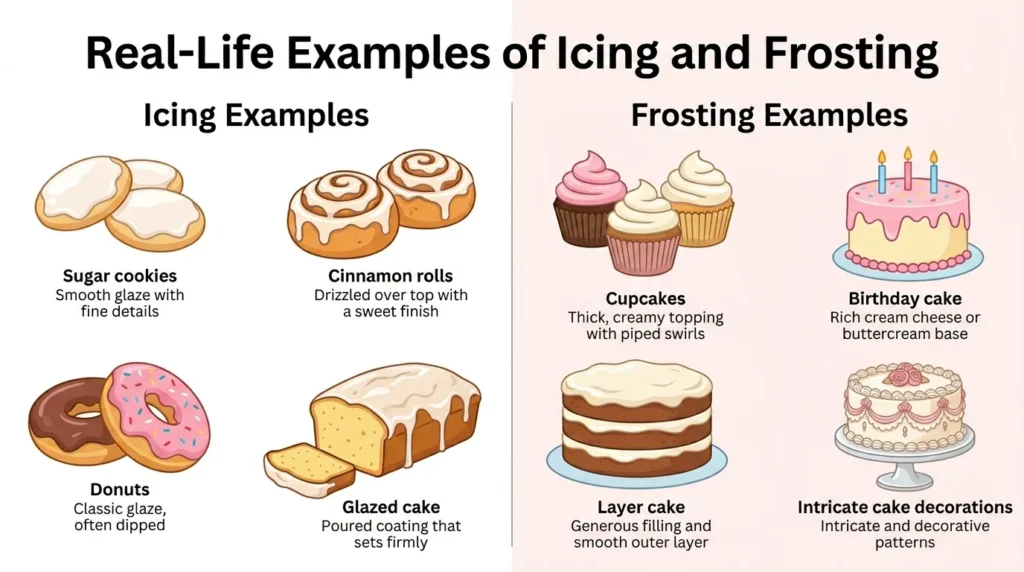
Personal Baking Example
A home baker uses cream cheese frosting on carrot cake.
Holiday Cookie Example
Decorated Christmas cookies use royal icing.
Bakery Example
A bakery frosts cupcakes and glazes donuts.
Wedding Cake Example
Professional decorators combine frosting layers with icing details.
Commercial Production Example
Large bakeries select toppings based on shelf life and presentation needs.
When to Use Each
Use Icing When:
- Decorating cookies
- Glazing pastries
- Adding a shiny finish
- Creating detailed designs
- Making cinnamon roll toppings
Use Frosting When:
- Decorating cakes
- Covering cupcakes
- Creating piped designs
- Adding rich flavor
- Building layered decorations
Why People Get Confused Between Icing and Frosting
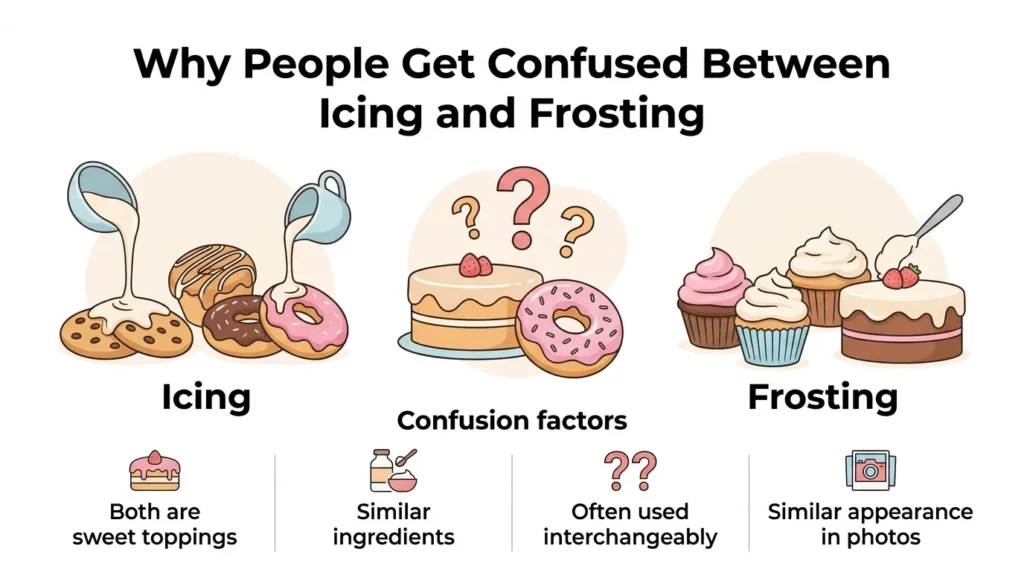
Several factors contribute to confusion:
- Regional language differences
- Recipe variations
- Marketing terminology
- Social media baking content
- Different definitions across countries
In some regions, nearly all sweet cake toppings are casually called “icing,” even when they are technically frosting.
How Search Engines Understand Icing and Frosting User Intent
When users search “difference between icing and frosting,” search engines such as Google recognize comparison and educational intent.
Most users want answers to:
- What is icing?
- What is frosting?
- Which is best for cakes?
- Which is best for cookies?
- Can they be substituted?
Recipe creators frequently discuss these topics on YouTube, share decorating tutorials on Instagram, and post baking content across Meta platforms because visual baking techniques attract strong audience engagement.
Search engines prioritize content that provides practical, easy-to-follow comparisons.
Expert Insight
One insight many beginner bakers miss is that texture matters more than sweetness when choosing between icing and frosting.
In professional baking environments, decorators often select toppings based on structure, stability, and presentation rather than flavor alone. A beautifully decorated cookie requires different characteristics than a layered birthday cake.
Understanding the purpose behind each topping leads to consistently better baking results.
FAQs
Is icing the same as frosting?
No. Icing is generally thinner, while frosting is thicker and creamier.
Which is better for cakes?
Frosting is usually better for covering and decorating cakes.
Can I use icing on cupcakes?
Yes, although frosting is more common.
Does icing harden?
Many types of icing harden after drying.
Does frosting harden?
Most frostings remain soft and creamy.
What is royal icing?
Royal icing is a hard-setting icing commonly used for cookie decoration.
Which is sweeter, icing or frosting?
Icing is often perceived as sweeter because it contains less fat.
Can I make both at home?
Yes. Both icing and frosting are easy to prepare with basic ingredients.
Why do recipes use different terms?
Regional and culinary traditions influence terminology.
What do professional bakers prefer?
Most professionals use both, depending on the dessert and decorating goal.
Conclusion
Understanding the difference between icing and frosting helps bakers choose the right topping for every dessert. While both add sweetness and visual appeal, they serve different purposes in baking.
Icing is thinner, smoother, and often used for glazes, drizzles, and detailed decorations. Frosting is thicker, creamier, and ideal for covering cakes, decorating cupcakes, and creating elaborate designs. The choice depends on texture, appearance, flavor, and the specific dessert being prepared.
In practical baking scenarios, icing works best when a smooth, glossy finish is needed, while frosting excels when structure, richness, and decorative volume matter. Professional bakers frequently use both to achieve the best results.
Ultimately, the difference between icing and frosting comes down to consistency, application, and purpose. Once you understand these distinctions, selecting the perfect topping becomes simple and your baked creations can look and taste even better.
Read more about!
Difference Between Adderall and Ritalin: Complete Guide
Difference Between BS and BA: Complete Guide

I am Emily Johnson, a USA-based content writer who creates easy-to-read blogs on language and daily life topics. I explain complex ideas in simple English for students and beginners so they can understand easily.