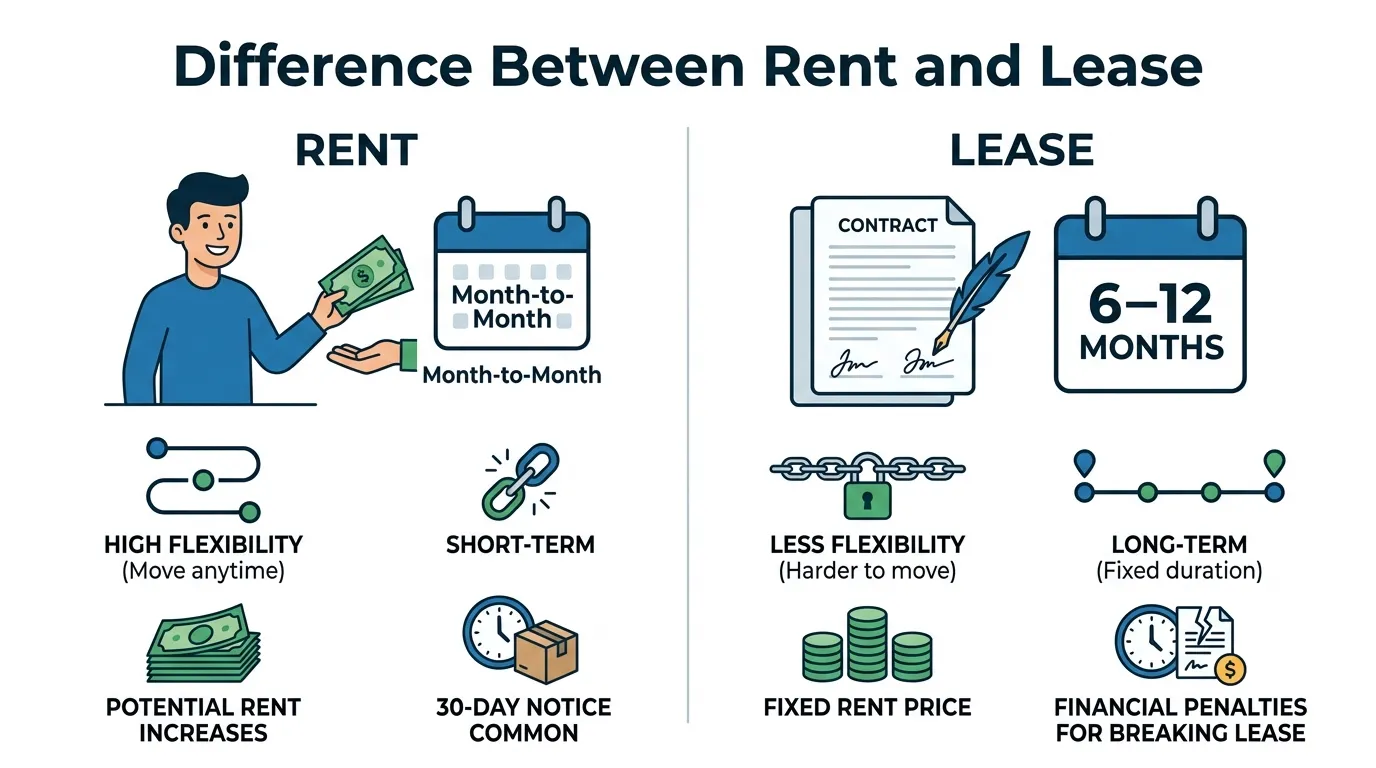
Renting usually involves a short-term, flexible agreement, while leasing is a fixed-term contract with set conditions for a longer period.
Many people searching for the difference between rent and lease assume both terms mean exactly the same thing. While they are closely related, there are important legal and practical differences that can affect tenants, landlords, businesses, and property agreements.
The difference between rent and lease mainly comes down to the length of the agreement and how easily the terms can change.
Understanding the difference between rent and lease helps you make smarter housing and business decisions, avoid costly misunderstandings, and choose the right type of agreement for your situation.
In this guide, you’ll learn what rent and lease mean, how they work, their advantages and disadvantages, real-life examples, common mistakes, and when each option makes the most sense.
Difference Between Rent and Lease
A rental agreement is usually a short-term arrangement, often month-to-month, that can be modified more easily. A lease agreement is typically a fixed-term contract, such as 6 or 12 months, with terms that generally remain unchanged during the contract period.
Example: Renting an apartment month-to-month is usually a rental agreement, while signing a 12-month apartment contract is generally a lease.
Definition of Rent and Lease
- Rent: A payment made regularly for the temporary use of a property under a rental agreement, often month-to-month.
- Lease: A legally binding contract granting use of a property for a fixed period under specific terms and conditions.
Example: Paying monthly for an apartment without a long-term commitment is renting, while committing to a one-year contract is leasing.
Pronunciation
| Term | US Pronunciation | UK Pronunciation |
| Rent | RENT | RENT |
| Lease | LEES | LEES |
Now that we know the basic definitions, let’s understand the practical and legal differences that matter most in real-world situations.
Difference Between Rent and Lease Comparison
| Feature | Rent | Lease |
| Contract Length | Usually month-to-month | Fixed term (6–24 months common) |
| Flexibility | High | Lower |
| Rent Changes | Easier to change | Usually fixed during term |
| Tenant Commitment | Short-term | Long-term |
| Landlord Stability | Less predictable | More predictable |
| Early Termination | Generally easier | May involve penalties |
| Planning Ability | Limited | Better long-term planning |
| Common Use | Temporary housing | Stable housing arrangements |
Key Differences Explained Between Rent and Lease
1. Contract Duration
The most important difference involves time.
A rental agreement commonly renews every month, while a lease usually lasts for a specific period.
Example: A college student staying for three months may prefer renting. A family planning to stay for several years often chooses a lease.
2. Flexibility
Renting offers greater flexibility.
Tenants can often move with shorter notice requirements.
Example: Someone accepting a temporary work assignment may benefit from renting.
3. Stability
Leases provide stability for both parties.
The agreement typically locks in important terms.
Example: A tenant leasing for one year knows monthly housing costs will likely remain unchanged.
4. Price Changes
Rental rates can sometimes be adjusted more frequently.
Lease agreements generally keep rent fixed until the term ends.
5. Legal Protection
Both agreements offer legal protection, but leases usually contain more detailed provisions.
6. Early Exit Rules
Ending a lease early may involve penalties.
Rental agreements often allow easier termination with proper notice.
7. Financial Planning
Leases help with budgeting because monthly costs are predictable.
Businesses especially value this stability.
What Is a Rental Agreement and How Does It Work?
A rental agreement is generally a short-term contract between a property owner and tenant.
Most rental agreements automatically renew each month until either party provides notice to end the arrangement.
Why People Choose Renting
- Greater flexibility
- Easier relocation
- Short-term housing needs
- Temporary employment assignments
- Student accommodation
In practical use, renting works best when future plans are uncertain.
What Is a Lease Agreement and How Does It Work?
A lease is a fixed-term legal contract outlining rights and responsibilities.
The lease specifies:
- Monthly payment amount
- Contract duration
- Property rules
- Maintenance responsibilities
- Security deposit terms
Because the agreement remains relatively stable, both parties gain predictability.
Difference Between Rent and Lease in Real Estate
In residential real estate, choosing between renting and leasing depends largely on lifestyle and financial goals.
Renting May Be Better When:
- You expect to move soon
- You want flexibility
- You are testing a new city
- Your employment situation may change
Leasing May Be Better When:
- You want stable housing
- You prefer predictable costs
- You plan to stay long-term
- You want stronger occupancy security
Why Does the Difference Between Rent and Lease Matter Financially?
Many beginners focus only on monthly payments.
However, experienced renters and property investors consider long-term financial impact.
A lease often protects tenants from unexpected rent increases.
A rental agreement may offer mobility but can expose tenants to changing market prices.
In high-demand housing markets, lease agreements can provide valuable cost certainty.
How Businesses Use Rent and Lease Agreements
The concepts apply beyond apartments and houses.
Businesses commonly rent or lease:
- Office space
- Retail stores
- Warehouses
- Manufacturing facilities
- Equipment and vehicles
For example, a startup company may rent a flexible office space, while a large corporation might lease a commercial property for several years.
Can Rent Become a Lease?
Yes.
Many landlords begin with a rental agreement and later offer a lease if the tenant decides to stay longer.
This approach allows both parties to evaluate the relationship before committing to a long-term contract.
What Are the Advantages and Disadvantages of Rent vs Lease?
Advantages of Renting
- Flexibility
- Easier relocation
- Short-term commitment
- Suitable for uncertain situations
Disadvantages of Renting
- Less stability
- Potential rent increases
- Limited long-term planning
Advantages of Leasing
- Predictable costs
- Greater stability
- Long-term housing security
- Easier budgeting
Disadvantages of Leasing
- Reduced flexibility
- Possible early termination fees
- Long-term commitment
Difference and Similarity Between Rent and Lease
| Feature | Rent | Lease | Similarity |
| Purpose | Temporary property use | Fixed-term property use | Both grant occupancy rights |
| Payment | Regular payments | Regular payments | Monthly payments common |
| Legal Contract | Yes | Yes | Both create legal obligations |
| Property Access | Tenant use | Tenant use | Provide lawful possession |
| Landlord Role | Property owner | Property owner | Same ownership structure |
| Residential Use | Common | Common | Used in housing markets |
| Commercial Use | Possible | Common | Business properties use both |
| Tenant Rights | Protected by law | Protected by law | Legal protections apply |
This table clearly shows the difference and similarity between rent and lease for quick understanding.
Common Mistakes with Rent and Lease
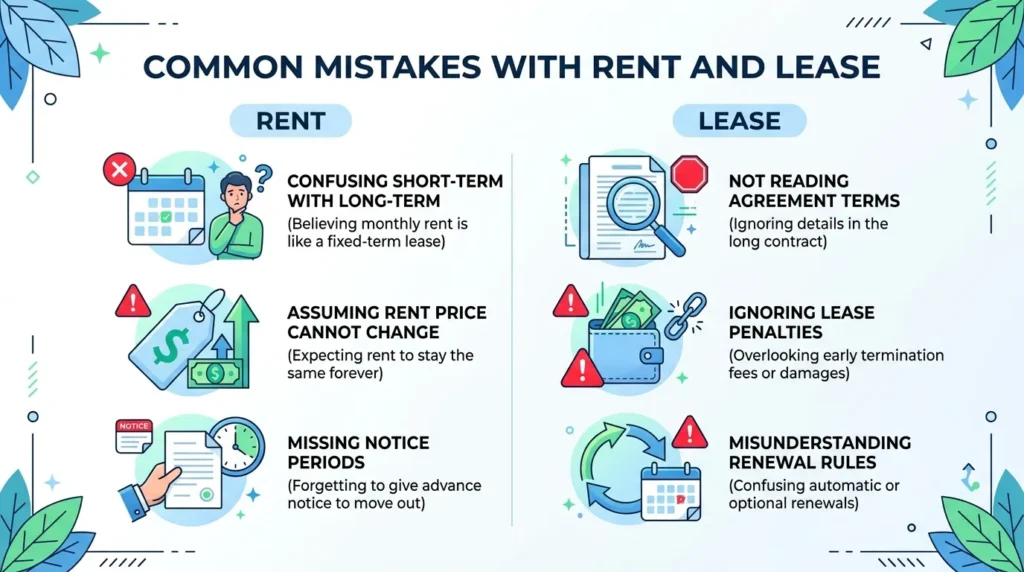
Mistake 1: Thinking They Mean Exactly the Same Thing
Correction: Understand that contract duration is usually the key distinction.
Mistake 2: Ignoring Early Termination Clauses
Correction: Read cancellation terms carefully before signing.
Mistake 3: Focusing Only on Monthly Cost
Correction: Consider flexibility, stability, and future plans.
Mistake 4: Not Reading Renewal Terms
Correction: Review how the agreement renews or expires.
Mistake 5: Assuming All Countries Use the Terms Identically
Correction: Legal definitions can vary by region.
Real-Life Examples with Rent and Lease
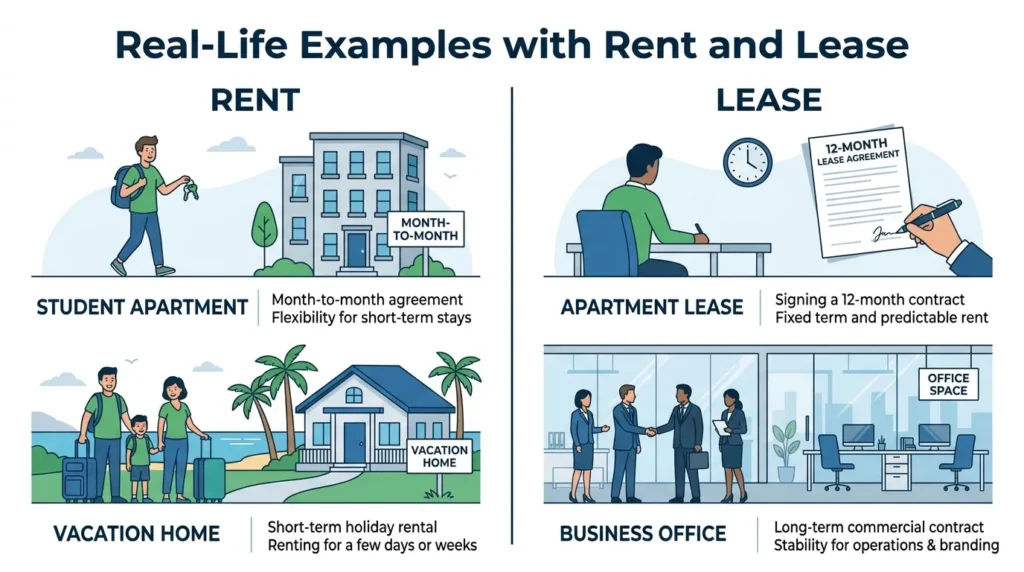
Personal Use Example
A university student rents a room month-to-month during a semester.
Family Housing Example
A family signs a 12-month lease to secure housing stability.
Business Example
A startup rents coworking space while testing market demand.
Commercial Real Estate Example
A retailer leases a shopping center location for five years.
Equipment Example
A company leases office equipment instead of purchasing it outright.
When to Use Each
Use Rent When:
- Plans are uncertain
- You may relocate soon
- You need flexibility
- Temporary accommodation is required
Use Lease When:
- Long-term stability matters
- Budget predictability is important
- You plan to stay for months or years
- Housing security is a priority
Why People Get Confused Between Rent and Lease
Several factors contribute to confusion:
- Everyday conversation uses both terms interchangeably
- Media often mixes the terminology
- Regional legal definitions vary
- Property advertisements sometimes use both words
- Online discussions simplify legal distinctions
Many users searching Google want a simple answer because these terms appear similar on the surface.
How Search Engines Understand Rent and Lease User Intent
When someone searches “difference between rent and lease,” search engines such as Google recognize a comparison intent.
Users typically want answers to:
- What is rent?
- What is a lease?
- Which option is better?
- How do contracts differ?
- What are the legal implications?
Content creators on platforms like Instagram, YouTube, and Meta often explain rental agreements because housing decisions generate strong engagement and practical interest.
Search engines prioritize content that answers these questions clearly, completely, and accurately.
Expert Insight
In real-world property management, the best choice is rarely about which option is universally better.
Instead, it depends on risk tolerance, future plans, and financial predictability.
Most beginners focus on flexibility versus commitment. Experienced landlords and property professionals often focus on occupancy stability, vacancy risk, and long-term financial planning.
A good rule of thumb is simple:
Choose renting for flexibility and leasing for stability.
FAQs
Is renting the same as leasing?
No. Renting is generally short-term, while leasing usually involves a fixed-term contract.
Which is cheaper, rent or lease?
Neither is automatically cheaper. Costs depend on location and market conditions.
Can a landlord increase rent during a lease?
Usually not until the lease term ends, unless the contract allows it.
Is a lease legally binding?
Yes. A lease is a legally enforceable agreement.
Can I break a lease early?
Sometimes, but penalties may apply.
Why do landlords prefer leases?
Leases provide predictable income and occupancy stability.
Is month-to-month renting better?
It can be better for people who need flexibility.
Can businesses lease property?
Yes. Commercial real estate frequently uses lease agreements.
What happens when a lease expires?
It may renew, convert to month-to-month renting, or end depending on the contract.
Which option is best for first-time renters?
It depends on how long you expect to stay and how much flexibility you need.
Conclusion
Understanding the difference between rent and lease helps tenants, landlords, and businesses make informed decisions. While both arrangements allow someone to use a property in exchange for payment, they serve different purposes.
Renting usually offers greater flexibility and shorter commitments, making it ideal for people whose plans may change. Leasing provides stability, predictable costs, and stronger long-term planning benefits, making it attractive for families, professionals, and businesses seeking certainty.
In practical scenarios, neither option is inherently better. The right choice depends on your goals, budget, timeline, and risk tolerance. If flexibility matters most, renting may be the smarter path. If security and predictable housing costs are your priority, leasing often provides greater value.
Ultimately, the difference between rent and lease comes down to commitment, stability, and flexibility. Once you understand those core distinctions, choosing the right agreement becomes much easier.
Read more about!
Difference Between Mule and Donkey: Complete Guide
Difference Between Parsley and Cilantro: Complete Guide

I am Emily Johnson, a USA-based content writer who creates easy-to-read blogs on language and daily life topics. I explain complex ideas in simple English for students and beginners so they can understand easily.