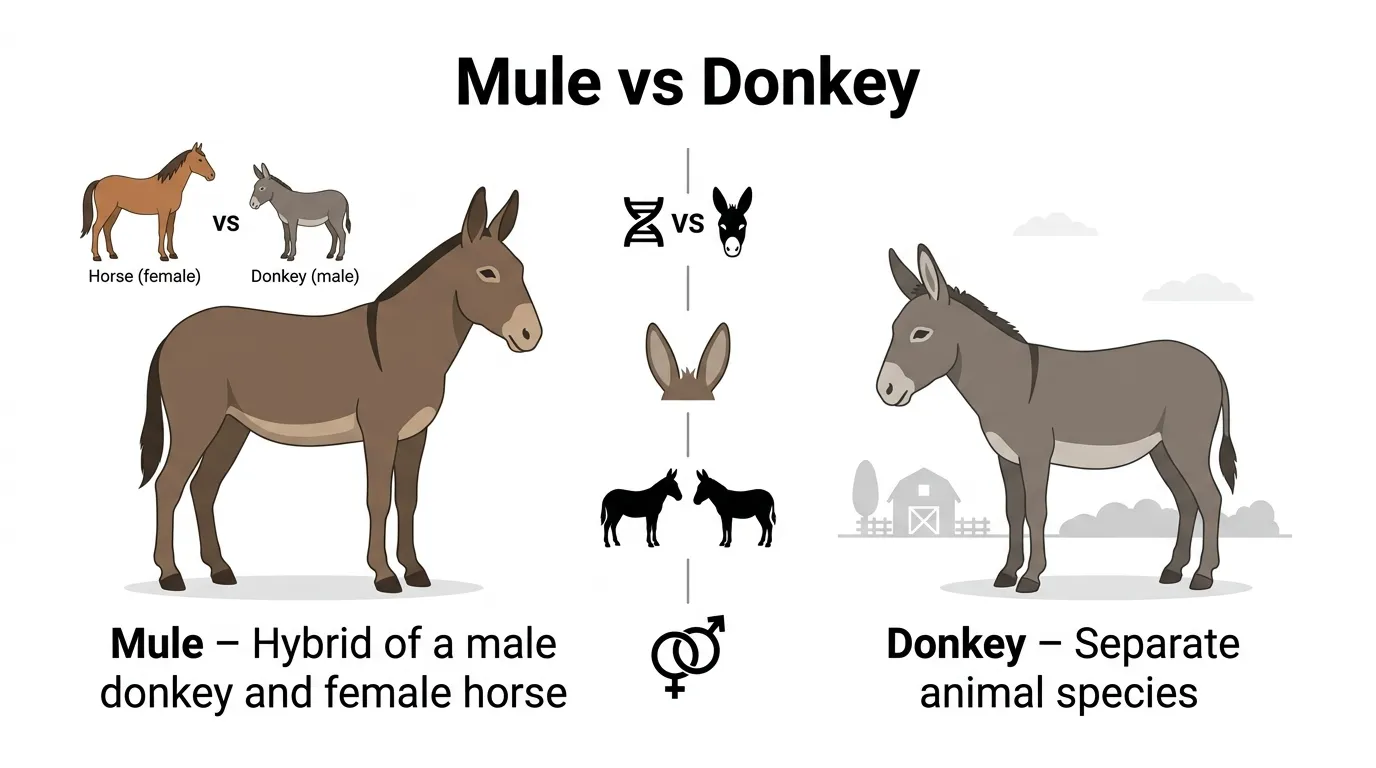
A mule is a hybrid offspring of a male donkey and a female horse, while a donkey is a separate animal species that can reproduce naturally.
Many people use the terms mule and donkey as if they mean the same animal. However, understanding the difference between mule and donkey is important because they are not identical.
A mule is actually a hybrid animal, while a donkey is a separate species. This confusion often happens because both animals look similar, work as pack animals, and share some physical traits.
If you’ve ever wondered about the difference between mule and donkey, how they are related, or which one is stronger, this complete guide will explain everything in simple words.
You’ll learn their definitions, characteristics, uses, behavior, advantages, and real-world applications.
Difference Between Mule and Donkey
The main difference between mule and donkey is that a donkey is a distinct animal species, while a mule is the offspring of a male donkey and a female horse.
For example, a donkey can naturally reproduce with another donkey, but most mules cannot reproduce because they are usually sterile.
Definition of Mule and Donkey
- Mule: A hybrid animal produced by breeding a male donkey (jack) with a female horse (mare). Mules combine traits from both parents.
- Donkey: A domesticated member of the equine family that belongs to its own species and can reproduce with other donkeys.
Example: A farm donkey can produce offspring with another donkey, while a mule generally cannot.
Pronunciation
| Term | US Pronunciation | UK Pronunciation |
| Mule | MYOOL | MYOOL |
| Donkey | DON-kee | DON-kee |
Now that we know what each animal is, let’s understand their differences in detail.
Mule vs Donkey Comparison
| Feature | Mule | Donkey |
| Origin | Hybrid of horse and donkey | Separate species |
| Parents | Male donkey + female horse | Two donkeys |
| Fertility | Usually sterile | Fertile |
| Size | Generally larger | Usually smaller |
| Strength | Extremely strong | Strong but less powerful |
| Speed | Faster | Slower |
| Intelligence | Very intelligent | Intelligent and cautious |
| Endurance | Excellent | Excellent |
| Lifespan | 30–40 years | 25–35 years |
| Common Use | Heavy work and transport | Farming and carrying loads |
Key Differences Explained Between Mule and Donkey
1. Origin and Genetics
The biggest difference between mule and donkey lies in their genetics.
A donkey is a pure species. A mule is a hybrid created from two different animals.
Real-world example: Farmers often breed mules to gain the strength of a horse and the endurance of a donkey.
2. Ability to Reproduce
Donkeys can reproduce normally.
Mules are generally sterile because they inherit mismatched chromosomes from horses and donkeys.
Example: A donkey farm can continue breeding donkeys naturally, while mule populations require ongoing crossbreeding.
3. Physical Appearance
Mules often inherit:
- Long ears from donkeys
- Larger body from horses
- Strong legs
- Taller height
Donkeys usually have:
- Stockier bodies
- Shorter stature
- More uniform appearance
4. Strength and Work Capacity
Mules are famous for carrying heavy loads over difficult terrain.
Many experts consider a mule stronger than a donkey of similar size.
Example: Mountain transport services frequently prefer mules for carrying supplies.
5. Speed and Agility
Because of their horse ancestry, mules tend to move faster than donkeys.
They are also more agile on steep trails.
6. Temperament and Behavior
Many users get confused here.
Donkeys are often labeled as stubborn, but they are actually cautious thinkers.
Mules inherit intelligence from both parents and usually assess danger before acting.
7. Cost and Maintenance
Mules often cost more because breeding them requires both horses and donkeys.
Donkeys are generally less expensive to purchase and maintain.
What Is a Donkey and Why Does It Exist?
Donkeys have served humans for thousands of years.
They were originally domesticated for:
- Transportation
- Agriculture
- Carrying goods
- Guarding livestock
Their ability to survive in harsh environments makes them valuable worldwide.
In practical use, many rural communities still rely on donkeys for everyday work.
What Is a Mule and How Does It Work as a Hybrid?
A mule combines desirable characteristics from both parents.
From horses, mules inherit:
- Height
- Speed
- Athletic ability
From donkeys, they inherit:
- Toughness
- Intelligence
- Endurance
This combination creates a highly efficient working animal.
Why Are Mules Usually Stronger Than Donkeys?
This phenomenon is known as hybrid vigor.
Hybrid vigor often allows offspring to outperform their parents in certain traits.
As a result, mules frequently demonstrate:
- Greater strength
- Better endurance
- Increased resilience
This is one reason they are preferred in mountainous regions.
Difference Between Mule and Donkey in Farming
Farmers choose animals based on specific needs.
Donkeys Are Best For:
- Light farm work
- Small properties
- Livestock guarding
- Basic transportation
Mules Are Best For:
- Heavy hauling
- Long-distance transport
- Mountain trails
- Commercial agriculture
Difference Between Mule and Donkey in Behavior
Many beginners think donkeys are stubborn and mules are aggressive.
In reality:
Donkeys
- Careful decision-makers
- Calm and observant
- Highly protective
Mules
- Independent thinkers
- Confident workers
- Fast learners
Both animals are intelligent compared to many livestock species.
Difference Between Mule and Donkey in Lifespan and Health
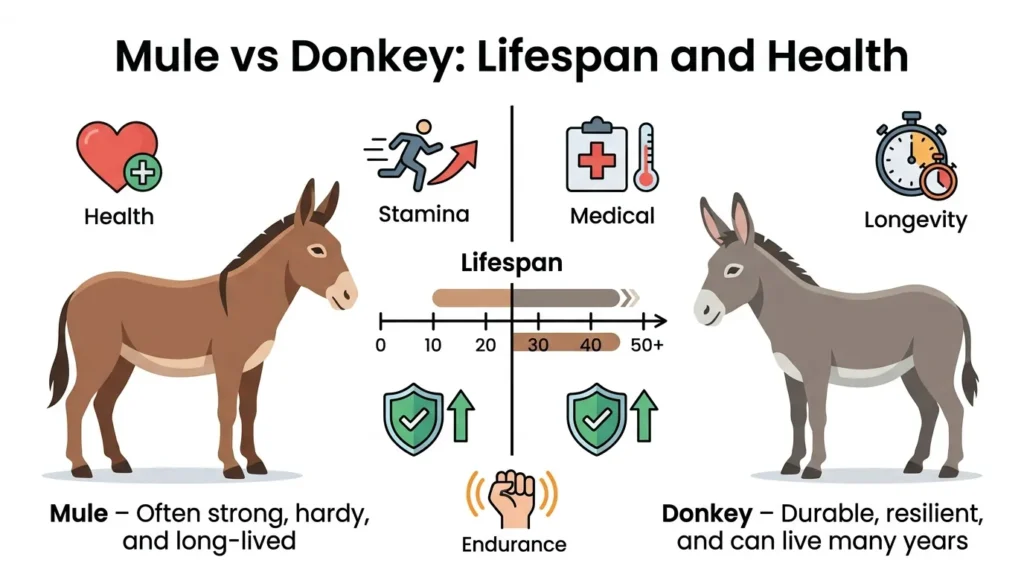
Both animals can live long lives when cared for properly.
Average Lifespan
- Mule: 30–40 years
- Donkey: 25–35 years
Mules often benefit from hybrid vigor, which may reduce some inherited health problems.
Difference and Similarity
| Feature | Mule | Donkey | Similarity |
| Classification | Hybrid animal | Pure species | Both belong to the equine family |
| Parents | Horse and donkey | Two donkeys | Both have donkey genetics |
| Fertility | Usually sterile | Fertile | Both reproduce through equine biology |
| Strength | Higher load capacity | Strong for size | Both are working animals |
| Speed | Faster movement | Slower pace | Both can travel long distances |
| Intelligence | Highly intelligent | Highly intelligent | Both learn tasks effectively |
| Uses | Heavy transport | Farm and utility work | Both assist humans |
| Adaptability | Excellent | Excellent | Both handle harsh conditions |
This table clearly shows the difference and similarity between mule and donkey for quick understanding.
Common Mistakes With Mule and Donkey
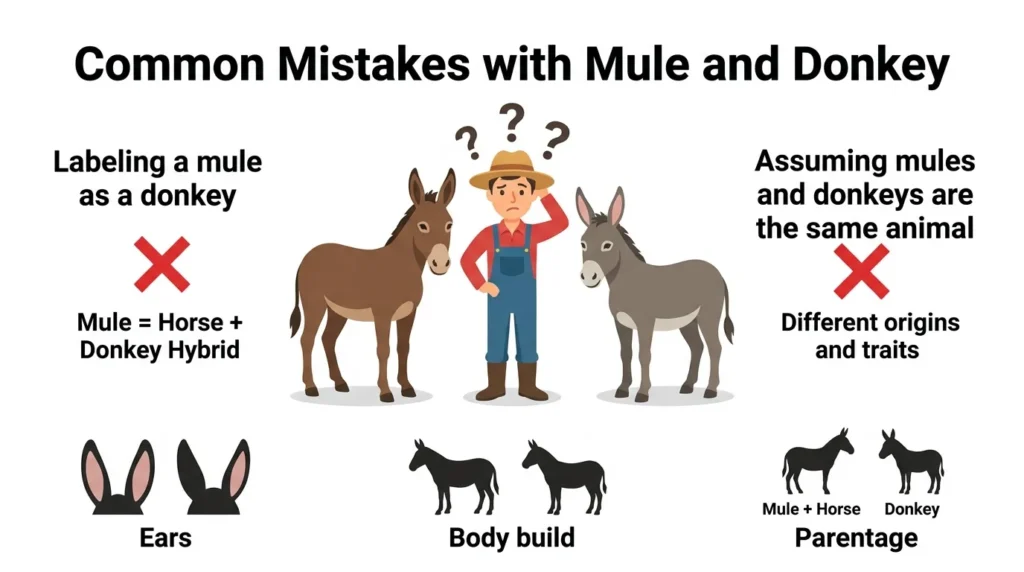
Mistake 1: Thinking a Mule Is a Type of Donkey
Correction: A mule is a hybrid, not a donkey species.
Mistake 2: Assuming Donkeys Are Stubborn
Correction: They are cautious and safety-conscious.
Mistake 3: Believing Mules Can Easily Reproduce
Correction: Most mules are sterile.
Mistake 4: Assuming They Have the Same Strength
Correction: Mules generally have greater carrying capacity.
Mistake 5: Judging Intelligence by Appearance
Correction: Both animals are highly intelligent.
Real-Life Examples With Mule and Donkey
Personal Use
A family in a rural village uses a donkey for transporting water and supplies.
Farming Use
A farmer uses mules to move heavy equipment across rough terrain.
Tourism Industry
Mountain trekking companies often use mules to carry gear.
Livestock Protection
Some ranchers keep donkeys to guard sheep against predators.
Commercial Transport
Remote communities use mules where vehicles cannot travel easily.
When to Use Each
Choose a Donkey When:
- You need a low-cost working animal.
- The work is relatively light.
- You want livestock protection.
Choose a Mule When:
- Heavy loads must be carried.
- Long-distance transport is required.
- Difficult terrain is involved.
Why People Get Confused Between Mule and Donkey
Several factors contribute to confusion:
- Similar appearance
- Shared donkey ancestry
- Similar jobs and uses
- Media representations
- Lack of knowledge about hybrid animals
In simple words, many people see long ears and assume both animals are the same.
How Search Engines Understand “Difference Between Mule and Donkey” and User Intent
Search engines such as Google analyze if users want:
- Animal identification
- Species comparison
- Farming information
- Educational content
Platforms like Instagram and YouTube often contain videos showing mules and donkeys working, which increases public interest in comparing them.
Google typically ranks content that clearly explains:
- Definitions
- Differences
- Similarities
- Real-world applications
because these satisfy user intent most effectively.
Expert Insight
From an animal husbandry perspective, the most overlooked fact is that mules were developed to combine the best traits of horses and donkeys.
In real scenarios, experienced handlers often choose mules for demanding work because they offer a balance of strength, endurance, and intelligence. Meanwhile, donkeys remain valuable because of their reliability, affordability, and adaptability.
Understanding their genetic background is often the easiest way to remember the difference.
FAQs
What is the main difference between mule and donkey?
A donkey is a species, while a mule is a hybrid offspring of a horse and donkey.
Can a mule reproduce?
Most mules are sterile and cannot reproduce.
Which is stronger, a mule or a donkey?
A mule is generally stronger and can carry heavier loads.
Why do mules have long ears?
They inherit long ears from their donkey parent.
Are donkeys and mules equally intelligent?
Both are intelligent, but mules often display advanced problem-solving abilities.
Which lives longer, a mule or a donkey?
Mules often live slightly longer, around 30–40 years.
Are mules faster than donkeys?
Yes, mules are usually faster because of their horse ancestry.
Why are mules used in mountains?
Their strength, balance, and endurance make them ideal for rugged terrain.
Is a mule half horse and half donkey?
Yes. A mule results from breeding a male donkey with a female horse.
Are donkeys easier to maintain?
Generally yes, because they are less expensive and require simpler breeding programs.
Conclusion
Understanding the difference between mule and donkey becomes simple once you know their origins. A donkey is a distinct species that can reproduce naturally, while a mule is a hybrid created by crossing a male donkey with a female horse. Although they share some physical traits, they differ in genetics, fertility, strength, size, and work capacity.
In practical use, donkeys are valued for their reliability, low maintenance, and ability to thrive in challenging environments. Mules, on the other hand, are prized for their exceptional strength, endurance, and hybrid vigor. This is why farmers, transport operators, and mountain guides often choose mules for demanding tasks.
Many users get confused because both animals have similar appearances and perform similar jobs. However, remembering one simple fact can help: every mule has a donkey parent, but not every donkey is a mule.
If you are a student, animal enthusiast, farmer, or researcher, knowing the difference between mule and donkey helps you better understand their unique roles in agriculture, transportation, and human history.
Read more about!
Difference Between Their and There: Easy Guide
Difference Between BS and BA: Complete Guide

I am Emily Johnson, a USA-based content writer who creates easy-to-read blogs on language and daily life topics. I explain complex ideas in simple English for students and beginners so they can understand easily.