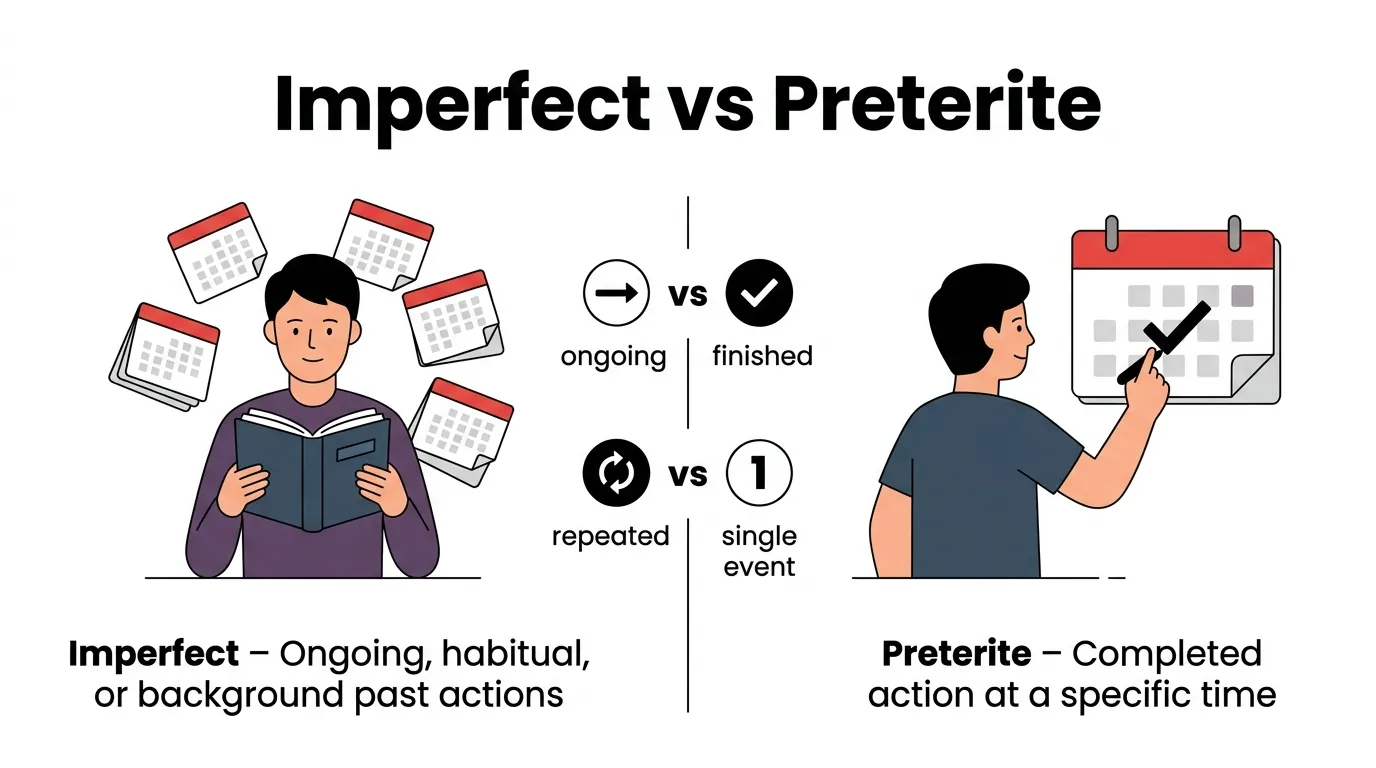
Imperfect describes ongoing or repeated past actions, while Preterite describes completed actions that happened at a specific time in the past.
If you’re learning Spanish, you’ve probably struggled with the difference between imperfect and preterite. Many students understand past tense verbs but get confused about when to use each one.
The difference between imperfect and preterite is one of the most searched Spanish grammar topics because both describe actions in the past, yet they tell different stories.
In simple words, the difference between imperfect and preterite is that the imperfect describes ongoing, repeated, or background actions, while the preterite describes completed actions with a clear beginning or end. Understanding this distinction can dramatically improve your Spanish speaking and writing skills.
In this complete guide, you’ll learn what each tense means, how they work, when to use them, common mistakes, real-life examples, and expert tips that make choosing the correct tense much easier.
Difference Between Imperfect and Preterite
The imperfect tense describes ongoing, repeated, habitual, or background actions in the past.
The preterite tense describes completed actions or specific events that happened at a definite point in the past.
Example:
- Imperfect: Yo estudiaba español todos los días. (I used to study Spanish every day.)
- Preterite: Yo estudié español ayer. (I studied Spanish yesterday.)
The first describes a habit. The second describes a completed event.
Definition of Imperfect and Preterite
- Imperfect: A past tense used for ongoing actions, habits, descriptions, feelings, or background information in the past.
- Preterite: A past tense used for actions completed at a specific time or actions viewed as finished events.
Quick Example:
- Imperfect: “I was reading.”
- Preterite: “I read the book.”
Pronunciation
Imperfect
- US: im-PUR-fekt
- UK: im-PUH-fekt
Preterite
- US: PRET-er-it
- UK: PRET-uh-rit
Now that you know what these tenses are, let’s understand exactly how they differ and why Spanish uses both.
Difference Between Imperfect and Preterite
| Feature | Imperfect | Preterite |
| Main Purpose | Ongoing or habitual action | Completed action |
| Time Focus | No clear ending | Clear beginning/end |
| Usage | Background information | Main event |
| Frequency | Repeated actions | Single occurrence |
| Description | People, places, situations | Specific actions |
| Translation | Was doing / used to do | Did |
| Duration | Continuous | Finished |
| Storytelling Role | Sets the scene | Moves the story forward |
Example
| Imperfect | Preterite |
| I was walking. | I walked to school. |
| It used to rain. | It rained yesterday. |
Key Differences Explained Between Imperfect and Preterite
1. Habit vs Single Event
The imperfect describes habits.
Example:
- Jugaba fútbol cada sábado.
- I used to play soccer every Saturday.
The preterite describes a specific event.
Example:
- Jugué fútbol el sábado.
- I played soccer on Saturday.
2. Background vs Action
The imperfect paints the background.
Example:
- It was sunny.
- People were talking.
The preterite tells what happened.
Example:
- The game started.
- The teacher arrived.
3. Ongoing vs Completed
Imperfect:
- The action was in progress.
Preterite:
- The action finished.
4. Description vs Event
Imperfect:
- Describes age, weather, emotions, appearance.
Preterite:
- Describes actions that occurred.
5. Repetition vs One-Time Action
Imperfect:
- Used repeatedly.
Preterite:
- Happened once.
6. No Exact Time vs Specific Time
Imperfect:
- No exact timeframe needed.
Preterite:
- Often linked to words like yesterday, last night, last year.
What Is the Imperfect Tense and Why Does It Exist?
Spanish speakers need a way to describe situations without focusing on completion.
The imperfect helps express:
- Habits
- Descriptions
- Emotions
- Background details
- Ongoing actions
Example:
“Cuando era niño, vivía en Madrid.”
This tells us about an ongoing situation in childhood.
What Is the Preterite Tense and How Does It Work?
The preterite focuses on completed actions.
Examples:
- She arrived.
- We finished dinner.
- They bought a house.
The action is viewed as finished.
This makes the preterite essential for narrating events and telling stories.
Difference Between Imperfect and Preterite in Storytelling
One of the easiest ways to understand these tenses is through storytelling.
Imperfect Sets the Scene
- It was raining.
- The birds were singing.
- People were walking.
Preterite Advances the Story
- Suddenly the phone rang.
- The door opened.
- The dog ran away.
A useful rule:
Imperfect = background
Preterite = main event
How Does the Difference Between Imperfect and Preterite Affect Spanish Fluency?
Many learners can memorize vocabulary but struggle with tense selection.
The correct use of imperfect and preterite helps:
- Sound more natural
- Improve listening skills
- Understand native speakers
- Write accurate Spanish
In real conversations, choosing the wrong tense can change the meaning entirely.
Difference Between Imperfect and Preterite in Common Spanish Phrases
Imperfect Triggers
Look for:
- Siempre (always)
- A menudo (often)
- Cada día (every day)
- Generalmente (generally)
Preterite Triggers
Look for:
- Ayer (yesterday)
- Anoche (last night)
- La semana pasada (last week)
- De repente (suddenly)
These signal words help learners choose the correct tense faster.
Difference and Similarity
| Feature | Imperfect | Preterite | Similarity |
| Meaning | Ongoing past action | Completed past action | Both describe past events |
| Time Frame | Undefined | Defined | Both refer to the past |
| Story Function | Background | Main action | Both support storytelling |
| Frequency | Repeated habits | Single occurrence | Both describe experiences |
| Completion | Not emphasized | Emphasized | Both are verb tenses |
| Description | Common | Less common | Both add context |
| Learning Difficulty | Moderate | Moderate | Both require practice |
| Usage | Habits and settings | Events and actions | Both are essential in Spanish |
This table clearly shows the difference and similarity between imperfect and preterite for quick understanding.
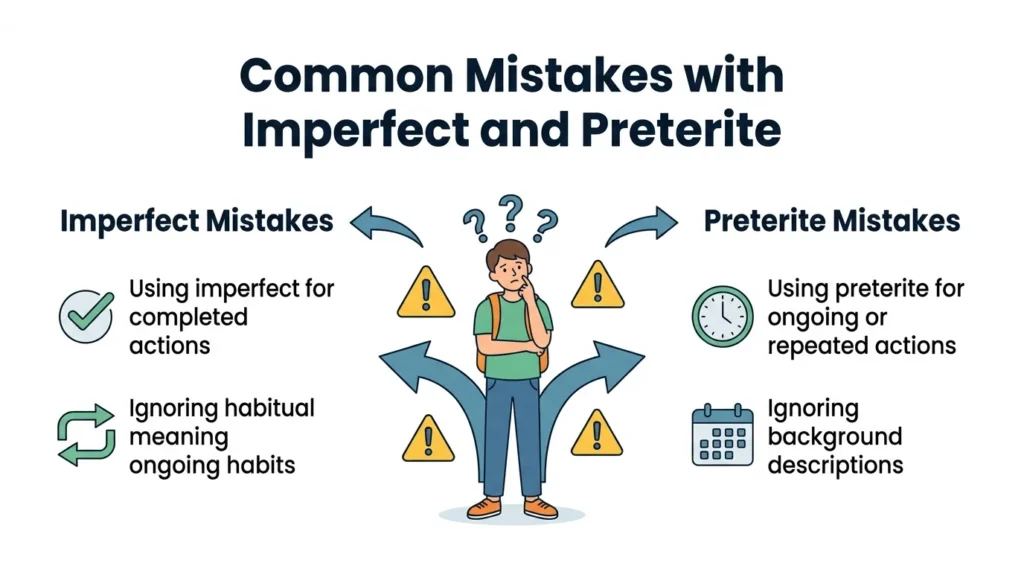
Common Mistakes with Imperfect and Preterite
Mistake 1
Using preterite for habits.
Wrong: I studied every day (single event meaning)
Fix: Use imperfect for repeated actions.
Mistake 2
Using imperfect for completed actions.
Fix: Use preterite when the action ended.
Mistake 3
Ignoring context clues.
Words like “always” usually suggest imperfect.
Mistake 4
Translating directly from English.
Spanish tense choices often depend on perspective, not translation.
Mistake 5
Memorizing rules without reading stories.
Context improves understanding faster than isolated grammar drills.
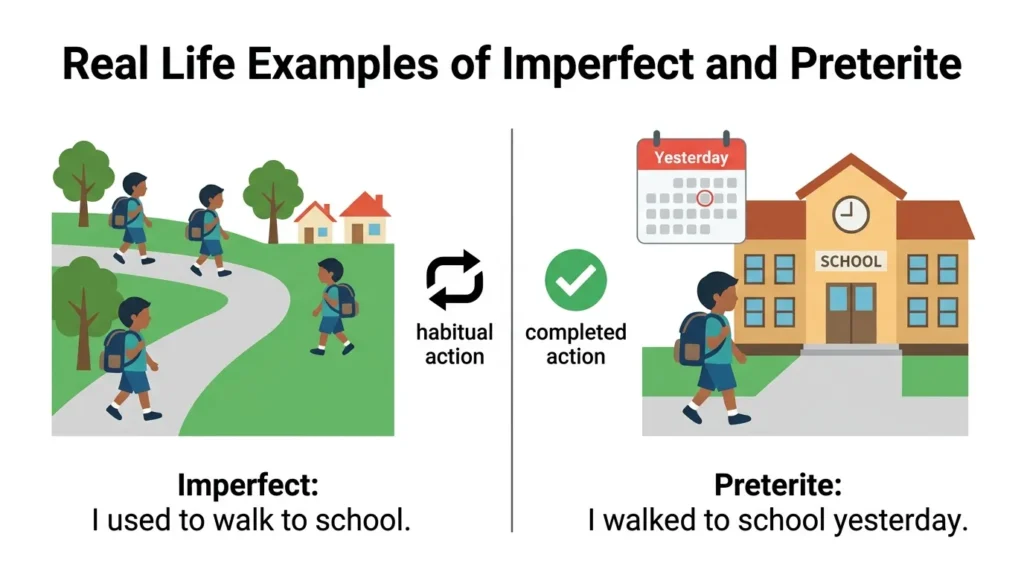
Real Life Examples with Imperfect and Preterite
Personal Use
- Imperfect: I used to visit my grandparents every summer.
- Preterite: I visited them last summer.
School Use
- Imperfect: The teacher explained grammar every day.
- Preterite: The teacher explained today’s lesson.
Business Use
- Imperfect: The company was growing rapidly.
- Preterite: The company launched a new product.
Travel Use
- Imperfect: We stayed near the beach each year.
- Preterite: We stayed there last weekend.
When to Use Each
Use Imperfect When:
- Describing people
- Talking about habits
- Discussing weather
- Giving background information
- Describing emotions
Use Preterite When:
- Describing completed actions
- Giving exact dates
- Explaining specific events
- Narrating actions that move a story forward
Why People Get Confused Between Imperfect and Preterite
Many users get confused because English does not always make this distinction clearly.
Reasons include:
- Direct translation habits
- Similar past-tense meanings
- Multiple grammar rules
- Lack of contextual practice
Most beginners focus on verb endings rather than the speaker’s perspective.
How Search Engines Understand Difference Between Imperfect and Preterite and User Intent
When users search this topic on Google, they usually have one of three goals:
- Understand Spanish grammar.
- Pass language exams.
- Improve conversation skills.
Educational content on YouTube and language-learning communities often emphasize examples because user engagement increases when learners see real-world context rather than memorized rules.
Platforms such as Instagram and Meta frequently expose learners to short Spanish lessons, increasing interest in tense comparisons like imperfect vs preterite.
Expert Insight
As language instructors often explain, the biggest breakthrough comes when learners stop asking, “Which tense is correct?” and start asking, “How am I viewing the action?”
In practical use:
- If you’re describing a scene, use imperfect.
- If you’re reporting an event, use preterite.
This perspective-based approach is how advanced speakers naturally choose the correct tense.
FAQs
What is the difference between imperfect and preterite in Spanish?
Imperfect describes ongoing or repeated actions, while preterite describes completed actions.
Is imperfect the same as “used to”?
Often yes. Imperfect commonly translates as “used to.”
When should I use preterite?
Use it for finished actions or specific events.
Why does Spanish have two past tenses?
Spanish distinguishes between background actions and completed events.
Which tense is harder to learn?
Most learners find choosing between them harder than memorizing forms.
Can both tenses appear in one sentence?
Yes. Storytelling often combines both.
Does imperfect always mean ongoing?
Usually, but it can also describe habits and states.
How can I practice imperfect and preterite?
Read stories, listen to Spanish conversations, and identify background versus action.
Conclusion
Understanding the difference between imperfect and preterite is one of the most important steps in mastering Spanish grammar. While both tenses refer to the past, they serve different purposes. The imperfect focuses on habits, descriptions, ongoing situations, and background information, whereas the preterite highlights completed actions and specific events.
A simple way to remember the distinction is this: the imperfect paints the picture, and the preterite tells what happened inside that picture. Once learners understand this storytelling relationship, choosing the correct tense becomes much easier.
If you’re preparing for exams, improving conversational Spanish, or reading authentic content, mastering the difference between imperfect and preterite will make your communication more natural and accurate. Practice with real examples, focus on context rather than translation, and you’ll quickly develop confidence using both tenses correctly.
Read more about!
Difference Between Contingent and Pending: Explained Clearly
Difference Between Guilt and Shame: Complete Guide

I am Emily Johnson, a USA-based content writer who creates easy-to-read blogs on language and daily life topics. I explain complex ideas in simple English for students and beginners so they can understand easily.