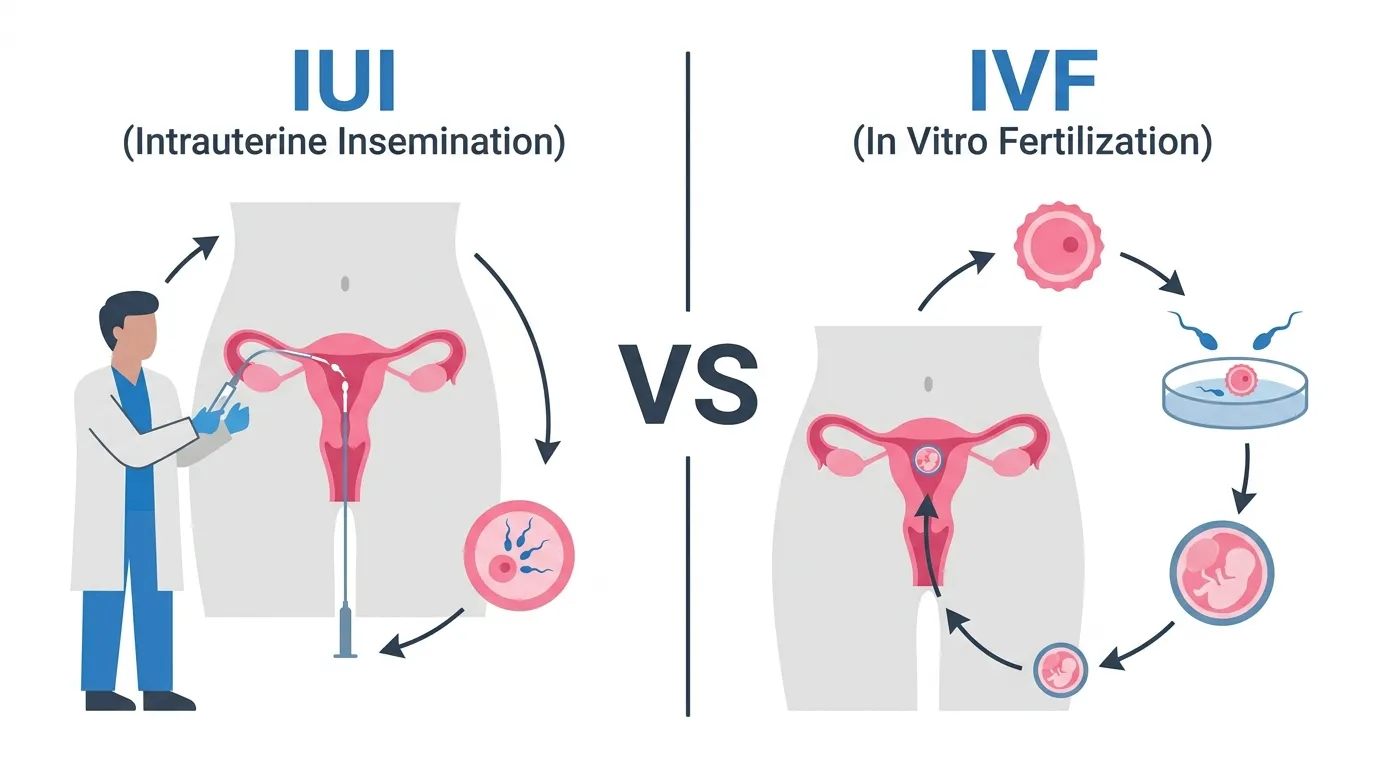
IUI places sperm directly into the uterus to aid natural fertilization, while IVF fertilizes eggs in a lab before transferring an embryo to the uterus.
Infertility treatments can feel confusing, especially when people hear terms like difference between IUI and IVF during doctor visits or online searches. Many users get overwhelmed because both procedures aim to help pregnancy, but they work in very different ways.
So when someone asks difference between IUI and IVF, they usually want clear, simple guidance on which treatment is better, how each works, and what results to expect.
In simple words, the difference between IUI and IVF comes down to where fertilization happens and how much medical intervention is involved. IUI is simpler and less invasive, while IVF is more advanced and controlled.
In this guide, you’ll understand everything step-by-step process, success rates, cost, and real-world use so you don’t need to search anywhere else.
You’ll also learn why doctors recommend one over the other, what affects success rates, and how modern fertility clinics like those discussed by organizations such as American Society for Reproductive Medicine and World Health Organization approach these treatments.
Difference Between IUI and IVF
IUI (Intrauterine Insemination) places sperm directly into the uterus to allow natural fertilization inside the body. IVF (In Vitro Fertilization) fertilizes the egg outside the body in a lab, then transfers the embryo into the uterus.
Example: A couple with mild infertility may try IUI first, while IVF is often used for blocked tubes or advanced fertility issues.
Definition of IUI and IVF
- IUI (Intrauterine Insemination): A fertility procedure where washed sperm is placed directly into the uterus during ovulation to increase chances of fertilization.
- IVF (In Vitro Fertilization): A medical process where eggs are retrieved, fertilized with sperm in a lab, and then the embryo is implanted into the uterus.
Both are assisted reproductive technologies used to treat infertility.
Pronunciation
Understanding pronunciation helps when discussing medical reports or consulting doctors internationally:
- IUI: “eye-you-eye” (US/UK same)
- IVF: “eye-vee-eff” (US/UK same)
Now that the basics are clear, let’s break down the difference between IUI and IVF in a more detailed and practical way.
Difference Between IUI and IVF: Core Comparison
| Feature | IUI | IVF | Similarity |
| Fertilization location | Inside body | Outside body (lab) | Both help sperm meet egg |
| Procedure complexity | Simple | Advanced | Both require medical monitoring |
| Cost | Lower | Higher | Both are fertility treatments |
| Success rate | Moderate | Higher | Both improve pregnancy chances |
| Medication use | Mild | Strong hormonal stimulation | Both may use fertility drugs |
| Time duration | Short cycle | Longer cycle | Both follow ovulation timing |
| Invasiveness | Non-surgical | Minor surgical steps | Both are outpatient procedures |
| Best suited for | Mild infertility | Severe infertility | Both treat reproductive issues |
This table clearly shows the difference and similarity between IUI and IVF for quick understanding.
Key Differences Explained Between IUI and IVF
1. Where fertilization happens
- IUI: Fertilization happens naturally inside the body
- IVF: Fertilization happens in a lab
- Example: IVF is chosen when natural fertilization is not possible
2. Medical involvement level
- IUI: Minimal medical support
- IVF: Full clinical control with lab monitoring
- Insight: IVF allows more precision in embryo selection
3. Cost difference
- IUI: More affordable
- IVF: Expensive due to lab and medication
- Real-life: Many couples try IUI first before IVF
4. Success rates
- IUI: Lower per cycle
- IVF: Higher per cycle
- User intent insight: People search this to decide “what works faster”
5. Time to results
- IUI: Quick cycle
- IVF: Longer process with multiple stages
6. Medical suitability
- IUI: Mild infertility cases
- IVF: Blocked tubes, severe male factor infertility
7. Emotional and physical impact
- IUI: Less stressful
- IVF: More emotional and physical commitment
What is IUI and How Does It Work?
IUI works by placing processed sperm directly into the uterus during ovulation. The goal is to shorten the distance sperm must travel.
- Step 1: Ovulation tracking
- Step 2: Sperm washing
- Step 3: Insertion into uterus
In real scenarios, doctors recommend IUI for couples with unexplained infertility or mild male factor issues.
What is IVF and How Does It Work?
IVF is a multi-step process:
- Egg stimulation using hormones
- Egg retrieval
- Fertilization in lab
- Embryo development
- Embryo transfer
Entities like Centers for Disease Control and Prevention track IVF success rates globally because it is one of the most advanced fertility treatments.
Why Doctors Recommend IUI Before IVF
Many fertility specialists follow a step-up approach:
- Start with IUI (less invasive)
- Move to IVF if needed
This reduces emotional and financial pressure while still giving a chance for natural conception.
When to Choose IUI vs IVF
Choose IUI when:
- Infertility is mild
- Ovulation is normal
- No blocked fallopian tubes
Choose IVF when:
- Tubes are blocked
- Severe male infertility exists
- IUI has failed multiple times
Difference and Similarity
| Aspect | IUI | IVF | Similarity |
| Natural involvement | Higher | Lower | Both aim pregnancy |
| Cost factor | Low | High | Medical investment required |
| Procedure type | Simple clinic procedure | Advanced lab procedure | Both outpatient care |
| Emotional load | Lower | Higher | Both require patience |
| Control level | Low | High | Both medically guided |
| Success speed | Slower | Faster results per cycle | Both require timing |
This comparison makes the difference between IUI and IVF very easy to understand.
Common Mistakes with IUI and IVF
- Assuming IUI and IVF are the same
- Choosing IVF too early without trying IUI
- Ignoring age factor in success rates
- Not understanding hormonal effects
- Expecting instant pregnancy results
Fix: Always consult a fertility specialist before choosing.
Real Life Examples of IUI and IVF
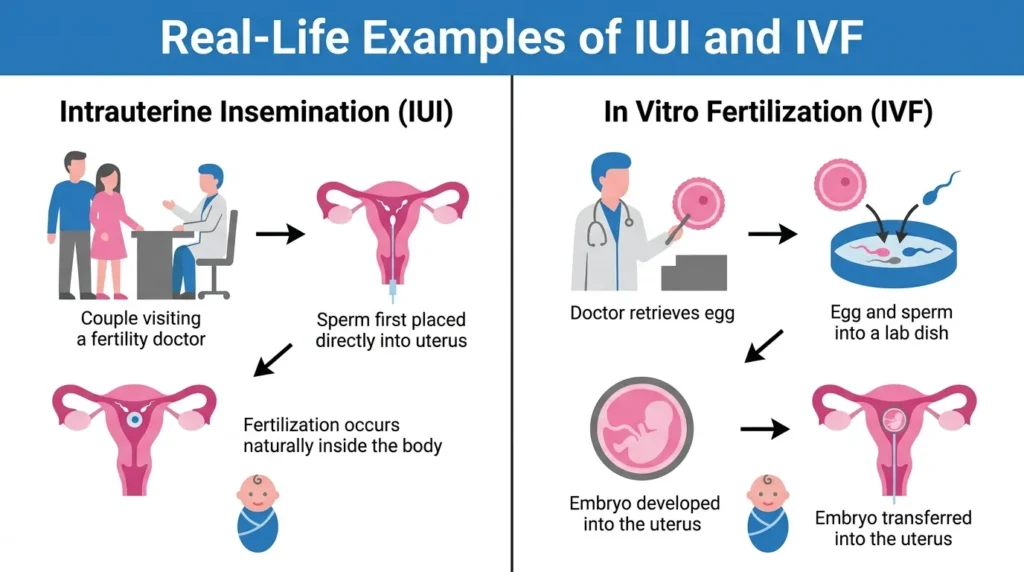
- A young couple with mild infertility starts with IUI
- A woman with blocked tubes directly chooses IVF
- A couple after multiple failed IUIs shifts to IVF
- A clinic uses IVF for genetic screening cases
- IUI is used in low-cost fertility programs
When to Use Each Method
- IUI: First-line treatment for mild issues
- IVF: Advanced treatment for complex infertility
Decision depends on medical diagnosis, not personal preference alone.
Why People Get Confused Between IUI and IVF
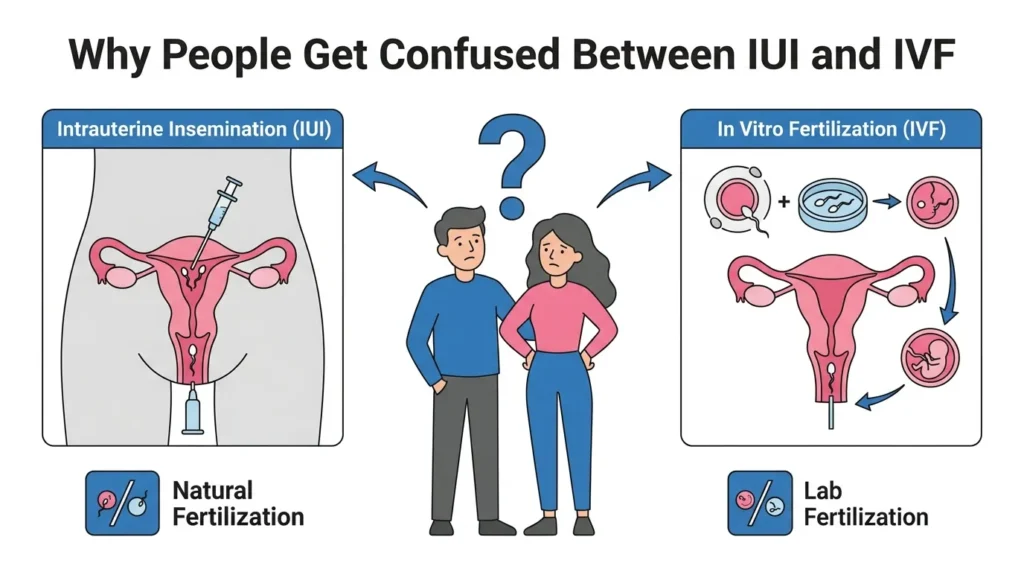
- Both aim for pregnancy
- Both involve medical procedures
- Online information often overlaps
- Social media simplifies medical terms
Entities like Google and YouTube often show mixed content, increasing confusion among users.
How Search Engines Understand This Topic
Search engines analyze user intent like:
- “what is IUI vs IVF” → informational intent
- “which is better IUI or IVF” → comparison intent
- “cost of IVF vs IUI” → transactional intent
Platforms like Instagram and health forums also influence search behavior, shaping what users click and trust.
Expert Insight
From a clinical perspective, fertility specialists follow a structured approach: start simple, then escalate. In practical use, IVF is not always the first option it is a strategic choice based on diagnosis.
Certified reproductive health consultants often emphasize that success depends more on age, egg quality, and sperm health than just choosing between IUI and IVF.
FAQs
1. Is IVF better than IUI?
IVF is more advanced but not always better for every case.
2. Is IUI painful?
No, it is usually a simple and painless procedure.
3. How many IUI cycles before IVF?
Typically 3–6 cycles before switching.
4. Which has higher success rate?
IVF has higher success per cycle.
5. Is IVF expensive?
Yes, it costs significantly more than IUI.
6. Can IUI work for blocked tubes?
No, IVF is required.
7. Is age important in both?
Yes, age strongly affects success rates.
8. Can both be used for male infertility?
Yes, depending on severity.
Conclusion
The difference between IUI and IVF mainly lies in how fertilization happens and how complex the treatment is. IUI is a simpler, less expensive method where fertilization occurs inside the body, making it suitable for mild infertility cases. IVF, on the other hand, is an advanced procedure where fertilization happens in a lab, offering higher control and success rates for complex fertility problems.
Understanding the difference between IUI and IVF helps couples make informed decisions based on medical advice, not confusion or online myths. In real-world practice, doctors often recommend starting with IUI before moving to IVF, depending on age, diagnosis, and fertility history. Both treatments have helped millions of families worldwide achieve pregnancy, and both continue to improve with modern reproductive technology.
Read more about!
Difference Between Guilt and Shame: Complete Guide
Difference Between Adderall and Ritalin: Complete Guide

I am Emily Johnson, a USA-based content writer who creates easy-to-read blogs on language and daily life topics. I explain complex ideas in simple English for students and beginners so they can understand easily.