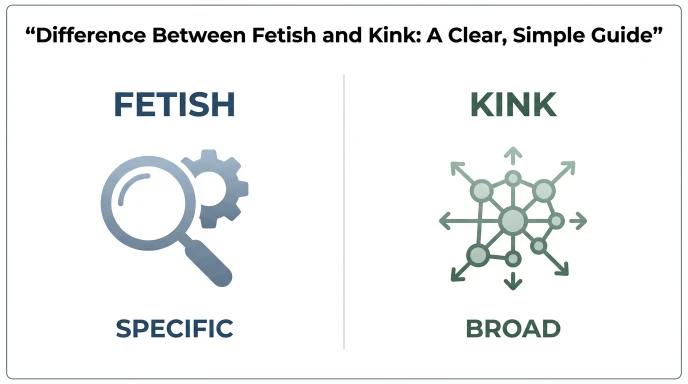
A fetish is a strong sexual focus on a specific object, body part, or situation, while a kink is a broader sexual preference or activity outside traditional norms.
When people search for the difference between fetish and kink, they often use the two words as if they mean exactly the same thing. They are related, but there is an important distinction.
In simple terms, a kink is a broad preference for a non-conventional form of sexual interest or activity, while a fetish usually involves a strong sexual focus on a specific object, body part, material, or situation.
The difference between fetish and kink can become clearer when you look at how central the interest is to a person’s arousal. This guide explains both terms, how they overlap, common misunderstandings, and when each word is more accurate.
Quick Answer
A kink is a broad term for a sexual interest or preference that differs from conventional sexual behavior. A fetish is generally a more specific and intense sexual focus on an object, body part, material, or particular stimulus.
Example: Someone who enjoys role-play may describe it as a kink, while someone whose sexual arousal strongly depends on a particular material or object may describe it as a fetish.
Definition of Fetish and Kink
- Fetish: A strong sexual interest or arousal connected to a particular object, body part, material, or specific stimulus.
- Kink: A broad term for a sexual preference, activity, fantasy, or practice that falls outside what a person considers conventional sex.
The two terms can overlap. A fetish can be considered a type of kink, but not every kink is a fetish.
Pronunciation
- Fetish: US: FEE-tish or FEH-tish; UK: commonly FEE-tish
- Kink: US and UK: kink
Now that the basic definitions are clear, let’s look at where the two terms actually differ.
Difference Between Fetish and Kink: Key Comparison
| Feature | Fetish | Kink |
| Basic meaning | Strong sexual focus on a specific stimulus | Broad term for an unconventional sexual preference |
| Focus | Often an object, body part, material, or specific stimulus | Can involve activities, fantasies, roles, dynamics, or sensations |
| Scope | Usually narrower | Usually broader |
| Role in arousal | May be a major or central source of arousal | May simply add interest or excitement |
| Example | Strong attraction to a particular material | Enjoying role-play or a particular consensual activity |
| Flexibility | Can be more specific | Can include many different preferences |
| Everyday usage | Often used for a specific fixation | Common umbrella term for varied preferences |
| Relationship | Can fall under the broader kink category | May include fetishes but is not limited to them |
What is the simplest way to remember it?
Think of kink as the larger category and fetish as a more specific type of sexual interest that can sometimes fall within that category.
What Is a Kink?
A kink is a broad term for a sexual preference, fantasy, activity, or dynamic that someone finds exciting but that may not be considered part of conventional sexual behavior.
The word is flexible. One person’s kink might involve a particular role-play scenario, while another person’s could involve a certain type of consensual power dynamic, sensation, clothing, or fantasy.
The important point is that kink describes a wide range of preferences.
A person can also have a kink that is simply something they enjoy occasionally. It does not necessarily need to be required for arousal.
In practical use
Someone might say:
“That’s one of my kinks.”
They could be describing something they enjoy without suggesting that it is essential to their sexual arousal.
What Is a Fetish?
A fetish is generally more specific. It involves strong sexual interest or arousal connected to a particular object, body part, material, or other stimulus.
For example, a person may have a strong sexual interest in a particular type of material or object.
The key distinction is specificity and importance.
A fetish may be something a person finds especially central to their sexual interest, although the experience varies from person to person.
Important terminology point
In everyday conversation, people often use fetish casually to mean “strong preference.” In psychology and clinical contexts, however, the term can have a more specific meaning.
That distinction matters because a sexual interest itself is not automatically a mental disorder.
Difference Between Fetish and Kink: How Are They Related?
Many users get confused because the categories overlap.
A useful way to understand the relationship is:
Kink → broad category
Fetish → more specific sexual focus
A person may have several kinks, and one of those interests could also be described as a fetish.
However, calling every unusual sexual preference a fetish is inaccurate.
Simple example
Imagine someone enjoys a particular type of consensual role-play.
That would generally be described as a kink.
Now imagine someone has a very strong sexual focus on a particular object or material.
That may be described as a fetish.
The difference is not simply if something is unusual. It is more about what the interest is focused on and how central it is to arousal.
Is a Fetish the Same as a Kink?
No. The terms are related, but they are not perfect synonyms.
Kink is the broader everyday term. Fetish usually points toward a particular object, body part, material, or stimulus.
There can be overlap, though.
This is why two people may describe the same preference differently. One person may call it a kink because they use the term broadly, while another may use fetish because the specific stimulus is central to their attraction.
Mini summary
All fetishes do not need to be discussed as kinks, and not every kink is a fetish.
The safest approach is to use the term that most accurately describes the person’s own experience.
What Is the Main Difference Between Fetish and Kink?
There are several useful ways to separate the concepts.
1. Specificity
A fetish is often centered on a specific stimulus.
A kink can involve a much wider range of interests.
2. Centrality
A fetish may play a particularly important role in someone’s arousal.
A kink can simply be something enjoyable that adds variety.
3. Type of interest
Kinks can involve activities, fantasies, roles, sensations, or relationship dynamics.
Fetishes are more commonly discussed in connection with particular objects, body parts, materials, or stimuli.
4. Everyday language
Kink is commonly used as an umbrella term.
Fetish tends to sound more specific and intense.
5. Clinical terminology
In professional contexts, “fetish” may be used differently from how people use it casually. A fetishistic interest by itself does not automatically mean a person has a disorder.
Fetish vs Kink: Similarities and Differences
| Feature | Fetish | Kink | Similarity |
| Meaning | Specific sexual interest | Broad sexual preference | Both describe sexual interests |
| Focus | Often a particular stimulus | Can involve many forms of interest | Both vary between people |
| Intensity | May be especially strong | Can range from mild to strong | Neither has one fixed intensity |
| Activity | May focus on an object or stimulus | May involve activities or fantasies | Both can be part of consensual adult sexuality |
| Personal meaning | Can be highly individual | Can also be highly personal | Context matters |
| Everyday use | Often suggests a specific fixation | Often used as an umbrella term | Both are used informally |
| Consent | Healthy practice requires consent | Healthy practice requires consent | Consent and boundaries matter for both |
| Clinical meaning | Can have a more technical definition | Usually a broader informal term | Everyday and clinical meanings can differ |
This table clearly shows the difference and similarity between fetish and kink for quick understanding.
Why Do People Get Confused About Fetish and Kink?
The confusion comes partly from everyday language.
On social platforms such as Instagram, Reddit, and other online communities, people may use fetish, kink, preference, and fantasy loosely. As a result, the boundaries can appear less clear than they are in more precise explanations.
Search engines such as Google also encounter both terms in overlapping contexts. That does not mean the words are identical.
Another reason is that people have different definitions based on personal experience.
For example, one person may use “kink” for almost any sexual preference outside their usual routine. Another person may reserve “kink” for specific activities and “fetish” for object-focused interests.
So context matters.
When Should You Use “Fetish” and When Should You Use “Kink”?
Use kink when you are talking about a broad sexual preference, activity, fantasy, or dynamic.
Use fetish when the interest specifically centers on a particular object, body part, material, or stimulus.
A simple decision rule
Ask:
“Is the interest mainly about a particular thing or stimulus?”
If yes, fetish may be the more precise word.
If it is a broader activity, fantasy, role, dynamic, or preference, kink may be more appropriate.
This is not an absolute rule because everyday language varies.
Common Mistakes With Fetish and Kink
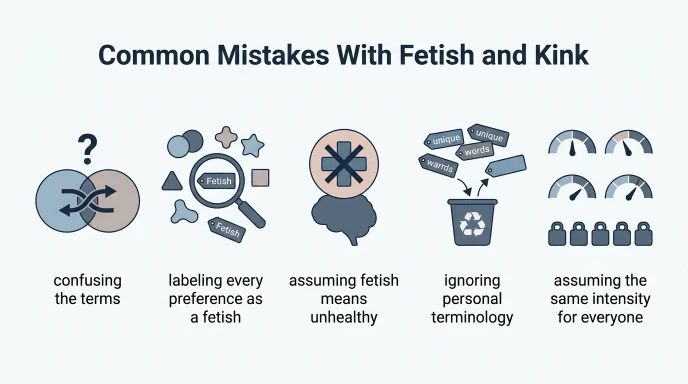
Mistake 1: Treating the words as exact synonyms
They overlap, but they have different levels of meaning.
Fix: Think of kink as broader and fetish as more specific.
Mistake 2: Calling every unusual preference a fetish
Not every unconventional sexual preference is a fetish.
Fix: Look at what the interest actually involves.
Mistake 3: Assuming a fetish means something is unhealthy
Having a particular sexual interest does not automatically mean a person has a disorder.
Fix: Separate sexual preference from clinical diagnosis.
Mistake 4: Ignoring personal terminology
People may describe their own interests differently.
Fix: When discussing someone’s preference, use the terminology they prefer when possible.
Mistake 5: Assuming intensity is identical for everyone
One person’s interest may be occasional, while another person’s may be central.
Fix: Consider the individual’s actual experience instead of assuming a fixed level of intensity.
Real-Life Examples of Fetish and Kink

Example 1: Role-play
An adult enjoys consensual role-play because it adds excitement and variety.
Likely term: Kink.
Example 2: Material-focused interest
An adult has a strong sexual interest specifically connected to a particular material.
Likely term: Fetish.
Example 3: Power dynamics
Two consenting adults enjoy exploring a particular power dynamic.
Likely term: Kink.
Example 4: Combination
Someone enjoys a particular activity and also has a strong attraction to a specific object associated with it.
Possible description: The activity may be a kink, while the object-focused interest may be a fetish.
These examples show why the distinction is about the nature of the interest, not simply if it is considered unusual.
11. Is Having a Fetish or Kink Normal?
There is no single “normal” pattern of adult sexual interest.
People have different preferences, fantasies, and boundaries. A consensual sexual interest is not automatically a mental health problem simply because it is uncommon.
Clinical concerns arise under different circumstances, such as when an interest involves non-consenting people or causes significant distress or impairment.
That is an important distinction because online discussions sometimes use psychological terms casually without considering their actual clinical meaning.
12. How Do Social Media and Online Communities Affect These Terms?
Modern online communities have made terms such as kink and fetish much more visible.
Platforms such as Reddit, Instagram, and Meta-owned services expose users to a wide range of terminology and communities. This can help people discover language for interests they previously could not describe.
At the same time, social media can blur definitions.
A hashtag, meme, post, or comment may use a word differently from a dictionary or clinical source. That is why it is better to understand the underlying meaning rather than rely on how a term is used in one online post.
How Google Understands “Fetish vs Kink”
Google’s job is not simply to match the exact words in a query. Search systems try to understand the user’s underlying intent.
Someone searching “difference between fetish and kink” is usually looking for:
- A simple definition
- A comparison
- Examples
- The relationship between the terms
- If they mean the same thing
- Guidance on which term is more accurate
That is why a useful comparison page should answer the direct question early instead of filling the introduction with unrelated information.
The same principle applies to searches such as “what is a kink?”, “what is a fetish?”, and “is fetish the same as kink?”
Expert Insight: The Most Useful Distinction
The most practical way to separate these terms is not to ask if an interest is unusual.
Instead, ask three questions:
- What is the person interested in?
- How specific is that interest?
- How central is it to their arousal or experience?
A broad activity, fantasy, or dynamic is more naturally described as a kink. A highly specific focus on an object, body part, material, or stimulus may be more accurately described as a fetish.
In real scenarios, however, language remains flexible. People do not always follow textbook categories when describing themselves.
That is why context and personal terminology matter.
Frequently Asked Questions
What is the difference between fetish and kink?
A kink is a broad sexual preference or interest outside conventional sexual behavior. A fetish is usually a more specific sexual focus on an object, body part, material, or stimulus.
Is a fetish considered a kink?
A fetish can be considered a type of kink in broad everyday usage, but the terms are not exact synonyms. Fetish generally describes a more specific type of interest.
Is kink the same as fetish?
No. Kink is broader, while fetish usually refers to a specific object, body part, material, or stimulus connected with sexual arousal.
What is an example of a kink?
Role-play, particular consensual dynamics, or certain forms of sensation can be described as kinks. The exact meaning depends on the person’s preference.
What is an example of a fetish?
A strong sexual focus on a particular object, body part, or material can be described as a fetish.
Is having a fetish or kink a disorder?
Not automatically. A sexual interest by itself is not necessarily a mental disorder. Clinical definitions depend on factors such as significant distress, impairment, or involvement of non-consenting people.
Why do people use fetish and kink interchangeably?
Because everyday online language is less precise than clinical or dictionary terminology. Many communities use kink as a broad umbrella term that can include fetishes.
Which word should I use: fetish or kink?
Use kink for a broad preference, activity, fantasy, or dynamic. Use fetish when the interest specifically centers on an object, body part, material, or particular stimulus.
Conclusion
The difference between fetish and kink mainly comes down to scope, focus, and how the interest functions for the individual. A kink is a broad term for a sexual preference, activity, fantasy, or dynamic outside what someone considers conventional. A fetish is generally more specific and involves strong sexual interest in a particular object, body part, material, or stimulus.
The two terms can overlap, which explains why many people use them interchangeably online. Still, they are not exact synonyms. The easiest way to remember the distinction is that kink is the broader concept, while fetish usually describes a more specific focus.
In practical use, context matters more than labels. People may describe their own interests differently, and everyday language does not always follow clinical terminology. Most importantly, consensual adult interests should not automatically be treated as disorders simply because they are uncommon.
Understanding these differences makes it much easier to answer searches such as “what is a fetish,” “what is a kink,” and “is a fetish the same as a kink?”
READ MORE ABOUT!
- Difference Between OB and GYN: Simple Guide
- Difference Between Cellulite and Lipedema: Key Signs Explained

I am James Carter, a professional content writer from the United States. I specialize in writing simple and clear comparison blogs that help students and readers understand difficult topics easily. My writing focuses on everyday language, education, science, and lifestyle topics. I believe that learning should be easy for everyone, so I use simple words and real-life examples in my articles.