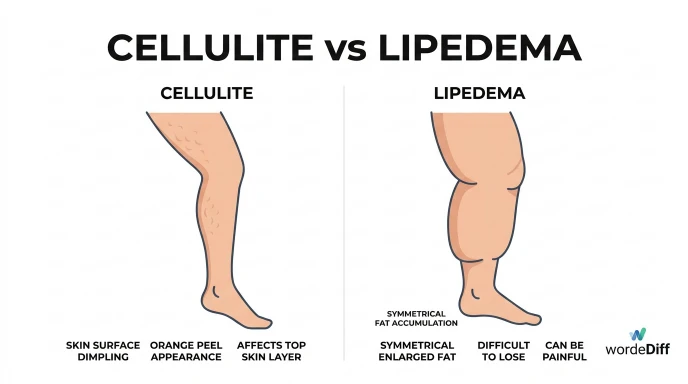
If your thighs or legs look uneven, dimpled, swollen, or larger than expected, you may wonder about the difference between cellulite and lipedema.
These two conditions can look similar, but they are not the same. Cellulite mainly changes the appearance and texture of the skin, while lipedema is a chronic disorder involving abnormal fat distribution and may cause pain, tenderness, easy bruising, and swelling.
Understanding the difference between cellulite and lipedema matters because the causes, symptoms, diagnosis, and treatment approaches are different. In this guide, you will learn what each condition is, how to tell them apart, why people get confused, and when professional evaluation may be helpful.
Quick Answer:
Cellulite is mainly a cosmetic skin-texture change that creates dimples or a “cottage cheese” appearance. Lipedema is a chronic condition involving abnormal, usually symmetrical fat accumulation that can cause pain, tenderness, swelling, and easy bruising.
For example, painless dimpling on the thighs is more typical of cellulite, while painful, easily bruised, symmetrical enlargement of the legs may suggest lipedema.
Definition of Cellulite and Lipedema
- Cellulite: A common skin appearance caused partly by fibrous connective bands that pull the skin downward while underlying fat pushes upward, creating dimples.
- Lipedema: A chronic disorder involving abnormal accumulation of fat, usually on both sides of the lower body, often affecting the hips, thighs, and legs.
Pronunciation
- Cellulite: US SEL-yuh-lite | UK SEL-yuh-lite
- Lipedema: commonly pronounced lip-uh-DEE-muh; pronunciation can vary slightly by region.
Now that the basic definitions are clear, the main difference becomes easier to understand: cellulite is primarily about skin texture, while lipedema involves an abnormal pattern of fatty tissue and can produce physical symptoms.
What Is the Difference Between Cellulite and Lipedema?
The biggest difference is what is happening underneath the skin.
Cellulite creates visible dimpling because of the interaction between fat, skin, and connective tissue. It is extremely common, particularly around the thighs and buttocks, and even people who are very fit can have it.
Lipedema, on the other hand, involves abnormal fat distribution. It commonly affects both sides of the body in a relatively symmetrical pattern. The legs may appear disproportionately larger than the upper body, while the feet are typically not affected. Pain, tenderness, heaviness, swelling, and easy bruising can also occur.
In simple words:
Cellulite changes how the skin looks. Lipedema changes how fat is distributed and can cause physical symptoms.
Key Differences Explained Between Cellulite and Lipedema
1. Appearance
Cellulite usually appears as small dimples, waves, or uneven areas on the skin. It may become easier to see when the skin is pinched or when someone stands.
Lipedema can create a larger, more uniform increase in the size of the affected limbs. The skin may also have an uneven or nodular texture, particularly as the condition progresses.
Real-life example: Someone may have normal-sized legs with a few dimples on the thighs from cellulite. A person with lipedema may have noticeably disproportionate thighs and calves on both sides.
2. Pain and Tenderness
Typical cellulite is not considered a painful medical disorder.
Lipedema can be painful or tender. Some people experience discomfort when the affected tissue is pressed, along with a feeling of heaviness in the legs.
This is one of the most useful clues when people ask, “Is it cellulite or lipedema?”
3. Bruising
Easy bruising is not a defining feature of ordinary cellulite.
People with lipedema may bruise easily, and this symptom can occur alongside tenderness and swelling.
4. Symmetry
Cellulite does not have to follow a perfectly symmetrical pattern.
Lipedema characteristically causes relatively symmetrical enlargement, often affecting both legs or both arms.
5. Feet and Hands
Lipedema usually affects the legs while sparing the feet. This can create a noticeable transition around the ankles.
Cellulite does not follow this kind of anatomical pattern because it is a skin-texture issue rather than a specific fat-distribution disorder.
6. Response to Weight Loss
Cellulite can become less noticeable when a person loses weight, although weight loss does not guarantee that cellulite will disappear. The American Academy of Dermatology notes that extra weight can make cellulite more visible.
Lipedema tissue is often resistant to reduction through ordinary diet and exercise. A person may lose weight from other parts of the body while the areas affected by lipedema change much less.
7. Main Health Concern
Cellulite is generally a cosmetic concern rather than a dangerous disease.
Lipedema can affect comfort, movement, mobility, and quality of life. In some cases, it can occur alongside lymphedema or other conditions.
8. Diagnosis
Cellulite is usually identified by examining the skin and its characteristic dimpling.
Lipedema is diagnosed primarily through medical history and physical examination. There is no single routine test that confirms lipedema, although imaging or other tests may sometimes be used to investigate other conditions or complications.
Difference and Similarity for Cellulite and Lipedema
| Feature | Cellulite | Lipedema | Similarity |
| Main issue | Dimpled or uneven skin texture | Abnormal fat distribution | Both can affect the legs |
| Pain | Usually not painful | May be painful or tender | Symptoms vary between people |
| Bruising | Not a typical feature | Easy bruising can occur | Both may be noticed through skin changes |
| Pattern | Often thighs and buttocks | Usually symmetrical lower-body areas | Both can involve thighs |
| Feet | No specific pattern | Usually spared | Both can change leg appearance |
| Weight loss | May make cellulite less visible | Often does not remove affected fat | Diet and exercise can affect overall body composition |
| Diagnosis | Usually visual examination | Medical history and physical examination | Professional assessment can help |
| Treatment goal | Improve appearance | Manage symptoms and function | Treatment depends on the individual |
This table clearly shows the difference and similarity between cellulite and lipedema for quick understanding.
What Causes Cellulite and Lipedema?
Cellulite develops from the relationship between connective tissue, fat, and the skin. Fibrous connective cords can pull the skin downward while fat pushes upward, producing the familiar dimpled appearance. Hormones, genetics, skin structure, body composition, and age may influence how visible cellulite becomes.
The exact cause of lipedema is not fully understood. Research and clinical guidelines describe it as a chronic disorder involving abnormal adipose tissue. It commonly begins or becomes more noticeable around hormonal changes such as puberty, pregnancy, or menopause, and family history may play a role.
So, although both involve fatty tissue under the skin, they develop through different biological processes.
How Can You Tell If It Is Cellulite or Lipedema?
There is no reliable home test that can diagnose lipedema. However, certain patterns can help you understand why professional evaluation might be appropriate.
Cellulite is more likely when:
- The main concern is skin dimpling.
- The area is not painful or unusually tender.
- The changes are mainly cosmetic.
- There is no unusual symmetrical enlargement of the legs.
- The appearance changes with skin position or muscle tone.
Lipedema may be worth discussing with a healthcare professional when:
- Both legs are enlarged in a similar pattern.
- The affected areas feel painful or tender.
- Your legs feel unusually heavy.
- You bruise easily.
- Your feet remain relatively unaffected while the legs are enlarged.
- Diet and exercise change other body areas but have little effect on the affected tissue.
These signs are clues, not a diagnosis.
Why Do People Get Confused About Cellulite and Lipedema?
Many users get confused because lipedema can sometimes create a dimpled or uneven skin appearance that looks similar to cellulite. Social media can make the confusion worse because Instagram, YouTube, and other platforms often use simplified “before and after” images without explaining the medical differences.
Another problem is that people may assume every type of leg fat is ordinary cellulite or simply a result of body weight. That is not always accurate.
Google searches such as “cellulite or lipedema,” “is cellulite a sign of lipedema,” and “how to tell if I have lipedema” reflect this confusion. The important point is that appearance alone cannot always provide a clear answer.
How Is Cellulite Treated?
Cellulite usually does not require medical treatment. If someone wants to reduce its appearance, options may include lifestyle changes and dermatologist-led procedures.
The American Academy of Dermatology reports that some treatments, including acoustic wave therapy, certain laser treatments, and subcision, can reduce the appearance of cellulite. Results vary, and some treatments are temporary.
Exercise and maintaining a healthy weight may also make cellulite less noticeable for some people. However, cellulite is different from ordinary excess fat, so simply removing fat does not necessarily remove the dimpling.
How Is Lipedema Treated?
There is currently no simple cure for lipedema, so treatment focuses on managing symptoms, maintaining mobility, and improving quality of life.
Depending on the person’s condition, healthcare professionals may recommend exercise, compression, skin care, physical therapy, lymphatic drainage, nutritional strategies, or other supportive approaches. Some patients may also be considered for specialized liposuction performed with techniques designed to reduce damage to lymphatic vessels.
Treatment should be individualized. A person should not assume that a cosmetic fat-removal procedure designed for ordinary body fat is appropriate for suspected lipedema.
Common Mistakes With the Difference Between Cellulite and Lipedema
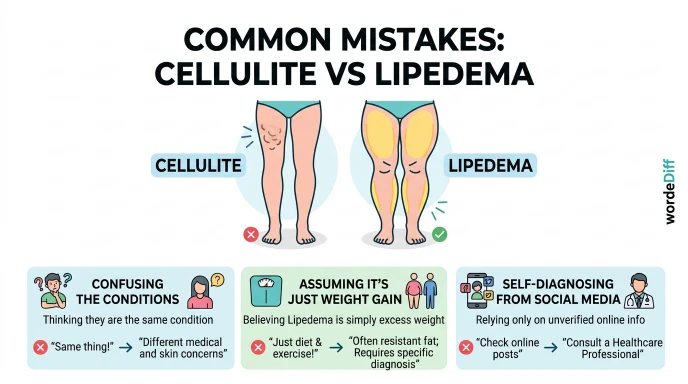
Mistake 1: Thinking all cellulite is lipedema.
Most cellulite is simply cellulite. Dimpling by itself does not mean someone has lipedema.
Mistake 2: Assuming lipedema is just obesity.
Lipedema has a distinct pattern of abnormal fat distribution and can occur alongside obesity, but the two are not the same condition.
Mistake 3: Using social media images as a diagnosis.
Instagram and YouTube can be useful for education, but images cannot replace a clinical assessment.
Mistake 4: Expecting diet to eliminate lipedema.
Healthy eating and exercise are valuable, but lipedema-affected tissue may not respond like ordinary body fat.
Mistake 5: Confusing cellulite with cellulitis.
These words sound similar but describe very different things. Cellulitis is a bacterial skin infection that can cause redness, warmth, swelling, pain, and sometimes fever.
Real-Life Examples of Cellulite and Lipedema
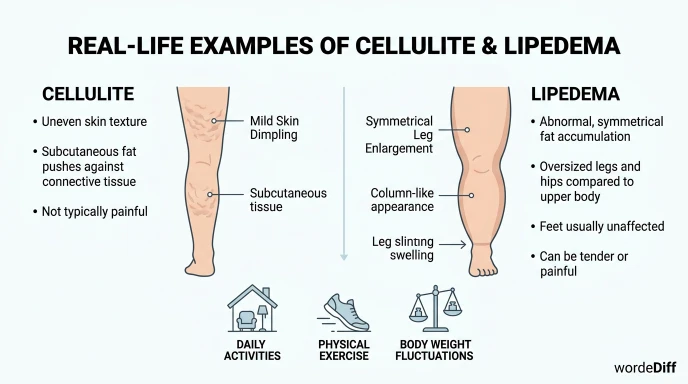
Example 1 Typical cellulite:
A physically active person notices small dimples on the back of the thighs. There is no pain, unusual swelling, or easy bruising. This pattern is consistent with common cellulite.
Example 2 Possible lipedema:
A person notices that both thighs and calves have gradually become larger and tender. Their feet remain relatively unaffected, and they bruise easily. These features are worth discussing with a healthcare professional.
Example 3 Weight change:
Someone loses weight from their waist and upper body but sees little change in unusually enlarged legs. This does not prove lipedema, but it is one feature clinicians may consider when evaluating the pattern.
Example 4 Mixed appearance:
A person can have cellulite and lipedema at the same time. Having one does not automatically exclude the other.
When Should You See a Doctor?
Consider speaking with a healthcare professional if you have persistent leg swelling, unexplained pain, unusual tenderness, easy bruising, significant asymmetry or symmetry-related changes, or difficulty with movement.
A clinician can review your medical history and examine the affected areas. If lipedema is suspected, additional testing may sometimes be used to rule out other causes of swelling or identify related problems.
Seek prompt medical care for sudden one-sided leg swelling, significant redness or warmth, severe pain, fever, chest pain, or shortness of breath, because these symptoms can point to problems that are different from cellulite or lipedema.
How Search Engines Understand the Difference Between Cellulite and Lipedema
Search engines such as Google increasingly need to understand the relationship between related medical concepts rather than simply matching exact keywords.
A useful page should connect cellulite, lipedema, fat distribution, skin dimpling, pain, bruising, swelling, diagnosis, and treatment in a clear context.
This also explains why searches from Instagram, YouTube, fitness apps, and health websites can produce mixed information. Some pages discuss appearance, while others discuss medical conditions. A high-quality health article needs to separate cosmetic concerns from clinical symptoms instead of treating every uneven skin texture as the same condition.
Expert Insight: The Most Useful Clue Is the Pattern
One of the most important practical points is that dimpling alone is not enough to identify lipedema.
When professionals evaluate possible lipedema, they look at the bigger picture: where the fat is distributed, if the pattern is symmetrical, if there is pain or tenderness, if bruising occurs easily, if the feet are spared, and how the condition has changed over time. Clinical guidelines emphasize medical history and physical findings in diagnosis.
This is why online quizzes, social media comparisons, and “look at your legs” checklists should be treated as educational tools, not diagnostic tests.
Frequently Asked Questions
Is cellulite the same as lipedema?
No. Cellulite is mainly a dimpled skin appearance, while lipedema is a chronic disorder involving abnormal fat distribution that may cause pain, tenderness, swelling, and easy bruising.
Can you have cellulite and lipedema at the same time?
Yes. A person with lipedema can also have cellulite. The presence of cellulite does not rule out another condition.
Does lipedema look like cellulite?
It can. Some stages of lipedema can create uneven or dimpled skin, which is one reason the two conditions are often confused.
Does losing weight get rid of cellulite?
Weight loss may make cellulite less noticeable for some people, but it does not guarantee that the dimpling will disappear.
Does exercise help lipedema?
Exercise can support mobility, fitness, and symptom management. Activities such as walking, cycling, and swimming may be useful, but exercise does not necessarily remove lipedema-affected fat like ordinary body fat.
Is lipedema painful?
It can be. Pain or tenderness, along with heaviness and easy bruising, are recognized features of lipedema.
Can a doctor diagnose lipedema?
Yes. Diagnosis is mainly based on medical history and physical examination. There is no single routine test that confirms every case of lipedema.
Is cellulite dangerous?
Ordinary cellulite is generally a cosmetic concern and does not usually require medical treatment.
Conclusion
The difference between cellulite and lipedema is more than how the skin looks. Cellulite mainly causes visible dimpling because of the way skin, connective tissue, and underlying fat interact. Lipedema involves abnormal fat distribution and may cause symptoms such as pain, tenderness, swelling, heaviness, and easy bruising.
The easiest way to think about it is this: cellulite is primarily a skin-texture concern, while lipedema is a chronic fat-distribution condition that can have physical symptoms.
If you notice symmetrical enlargement of your legs, painful or tender fatty tissue, frequent unexplained bruising, or a pattern that does not respond like ordinary body fat, it is reasonable to speak with a healthcare professional. Do not rely only on Instagram photos, YouTube videos, or online quizzes for diagnosis.
Understanding the difference between cellulite and lipedema can help you ask better questions and avoid confusing a common cosmetic feature with a medical condition.
Read more about!
- Difference Between Aioli and Mayo: Simple Guide
- Difference Between Catholic and Lutheran: Easy Guide

I am Emily Johnson, a USA-based content writer who creates easy-to-read blogs on language and daily life topics. I explain complex ideas in simple English for students and beginners so they can understand easily.