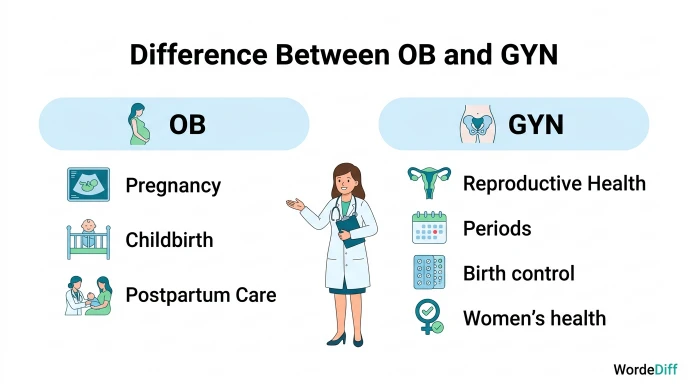
The difference between OB and GYN can be confusing because both terms describe areas of women’s reproductive health, and many doctors practice both.
In simple words, OB (obstetrics) focuses on pregnancy, childbirth, and care around birth, while GYN (gynecology) focuses on the reproductive system outside pregnancy. The difference between OB and GYN becomes easier to understand when you look at the type of care each one provides.
Someone who needs prenatal care may see an OB, while someone seeking help for irregular periods may need gynecologic care. This guide explains what is OB, what is GYN, how they differ, and when each type of care is used. It also explains why many doctors are called OB-GYNs and how their combined training can help patients receive continuous reproductive healthcare.
Quick Answer:
OB means obstetrics, the medical specialty focused on pregnancy, labor, delivery, and the postpartum period. GYN means gynecology, which focuses on reproductive and gynecologic health, including periods, contraception, infections, menopause, and many reproductive-system conditions.
For example, a pregnant patient may need obstetric care, while a patient with painful periods may need gynecologic care. Many physicians combine both specialties and are known as OB-GYNs. The American College of Obstetricians and Gynecologists (ACOG) recognizes obstetrics and gynecology as closely connected areas of medical practice.
Definition of OB and GYN
- OB (Obstetrics): The branch of medicine that provides care during pregnancy, labor, childbirth, and the period after delivery.
- GYN (Gynecology): The branch of medicine that focuses on the female reproductive system and related health concerns, if or not a person is pregnant.
An OB-GYN is a physician trained in both areas, which is why one doctor can provide both pregnancy care and general gynecologic care. ACOG’s professional materials refer to physicians as obstetrician-gynecologists and recognize certification in obstetrics, gynecology, or both.
Pronunciation
OB is commonly pronounced as “oh-bee.”
GYN is commonly pronounced as “guy-n.”
You may also hear OB-GYN pronounced “oh-bee-guy-n.”
Now that the basic terms are clear, let’s look at the practical difference between OB and GYN and why both specialties matter.
What Is OB and What Does an Obstetrician Do?
An obstetrician specializes in care related to pregnancy and childbirth.
OB care can include monitoring the health of the pregnant patient and developing baby, checking pregnancy progress, managing pregnancy-related conditions, and providing care during labor and delivery.
Depending on the patient’s needs, obstetric care may involve:
- Prenatal appointments
- Pregnancy monitoring
- Ultrasound-related care
- Labor management
- Delivery
- Cesarean delivery when medically indicated
- Management of pregnancy complications
- Postpartum care
The exact services vary by physician, hospital, pregnancy, and level of risk.
For example, a patient with a routine pregnancy may have regular prenatal visits with an OB-GYN. A patient with a complicated pregnancy may need additional care from specialists such as a maternal-fetal medicine physician.
ACOG’s educational resources cover obstetric conditions, maternal and fetal health, and intrapartum care, showing how broad the obstetric side of the specialty can be.
What Is GYN and What Does a Gynecologist Do?
Gynecology focuses on reproductive and sexual health that is not limited to pregnancy.
A gynecologist may help with concerns involving:
- Menstrual periods
- Heavy or irregular bleeding
- Pelvic pain
- Vaginal symptoms
- Certain reproductive-system infections
- Contraception
- Fertility-related concerns
- Menopause
- Cervical health
- Ovarian and uterine conditions
- Preventive reproductive healthcare
For example, someone experiencing unusually painful periods might make a gynecology appointment.
A person who wants to discuss birth control may also seek gynecologic care. ACOG describes obstetrician-gynecologists as healthcare providers who can participate in contraceptive counseling and shared decision-making with patients.
Difference Between OB and GYN: The Main Comparison
| Feature | OB | GYN | Similarity |
| Main focus | Pregnancy and childbirth | Reproductive and gynecologic health | Both involve reproductive healthcare |
| Pregnancy care | Central part of the specialty | May be outside the main focus | Both may work with patients of reproductive age |
| Labor and delivery | Provides obstetric care | Not the primary focus | Both may be part of an OB-GYN practice |
| Period problems | Not the main focus | Common area of care | Both may discuss reproductive health |
| Birth control | May discuss it | Commonly provides counseling and care | Both can support reproductive choices |
| Menopause | Not the main focus | Common gynecologic care | Both may address women’s health |
| Postpartum care | Important part of obstetric care | May provide ongoing gynecologic care | Care can overlap |
| Training | Obstetrics | Gynecology | Many physicians train in both |
This table clearly shows the difference and similarity between OB and GYN for quick understanding.
Key Differences Explained Between OB and GYN
1. OB Focuses on Pregnancy
The biggest difference is pregnancy.
Obstetrics is specifically concerned with pregnancy, labor, delivery, and care surrounding childbirth.
Real-life example:
A pregnant patient goes to an OB for prenatal monitoring and delivery planning.
2. GYN Focuses on Reproductive Health
Gynecology covers a much wider range of reproductive health concerns outside pregnancy.
Real-life example:
Someone with persistent pelvic pain may see a gynecologist for evaluation.
3. OB Includes Labor and Delivery
Obstetric care can continue through labor and childbirth.
Gynecology does not primarily focus on delivering babies.
Real-life example:
When a patient goes into labor, the obstetric team manages the pregnancy and delivery-related care.
4. GYN Covers Menstrual Concerns
Period-related problems are commonly handled through gynecologic care.
This may include concerns such as unusually heavy bleeding, painful periods, or irregular cycles.
Real-life example:
A teenager or adult with periods that are consistently very painful may seek gynecologic evaluation.
5. OB and GYN Can Overlap
This is where many beginners get confused.
A doctor can be trained in both obstetrics and gynecology. That physician is called an OB-GYN.
So, asking if someone is an OB or GYN does not always mean choosing between two completely separate doctors.
6. GYN Care Continues Outside Pregnancy
A person does not need to be pregnant to receive gynecologic care.
Gynecologists can provide reproductive healthcare across different stages of life, including adolescence, adulthood, and menopause.
7. OB Care Changes With Pregnancy
Once pregnancy begins, healthcare needs change.
The focus moves toward pregnancy progress, maternal health, fetal health, labor planning, delivery, and recovery after birth.
Why Are OB and GYN Often Combined as OB-GYN?
The two specialties are closely connected.
Pregnancy involves the reproductive system, but it also creates unique medical needs that require obstetric training. At the same time, reproductive health continues before and after pregnancy.
That is why many physicians train and practice in both areas.
In practical use, an OB-GYN can provide a more continuous form of care. A patient might see the same physician for routine gynecologic visits, receive prenatal care during pregnancy, and return for postpartum or general gynecologic care later.
ACOG’s materials specifically refer to obstetrician-gynecologists and to certification covering obstetrics, gynecology, or both.
What Services Does an OB-GYN Provide?
An OB-GYN may provide services across both specialties.
Depending on the physician’s practice, these can include:
- Routine gynecologic visits
- Pregnancy care
- Prenatal appointments
- Labor and delivery
- Postpartum care
- Contraceptive counseling
- Menstrual health evaluation
- Menopause care
- Pelvic health evaluation
- Treatment of gynecologic conditions
- Reproductive health counseling
Not every OB-GYN performs every procedure or handles every type of pregnancy. Some doctors have additional areas of expertise.
For example, a high-risk pregnancy may require a maternal-fetal medicine specialist.
When Should You See an OB?
You may need obstetric care when you are pregnant or planning pregnancy and need pregnancy-related medical support.
Common reasons include:
- Confirming and monitoring a pregnancy
- Starting prenatal care
- Monitoring pregnancy development
- Discussing pregnancy-related symptoms
- Planning for childbirth
- Managing pregnancy complications
- Receiving postpartum care
If a pregnancy is considered high risk, the patient may be referred to an appropriate specialist.
The important point is that obstetric care is centered on pregnancy and childbirth rather than general reproductive health alone.
When Should You See a GYN?
Gynecologic care may be appropriate for many reproductive-health concerns that are not specifically related to pregnancy.
Examples include:
- Painful periods
- Heavy menstrual bleeding
- Irregular cycles
- Pelvic discomfort
- Contraception questions
- Menopause symptoms
- Vaginal or reproductive-health concerns
- Routine reproductive healthcare
If you are unsure if your concern belongs in obstetrics or gynecology, an OB-GYN practice can often help determine the appropriate type of appointment.
Can an OB-GYN Do Both?
Yes.
An OB-GYN is specifically trained in both obstetrics and gynecology.
This is one of the most important points when understanding the difference between OB and GYN.
Think of it this way:
OB = pregnancy and childbirth
GYN = reproductive health
OB-GYN = both
That simple framework makes the terminology much easier to remember.
Are OB and GYN Separate Doctors?
They can be, but they do not have to be.
Some physicians may focus more heavily on one side of the specialty. Others practice both obstetrics and gynecology.
A patient’s care setting also matters. A hospital may have separate teams for certain services, while a private practice may have physicians who provide both types of care.
This is why you should look at the services offered by the specific clinic rather than assuming every doctor has exactly the same scope of practice.
Difference Between OB and GYN During Pregnancy
Pregnancy is where the distinction becomes especially obvious.
An OB provides care related directly to pregnancy and birth.
A gynecologist may still be involved in a person’s overall reproductive health, but pregnancy itself falls under obstetric care.
For example:
Before pregnancy:
A patient may see a GYN for reproductive healthcare or preconception counseling.
During pregnancy:
Prenatal and pregnancy-related care may be provided by an OB or OB-GYN.
During delivery:
The obstetric team manages labor and childbirth.
After delivery:
Postpartum and ongoing gynecologic care may follow.
This creates a natural connection between the two fields.
Why People Get Confused About OB vs GYN
The confusion is understandable because the terms are closely connected.
The Names Sound Similar
Both words describe reproductive healthcare specialties, so the distinction is not obvious to someone unfamiliar with medical terminology.
Many Doctors Use “OB-GYN”
A physician who practices both may simply be called an OB-GYN.
That makes people wonder if OB and GYN are two different doctors or two parts of the same specialty.
Services Can Overlap
Some reproductive-health services can involve both sides of the specialty.
For example, contraception is primarily gynecologic care but may also be discussed by an OB-GYN during pregnancy planning or postpartum care.
Medical Training Is Connected
Obstetrics and gynecology are commonly combined into one residency specialty in the United States. ACOG provides educational and residency resources specifically for the combined obstetrics and gynecology field.
Common Mistakes With the Difference Between OB and GYN
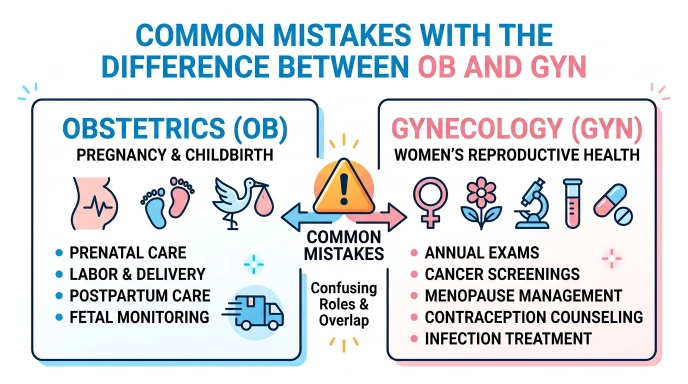
Mistake 1: Thinking OB Means “Only Pregnancy”
Pregnancy is the central focus of obstetrics, but obstetric care also involves labor, delivery, and the postpartum period.
Fix: Think of OB as the pregnancy-and-birth side of the specialty.
Mistake 2: Thinking GYN Is Only About Periods
Gynecology covers much more than menstrual health.
Fix: Remember that GYN covers a broad range of reproductive-system and women’s health concerns.
Mistake 3: Assuming OB and GYN Are Always Separate Doctors
Many physicians are trained in both.
Fix: Look for the term OB-GYN.
Mistake 4: Assuming Every OB-GYN Offers Identical Services
Doctors can have different practice areas, procedures, and referral patterns.
Fix: Check the clinic’s listed services when choosing a provider.
Mistake 5: Using the Terms Interchangeably
OB and GYN are related but technically describe different areas.
Fix: Use OB for pregnancy-related care and GYN for broader gynecologic care.
Real-Life Examples of the Difference Between OB and GYN
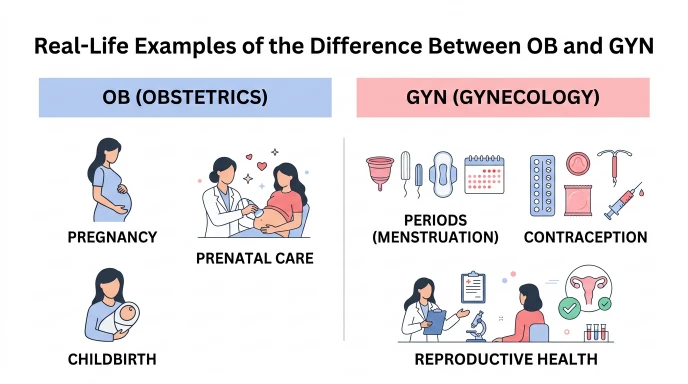
Personal Health Example
A person has unusually painful periods and wants to find out why.
Best fit: GYN care.
Pregnancy Example
A person has a positive pregnancy test and wants prenatal care.
Best fit: OB or OB-GYN care.
Birth Example
A patient is in labor and needs medical management during delivery.
Best fit: Obstetric care.
Birth Control Example
Someone wants to discuss contraceptive options.
Best fit: GYN or OB-GYN care, depending on the situation.
ACOG describes contraceptive counseling as a process involving discussion of risks, benefits, alternatives, and patient preferences.
Menopause Example
A person wants help managing menopause-related concerns.
Best fit: GYN or another qualified healthcare professional with appropriate menopause expertise.
High-Risk Pregnancy Example
A pregnant patient develops a condition that makes the pregnancy medically complex.
Best fit: The primary OB-GYN may coordinate care with a maternal-fetal medicine specialist.
When to Use Each: OB vs GYN
A simple decision guide can help.
Choose OB-related care when the main issue involves:
- Pregnancy
- Prenatal care
- Labor
- Delivery
- Pregnancy complications
- Postpartum recovery
GYN-related care is best suited when the main issue involves:
- Periods
- Pelvic symptoms
- Contraception
- Menopause
- Reproductive health
- Gynecologic conditions
Choose an OB-GYN when you want one physician who provides both areas of care.
Of course, the right provider depends on your symptoms and medical needs. Some situations require referral to another specialist.
How Search Engines Understand “Difference Between OB and GYN” and User Intent
When someone searches difference between OB and GYN, their intent is usually informational and comparative.
They are not necessarily trying to book a specific doctor immediately. They first want to understand the terminology and decide what kind of care they may need.
Search engines such as Google can associate this query with related concepts including:
- Obstetrics
- Gynecology
- OB-GYN
- Pregnancy care
- Prenatal care
- Labor and delivery
- Reproductive health
- Menopause
- Birth control
That is why a useful article should answer both the basic definition and the practical question: “Which type of doctor should I see?”
The same principle applies across information platforms such as YouTube and Instagram, where people may encounter short explanations of medical terms. However, social media content should not replace individualized medical advice.
Expert Insight
The most useful way to understand OB versus GYN is not to memorize two definitions. Instead, connect each specialty to the patient’s situation.
If the central issue is pregnancy, labor, delivery, or postpartum obstetric care, think OB.
If the central issue is reproductive health outside pregnancy, think GYN.
In real scenarios, there is plenty of overlap because many physicians practice both. An OB-GYN can provide care across both areas, while more complex cases may involve additional specialists.
ACOG’s current educational and professional materials continue to treat obstetrics and gynecology as a connected medical field, with ongoing education covering diagnosis, treatment, and updated clinical practice.
One important practical point: online articles can explain terminology, but they cannot determine which provider is appropriate for an individual medical problem. Symptoms, medical history, pregnancy status, and risk factors can all change the answer.
Frequently Asked Questions
What is the main difference between OB and GYN?
OB focuses mainly on pregnancy, childbirth, and postpartum care. GYN focuses on reproductive and gynecologic health outside pregnancy.
Is an OB-GYN the same as a gynecologist?
Not exactly. An OB-GYN is trained in both obstetrics and gynecology, while the word gynecologist specifically refers to the gynecology side of care.
Is an OB-GYN a doctor?
Yes. An OB-GYN is a physician trained in obstetrics and gynecology.
Should I see an OB or GYN for pregnancy?
Pregnancy-related care is generally handled by an OB or an OB-GYN. The appropriate provider depends on the pregnancy and the patient’s individual needs.
Can a gynecologist deliver a baby?
A physician who is trained and practicing as an obstetrician can provide delivery care. A physician practicing only gynecology does not necessarily provide obstetric delivery services.
Do OB-GYNs treat period problems?
Yes. Because OB-GYNs are trained in gynecology as well as obstetrics, they can evaluate many menstrual and reproductive-health concerns.
What does OB stand for?
OB stands for obstetrics, the medical specialty concerned with pregnancy, childbirth, and related care.
What does GYN stand for?
GYN is short for gynecology, the medical specialty focused on the female reproductive system and related health concerns.
Is GYN only for pregnant women?
No. Gynecologic care is not limited to pregnancy. It covers many reproductive-health concerns before, between, and after pregnancies, as well as care during different life stages.
Can one doctor provide both OB and GYN care?
Yes. Doctors trained in both areas are called OB-GYNs. ACOG recognizes physicians with certification in obstetrics, gynecology, or both.
Conclusion
Understanding the difference between OB and GYN is much easier when you connect each term to its main purpose. OB, or obstetrics, focuses on pregnancy, labor, childbirth, and postpartum care. GYN, or gynecology, focuses on reproductive and gynecologic health outside the pregnancy-focused part of care.
The two areas are closely related, which explains why many doctors practice both and use the title OB-GYN. In practical use, an OB-GYN may provide routine gynecologic care, pregnancy care, contraception counseling, and postpartum follow-up, depending on the physician’s practice.
The simplest way to remember the difference between OB and GYN is:
OB = pregnancy and birth.
GYN = reproductive and gynecologic health.
OB-GYN = both.
If you are choosing a provider, do not rely on the title alone. Check what services the practice provides and if your particular concern requires a specialist. For pregnancy, reproductive symptoms, or other health concerns, a qualified healthcare professional can help determine the appropriate type of care.
Read more about!
- Difference Between Cellulite and Lipedema: Key Signs Explained
- Difference Between Catholic and Lutheran: Easy Guide

I am Emily Johnson, a USA-based content writer who creates easy-to-read blogs on language and daily life topics. I explain complex ideas in simple English for students and beginners so they can understand easily.