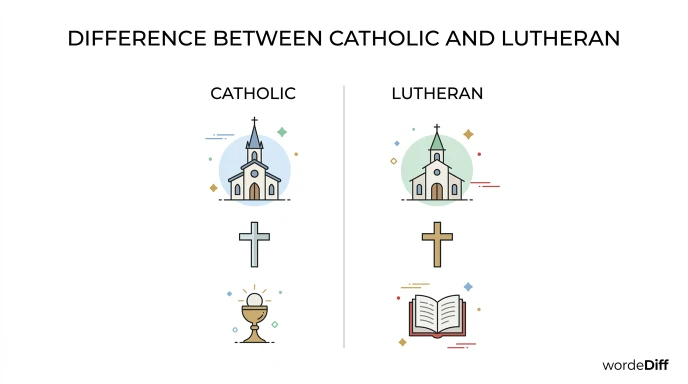
Many people get confused about the difference between Catholic and Lutheran because both are Christian traditions and share many basic beliefs about Jesus Christ.
However, they differ in areas such as church authority, salvation, sacraments, worship, and the role of tradition.
The difference between Catholic and Lutheran mainly comes from the Protestant Reformation. Lutheranism began in the 16th century through the work of Martin Luther, while Catholic Christianity follows the long-established teaching and structure of the Catholic Church.
Understanding the difference between Catholic and Lutheran can help explain why their services, beliefs, and church practices are not always the same.
Quick Answer:
Catholics recognize the authority of the Pope, church tradition, and Scripture together, while Lutherans place primary authority on Scripture and emphasize justification by faith.
Example: Both traditions practice Baptism and Communion, but they understand church authority and some sacramental teachings differently.
Definition of Catholic and Lutheran
- Catholic: A Christian tradition centered on the Catholic Church, its bishops, the Pope, Scripture, and Sacred Tradition.
- Lutheran: A Protestant Christian tradition based on the teachings of Martin Luther and the Lutheran confessions, with strong emphasis on Scripture and justification by faith.
Pronunciation
Catholic: US/UK KATH-uh-lik
Lutheran: US/UK LOO-thuh-run
Now let’s understand the differences more clearly. Although Catholics and Lutherans share many beliefs, their views on authority, salvation, and church structure create important distinctions.
What Is the Main Difference Between Catholic and Lutheran?
The central difference is church authority and doctrine.
Catholic Christianity teaches that the Bible is authoritative together with Sacred Tradition and the teaching authority of the Church, known as the Magisterium. The Pope has a unique leadership role within the Catholic Church.
Lutheranism developed during the Protestant Reformation and gives Scripture the highest authority for Christian doctrine. Lutheran churches also use historic Christian creeds and the Book of Concord as important confessional documents.
In simple words, both value the Bible, but they understand the relationship between Scripture, tradition, and church authority differently.
How Did Catholicism and Lutheranism Become Different?
The historical split is connected to the Protestant Reformation of the 16th century.
Martin Luther, a German monk and theologian, challenged several teachings and practices associated with the Catholic Church. His concerns included the sale of indulgences, church authority, and teachings about salvation.
The disagreements eventually contributed to the formation of Lutheran churches and other Protestant traditions.
This history explains why the Catholic vs. Lutheran comparison is not simply about different worship styles. The differences developed from major theological and institutional debates.
Key Differences Between Catholic and Lutheran
1. Church Authority
The Catholic Church recognizes the Pope as its supreme earthly pastor and teacher, alongside the authority of bishops and the Church’s teaching tradition.
Lutherans do not recognize the Pope as the universal head of the Christian Church. Lutheran churches are organized through different structures depending on the denomination and country.
Real-life example: A Catholic parish follows the authority and teachings of the Catholic Church, while a Lutheran congregation follows its particular Lutheran church body and confessional tradition.
2. Scripture and Tradition
Catholic teaching gives an important role to both Sacred Scripture and Sacred Tradition, interpreted through the Church’s teaching authority.
Lutherans strongly emphasize Scripture as the ultimate standard for doctrine.
Both traditions read the Bible seriously, but they differ in how church tradition and institutional authority relate to Scripture.
3. Salvation and Justification
One of the most important theological differences concerns justification.
Lutheran theology strongly emphasizes justification by grace through faith in Christ. Good works are viewed as the fruit of faith rather than something that earns salvation.
Catholic teaching also teaches that salvation is by God’s grace and cannot be earned by human effort alone. However, Catholic theology describes justification in terms that include God’s grace transforming the believer and the believer’s response through faith and love.
So, saying that Catholics believe people simply “earn salvation by works” is an inaccurate oversimplification.
4. Sacraments
Catholicism recognizes seven sacraments:
- Baptism
- Confirmation
- Eucharist
- Penance
- Anointing of the Sick
- Holy Orders
- Matrimony
Lutherans generally recognize two sacraments, Baptism and Holy Communion, because these are understood to have been instituted by Christ with a visible element and divine promise.
Some Lutheran traditions may describe other rites differently, but Baptism and Communion hold the central sacramental role.
5. Communion or Eucharist
Both Catholics and Lutherans have a strong belief in the importance of Christ’s presence in Holy Communion.
Catholic teaching holds that the bread and wine become the Body and Blood of Christ through transubstantiation.
Lutherans reject transubstantiation as an explanation of the mystery but affirm Christ’s real presence in the Lord’s Supper.
This is an important point: Lutheran Communion is not simply viewed as ordinary bread and wine with symbolic meaning.
6. The Pope
The Pope is a central figure in Catholic Christianity and serves as Bishop of Rome and the visible head of the Catholic Church.
Lutheran churches do not accept papal authority.
This is one of the easiest ways to identify a major institutional difference between the two traditions.
7. Mary and the Saints
Catholics give Mary, the mother of Jesus, a special place in Christian devotion and honor many saints. Catholics may ask saints to pray for them.
Lutherans respect Mary and the saints as important figures in Christian history but generally do not practice the same form of invocation of saints found in Catholicism.
8. Church Structure
Catholicism has a worldwide hierarchical structure involving the Pope, bishops, priests, and deacons.
Lutheran church structures vary. Some Lutheran bodies have bishops, while others use different forms of leadership.
Therefore, “Lutheran church structure” is not identical everywhere.
Difference Between Catholic and Lutheran: Comparison
| Feature | Catholic | Lutheran | Similarity |
| Tradition | Scripture and Sacred Tradition | Scripture has highest authority | Both value historic Christianity |
| Church leader | Pope leads the Catholic Church | No universal Lutheran Pope | Both have church leaders |
| Salvation | Grace transforms and saves; faith and love matter | Strong emphasis on justification by grace through faith | Both teach salvation comes from God’s grace |
| Sacraments | Seven | Two central sacraments | Both practice Baptism and Communion |
| Communion | Real presence explained through transubstantiation | Real presence without transubstantiation | Both take Communion seriously |
| Mary | Highly honored | Respected as Jesus’ mother | Both affirm Mary’s biblical importance |
| Saints | Saints are honored and may be asked for intercession | Saints are honored as examples of faith | Both respect historic Christian figures |
| Worship | Structured liturgy and Mass | Often liturgical, but practices vary | Both may use hymns, Scripture, prayer, and Communion |
This table clearly shows the difference and similarity between Catholic and Lutheran beliefs for quick understanding.
Are Catholic and Lutheran Beliefs Similar?
Yes. Despite important differences, Catholics and Lutherans share many core Christian beliefs.
Both generally affirm:
- One God
- The Trinity
- Jesus Christ as Lord and Savior
- Jesus’ death and resurrection
- The authority and importance of the Bible
- Baptism
- Holy Communion
- The Apostles’ Creed
- The Nicene Creed
- The importance of prayer and Christian living
This shared foundation is important. The Catholic-Lutheran relationship is not a comparison between Christianity and a completely unrelated religion. Both belong to the broader Christian tradition.
Why Do People Get Confused About Catholic and Lutheran Churches?
One reason is that Lutheran worship can look surprisingly similar to Catholic worship.
Many Lutheran churches use:
- Liturgical calendars
- Clergy robes
- Hymns
- Scripture readings
- Creeds
- Communion
- Traditional prayers
Because of these similarities, someone visiting both churches might initially notice more similarities than differences.
The deeper differences usually become clearer when discussing theology, church authority, sacraments, and the understanding of justification.
Common Mistakes About Catholic and Lutheran Beliefs
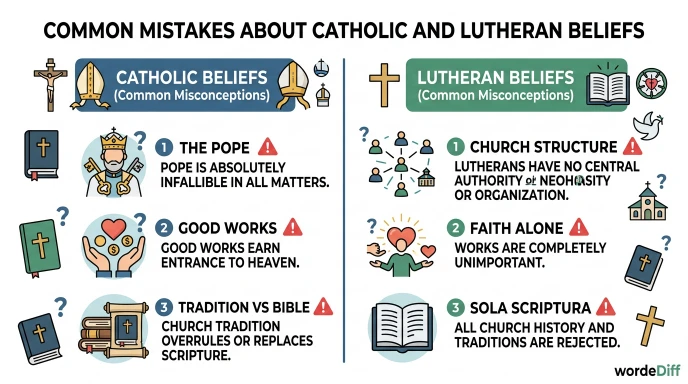
Mistake 1: Thinking Lutherans Are Not Christian
Lutheranism is a Christian Protestant tradition that confesses central Christian doctrines such as the Trinity and the resurrection of Jesus.
Mistake 2: Saying Catholics Believe Salvation Is Earned Only Through Good Works
This is an oversimplification. Catholic teaching emphasizes salvation by God’s grace and the transforming role of faith and love.
Mistake 3: Thinking Lutherans Reject Communion
Lutherans take Holy Communion very seriously and affirm Christ’s real presence, although their explanation differs from Catholic transubstantiation.
Mistake 4: Assuming Every Lutheran Church Is Organized the Same Way
There are different Lutheran denominations and church bodies, so leadership and worship practices can vary.
Mistake 5: Assuming the Two Traditions Are Identical Because Their Worship Looks Similar
Similar worship styles do not mean identical theology. The deeper differences involve authority, doctrine, and sacramental theology.
Real-Life Examples of Catholic and Lutheran Differences
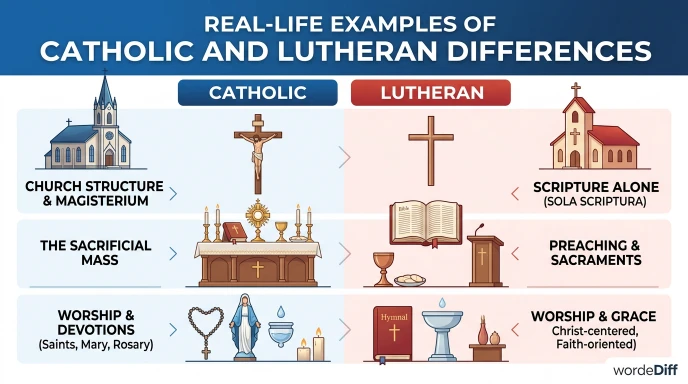
Example 1 Sunday Worship:
A Catholic attends Mass, while a Lutheran may attend a Divine Service or another form of Lutheran worship. Both may hear Scripture, sing hymns, pray, and receive Communion.
Example 2 Church Authority:
A Catholic looks to the Pope and the Catholic Church’s teaching authority. A Lutheran looks primarily to Scripture and the teachings expressed in Lutheran confessional documents.
Example 3 Communion:
Both may believe Christ is truly present, but Catholic and Lutheran theology explains that presence differently.
Example 4 Family Background:
A person raised Catholic may be familiar with confession to a priest and seven sacraments. A Lutheran Christian may be more familiar with Baptism and Communion as the two central sacraments.
When Should You Use Catholic or Lutheran?
The terms should be used according to the person’s actual Christian tradition.
Use Catholic when referring to someone who belongs to the Catholic Church.
Use Lutheran when referring to someone who belongs to a Lutheran church tradition.
It is also important not to assume that every Christian who attends a traditional-looking church is Catholic. Worship style alone does not determine denomination.
How Do Catholic and Lutheran Churches Relate Today?
Catholics and Lutherans have made important efforts toward better understanding and cooperation, especially through modern ecumenical dialogue.
The Joint Declaration on the Doctrine of Justification, signed in 1999 by the Catholic Church and the Lutheran World Federation, was a significant development in Catholic-Lutheran relations. It addressed historical disagreements about justification and identified substantial shared understanding while recognizing remaining differences.
This is useful context because the relationship today cannot be understood only through the conflicts of the 16th century.
Expert Insight: Look Beyond Worship Style
A practical way to understand the difference between Catholic and Lutheran is to look beyond what happens during a Sunday service.
A Catholic and a Lutheran may both stand, sing, pray, hear Scripture, recite a creed, and receive Communion. The important differences become clearer when you ask why each tradition practices these things and what authority supports the practice.
For beginners, three questions provide a useful starting point:
- Who has authority to define doctrine?
- How is justification and salvation understood?
- How are the sacraments understood?
These questions reveal much more than simply comparing church buildings or worship music.
Frequently Asked Questions
What is the main difference between Catholic and Lutheran?
The major differences involve church authority, Scripture and tradition, justification, the number and understanding of sacraments, and the role of the Pope.
Are Lutherans Catholic?
No. Lutherans are part of the Protestant Christian tradition, while Catholics belong to the Catholic Church.
Do Catholics and Lutherans believe in Jesus?
Yes. Both traditions are Christian and affirm Jesus Christ as Lord and Savior.
Do Lutherans believe in the Trinity?
Yes. Lutheran Christianity teaches the historic Christian doctrine of the Trinity: Father, Son, and Holy Spirit.
Do Catholics and Lutherans both practice Communion?
Yes. Both practice Holy Communion, but they explain Christ’s presence in the sacrament differently.
Do Lutherans recognize the Pope?
No. Lutheran churches do not recognize the Pope as the universal head of the Christian Church.
Which is older, Catholicism or Lutheranism?
The Catholic Church’s historical roots extend to the earliest centuries of Christianity. Lutheranism emerged as a distinct Protestant tradition during the 16th-century Reformation.
Can Catholics and Lutherans attend each other’s services?
People can visit services of another Christian tradition, but rules concerning Communion and participation can differ. Anyone planning to receive Communion should check the particular church’s policy.
Conclusion
The difference between Catholic and Lutheran is rooted in history and theology, especially the Protestant Reformation. Catholics and Lutherans share many central Christian beliefs, including faith in Jesus Christ, the Trinity, Baptism, Scripture, and the importance of Communion. Yet they differ significantly in church authority, the role of tradition, justification, sacraments, papal authority, and some teachings about Mary and the saints.
The simplest way to remember the comparison is this: Catholic Christianity recognizes the Pope, Sacred Tradition, and the teaching authority of the Catholic Church, while Lutheran Christianity places primary authority on Scripture and emphasizes justification by grace through faith.
At the same time, the two traditions are not completely opposed in every belief. Modern Catholic-Lutheran dialogue has identified important areas of shared understanding. If you want to compare the two accurately, it is best to look at their actual teachings rather than judging them only by worship style or popular stereotypes.
Read more about!
- Difference Between Liberal and Leftist: A Simple Guide
- Difference Between Hurricane and Tornado: Key Facts Explained

I am Emily Johnson, a USA-based content writer who creates easy-to-read blogs on language and daily life topics. I explain complex ideas in simple English for students and beginners so they can understand easily.