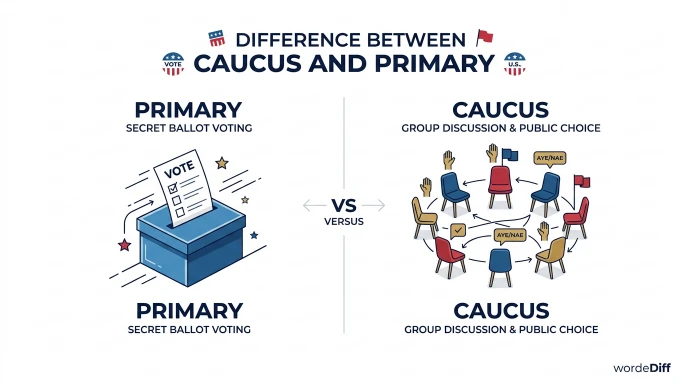
Many people get confused when they hear caucus and primary during a U.S. election. Both help political parties choose their candidates, but they work in very different ways.
The difference between caucus and primary mainly comes down to how people participate, who runs the process, and how candidate preferences are recorded.
In a primary, voters normally cast a ballot, often privately. A caucus is generally a party meeting where participants gather and express support for a candidate under party rules.
If you are searching for the difference between caucus and primary, this guide explains what each term means, how each process works, why people confuse them, and when each one is used.
Quick Answer
A primary is an election in which voters choose their preferred candidate, usually by casting a ballot. A caucus is a meeting organized by a political party where participants choose or express support for candidates through a party-run process.
Example: In a primary, you may go to a polling place and mark a ballot. In a caucus, you may attend a local party meeting and participate in a group-based selection process.
Definition of Difference Between Caucus and Primary
- Caucus: A party-organized meeting where participants discuss, support, and help select candidates or delegates according to party rules.
- Primary: A state-run election in which voters cast ballots to indicate their preferred candidate.
Both can play a role in choosing a party’s presidential nominee.
Pronunciation
Caucus: US/UK KAW-kus
Primary: US/UK PRY-mer-ee
Now that the basic meanings are clear, the main difference becomes easier to understand: a primary feels more like a normal election, while a caucus is more like a party meeting.
Key Differences Between Caucus and Primary
1. Voting Method
The biggest difference is how participants show their preference.
In a primary, voters generally use a ballot. The vote is usually private or secret. In a caucus, the process can involve meetings, discussion, grouping, or other methods set by the political party. Some caucuses also use secret ballots.
Real-life example: A primary voter can privately mark Candidate A on a ballot. A caucus participant may attend a meeting and publicly support Candidate A.
2. Who Runs the Process?
Primaries are generally administered by state or local election officials. Caucuses are run by political parties.
This distinction matters because election laws can shape primaries, while party rules play a major role in caucuses.
3. Where Does It Happen?
A primary normally takes place at an official polling location or through an approved voting method.
A caucus takes place at a party meeting location, which may be organized at the precinct, county, district, or another local level.
4. How Much Time Does It Take?
A primary is usually easier for voters who want a quick voting experience. A caucus can require participants to attend a meeting and remain involved for longer.
That time commitment is one reason caucuses can attract fewer participants than primaries.
5. Privacy
Primary voting generally uses a secret ballot.
Caucus participation can be more public, depending on the state’s and party’s rules. Some caucuses use public expressions of support, while others use secret ballots.
6. Discussion and Persuasion
Caucuses can involve direct discussion between participants. In some systems, supporters may try to persuade undecided participants to support their preferred candidate.
A standard primary does not normally require voters to debate or persuade other voters at the polling place.
7. Participation Rules
Both primaries and caucuses can have open, closed, semi-open, or semi-closed structures, depending on state and party rules.
So, it is incorrect to assume that every primary is open or every caucus is limited to registered party members.
8. Delegate Selection
Both systems can help determine how delegates are allocated to presidential candidates.
The exact delegate rules vary by state and political party. A candidate’s success is therefore not determined simply by the raw number of people who participate.
Difference Between Caucus and Primary: Comparison
| Feature | Caucus | Primary | Similarity |
| Basic format | Party meeting or organized gathering | Election with ballots | Both help select party candidates |
| Administration | Usually run by a political party | Generally run by state/local election officials | Both follow specific rules |
| Voting style | Can involve groups, discussion, or ballots | Usually ballot-based | Both record candidate preference |
| Privacy | May be public or private | Usually private | Both can determine delegate support |
| Time | Can take longer | Usually quicker | Both occur before the general election |
| Participation | Depends on party and state rules | Depends on state and party rules | Both may have open or closed formats |
| Main purpose | Help choose candidates/delegates | Help choose candidates/delegates | Both are part of nomination |
| Experience | More meeting-oriented | More election-oriented | Both influence the nomination process |
This table clearly shows the difference and similarity between caucus and primary for quick understanding.
How Does a Primary Work?
A primary works much like a regular election.
Eligible voters participate according to their state’s rules. They select a candidate, usually by casting a ballot. The results are then used to determine how delegates or other nomination support are allocated under the applicable rules.
For presidential elections, primaries are part of a larger nomination process. Winning a state primary does not mean a candidate automatically becomes president. Instead, primary results contribute to the process of securing a party’s presidential nomination.
The same basic idea applies to many congressional, state, and local primary elections.
How Does a Caucus Work?
A caucus is more meeting-based.
Participants gather at a designated location under political party rules. Depending on the caucus system, people may publicly indicate their candidate preference, form groups, discuss candidates, or use a ballot. Some systems can include additional stages for selecting delegates.
This makes a caucus different from simply walking into a polling place and casting a ballot.
In practical use, the caucus process can place more emphasis on participation, organization, and direct interaction among party supporters.
Why Do People Get Confused About Caucuses and Primaries?
The confusion is understandable because both events can happen during the same election season and can serve a similar overall purpose.
The key is to separate purpose from method.
The purpose is similar: both can help political parties select presidential nominees or allocate delegates.
The method is different: a primary is generally an election, while a caucus is generally a party-run meeting.
Another reason for confusion is that the rules are not identical across the United States. States and political parties can use different systems, and even caucuses do not all operate in exactly the same way.
Common Mistakes With Caucus and Primary
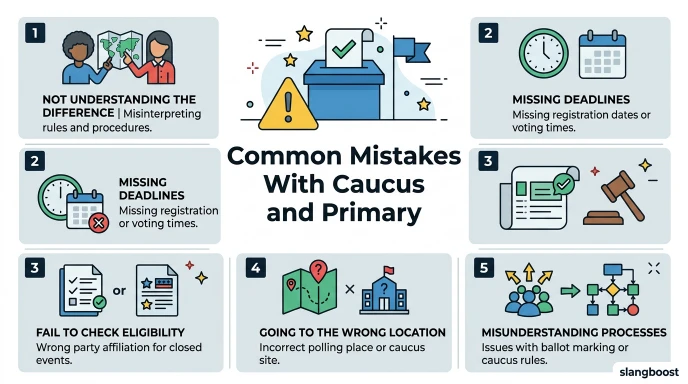
Mistake 1: Thinking They Are Exactly the Same
They have a similar purpose, but their procedures differ.
Fix: Remember: primary = election; caucus = party meeting.
Mistake 2: Assuming Every Caucus Uses Public Grouping
Not every caucus works through visible groups. Some use secret ballots.
Fix: Always check the rules for the specific state and party.
Mistake 3: Assuming Every Primary Is Open
Primary participation rules vary.
Fix: Check if the primary is open, closed, semi-open, or another format.
Mistake 4: Thinking the Winner Immediately Becomes President
A primary or caucus is part of the nomination process, not the final presidential election.
Fix: Think of it as an earlier step toward selecting a party nominee.
Mistake 5: Ignoring Delegates
The candidate with the most raw votes in one event is not necessarily the person who immediately wins the national nomination.
Fix: Understand how delegates are awarded under the applicable rules.
Real-Life Examples of Caucus and Primary
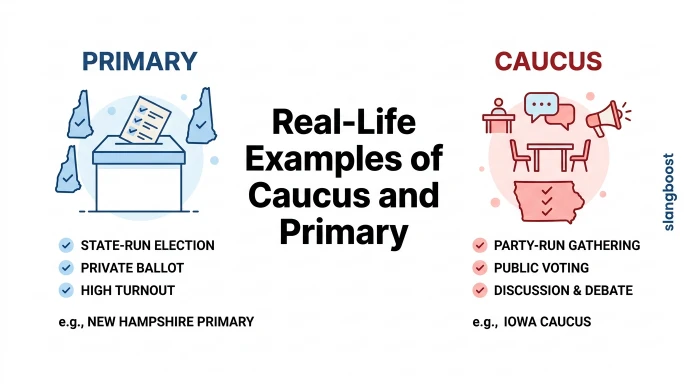
1 Primary:
A voter goes to a polling location, selects a presidential candidate on a ballot, and submits the vote. The state’s results contribute to the candidate’s delegate total.
2 Caucus:
A party supporter attends a local caucus meeting, participates according to party rules, and indicates support for a presidential candidate.
3 Closed Primary:
A state may restrict participation in a primary to voters registered with a particular political party.
4 Open System:
An open primary or caucus can allow voters who are not registered with the party to participate, depending on the applicable rules.
When Should You Think “Caucus” vs. “Primary”?
Use primary when the context focuses on:
- Ballots and polling places
- State-run elections
- Secret voting
- Primary election results
- Candidate preference voting
Think caucus when the context focuses on:
- Party meetings
- Local gatherings
- Candidate discussions
- Group participation
- Party-organized selection procedures
A useful memory trick is simple:
Primary = polling and ballots.
Caucus = gathering and participation.
It is not a perfect rule for every state, but it makes the basic distinction much easier.
How Search Engines Understand Caucus vs. Primary
Search engines such as Google connect this topic with related concepts including presidential nominations, delegates, political parties, voting rules, primary elections, caucus meetings, national conventions, and the Electoral College.
That is why a useful article should not only define the two words. It should also explain how they fit into the larger U.S. election system.
For example, a person searching “what is a caucus?” may need a definition, while someone searching “caucus vs primary” probably wants a direct comparison. Another user may search “how does a primary work?” because they want the process rather than a dictionary definition.
The best explanation satisfies these different intents without repeating the same information.
Expert Insight: The Difference Is About Process, Not Purpose
The most useful way to understand the difference between caucus and primary is to focus on the process.
Both can help a political party determine candidate support and delegate allocation. But a primary is generally designed around a formal election process, while a caucus is organized around a party meeting.
This distinction also explains why the voter experience can feel very different.
A primary is usually convenient for someone who wants to cast a vote and leave. A caucus may demand more time and active participation. Neither method is automatically “better” in every situation because state and party rules determine how each system operates.
Most importantly, do not treat the terms as interchangeable. The details matter when you are trying to understand election results or delegate counts.
Frequently Asked Questions
What is the main difference between a caucus and a primary?
A primary is generally a ballot-based election, while a caucus is generally a political party meeting. Both can help select candidates or allocate delegates.
Is a caucus an election?
A caucus is a candidate-selection process organized by a political party. It can include voting, discussion, grouping, or other procedures depending on the rules.
Is a primary the same as voting in the general election?
No. A primary helps select a party’s candidate. The general election is the later election in which voters choose among candidates for office.
Can anyone vote in a primary?
Not always. Participation rules vary by state and party. Primaries can be open, closed, or have other participation structures.
Can anyone attend a caucus?
Eligibility varies. Because caucuses are organized under party and state rules, participants should check the requirements for the specific caucus.
Do caucuses and primaries choose the president?
No. They help political parties choose their nominees. The general election and Electoral College process come later.
Which one takes more time?
A caucus can take more time because it may require attending a meeting and participating in the process. A primary is generally more straightforward for voters.
Why are delegates important?
Delegates represent a major part of the presidential nomination process. Candidates generally need enough delegates to secure their party’s nomination at the national convention.
Conclusion
The difference between caucus and primary is mainly about how the candidate-selection process happens. A primary is generally a state-administered election where voters cast ballots for their preferred candidate. A caucus is generally a party-run meeting where participants express candidate preferences through procedures established by the party and state.
Both can influence delegate allocation and help determine which candidate becomes a party’s presidential nominee. However, the exact rules can vary significantly by state and political party.
The easiest way to remember the distinction is primary = ballot-based election and caucus = party meeting. If you understand that basic idea, most explanations of U.S. presidential primaries and caucuses become much easier to follow.
For current elections, always check the rules of the relevant state and political party because participation, voting methods, and delegate allocation can change.
Read more about!
- Difference Between Liberal and Leftist: A Simple Guide
- Difference Between Afternoon and Evening: Simple Guide

I am James Carter, a professional content writer from the United States. I specialize in writing simple and clear comparison blogs that help students and readers understand difficult topics easily. My writing focuses on everyday language, education, science, and lifestyle topics. I believe that learning should be easy for everyone, so I use simple words and real-life examples in my articles.