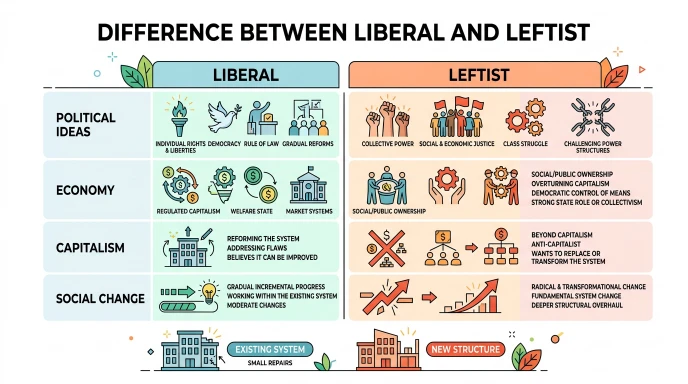
The difference between liberal and leftist is that liberals usually support reform, while leftists often support deeper economic and social change.
The difference between liberal and leftist can be confusing because both terms are linked to progressive politics, but they do not mean the same thing.
A liberal usually supports individual rights, democratic institutions, and reforms within the existing economic and political system. A leftist generally wants deeper changes to reduce economic inequality and challenge systems they see as unfair.
The difference between liberal and leftist also depends on the country and political context. In the United States, these labels can overlap more than they do in other countries.
Understanding the difference between liberal and leftist helps when reading political news, social media posts, or public debates.
Quick Answer:
Liberals usually favor reforming the existing system, while leftists are more likely to support major structural or economic change.
What Is the Difference Between Liberal and Leftist?
A liberal generally supports individual freedoms, civil rights, democratic government, and social or economic reforms. Modern American liberalism is often associated with policies such as stronger social programs, environmental protections, and regulation of business.
A leftist is someone whose political views are generally on the left and may include socialism, democratic socialism, anti-capitalism, or stronger efforts to redistribute wealth and power.
The key point is that liberal is not simply another word for leftist. A person can be liberal without being leftist, although some people may identify with both.
Liberal Meaning in Politics
The word liberal has different meanings depending on the country and historical period.
In modern U.S. politics, a liberal often supports:
- Civil rights and equal treatment
- Individual freedoms
- Social safety-net programs
- Environmental regulation
- Consumer protections
- Progressive taxation
- Government action to address social problems
- A regulated market economy
Many liberals accept capitalism but believe it should have rules and protections. They may support private businesses while also favoring government programs such as public education, health support, or assistance for low-income families.
In simple words, liberal politics often focuses on improving the current system rather than completely replacing it.
Leftist Meaning in Politics
Leftist is a broader political label for people who hold strongly left-wing views.
These views may include:
- Socialism
- Democratic socialism
- Stronger labor rights
- Greater wealth redistribution
- Public ownership of some important services
- Strong opposition to economic inequality
- Criticism of capitalism
- Major changes to political and economic institutions
Not every leftist supports the same policies. Some support democratic socialism, while others support more radical forms of socialism or anti-capitalist politics.
This is why calling someone simply “leftist” does not tell you exactly what political system they support.
Difference Between Liberal and Leftist: Main Comparison
| Feature | Liberal | Leftist | Similarity |
| Political position | Usually center-left or progressive | Usually further left | Both can support progressive policies |
| Economic system | Often accepts regulated capitalism | May favor socialism or major economic change | Both may support reducing inequality |
| Main goal | Reform and improve existing systems | Change deeper structures | Both may seek social improvement |
| Business | Supports private business with rules | May favor stronger limits or public ownership | Both can support worker protections |
| Government role | Government can regulate and provide services | Government or communities may have a larger economic role | Both may support public programs |
| Social issues | Often supports civil rights and equality | Usually supports strong equality measures | Both often favor social equality |
| Change | More likely to favor gradual reform | More likely to support structural change | Both can support political change |
| Capitalism | Usually accepts it with regulation | May strongly criticize or reject it | Both may criticize economic inequality |
This table clearly shows the difference between liberal and leftist while also showing where the two viewpoints overlap.
Is a Liberal the Same as a Leftist?
No. The terms can overlap, but they are not identical.
A liberal may believe capitalism is useful but needs strong rules. A leftist may believe that capitalism itself creates major problems and that a different economic system is needed.
For example, imagine two people who both want affordable healthcare.
One liberal might support expanding government healthcare programs while keeping private insurance.
A leftist might support a much larger public healthcare system and argue that healthcare should not primarily operate as a private market.
Both want greater access to healthcare, but their ideas about how to reach that goal can be very different.
What Is the Main Economic Difference?
Economics is one of the clearest areas where the difference between liberal and leftist appears.
Modern liberals often support a mixed economy. This means private companies can operate, while government regulates markets and provides certain public services.
Leftists are more likely to question if private ownership should control major parts of the economy. Some support public ownership, worker ownership, or stronger redistribution of wealth.
However, there is no single economic policy that defines every liberal or every leftist.
A person can hold a left-wing view on one economic issue and a more moderate view on another.
How Do Liberals and Leftists Differ on Capitalism?
Capitalism is an important dividing line.
Many liberals see capitalism as an economic system that can work when governments create rules to prevent abuse and protect workers and consumers.
Some leftists see capitalism as a deeper source of inequality. They may argue that changing individual policies is not enough and that ownership, wealth, and economic power need to be reorganized.
This creates an important distinction:
Liberal approach: “How can we make the current system work better?”
Leftist approach: “Does the current system itself need major structural change?”
These are simplified examples, but they help explain why the terms are sometimes used differently.
How Do They Differ on Social Issues?
On social issues, liberals and leftists can have a lot in common.
Both may support:
- Civil rights
- Gender equality
- Racial equality
- LGBTQ+ rights
- Reproductive rights
- Anti-discrimination laws
- Greater access to education
The disagreement may appear less in the desired outcome and more in the wider political approach.
A liberal might focus on legal protections and policy reforms. A leftist may connect the same issue to broader questions about wealth, class, labor, institutions, and power.
So, two people may agree on a social issue while still having very different political philosophies.
Why Do People Get Confused About Liberal and Leftist?
The confusion comes from several sources.
First, political labels change over time. A political position considered left-wing decades ago may not be described in the same way today.
Second, political language differs between countries. The meaning of liberal in the United States is not always the same as its meaning in Europe or elsewhere.
Third, social media often uses political labels loosely. Someone on Instagram, TikTok, Reddit, or YouTube may call a person “liberal” or “leftist” without explaining the person’s actual beliefs.
Fourth, political groups are not perfectly divided. A person can have liberal views on social issues and leftist views on economic issues.
That is why it is better to look at someone’s actual policies and beliefs instead of relying only on a label.
Liberal vs. Leftist in the United States
In the United States, liberal commonly describes people on the center-left or progressive side of the political spectrum.
U.S. liberals may support:
- Democratic institutions
- Civil rights
- Environmental action
- Government-funded programs
- Labor protections
- Higher taxes on some high-income groups
- Regulation of large corporations
The term leftist is often used for people whose views are further left than mainstream liberalism.
For example, some leftists may support democratic socialism, stronger public ownership, or a much larger transformation of the economic system.
Still, there is no official line separating the two. Political identity is more complicated than a simple left-to-right scale.
Liberal vs. Leftist in Other Countries
The meaning changes across countries.
In some countries, liberalism is strongly connected with free markets, limited government, and individual rights. In the United States, however, modern liberalism often refers to center-left policies and a larger government role in social programs.
The word leftist is also broad internationally. It can include social democrats, democratic socialists, socialists, communists, and other left-wing groups.
Because of these differences, always consider the country and political context before interpreting the label.
Real-Life Examples of the Difference
Example 1: Healthcare
A liberal might support expanding public healthcare while allowing private healthcare companies to continue operating.
A leftist might argue that healthcare should be primarily publicly provided or removed from normal profit-driven markets.
Example 2: Taxes
A liberal may support higher taxes on wealthy people to fund public services.
A leftist may support much stronger wealth redistribution and question the concentration of private wealth itself.
Example 3: Workers
A liberal may support a higher minimum wage and stronger labor laws.
A leftist may support those policies while also favoring worker ownership, unions, or major changes to workplace power.
Example 4: Business
A liberal may believe large companies are useful but need stronger regulation.
A leftist may believe that some large industries should be publicly or cooperatively owned.
These examples show that the disagreement is often about the depth and method of change, not simply if change is needed.
When Should You Use Liberal or Leftist?
Use liberal when you are describing someone whose views generally support liberal or progressive reform.
Use leftist for someone with more left-wing views, such as support for socialism or major changes to capitalism.
If you do not know someone’s exact views, avoid assuming their political identity.
A better approach is to describe the specific belief.
Instead of saying:
“She is a leftist.”
You could say:
“She supports stronger public ownership and wealth redistribution.”
This gives readers more useful information.
Common Mistakes About Liberal and Leftist
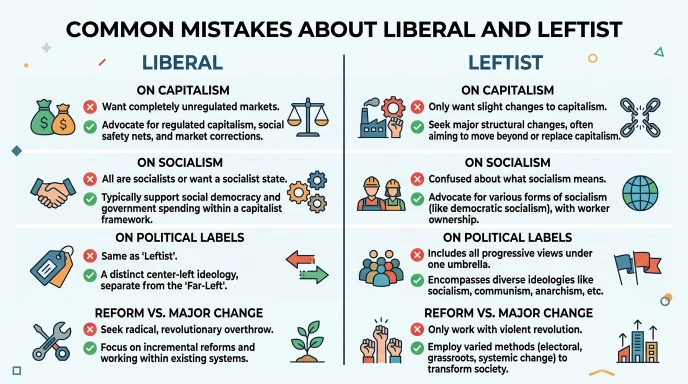
Mistake 1: Treating the Words as Exact Synonyms
They can overlap, but they are not identical.
Fix: Look at the person’s economic and political views.
Mistake 2: Assuming Every Liberal Supports Socialism
Most modern U.S. liberals do not automatically support socialism.
Fix: Check the person’s actual economic position.
Mistake 3: Assuming Every Leftist Rejects Democracy
Left-wing politics includes democratic traditions as well as more radical movements.
Fix: Do not judge a person’s beliefs from the label alone.
Mistake 4: Using U.S. Definitions Everywhere
Political labels can mean different things in different countries.
Fix: Always consider the local political context.
Mistake 5: Treating Political Labels as Fixed
People can change their views and may hold mixed positions.
Fix: Focus on policies and principles rather than labels alone.
Why Do People Use These Political Labels?
Political labels make complicated ideas easier to discuss.
Instead of explaining someone’s views on taxation, healthcare, labor, business, civil rights, and government, people may use one word such as “liberal” or “leftist.”
The problem is that a short label can hide important details.
On platforms such as Reddit, YouTube, Instagram, and TikTok, these words can also become part of political arguments. In some discussions, they are used neutrally. In others, they may be used as criticism or as a political identity.
The meaning therefore depends heavily on context and tone.
Are Liberal and Leftist Positive or Negative Words?
Neither word is automatically positive or negative.
Some people proudly describe themselves as liberal or leftist. Others use these labels critically.
Tone matters.
For example:
- “She has liberal views on healthcare.” neutral
- “He is a committed leftist.” can be neutral or positive
- “They called him a leftist as an insult.” negative use
The same political label can have different emotional meanings depending on who says it and why.
How Social Media Changes Political Language
Social media has made political labels much more common in everyday conversations.
On platforms such as Instagram, TikTok, Reddit, YouTube, and X, political discussions often move quickly. Users may use labels to summarize complex beliefs in just a few words.
This can be useful, but it can also create confusion.
A short post may call someone liberal, even when their views are actually progressive, social democratic, or socialist.
For this reason, readers should look beyond the label when a political argument matters.
Difference Between Liberal and Leftist: A Simple Way to Remember
A useful shortcut is:
Liberal = reform the system.
Leftist = more likely to seek deeper structural change.
This is not a perfect rule. Real political beliefs are more complicated.
Still, it gives beginners a useful starting point. When you want more accuracy, look at a person’s views on capitalism, markets, government ownership, taxation, labor, social programs, and political institutions.
FAQs
Is a liberal a leftist?
Not necessarily. Some liberals may also identify as leftists, but liberalism and leftism are different political traditions.
What is the main difference between liberal and leftist?
Liberals often support improving the current system, while leftists may want bigger economic or structural changes.
Do liberals support capitalism?
Many modern U.S. liberals support a regulated capitalist or mixed economy.
Do all leftists support socialism?
No. “Leftist” is a broad label that can include different political philosophies.
Are liberal and leftist the same in every country?
No. Political labels can mean different things in different countries.
Can someone be both liberal and leftist?
Yes. A person may identify with liberal ideas while also holding more left-wing economic or structural views.
Conclusion
The difference between liberal and leftist is mainly about political ideas, economic views, and how much change someone wants. Liberals generally support individual rights, democratic institutions, and reforms that improve the existing system. Leftists are generally further to the left and may call for deeper changes involving wealth, ownership, labor, and economic power.
There is still plenty of overlap. Both groups may support civil rights, social equality, environmental protection, worker protections, and government programs. The biggest difference often appears when discussing capitalism and how much the economic system itself should change.
Remember that these labels are not universal. Their meanings can shift across countries, time periods, and political conversations. When you see liberal or leftist online, check the person’s actual beliefs instead of judging by the label.
Read more about!
- Difference Between Hurricane and Tornado: Key Facts Explained
- Difference Between Afternoon and Evening: Simple Guide

I am Emily Johnson, a USA-based content writer who creates easy-to-read blogs on language and daily life topics. I explain complex ideas in simple English for students and beginners so they can understand easily.