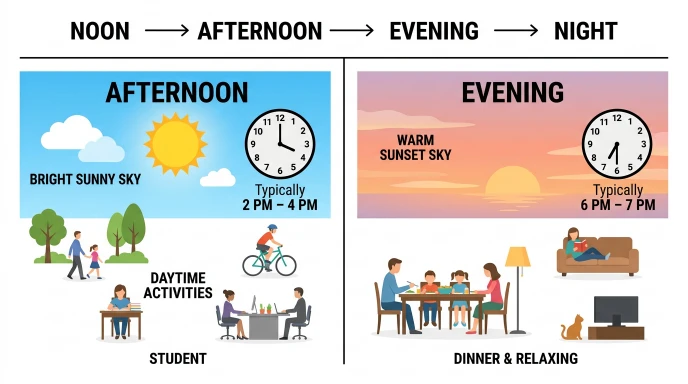
The difference between afternoon and evening is simple, but many people are unsure when afternoon ends and evening begins.
In simple words, the afternoon is the part of the day after noon, while the evening is the later part of the day before night. The exact boundary is not fixed everywhere, so context matters.
This guide covers the difference between afternoon and evening, their times, uses, and examples. You will also learn when to say “good afternoon” or “good evening” and why people sometimes use these terms differently.
Quick Answer
Afternoon usually means the time from 12:00 p.m. until around 5:00 or 6:00 p.m. Evening generally begins around 5:00 or 6:00 p.m. and continues until bedtime or night. Example: A meeting at 2 p.m. is an afternoon meeting, while dinner at 7 p.m. is usually an evening activity.
Definition of Difference Between Afternoon and Evening
- Afternoon: The part of the day that comes after noon and before evening.
- Evening: The later part of the day between afternoon and night, often when people finish work and relax.
These definitions are based on common everyday English. The exact time can change with culture, season, and context.
Pronunciation
- Afternoon: US and UK af-ter-NOON
- Evening: US and UK EEV-ning
Both words are used in American and British English with very similar meanings and pronunciation.
Now that the basic definitions are clear, let’s look at the difference between afternoon and evening in everyday situations.
What Is the Main Difference Between Afternoon and Evening?
The biggest difference is time of day.
Afternoon starts after 12 noon. It usually covers the early and middle part of the later day, when schools, offices, shops, and many businesses are still active.
Evening comes later.It usually starts around 5 or 6 p.m., when people finish work and begin relaxing or having dinner.
However, there is no universal clock that says, “Afternoon ends at exactly 5:43 p.m.” Language does not work that way. People use these words based on normal social habits and the situation.
In simple words: Afternoon = after noon, before evening. Evening = later in the day, before night.
Difference Between Afternoon and Evening: Time Range
The time ranges are flexible, but this general guide works well:
| Part of Day | Common Time | Typical Activities |
| Morning | 5 a.m.–12 p.m. | Breakfast, school, early work |
| Afternoon | 12 p.m.–5 or 6 p.m. | Work, classes, appointments |
| Evening | 5 or 6 p.m.–9 p.m. or later | Dinner, exercise, social activities |
| Night | Around 9 p.m. onward | Sleep, late activities |
These are general social ranges, not strict scientific rules.
For example, someone may call 5:30 p.m. “late afternoon,” while another person may call it “early evening.” Both can sound natural.
Is 5 PM Afternoon or Evening?
This is one of the most common questions about the difference between afternoon and evening.
At 5 p.m., either term can be correct depending on the situation.
- “I will call you at 5 p.m. this afternoon.” Natural in many contexts.
- “We are meeting at 5 p.m. this evening.” Also natural.
- “The event starts in the early evening.” Common if the event begins around 5 or 6 p.m.
The season can also affect how people think about the time. At 5 p.m. in winter, it may already feel like evening because it gets dark earlier. In summer, 5 p.m. can still feel like afternoon.
When Should You Say “Good Afternoon”?
Use “good afternoon” after noon and during the afternoon.
For example:
- “Good afternoon, everyone.”
- “Good afternoon, Ms. Smith.”
- “Good afternoon. How can I help you?”
It is common in schools, offices, customer service, meetings, and professional communication.
A simple rule is:
12 p.m. to around 5 p.m. = usually “Good afternoon.”
As the day gets later, “good evening” becomes more natural.
When Should You Say “Good Evening”?
“Good evening” is normally used during the evening, especially from around 5 or 6 p.m. onward.
Examples include:
- “Good evening, everyone.”
- “Good evening, Doctor.”
- “Good evening. Welcome to the program.”
Interestingly, “good evening” is usually a greeting, while “good night” is normally used when leaving or going to sleep.
For example:
“Good evening! How are you?”
But:
“Good night! See you tomorrow.”
This is an important everyday English distinction.
Key Differences Explained Between Afternoon and Evening
1. Position in the Day
Afternoon comes directly after noon. Evening comes after the afternoon.
Example: 1 p.m. is clearly afternoon, while 8 p.m. is clearly evening.
2. Typical Time
Afternoon commonly covers 12 p.m. to 5 or 6 p.m.
Evening often starts around 5 or 6 p.m. and continues into the later part of the day.
The overlap explains why 5 p.m. can cause confusion.
3. Daily Activities
Afternoon is often linked with work, school, appointments, errands, and business.
Evening is more often connected with dinner, entertainment, exercise, family time, and social events.
4. Light and Darkness
Afternoon usually happens while there is still daylight.
Evening is the period when daylight begins to fade or has already faded.
This is why the meaning can feel different depending on the season and location.
5. Social Context
People often use “afternoon” for professional appointments during the middle of the day.
“Evening” is common for dinners, parties, concerts, classes, and social gatherings.
For example:
- “afternoon appointment”
- “evening dinner”
- “afternoon class”
- “evening event”
6. Greeting Style
“Good afternoon” is normally used after noon and before evening.
“Good evening” is used later in the day.
This makes greetings one of the easiest ways to understand the practical difference.
7. Cultural and Regional Differences
There is no single worldwide rule for the exact start of evening.
British and American English have similar meanings, but people may use these words differently.
A person in one region may call 5 p.m. afternoon, while someone else may call it evening.
8. Meaning in Schedules
Businesses, schools, hotels, and event organizers may define time periods differently.
For example, an event described as an “evening event” may begin at 5 p.m., 6 p.m., or even 7 p.m.
Always check the actual clock time when precision matters.
Difference and Similarity
| Feature | Afternoon | Evening | Similarity |
| Meaning | Time after noon | Later part of the day | Both describe parts of one day |
| Usual start | Around 12 p.m. | Around 5–6 p.m. | Time ranges can overlap |
| Usual end | Around 5–6 p.m. | Before or around night | Neither has a strict universal ending |
| Activities | Work, school, errands | Dinner, exercise, social events | Both can include work or leisure |
| Greeting | Good afternoon | Good evening | Both are polite greetings |
| Daylight | Usually daylight | Often fading daylight | Light conditions influence perception |
| Context | Midday and professional settings | Later and social settings | Context helps determine the best word |
| Exact boundary | Flexible | Flexible | Both depend partly on local usage |
This table clearly shows the difference and similarity between difference between afternoon and evening for quick understanding.
Why Is the Boundary Between Afternoon and Evening Confusing?
The main reason is that time labels are linguistic categories, not exact measurements.
A clock gives us a precise time, but words such as morning, afternoon, evening, and night divide the day in a more flexible way.
Think about 5 p.m.
At 5 p.m.:
- A worker may say, “This afternoon was busy.”
- A restaurant may advertise an “evening special.”
- A family may say, “We will have dinner this evening.”
- A school may describe a 5 p.m. class as an afternoon class.
All of these can make sense.
That is why it is better to think of afternoon and evening as overlapping social time periods rather than strict boxes.
Real-Life Examples of Afternoon and Evening
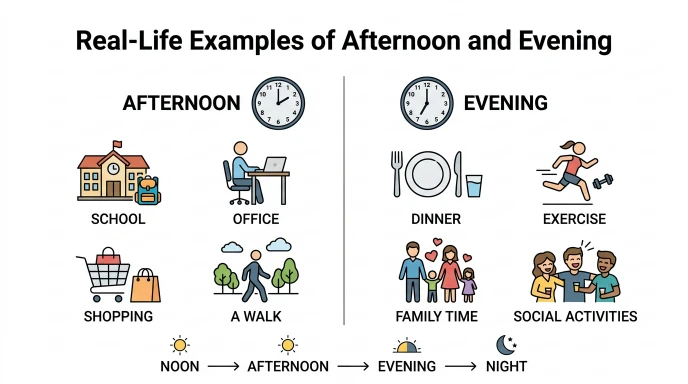
Personal Use
“I usually go for a walk in the afternoon.”
This suggests a time after lunch and before the later part of the day.
Business Use
“Our afternoon meeting starts at 2 p.m.”
Here, afternoon clearly identifies a daytime business period.
Social Use
“We are having dinner this evening.”
Dinner is normally associated with evening, so “this evening” sounds natural.
Education
“The students have an afternoon class.”
A class starting at 1 or 2 p.m. would normally be called an afternoon class.
Fitness
“I work out in the evening after work.”
Many people use “evening” for exercise after finishing their workday.
Media and Entertainment
A television program or YouTube livestream beginning at 7 p.m. may be described as an evening program.
When to Use Afternoon vs. Evening
Use afternoon when:
- The time is shortly after noon.
- You are discussing daytime work or school.
- An appointment happens around 1–4 p.m.
- You are greeting someone after noon but before evening.
Use evening when:
- The time is around 5–6 p.m. or later.
- People are finishing work and starting leisure activities.
- You are discussing dinner or nighttime social plans.
- You are greeting someone later in the day.
A Simple Memory Trick
Remember:
Noon → Afternoon → Evening → Night
If you can place the activity on this timeline, choosing the correct word becomes much easier.
Common Mistakes With Difference Between Afternoon and Evening
Mistake 1: Thinking 5 p.m. Has Only One Correct Label
There is no universal rule that makes 5 p.m. only afternoon or only evening.
Fix: Consider the context.
Mistake 2: Using “Good Night” as a Greeting
“Good night” usually means goodbye or indicates that someone is going to sleep.
Fix: Use “good evening” when greeting someone later in the day.
Mistake 3: Assuming Evening Always Starts at 6 p.m.
Six p.m. is a common reference point, but evening does not have a fixed worldwide start time.
Fix: Treat 5–6 p.m. as a flexible transition period.
Mistake 4: Confusing Evening With Night
Evening usually comes before night.
Fix: Think of evening as the transition from the active day toward nighttime.
Mistake 5: Treating Regional Usage as Wrong
Different English-speaking communities may use these words slightly differently.
Fix: Focus on the intended time and context instead of looking for one rigid rule.
Why People Get Confused About Afternoon and Evening
Several factors create confusion.
Language differences: Different English speakers may use slightly different time boundaries.
Season: A winter evening can become dark much earlier than a summer evening.
Culture: Meal times, work schedules, and social habits vary between communities.
Media influence: TV shows, YouTube videos, Instagram posts, and other online content may use “evening” loosely.
Context: A restaurant, office, school, or event organizer may define its own time categories.
The important point is that these words describe human time perception, not just numbers on a clock.
How Google and Other Platforms Understand “Afternoon” and “Evening”
People search these terms on Google to learn when and how to use afternoon and evening correctly.
The intent is not simply to learn dictionary definitions. People want to know how native speakers actually use these terms.
The same idea applies to social platforms such as Instagram, Meta services, and YouTube. A post, video, event, or livestream may describe something as an afternoon or evening activity based on its audience and schedule.
For users, the useful lesson is simple: the clock provides precision, while language provides context.
Expert Insight: Is There an Exact Time When Afternoon Ends?
No universally accepted exact minute separates afternoon from evening.
In practical English, 12 p.m. clearly belongs to afternoon, while 8 p.m. clearly belongs to evening. The difficult area is the transition around 5–6 p.m.
For professional communication, use the exact time when there could be confusion.
Instead of:
“The meeting is in the evening.”
Say:
“The meeting starts at 5:30 p.m.”
This small change removes uncertainty and makes communication more precise.
FAQs
What is the main difference between afternoon and evening?
Afternoon is the period after noon, while evening is the later part of the day before night.
Is 4 PM afternoon or evening?
4 p.m. is generally afternoon.
Is 5 PM afternoon or evening?
5 p.m. can be either late afternoon or early evening, depending on context and personal usage.
Is 6 PM afternoon or evening?
6 p.m. is commonly considered evening, although some people may still call it late afternoon.
Is 7 PM evening?
Yes. 7 p.m. is normally considered evening.
Should I say good afternoon at 5 PM?
You can, but good evening may sound more natural at 5 p.m. or later, especially in social or professional settings.
Is evening the same as night?
No. Evening generally comes before night. The exact boundary varies by context.
When does afternoon start?
Afternoon normally starts at 12 noon.
When does evening start?
Evening commonly starts around 5 or 6 p.m., but there is no strict universal starting time.
Conclusion
The difference between afternoon and evening is mainly about where a time falls in the later part of the day. Afternoon begins after noon and usually covers the period from around 12 p.m. to 5 or 6 p.m. Evening comes later, often beginning around 5 or 6 p.m. and continuing until night.
The key point is that these are flexible language terms. There is no worldwide rule that says exactly when afternoon must end or evening must begin. That is why 5 p.m. can sometimes be called late afternoon and sometimes early evening.
For everyday English, remember the simple order: morning → afternoon → evening → night. Say “good afternoon” earlier and “good evening” later. If the exact time matters, simply give the time.
Once you know the difference, using afternoon and evening becomes easy.
Read more about!
- Difference Between Polar and Nonpolar: Simple Chemistry Guide
- Difference Between Lose and Loose: Easy Guide

I am Emily Johnson, a USA-based content writer who creates easy-to-read blogs on language and daily life topics. I explain complex ideas in simple English for students and beginners so they can understand easily.