The difference between polar and nonpolar molecules can seem confusing at first, especially when different molecules contain similar atoms.
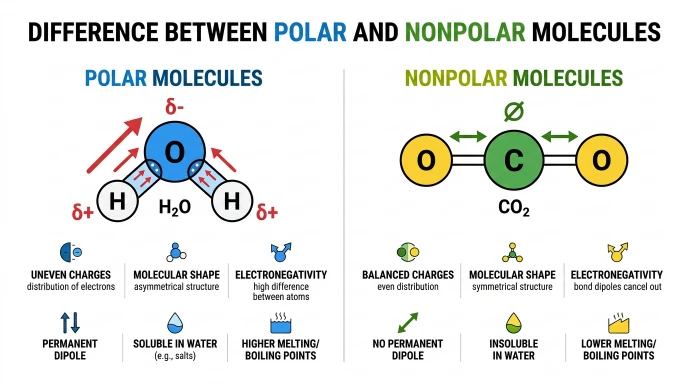
The main difference is how electrons are shared and distributed. Polar molecules have uneven charges, while nonpolar molecules have balanced charges. However, molecular shape also matters.
For example, water is polar because its bent shape creates an uneven charge, while carbon dioxide is nonpolar because its straight shape balances the charges.
Understanding polarity helps explain why some substances mix with water while others do not. It also helps explain intermolecular forces, solubility, and many everyday chemical behaviors.
In this guide, you will learn what polar and nonpolar molecules are, how to identify them, their key differences, common examples, and why polarity is important in chemistry.
Quick Answer
Polar molecules have uneven charges, while nonpolar molecules have balanced charges.For example, H₂O is polar, while CO₂ is nonpolar because its bond dipoles cancel due to its linear shape.
Definition of Polar and Nonpolar
- Polar: A molecule with an uneven charge distribution and a partial positive and negative side.
- Nonpolar: A molecule with an even or balanced charge distribution and no permanent dipole.
What Causes a Molecule to Be Polar or Nonpolar?
Two main factors determine if a molecule is polar or nonpolar:
- Electronegativity
- Molecular shape
Electronegativity tells us how strongly an atom attracts shared electrons. When two bonded atoms have different electronegativities, the electrons may be pulled more toward one atom.
This creates a polar bond.
However, having polar bonds does not always mean the entire molecule is polar. The molecule’s shape also matters.
For example, CO₂ contains polar C=O bonds, but its straight shape causes the bond dipoles to cancel. As a result, CO₂ is nonpolar.
Polar vs Nonpolar Bonds
A polar bond forms when electrons are shared unequally between two atoms.
For example, oxygen attracts electrons more strongly than hydrogen in an O–H bond. This gives the oxygen side a partial negative charge and the hydrogen side a partial positive charge.
A nonpolar bond forms when electrons are shared equally or almost equally.
Examples include:
- H–H → nonpolar
- O–O → nonpolar
- Cl–Cl → nonpolar
- O–H → polar
- H–Cl → polar
The important point is that bond polarity and molecular polarity are not always the same thing.
How Does Molecular Shape Affect Polarity?
Molecular shape determines if bond dipoles cancel or add together.
If polar bonds point in opposite directions in a symmetrical molecule, their effects may cancel.
If the molecule is asymmetrical, the dipoles may not cancel.
Example: CO₂
CO₂ has a linear shape:
O=C=O
The two oxygen atoms pull electrons away from carbon in opposite directions. Their effects balance each other.
So, CO₂ is nonpolar.
Example: H₂O
Water has a bent shape:
H–O–H
The O–H bond dipoles do not cancel because of the bent structure.
Therefore, H₂O is polar.
This is one of the easiest ways to understand the difference between polar and nonpolar molecules.
Difference Between Polar and Nonpolar: Key Differences
1. Charge Distribution
Polar molecules have an uneven distribution of electrical charge.
One side may be slightly negative while another side is slightly positive.
Nonpolar molecules have a more balanced charge distribution.
Example: H₂O is polar, while CO₂ is nonpolar.
2. Electronegativity
Electronegativity is important because it determines how strongly atoms attract shared electrons.
Large differences in electronegativity often create polar bonds.
Small or zero differences usually create nonpolar bonds.
For example, H–H is nonpolar because both hydrogen atoms attract the electrons equally.
3. Molecular Shape
Shape can determine the final polarity of a molecule.
A symmetrical molecule may have its bond dipoles cancel.
An asymmetrical molecule may have a net dipole.
That is why you should always consider molecular geometry before deciding if a molecule is polar or nonpolar.
4. Dipole Moment
Polar molecules have a net dipole moment because their charges are not evenly balanced.
Nonpolar molecules have no permanent net dipole moment.
A dipole simply describes a separation of positive and negative charge.
5. Water Interaction
Polar molecules usually interact well with polar substances such as water.
Nonpolar substances generally do not mix well with water.
This explains why oil and water separate.
6. Intermolecular Forces
Polar molecules can experience dipole-dipole attractions. Some can also form hydrogen bonds.
Nonpolar molecules mainly experience London dispersion forces, caused by temporary electron shifts.
Both polar and nonpolar molecules can have intermolecular forces, but the types and strengths can differ.
7. Solubility
Polar substances tend to dissolve better in polar solvents.
Nonpolar substances usually dissolve better in nonpolar solvents.
This is often summarized as:
Like dissolves like.
It is a useful rule, although real solubility also depends on molecular size, structure, temperature, and other factors.
8. Real-Life Behavior
Polarity affects many everyday and industrial processes.
It helps explain:
- Why oil and water separate
- How detergents remove grease
- How solvents dissolve chemicals
- How compounds are separated in laboratories
- How some substances interact with biological systems
Polar and Nonpolar Comparison
| Feature | Polar | Nonpolar | Similarity |
| Charge distribution | Uneven | Even or balanced | Both contain charged particles |
| Dipole | Usually has a net dipole | No permanent net dipole | Both can have temporary dipoles |
| Electronegativity | Often different | Often similar or balanced | Electronegativity affects both |
| Shape | Often asymmetrical | Often symmetrical | Shape matters in both |
| Water interaction | Often mixes or interacts well | Usually mixes poorly | Both can interact with solvents |
| Main forces | Dipole forces and dispersion | Mainly dispersion forces | Both have intermolecular forces |
| Solubility | Often dissolves in polar solvents | Often dissolves in nonpolar solvents | Solubility depends on several factors |
| Examples | H₂O, NH₃ | CO₂, CH₄ | Both are chemical molecules |
This table clearly shows the key differences and similarities between polar and nonpolar molecules.
Common Examples of Polar Molecules
Water (H₂O)
Water is polar because oxygen pulls electrons more strongly, and its bent shape keeps the charges uneven.
Ammonia (NH₃)
Ammonia is polar because it has polar N–H bonds and a trigonal pyramidal shape.
Hydrogen Chloride (HCl)
HCl is polar because chlorine attracts the shared electrons more strongly than hydrogen.
Ethanol (C₂H₅OH)
Ethanol contains a polar hydroxyl group that allows it to interact with water.
Common Examples of Nonpolar Molecules
Carbon Dioxide (CO₂)
CO₂ has polar bonds, but its linear shape causes the dipoles to cancel. The molecule is therefore nonpolar.
Methane (CH₄)
Methane has a symmetrical tetrahedral shape, making it nonpolar overall.
Oxygen (O₂)
O₂ contains two identical oxygen atoms that share electrons equally, so it is nonpolar.
Nitrogen (N₂)
Like O₂, nitrogen contains identical atoms and has a nonpolar bond.
How to Tell If a Molecule Is Polar or Nonpolar
You can use a simple five-step method.
Step 1: Draw the Lewis Structure
First, determine how the atoms are connected.
Step 2: Check Electronegativity
Look at if the bonded atoms attract electrons equally.
Step 3: Identify Bond Polarity
Decide which bonds are polar and which are nonpolar.
Step 4: Determine Molecular Shape
Check if the molecule is linear, bent, tetrahedral, trigonal pyramidal, or another shape.
Step 5: Check Dipole Cancellation
Ask if the bond dipoles cancel.
If they cancel, the molecule may be nonpolar.
If they do not cancel, it is generally polar.
Easy rule: Uneven charge = polar. Balanced charge = nonpolar.
Why Is CO₂ Nonpolar but H₂O Polar?
This is one of the most common chemistry questions.
CO₂ contains two polar C=O bonds. However, it has a linear shape. The bond dipoles point in opposite directions and cancel.
H₂O also contains polar bonds, but its bent shape prevents the dipoles from canceling.
Therefore:
- CO₂ → polar bonds, nonpolar molecule
- H₂O → polar bonds, polar molecule
The example shows why you cannot determine molecular polarity by looking at bonds alone.
How Polarity Affects Solubility
Polarity strongly affects how substances dissolve.
Water is polar, so it interacts well with many polar and ionic substances.
Oil is mostly nonpolar, so it does not mix well with water.
This is why oil and water form separate layers.
The rule “like dissolves like” is useful here:
- Polar + polar → often mixes well
- Nonpolar + nonpolar → often mixes well
- Polar + nonpolar → often mixes poorly
Still, this is a general guideline rather than an absolute rule.
How Polarity Affects Intermolecular Forces
Intermolecular forces are attractions between molecules.
Polar molecules have dipole-dipole forces because their positive and negative sides attract.
Some polar molecules can also form hydrogen bonds.
Nonpolar molecules mainly rely on London dispersion forces. These forces happen when moving electrons create temporary charges.
The strength of these forces can affect boiling points, melting points, and other physical properties.
Real-Life Uses of Polarity
Polarity is useful far beyond school chemistry.
Cleaning
Detergents have both polar and nonpolar parts. The nonpolar part interacts with grease, while the polar part interacts with water.
This helps remove oily dirt during washing.
Laboratory Work
Chemists use polarity when choosing solvents and separating compounds.
A chemical may dissolve better in one solvent than another because of differences in polarity.
Medicine
Polarity can affect how drug molecules dissolve and interact with different environments.
Cooking
Oil and water behave differently because of their molecular properties. Their different polarity is one reason they separate.
Industry
Polarity is considered when developing paints, cosmetics, adhesives, cleaning products, and chemical solvents.
Common Mistakes With Polar and Nonpolar
Mistake 1: Looking Only at Electronegativity
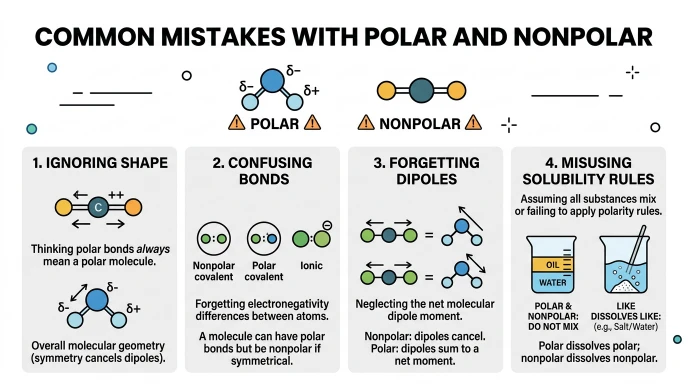
Different atoms may create polar bonds, but the whole molecule may still be nonpolar.
Fix: Always check molecular shape.
Mistake 2: Thinking CO₂ Is Polar
CO₂ has polar bonds, but its linear shape makes the molecule nonpolar.
Fix: Check if the dipoles cancel.
Mistake 3: Thinking Nonpolar Means No Forces
Nonpolar molecules still have London dispersion forces.
Fix: Remember that all molecules can experience temporary electron shifts.
Mistake 4: Assuming Every Symmetrical Molecule Is Nonpolar
Symmetry is helpful, but you still need to examine the bonds and structure.
Fix: Look at both bond polarity and molecular geometry.
Mistake 5: Treating “Like Dissolves Like” as a Perfect Rule
The rule is useful but does not explain every solubility situation.
Fix: Also consider molecular size, structure, temperature, and intermolecular forces.
When to Use Polar or Nonpolar
Use polar when a molecule has an overall uneven charge distribution.
Use nonpolar when its charge distribution is balanced and its bond dipoles cancel or are absent.
For quick identification, ask:
- Are the bonds polar?
- What is the molecular shape?
- Are the dipoles pointing in the same or opposite directions?
- Do the dipoles cancel?
This approach is more reliable than memorizing a long list of molecules.
Why Do People Get Confused About Polar and Nonpolar?
The biggest source of confusion is the difference between a polar bond and a polar molecule.
A polar bond only tells you that electrons are shared unevenly between two atoms.
Molecular polarity considers the entire molecule.
For example, CO₂ has polar bonds but is nonpolar overall. Water also has polar bonds but is polar overall because of its bent shape.
Another reason is that molecular geometry is three-dimensional. A flat Lewis structure does not always show the full shape of a molecule.
Once you understand electronegativity + molecular shape + dipole cancellation, the topic becomes much easier.
Expert Insight
A useful shortcut is:
Check the bonds, check the shape, then check for cancellation.
Do not stop after finding a polar bond.
For example:
- H₂O: polar bonds + bent shape → polar
- CO₂: polar bonds + linear shape → nonpolar
- CH₄: symmetrical structure → nonpolar
- NH₃: polar bonds + asymmetrical shape → polar
This simple process works well for most beginner-level molecular polarity questions.
Frequently Asked Questions
What is the main difference between polar and nonpolar molecules?
Polar molecules have uneven charges, while nonpolar molecules have even charges.
Is water polar or nonpolar?
Water is polar. Its O–H bonds are polar, and its bent shape prevents the dipoles from canceling.
Is CO₂ polar or nonpolar?
CO₂ is nonpolar overall. Its C=O bonds are polar, but its linear shape causes the dipoles to cancel.
Are polar bonds always found in polar molecules?
No. A molecule can contain polar bonds but still be nonpolar if the bond dipoles cancel.
Do nonpolar molecules have intermolecular forces?
Yes. Nonpolar molecules have London dispersion forces, caused by temporary electron shifts.
Why do oil and water not mix?
Water is polar, while oil is mostly nonpolar. Their different molecular attractions make them separate.
How can I quickly identify a polar molecule?
Check its bond polarity and molecular shape. If the bond dipoles do not cancel, the molecule is usually polar.
What is the easiest way to remember polar and nonpolar?
Think uneven = polar and balanced = nonpolar. Then check the molecular shape to confirm.
Conclusion
The difference between polar and nonpolar is how electrons are shared. Polar molecules have uneven charges, while nonpolar molecules have balanced charges. To identify them correctly, look at electronegativity, bond polarity, and molecular shape.
Remember that polar bonds do not always create a polar molecule. CO₂ is a great example because its polar bonds cancel due to its linear shape. Water, on the other hand, has a bent shape, so its O–H bond dipoles do not cancel.
Polarity explains solubility, oil and water separation, and how molecules interact. The easiest method is simple: check the bonds, determine the shape, and see if the dipoles cancel. Once you understand this process, identifying polar and nonpolar molecules becomes much easier.
Read more about!
- Difference Between W-4 and W-2: Key Differences Explained
- Difference Between Adjective and Adverb: Key Differences Explain

I am James Carter, a professional content writer from the United States. I specialize in writing simple and clear comparison blogs that help students and readers understand difficult topics easily. My writing focuses on everyday language, education, science, and lifestyle topics. I believe that learning should be easy for everyone, so I use simple words and real-life examples in my articles.