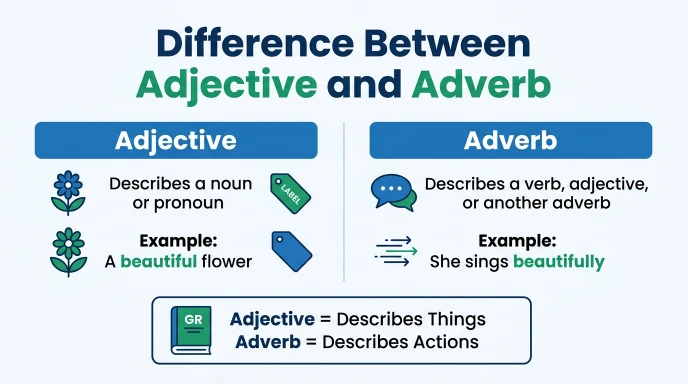
The difference between an adjective and an adverb is that an adjective describes a noun or pronoun, while an adverb describes a verb, adjective, or another adverb.
The difference between adjective and adverb is one of the most common grammar questions among English learners. Many people get confused because both words describe something, but they do different jobs in a sentence.
Understanding the difference between adjective and adverb helps you write more clearly, speak more naturally, and avoid common grammar mistakes.
If you’re writing an email, completing school assignments, creating content for social media, or improving your English for work, knowing the difference between adjective and adverb makes your communication stronger.
In this guide, you’ll learn simple definitions, practical examples, pronunciation, comparison tables, and real-life usage so you can confidently choose the correct word every time.
Difference Between Adjective and Adverb
The difference between adjective and adverb is simple: an adjective describes a noun or pronoun, while an adverb describes a verb, adjective, another adverb, or even an entire sentence.
Example:
- She is a careful driver. (Adjective describing the noun “driver”)
- She drives carefully. (Adverb describing the verb “drives”)
Definition of Adjective and Adverb
Adjective
An adjective is a word that describes or gives more information about a noun or pronoun.
Example:
- The blue car is fast.
- She is kind.
Adverb
An adverb is a word that describes a verb, adjective, another adverb, or a whole sentence. It often explains how, when, where, or to what extent something happens.
Example:
- He speaks clearly.
- The train arrived early.
Pronunciation
| Word | US Pronunciation | UK Pronunciation |
| Adjective | /ˈædʒɪktɪv/ | /ˈædʒɪktɪv/ |
| Adverb | /ˈædvɝːb/ | /ˈædvɜːb/ |
Now that you know the basic definitions, let’s explore the difference between adjective and adverb in greater detail with practical comparisons and real-world examples.
Difference Between Adjective and Adverb: Comparison
| Feature | Adjective | Adverb | Similarity |
| Purpose | Describes a noun or pronoun | Describes a verb, adjective, or another adverb | Both add more detail to a sentence. |
| Answers | What kind? Which one? How many? | How? When? Where? To what extent? | Both make writing more descriptive. |
| Modifies | Nouns and pronouns | Verbs, adjectives, adverbs, or sentences | Both modify other words. |
| Common Form | Often ends in -ful, -ous, -ive | Often ends in -ly, but not always | Both have regular and irregular forms. |
| Example | A happy child | Runs happily | Both improve sentence clarity. |
| Position | Usually before a noun or after linking verbs | Usually after the verb or before the word it modifies | Position depends on grammar rules. |
| Function | Describes qualities | Describes actions or intensity | Both improve communication. |
| Usage | Common in descriptions | Common in actions and explanations | Both are essential parts of speech. |
This table clearly shows the difference and similarity between adjective and adverb for quick understanding.
Key Differences Explained Between Adjective and Adverb
1. They Modify Different Words
The biggest difference between adjective and adverb is what they modify.
An adjective describes a noun or pronoun.
Example:
- A beautiful garden.
- The young athlete won.
An adverb describes an action or another description.
Example:
- She sings beautifully.
- He answered quickly.
2. They Answer Different Questions
Adjectives answer questions like:
- What kind?
- Which one?
- How many?
Example:
- The red dress.
- Three students.
Adverbs answer:
- How?
- When?
- Where?
- How often?
- To what extent?
Example:
- She smiled warmly.
- They arrived yesterday.
3. Their Position in a Sentence Is Different
Adjectives usually appear before nouns or after linking verbs.
Examples:
- A small house.
- The soup tastes delicious.
Adverbs often appear after the main verb or before the word they modify.
Examples:
- He finished the work quickly.
- She is very happy.
4. Most Adverbs End in “-ly”
Many adverbs are formed by adding -ly to adjectives.
| Adjective | Adverb |
| Slow | Slowly |
| Careful | Carefully |
| Happy | Happily |
| Loud | Loudly |
However, not every adverb ends in -ly.
Examples include:
- Fast
- Hard
- Well
- Late
Likewise, some adjectives also end in -ly, such as friendly, lovely, and lively.
5. They Perform Different Grammar Functions
An adjective provides information about a person, place, thing, or idea.
Example:
- The old library is beautiful.
An adverb explains how an action happens.
Example:
- Students studied quietly in the library.
This distinction makes sentences more precise and easier to understand.
What Is an Adjective?
An adjective is one of the most important parts of speech because it gives readers more information about nouns and pronouns. Without adjectives, writing would sound plain and repetitive.
For example:
- I bought a car.
- I bought a new electric car.
The second sentence immediately gives more useful information.
Adjectives can describe:
- Color
- Size
- Shape
- Age
- Quantity
- Opinion
- Material
- Nationality
Examples:
- Blue sky
- Tall building
- Italian food
- Happy customer
- Wooden chair
What Is an Adverb?
An adverb provides extra information about actions and descriptions. It tells readers how, when, where, how often, or to what extent something happens.
Examples:
- He answered politely.
- We arrived early.
- She almost finished the project.
- The baby slept peacefully.
Some adverbs modify adjectives.
Example:
- The movie was extremely interesting.
Some modify other adverbs.
Example:
- She speaks very clearly.
Difference Between Adjective and Adverb in Everyday English
In real conversations, many learners accidentally use an adjective where an adverb is needed, or vice versa. Understanding the difference between adjective and adverb helps you communicate more naturally in school, at work, and online.
For example:
❌ She sings beautiful.
✅ She sings beautifully.
❌ He is a quickly runner.
✅ He is a quick runner.
A simple rule is to identify what you’re describing:
- If you’re describing a person, place, thing, or idea, use an adjective.
- If you’re describing an action or how something happens, use an adverb.
When to Use an Adjective
Use an adjective whenever you want to describe a noun or pronoun.
Common situations include:
- Describing people
- Describing objects
- Giving opinions
- Explaining size, color, or quality
Examples
- The friendly teacher explained the lesson.
- We bought a large house.
- That was an excellent presentation.
- The weather feels cold today.
Real-World Uses
You use adjectives every day when:
- Writing emails
- Creating social media posts
- Shopping online
- Writing essays
- Giving product reviews
Without adjectives, writing becomes less detailed and engaging.
When to Use an Adverb
Use an adverb when describing:
- A verb
- An adjective
- Another adverb
- An entire sentence
Examples
- She completed the assignment quickly.
- He speaks very softly.
- The movie was incredibly interesting.
- Fortunately, nobody was injured.
Everyday Uses
Adverbs commonly appear in:
- Instructions
- Conversations
- News articles
- Blog posts
- Business communication
They help explain how, when, where, and to what extent an action occurs.
Difference Between Adjective and Adverb: Common Patterns
Although many adverbs end in -ly, English contains several exceptions.
Words That Stay the Same
| Word | Adjective | Adverb |
| Fast | ✔ | ✔ |
| Hard | ✔ | ✔ |
| Late | ✔ | ✔ |
| Early | ✔ | ✔ |
Words That Change Meaning
Some words look similar but have different meanings.
| Adjective | Adverb | Meaning |
| Hard | Hard | With effort |
| Hard | Hardly | Almost not |
| Late | Late | After expected time |
| Late | Lately | Recently |
Example:
- He worked hard yesterday.
- He has hardly worked this week.
Understanding these exceptions helps prevent common grammar mistakes.
Common Mistakes with Difference Between Adjective and Adverb
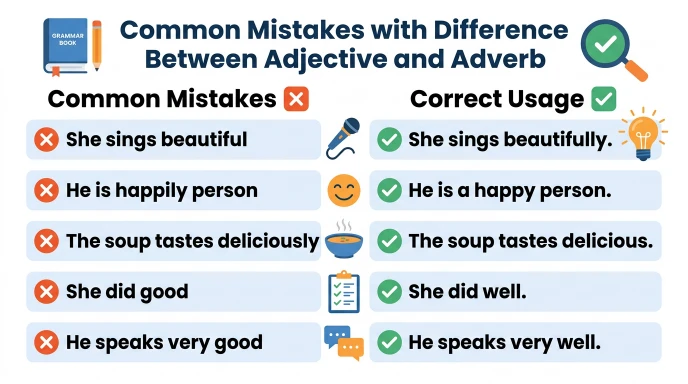
Many beginners struggle because adjectives and adverbs often look similar.
Mistake 1
❌ She dances beautiful.
✅ She dances beautifully.
Mistake 2
❌ He is happily person.
✅ He is a happy person.
Mistake 3
❌ The food tastes deliciously.
✅ The food tastes delicious.
(Linking verbs like taste, look, feel, and seem usually take adjectives.)
Mistake 4
❌ He speaks very good.
✅ He speaks very well.
Mistake 5
❌ She did good.
✅ She did well.
“Good” is an adjective, while “well” is usually the adverb.
Real-Life Examples with Difference Between Adjective and Adverb
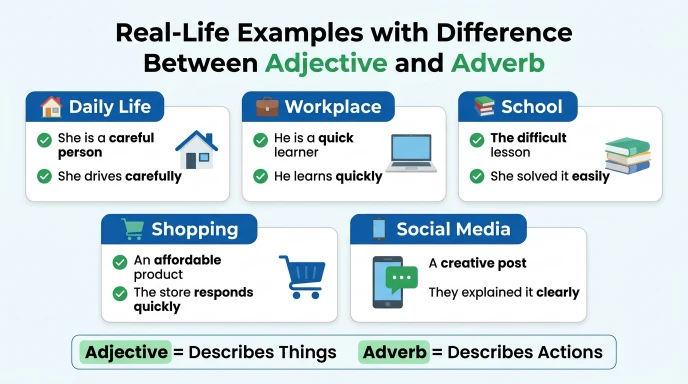
1. School
Teacher:
“Please write neatly.”
Here, neatly describes how students should write.
2. Workplace
“The manager gave a clear presentation.”
“She explained everything clearly.”
3. Online Shopping
“This is an affordable laptop.”
“The website loads quickly.”
4. Social Media
Creators on platforms like YouTube, Instagram, and Meta often rely on strong adjectives to grab attention, while adverbs help explain actions more clearly.
Example:
- Amazing tutorial!
- The instructor explains everything clearly.
5. Everyday Conversation
“My neighbor is friendly.”
“My neighbor speaks politely.”
Why People Get Confused Between Adjective and Adverb
Several reasons make these grammar terms confusing.
Similar Spellings
Many adverbs simply add -ly to adjectives.
Example:
- Careful → Carefully
Same Word, Different Function
Some words never change.
Examples:
- Fast
- Early
- Hard
This often causes uncertainty.
Linking Verbs
Words like:
- Look
- Feel
- Taste
- Smell
- Become
- Seem
usually require adjectives instead of adverbs.
Example:
✅ The soup tastes delicious.
NOT
❌ The soup tastes deliciously.
Informal English
In casual conversations, native speakers sometimes use grammar informally.
Example:
“He did good.”
Although common in speech, formal English prefers:
“He did well.”
How Search Engines Understand Difference Between Adjective and Adverb and User Intent
Search engines such as Google analyze more than just keywords. They try to understand why someone searches for the difference between adjective and adverb.
A beginner may want simple definitions, while a student may need comparison tables and examples for homework. Someone creating content might look for grammar rules to improve readability.
Google’s Helpful Content System favors articles that:
- Answer questions directly
- Use simple language
- Include practical examples
- Cover the topic completely
- Match user intent instead of repeating keywords
That’s why a complete guide with definitions, comparisons, examples, and FAQs is more useful than a short explanation.
Expert Insight
In practical writing and editing, one of the fastest ways to improve sentence quality is choosing the correct modifier.
Many beginners focus on vocabulary but overlook grammar. However, understanding when to use an adjective versus an adverb immediately makes writing sound clearer and more professional.
Professional editors often check modifiers because even a small mistake can change a sentence’s meaning. If you’re writing an essay, business email, blog post, or social media caption, using adjectives and adverbs correctly builds credibility and improves readability.
Understanding the difference between adjective and adverb isn’t just about passing grammar tests it’s a practical skill that helps you communicate with confidence.
FAQs
1. What is the main difference between adjective and adverb?
The main difference between adjective and adverb is that an adjective describes a noun or pronoun, while an adverb describes a verb, adjective, another adverb, or an entire sentence.
2. How can I identify an adjective in a sentence?
Ask yourself if the word describes a person, place, thing, or idea. If it does, it is usually an adjective.
Example:
- The red bicycle is mine.
3. Do all adverbs end in “-ly”?
No. While many adverbs end in -ly, several common adverbs do not.
Examples include:
- Fast
- Hard
- Well
- Early
- Late
Always consider the word’s function in the sentence rather than its ending.
4. Can one word be both an adjective and an adverb?
Yes. Some English words serve as both.
Examples:
- Fast
- Hard
- Early
- Late
Their role depends on how they are used in the sentence.
5. Why do people confuse adjectives and adverbs?
Many learners confuse them because they have similar spellings, and some words can function as both adjectives and adverbs. Informal English also contributes to the confusion.
6. Is “good” an adjective or an adverb?
Good is an adjective.
Example:
- She is a good student.
The adverb form is well.
Example:
- She sings well.
7. Can an adverb modify an adjective?
Yes. An adverb can describe the degree or intensity of an adjective.
Examples:
- Very happy
- Extremely useful
- Quite interesting
- Incredibly difficult
8. Why is learning the difference between adjective and adverb important?
Knowing the difference between adjective and adverb helps you write clearly, speak accurately, and avoid common grammar mistakes. It also improves essays, emails, business communication, and everyday conversations.
Conclusion
Understanding the difference between adjective and adverb is an essential grammar skill that improves both writing and speaking. Although these two parts of speech are closely related, they serve different purposes. An adjective describes a noun or pronoun, while an adverb explains how, when, where, or to what extent an action or description occurs.
In real-life communication, using the correct modifier makes your sentences more natural and easier to understand. If you’re writing a school assignment, creating website content, sending a professional email, or posting on social media, choosing between an adjective and an adverb helps you express your ideas accurately.
A simple way to remember the rule is to first identify what you’re describing. If it’s a person, place, thing, or idea, use an adjective. If you’re describing an action, another description, or the manner in which something happens, use an adverb.
With regular practice, this grammar rule becomes second nature. By understanding the difference between adjective and adverb, you’ll build stronger English skills, communicate with greater confidence, and avoid many of the mistakes that learners commonly make.
Read more about!
- Difference Between W-4 and W-2: Key Differences Explained
- Difference Between Velocity and Acceleration: Complete Guide

I am Emily Johnson, a USA-based content writer who creates easy-to-read blogs on language and daily life topics. I explain complex ideas in simple English for students and beginners so they can understand easily.