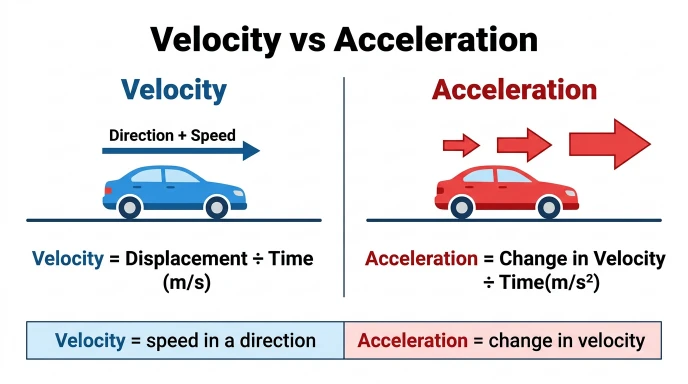
Velocity is the speed of an object in a specific direction, while acceleration is the rate at which its velocity changes over time.
If you’ve ever studied physics, you’ve probably come across the terms velocity and acceleration. Many students use them interchangeably, but they describe different aspects of motion.
Understanding the difference between velocity and acceleration is essential for learning how objects move.
In simple words, velocity tells you how fast an object moves in a specific direction, while acceleration tells you how quickly its velocity changes over time.
Knowing the difference between velocity and acceleration helps you solve physics problems, understand real-world motion, and build a strong foundation in science.
This guide explains both concepts with simple definitions, comparison tables, examples, and expert insights.
Difference Between Velocity and Acceleration
Velocity is the speed of an object in a specific direction.
Acceleration is the rate at which an object’s velocity changes over time.
Example: A car traveling east at 60 km/h has velocity. If it speeds up to 80 km/h, slows down, or turns, it is accelerating.
What Is Velocity and Acceleration?
Velocity
Velocity is the speed of an object in a particular direction.
Example: A train moving north at 90 km/h has a velocity of 90 km/h north.
Acceleration
Acceleration is the rate at which an object’s velocity changes. The change may involve speed, direction, or both.
Example: A bicycle speeding up from 10 km/h to 20 km/h is accelerating.
Pronunciation
| Term | US Pronunciation | UK Pronunciation |
| Velocity | /vəˈlɑː.sə.t̬i/ | /vəˈlɒs.ə.ti/ |
| Acceleration | /əkˌsel.əˈreɪ.ʃən/ | /əkˌsel.əˈreɪ.ʃən/ |
Now that you know the basic definitions, let’s explore the difference between velocity and acceleration in more detail.
Difference Between Velocity and Acceleration Comparison
| Feature | Velocity | Acceleration |
| Meaning | Speed in a specific direction | Change in velocity over time |
| Measures | Motion | Change in motion |
| Unit (SI) | meters per second (m/s) | meters per second squared (m/s²) |
| Depends On | Speed and direction | Change in speed, direction, or both |
| Quantity Type | Vector | Vector |
| Can Be Constant | Yes | Yes, if the rate of change remains constant |
| Example | Car moving at 50 km/h north | Car speeding up, slowing down, or turning |
Key Differences Explained Between Velocity and Acceleration
1. Meaning
The biggest difference is what each quantity measures.
Velocity tells you how fast an object moves in a certain direction.
Acceleration tells you how quickly that velocity changes.
Example: A car driving at 60 km/h east has velocity. If it increases to 80 km/h, it has acceleration.
2. What They Measure
Velocity measures the object’s current motion.
Acceleration measures how that motion changes.
Example:
- A plane flying steadily has velocity.
- A plane taking off experiences acceleration.
3. SI Units
Velocity and acceleration use different measurement units.
- Velocity: meters per second (m/s)
- Acceleration: meters per second squared (m/s²)
These units help scientists and engineers describe motion accurately.
4. Direction Matters
Both velocity and acceleration are vector quantities, meaning direction is important.
If an object changes direction even at the same speed it is accelerating because its velocity has changed.
Example: A car turning around a corner experiences acceleration even if its speed stays the same.
5. Change Over Time
Velocity describes the object’s motion at a given moment.
Acceleration describes how that motion changes over time.
This is why acceleration is often called the rate of change of velocity.
6. Positive, Negative, and Zero Values
Velocity can be positive, negative, or zero depending on the chosen direction.
Acceleration can also be:
- Positive (speed increasing)
- Negative (speed decreasing, often called deceleration)
- Zero (velocity remains constant)
7. Real-Life Interpretation
Think of driving a car.
- The speedometer tells you your speed. When direction is included, that’s your velocity.
- Pressing the accelerator or brake changes your velocity, creating acceleration.
This simple example makes it easier to understand the difference.
Why Does the Difference Between Velocity and Acceleration Matter?
Understanding these concepts is important in physics and everyday life.
Engineers use them to design safer vehicles.
Pilots use them during takeoff and landing.
Athletes improve performance by understanding acceleration.
Scientists use both to study moving objects.
Without understanding velocity and acceleration, it would be difficult to explain how motion changes.
How Are Velocity and Acceleration Related?
Velocity and acceleration are closely connected.
Acceleration changes velocity.
When acceleration is zero, velocity stays constant.
If acceleration is positive, velocity usually increases.
If acceleration is negative, velocity usually decreases.
In simple words:
- Velocity tells you how an object is moving.
- Acceleration tells you how that motion is changing.
Can an Object Have Velocity Without Acceleration?
Yes.
An object moving at a constant speed in a straight line has velocity but zero acceleration.
Example:
A train traveling at 100 km/h east without changing speed or direction has constant velocity and no acceleration.
However, if the train speeds up, slows down, or turns, acceleration occurs.
Can an Object Have Acceleration Without Increasing Speed?
Yes.
Many people think acceleration only means speeding up, but that’s not true.
Acceleration happens whenever velocity changes, including a change in direction.
Example:
A car driving around a circular track at a constant speed is still accelerating because its direction changes continuously.
This concept is called centripetal acceleration and is one of the most common examples in physics.
Common Formulas for Velocity and Acceleration
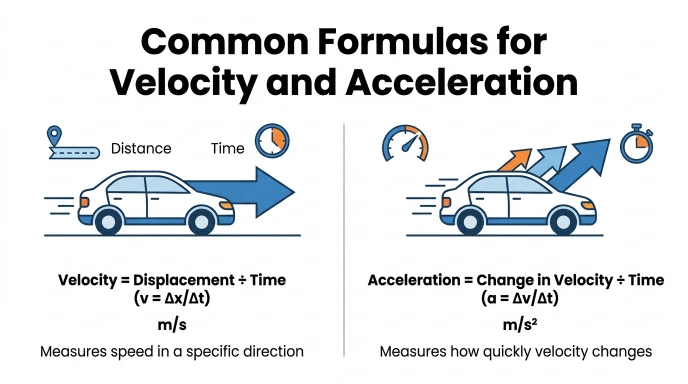
Although beginners don’t need to memorize every equation immediately, these two formulas are the most commonly used:
Velocity Formula
Velocity = Distance ÷ Time (when moving in a straight line with constant speed)
Acceleration Formula
Acceleration = Change in Velocity ÷ Time
These formulas help calculate how objects move and how their motion changes.
Difference + Similarity Between Velocity and Acceleration
| Feature | Velocity | Acceleration | Similarity |
| Meaning | Speed in a specific direction | Change in velocity over time | Both describe the motion of objects. |
| Measures | Motion | Change in motion | Both are fundamental concepts in physics. |
| SI Unit | meters per second (m/s) | meters per second squared (m/s²) | Both use SI units. |
| Type of Quantity | Vector | Vector | Both have magnitude and direction. |
| Depends On | Speed and direction | Change in speed, direction, or both | Both involve direction. |
| Value | Can be constant or changing | Can be positive, negative, or zero | Both can vary during motion. |
| Example | Car moving at 60 km/h north | Car speeding up or turning | Both are used to describe vehicle movement. |
This table clearly shows the difference and similarity between velocity and acceleration for quick understanding.
Common Mistakes with Velocity and Acceleration
Students often confuse these terms. Here are the most common mistakes and how to avoid them.
1. Thinking Velocity and Speed Are the Same
Many people ignore direction.
Correction: Velocity includes both speed and direction.
2. Believing Acceleration Only Means Speeding Up
Acceleration also occurs when an object slows down or changes direction.
Correction: Any change in velocity is acceleration.
3. Forgetting the Units
Some students use the same unit for both quantities.
Correction:
- Velocity = m/s
- Acceleration = m/s²
4. Ignoring Direction
Both velocity and acceleration are vector quantities.
Correction: Always consider direction when solving physics problems.
5. Assuming Constant Velocity Means Constant Acceleration
If velocity stays constant in both speed and direction, acceleration is zero.
Correction: Constant velocity means no acceleration.
Real-Life Examples with Velocity and Acceleration
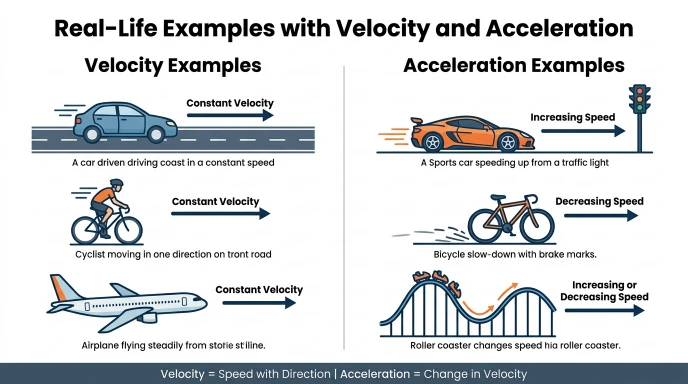
Example 1: Driving a Car
A car moving at 70 km/h east has velocity.
If it speeds up to 90 km/h, it has acceleration.
Example 2: Airplane Takeoff
Before takeoff, an airplane accelerates along the runway.
Once it reaches a steady speed and direction, it has nearly constant velocity.
Example 3: Riding a Bicycle
Cycling at a steady pace gives you velocity.
Pedaling faster or applying the brakes creates acceleration.
Example 4: Roller Coaster
A roller coaster speeds up, slows down, and changes direction throughout the ride.
This makes it a great example of changing velocity and acceleration.
Example 5: Satellite Orbit
A satellite may travel at a nearly constant speed around Earth, but it continuously changes direction.
Because its direction changes, it is constantly accelerating.
When to Use Each
Use Velocity When You Want to Describe:
- How fast something moves
- The direction of movement
- Constant motion
- Travel speed
- Motion in a straight line
Use Acceleration When You Want to Describe:
- Speeding up
- Slowing down
- Turning or changing direction
- Changes in motion
- Forces acting on an object
Quick Tip: If you’re describing motion, think velocity. If you’re describing changes in motion, think acceleration.
Why People Get Confused About Velocity and Acceleration
These concepts are closely related, which makes them easy to mix up.
Common reasons include:
- Both describe moving objects.
- Both are vector quantities.
- Both are introduced together in physics classes.
- People often confuse speed with velocity.
- Many assume acceleration only means increasing speed.
The easiest way to remember the difference is:
- Velocity describes movement.
- Acceleration describes changes in movement.
How Search Engines Understand “Difference Between Velocity and Acceleration” and User Intent
When someone searches “difference between velocity and acceleration,” search engines like Google recognize that the user wants a simple educational explanation rather than advanced mathematical proofs.
Google typically ranks content that answers questions such as:
- What is velocity?
- What is acceleration?
- How are they different?
- What are their SI units?
- Can an object have velocity without acceleration?
- What are real-life examples?
Articles that use beginner-friendly language, comparison tables, diagrams, formulas, and practical examples are more likely to satisfy user intent. Related terms such as motion, speed, force, displacement, Newton’s laws, and vector quantities also help search engines understand the topic more completely.
Expert Insight
From a physics perspective, understanding velocity before learning acceleration makes the topic much easier.
In classrooms and real-world applications, acceleration is not limited to speeding up. Any change in an object’s velocity including slowing down or changing direction is acceleration.
This concept is widely used in engineering, transportation, aviation, robotics, and sports science. Building a strong understanding of these two ideas creates a solid foundation for studying mechanics and other areas of physics.
FAQs
1. What is the main difference between velocity and acceleration?
Velocity describes the speed and direction of motion, while acceleration describes how that velocity changes over time.
2. Can velocity exist without acceleration?
Yes. If an object moves at a constant speed in a straight line, it has velocity but zero acceleration.
3. Can acceleration exist without increasing speed?
Yes. Changing direction also causes acceleration, even if speed stays the same.
4. What are the SI units of velocity and acceleration?
Velocity is measured in meters per second (m/s), while acceleration is measured in meters per second squared (m/s²).
5. Are velocity and acceleration vector quantities?
Yes. Both have magnitude and direction.
6. Does acceleration always mean speeding up?
No. Acceleration includes speeding up, slowing down, and changing direction.
7. Why is direction important in velocity?
Velocity includes both speed and direction. Changing either one changes the velocity.
8. Which is easier to measure?
Velocity is generally easier to measure directly. Acceleration is calculated by measuring how velocity changes over time.
Conclusion
Understanding the difference between velocity and acceleration is essential for learning how motion works. Although the two concepts are closely connected, they measure different things. Velocity tells you how fast an object moves in a specific direction, while acceleration tells you how quickly that velocity changes over time. A change in speed, direction, or both results in acceleration.
These concepts are used every day in driving, aviation, sports, engineering, and space science. Remember this simple rule: velocity describes motion, while acceleration describes changes in motion. Once you understand this relationship, solving physics problems and understanding real-world movement becomes much easier.
Read more about!
Difference Between Lose and Loose: Easy Guide
Difference Between Title and Deed: Explained Simply

I am Emily Johnson, a USA-based content writer who creates easy-to-read blogs on language and daily life topics. I explain complex ideas in simple English for students and beginners so they can understand easily.