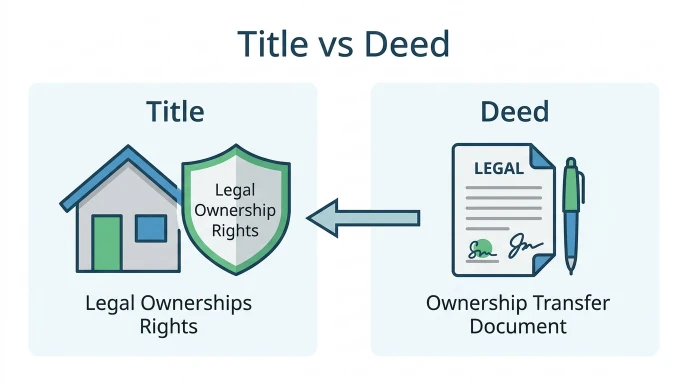
Title and deed are often confused, but a title is your legal right to own a property, while a deed is the official document that transfers that ownership.
If you’re buying or selling a home, you’ve probably heard the terms title and deed. Many people think they mean the same thing, but they serve different purposes in real estate.
Understanding the difference between title and deed can help you avoid confusion during a property transaction.
In simple words, a title is your legal right to own a property, while a deed is the legal document that transfers ownership from one person to another.
Knowing the difference between title and deed is important for homeowners, buyers, sellers, and investors.
In this guide, you’ll learn simple definitions, key differences, comparison tables, real-world examples, and expert insights to make the topic easy to understand.
Difference Between Title and Deed
A title is the legal ownership of a property, while a deed is the written legal document used to transfer that ownership.
Example: When you buy a house, you receive ownership through the title, but the deed is the signed document that officially transfers the property to you.
What Is a Title and a Deed?
Title
A title is the legal right to own, use, and transfer a property. It is not a physical document but a legal concept showing ownership.
Example: If your name appears as the legal owner of a home, you hold the title to that property.
Deed
A deed is a legal document that transfers property ownership from one person to another.
Example: During a home sale, the seller signs a deed to transfer ownership to the buyer.
Pronunciation
| Term | US Pronunciation | UK Pronunciation |
| Title | /ˈtaɪ.t̬əl/ | /ˈtaɪ.təl/ |
| Deed | /diːd/ | /diːd/ |
Now that you know what each term means, let’s explore the difference between title and deed in more detail.
Difference Between Title and Deed Comparison
| Feature | Title | Deed |
| Meaning | Legal ownership of property | Legal document transferring ownership |
| Form | Legal right or concept | Physical or electronic legal document |
| Purpose | Shows who owns the property | Transfers ownership |
| Signed | No | Yes |
| Recorded | Ownership is reflected in public records | Usually recorded with the local land office |
| Changes | Changes when ownership changes | Created when property is transferred |
| Required for Sale | Ownership must exist | Needed to complete the transfer |
| Example | Owning a house | Warranty deed or quitclaim deed |
Key Differences Explained Between Title and Deed
1. Meaning
The biggest difference between a title and a deed is what each represents.
A title is the legal ownership of a property, while a deed is the document that transfers that ownership.
Example: Buying a house gives you the title, but signing the deed completes the transfer.
2. Physical vs. Legal Concept
A title is not something you can hold in your hand.
A deed is an official legal document that can be printed, signed, and recorded.
Example: You may receive a copy of your deed, but you don’t receive a physical “title.”
3. Purpose
A title proves ownership rights.
A deed legally transfers those rights from one owner to another.
Without a valid deed, ownership usually cannot be transferred properly.
4. Legal Process
A title exists as long as ownership exists.
A deed becomes important during a sale, gift, inheritance, or other property transfer.
Example: When parents gift property to their child, they use a deed to transfer the title.
5. Signatures
A title does not require signatures.
A deed must usually be signed by the seller and, in many places, witnessed or notarized.
This makes the transfer legally valid.
6. Public Records
Property ownership is often reflected in government land records.
After signing, a deed is commonly recorded with the local land records office to provide public notice of the ownership transfer.
7. Ownership Rights
Holding the title gives you legal rights to:
- Live on the property
- Sell the property
- Lease the property
- Transfer ownership
- Leave it to heirs
The deed is simply the legal tool used to transfer these rights.
Why Does the Difference Between Title and Deed Matter?
Many first-time homebuyers assume the title and deed are the same. Understanding the difference helps you know what happens during a real estate transaction.
For example:
- A buyer wants legal ownership (title).
- The seller signs a deed to transfer that ownership.
- The deed is recorded to update public property records.
Knowing this process can help prevent misunderstandings and make buying or selling property easier.
How Does a Property Transfer Work?
Let’s understand this clearly.
A typical property transfer follows these steps:
- The seller agrees to sell the property.
- A deed is prepared.
- The seller signs the deed.
- The buyer receives ownership.
- The deed is recorded with the local land office.
- The buyer now holds the legal title.
In simple words, the deed transfers the title.
Can You Have a Title Without a Deed?
In most cases, your ownership rights come from a properly executed deed, but the title itself represents the legal ownership not the document.
For example:
- After purchasing a home, your deed serves as evidence of the transfer.
- Once the transfer is legally completed, you hold the title to the property.
This is why real estate professionals often say that the deed transfers the title.
What Types of Deeds Are Common?
Different situations require different types of deeds.
Warranty Deed
Provides the buyer with the strongest protection by guaranteeing the seller has the legal right to transfer the property.
Quitclaim Deed
Transfers whatever ownership interest the seller has without guaranteeing clear ownership.
Special Warranty Deed
Guarantees the title only for the period during which the seller owned the property.
Choosing the right deed depends on the type of property transaction and local legal requirements.
Difference + Similarity Between Title and Deed
| Feature | Title | Deed | Similarity |
| Meaning | Legal ownership of property | Legal document that transfers ownership | Both relate to property ownership. |
| Purpose | Shows ownership rights | Transfers ownership rights | Both are essential in real estate transactions. |
| Form | Legal concept | Written legal document | Both have legal importance. |
| Signature | No signature required | Must usually be signed by the seller | Both help establish ownership. |
| Recording | Reflected through property records | Usually recorded with the local land records office | Both may appear in public property records. |
| Use | Proves who owns the property | Changes who owns the property | Both are used during property transfers. |
| Duration | Exists as long as ownership exists | Used during the transfer process | Both protect legal property interests. |
This table clearly shows the difference and similarity between title and deed for quick understanding.
Common Mistakes with Title and Deed
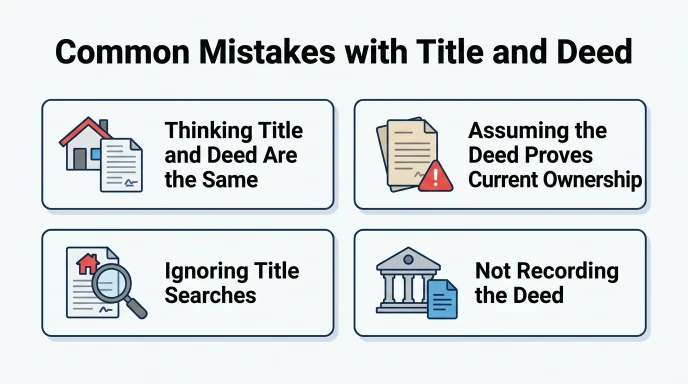
Many first-time buyers confuse these terms. Here are some common mistakes and how to avoid them.
1. Thinking a Title Is a Paper Document
Many people believe they receive a physical “title.”
Correction: A title is a legal ownership right, not a document.
2. Using “Title” and “Deed” as the Same Thing
These terms are related but not identical.
Correction: The deed transfers ownership, while the title represents ownership.
3. Assuming the Deed Alone Proves Ownership
A deed records the transfer, but ownership can still be affected by liens, disputes, or legal claims.
Correction: Always verify the property’s title before buying.
4. Ignoring a Title Search
Some buyers skip checking the property’s ownership history.
Correction: A title search helps identify unpaid taxes, liens, or ownership disputes before closing.
5. Not Recording the Deed
Failing to record a deed can create legal complications.
Correction: Record the deed with the appropriate local government office after the transfer.
Real-Life Examples with Title and Deed
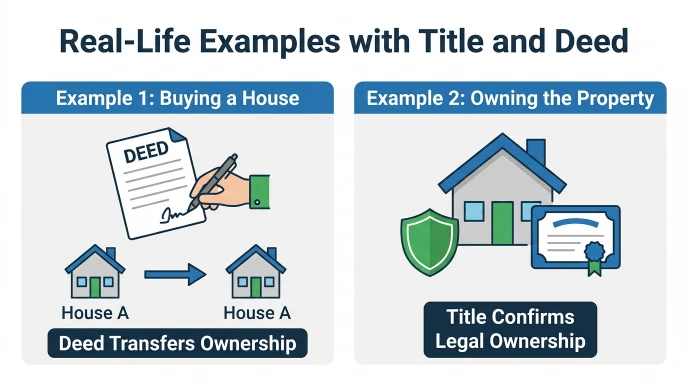
Example 1: Buying Your First Home
A buyer signs the closing documents.
The seller signs a warranty deed, transferring the title to the buyer.
Example 2: Property Gift Between Family Members
Parents transfer ownership of a house to their child using a quitclaim deed.
The child then becomes the legal title holder.
Example 3: Real Estate Investment
An investor purchases a rental property.
The deed transfers ownership, and the investor receives the legal title.
Example 4: Inheriting Property
A person inherits a home after a family member passes away.
Legal documents update the title according to local inheritance laws.
Example 5: Business Property Purchase
A company purchases office space.
A deed transfers ownership, while the company’s name becomes the legal title holder.
When to Use Each
Use “Title” When:
- Discussing property ownership.
- Checking legal ownership rights.
- Purchasing title insurance.
- Performing a title search.
- Resolving ownership disputes.
Use “Deed” When:
- Buying or selling property.
- Transferring ownership to another person.
- Gifting property.
- Recording ownership changes.
- Completing legal real estate documents.
Why People Get Confused About Title and Deed
Many people hear these terms together during real estate transactions, making them seem interchangeable.
Other reasons include:
- Real estate professionals often mention both at closing.
- Both relate to property ownership.
- Legal terminology can be confusing.
- Movies and TV sometimes use the words incorrectly.
- First-time buyers may not understand the transfer process.
In simple words, the deed transfers ownership, while the title is the ownership itself.
How Search Engines Understand “Difference Between Title and Deed” and User Intent
When someone searches “difference between title and deed,” search engines such as Google recognize that the user is looking for a clear legal comparison rather than complex legal advice.
Google looks for content that answers questions like:
- What is a title?
- What is a deed?
- Are title and deed the same?
- Which one proves ownership?
- How does property transfer work?
- Why is a title search important?
Helpful articles that use simple language, practical examples, comparison tables, and beginner-friendly explanations are more likely to satisfy search intent. Related terms such as property ownership, real estate closing, title insurance, land records, and ownership transfer also help search engines understand the topic more completely.
Expert Insight
From a real estate perspective, understanding the difference between a title and a deed can help prevent costly mistakes.
In real property transactions, professionals carefully review both the title and the deed before closing. A clear title reduces the risk of ownership disputes, while a properly prepared deed ensures ownership is legally transferred.
For buyers, reviewing title records and obtaining title insurance can provide added peace of mind. Although the exact legal process varies by country and jurisdiction, the basic principle remains the same: the deed transfers the property, and the title represents the legal ownership rights.
FAQs
1. What is the main difference between title and deed?
A title represents legal ownership, while a deed is the legal document that transfers ownership.
2. Can you own property without a deed?
Ownership generally comes through a valid legal transfer, and the deed is the document that records that transfer.
3. Is a title the same as a deed?
No. A title is a legal right, while a deed is the document used to transfer that right.
4. What is a title search?
A title search reviews public records to confirm ownership and identify liens, claims, or other legal issues affecting a property.
5. Why is a deed recorded?
Recording a deed creates a public record of the ownership transfer and helps protect the new owner’s rights.
6. What is title insurance?
Title insurance protects buyers and lenders against certain ownership problems or claims that may have existed before the purchase.
7. Which is more important, the title or the deed?
Both are important. The deed transfers ownership, while the title represents the legal ownership you receive.
8. Can a property have more than one title holder?
Yes. Property can be owned jointly by spouses, family members, business partners, or other co-owners, depending on local law.
Conclusion
Understanding the difference between title and deed is essential for anyone buying, selling, inheriting, or investing in real estate. While these terms are closely connected, they are not the same. A title represents your legal ownership rights to a property, whereas a deed is the legal document that transfers those rights from one owner to another.
In practical terms, every property transfer involves a deed, but the ultimate goal is to transfer the title. Knowing how these concepts work together can help you better understand real estate transactions, communicate confidently with agents and attorneys, and avoid common misunderstandings.
If you’re purchasing your first home or reviewing property documents, remembering one simple rule can make the process easier: the deed transfers ownership, and the title proves ownership.
Read more about!
Difference Between Ale and Lager: Key Differences Explained
Difference Between Lemon and Lime: Explained Clearly

I am Emily Johnson, a USA-based content writer who creates easy-to-read blogs on language and daily life topics. I explain complex ideas in simple English for students and beginners so they can understand easily.