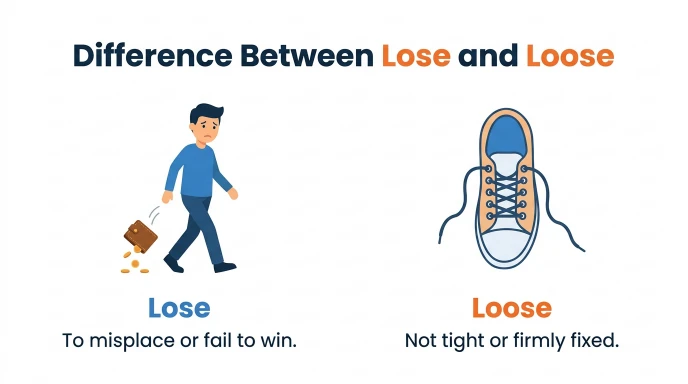
Lose means to fail to keep or win something, while loose means not tight or firmly fixed.
Have you ever typed “I don’t want to loose my keys” instead of “lose my keys”? You’re not alone. Many people confuse these two words because they look and sound similar.
Understanding the difference between lose and loose can help you avoid one of the most common English spelling mistakes.
In simple words, lose means to no longer have something or to fail to win, while loose means not tight or free from being firmly attached.
Knowing the difference between lose and loose improves your writing, speaking, and everyday communication. In this guide, you’ll learn simple definitions, pronunciation, key differences, comparison tables, examples, and practical tips to remember them easily.
Difference Between Lose and Loose
Lose is a verb that means to misplace something or fail to win.
Loose is usually an adjective that means not tight or not firmly attached.
Example: Don’t lose your wallet because your pants are too loose.
What Is Lose and Loose?
Lose
Lose means to no longer have something, fail to keep it, or not win.
Example: I don’t want to lose my phone.
Loose
Loose means not tight, not fixed firmly, or free to move.
Example: My shoes are too loose.
Pronunciation
| Word | US Pronunciation | UK Pronunciation |
| Lose | /luːz/ | /luːz/ |
| Loose | /luːs/ | /luːs/ |
Although they look similar, lose ends with a “z” sound, while loose ends with an “s” sound. Let’s explore the difference in more detail.
Difference Between Lose and Loose Comparison
| Feature | Lose | Loose |
| Part of Speech | Verb | Usually an adjective |
| Meaning | To misplace or fail to win | Not tight or firmly fixed |
| Function | Shows an action | Describes something |
| Pronunciation | Ends with /z/ sound | Ends with /s/ sound |
| Common Use | Losing keys, games, money | Loose clothes, loose screws |
| Opposite | Find or win | Tight |
| Example | Don’t lose your bag. | This shirt is loose. |
Key Differences Explained Between Lose and Loose
1. Meaning
The biggest difference is their meaning.
Lose refers to losing something or failing.
Loose describes something that is not tight.
Example:
- I don’t want to lose my passport.
- My backpack straps are loose.
2. Part of Speech
Lose is mainly used as a verb.
Loose is mainly used as an adjective.
Example:
- You may lose the match.
- The bolt is loose.
3. Pronunciation
Although the spelling is similar, the pronunciation is different.
- Lose sounds like “looz.”
- Loose sounds like “looss.”
This pronunciation difference helps native speakers distinguish them in conversation.
4. Usage in Sentences
Lose always expresses an action.
Loose describes a noun.
Examples:
- Don’t lose your ticket.
- Wear loose clothing in hot weather.
5. Grammar Role
Because lose is a verb, it can change tense.
Examples:
- Lose
- Lost
- Losing
Loose usually stays the same because it is an adjective.
6. Common Situations
People often use lose when talking about:
- Losing a game
- Losing money
- Losing weight
- Losing keys
- Losing confidence
People use loose when describing:
- Loose clothing
- Loose screws
- Loose hair
- Loose soil
- Loose rope
7. Memory Trick
Here’s an easy way to remember.
Lose has one “o”, just like when you lose something, you have one less.
Loose has two “o”s, giving it extra space just like something loose has extra room.
This simple trick helps many English learners remember the correct spelling.
Why Does the Difference Between Lose and Loose Matter?
Using the wrong word can completely change the meaning of a sentence.
For example:
❌ I don’t want to loose my wallet.
✅ I don’t want to lose my wallet.
Or:
❌ My shoes are too lose.
✅ My shoes are too loose.
Correct spelling makes your writing clearer and more professional, if you’re sending emails, writing assignments, posting on social media, or chatting with friends.
How Are Lose and Loose Used in Everyday English?
These words appear frequently in daily conversations and writing.
Common Uses of Lose
- Lose your phone
- Lose your job
- Lose a race
- Lose money
- Lose your temper
Common Uses of Loose
- Loose shirt
- Loose shoelaces
- Loose tooth
- Loose screw
- Loose pages
Mini Summary: If you’re talking about an action, use lose. If you’re describing something, use loose.
Why Do People Misspell Lose and Loose?
Many English learners and even native speakers mix up these words because:
- They look almost identical.
- They have similar pronunciation.
- Typing quickly can lead to spelling mistakes.
- Spell-check tools don’t always catch the error because both are correctly spelled words.
- People often focus on pronunciation instead of meaning.
Learning the meaning, grammar, and pronunciation of each word makes it much easier to choose the correct one.
Difference Between Lose and Loose in Writing and Speaking
If you’re writing an email, posting on social media, completing schoolwork, or speaking in everyday conversations, using the correct word helps others understand you clearly.
For example:
- In professional writing, using lose instead of loose shows good grammar and attention to detail.
- In casual conversation, the pronunciation difference helps listeners understand if you’re talking about losing something or something that isn’t tight.
Mastering this common word pair improves both written and spoken English.
Difference + Similarity Between Lose and Loose
| Feature | Lose | Loose | Similarity |
| Meaning | To no longer have something or fail to win | Not tight or firmly attached | Both are common English words. |
| Part of Speech | Verb | Usually an adjective | Both are used in everyday English. |
| Function | Describes an action | Describes a noun | Both appear in speaking and writing. |
| Pronunciation | Ends with a /z/ sound | Ends with an /s/ sound | Both begin with the same “loo” sound. |
| Example | Lose your wallet | Loose shoes | Both can appear in simple sentences. |
| Opposite | Find or win | Tight | Both have clear opposite meanings. |
| Common Mistake | Used instead of “loose” | Used instead of “lose” | Both are often confused because of similar spelling. |
This table clearly shows the difference and similarity between lose and loose for quick understanding.
Common Mistakes with Lose and Loose
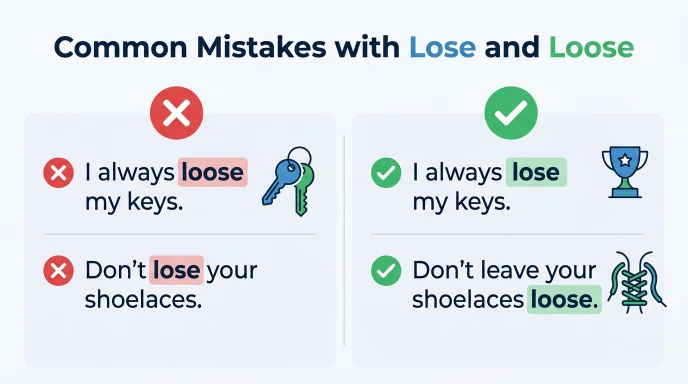
Many English learners confuse these words. Here are the most common mistakes and how to fix them.
1. Writing “Loose” Instead of “Lose”
❌ I don’t want to loose my phone.
✅ I don’t want to lose my phone.
Correction: Use lose for actions like misplacing something or failing.
2. Writing “Lose” Instead of “Loose”
❌ My jacket is too lose.
✅ My jacket is too loose.
Correction: Use loose when something is not tight.
3. Ignoring the Part of Speech
Some writers forget that lose is a verb and loose is usually an adjective.
Correction: Ask yourself if you’re describing an action or a thing.
4. Forgetting the Pronunciation
Many learners pronounce both words the same way.
Correction: Remember:
- Lose = /luːz/
- Loose = /luːs/
5. Relying Only on Spell Check
Spell check may not catch the mistake because both words are spelled correctly.
Correction: Read the sentence carefully and check the meaning.
Real-Life Examples with Lose and Loose
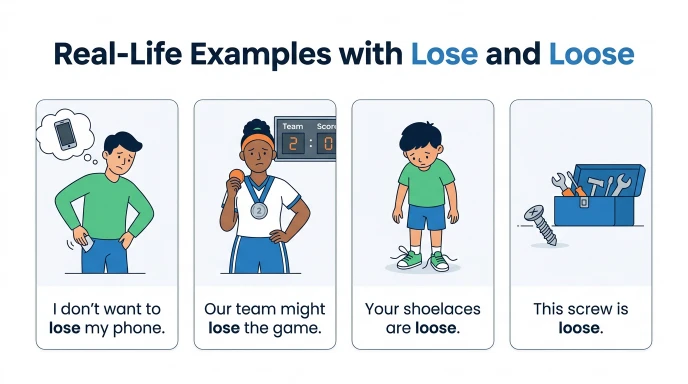
Example 1: Everyday Conversation
“I don’t want to lose my keys.”
“My backpack strap is loose.”
Example 2: School
A student may lose marks by using the wrong spelling.
A notebook may have loose pages.
Example 3: Workplace
You could lose an important document.
A loose cable may cause technical problems.
Example 4: Sports
One team may lose the match.
A player’s loose shoelaces should be tied before the game.
Example 5: Home
You may lose your TV remote.
A loose door handle needs repair.
When to Use Each
Use Lose When You Mean:
- Misplacing something
- Failing to win
- Missing an opportunity
- Reducing weight
- Giving up something
Use Loose When You Mean:
- Not tight
- Free to move
- Not securely attached
- Comfortable clothing
- Objects needing tightening
Quick Tip: If you can replace the word with tight, you probably need loose. If you’re talking about an action, you probably need lose.
Why People Get Confused About Lose and Loose
These words confuse people because they look almost identical and are pronounced similarly.
Other reasons include:
- Only one extra “o” separates them.
- Many people type quickly and don’t notice the spelling.
- Both are common English words, so spell check often misses the mistake.
- English pronunciation doesn’t always match spelling.
- Social media and texting encourage fast typing, leading to more errors.
The easiest way to remember them is to focus on their meaning instead of their spelling.
How Search Engines Understand “Difference Between Lose and Loose” and User Intent
When someone searches “difference between lose and loose,” search engines such as Google recognize that the user is looking for an English grammar explanation.
Google tries to provide content that answers questions like:
- What is the difference between lose and loose?
- When should I use lose?
- When should I use loose?
- Are lose and loose pronounced differently?
- How can I remember the correct spelling?
Helpful content that includes simple definitions, pronunciation, comparison tables, memory tricks, and real-life examples is more likely to satisfy user intent. Related terms such as English grammar, common spelling mistakes, verb, adjective, and word usage also help search engines understand the topic more completely.
Expert Insight
One of the most common spelling mistakes in English is confusing lose and loose. Even experienced writers occasionally make this error when typing quickly.
In practical writing, it’s helpful to pause and ask one simple question:
Am I describing an action or something that isn’t tight?
If it’s an action, use lose. If it describes an object, use loose.
Reading your sentence aloud can also help you hear the difference between the /z/ sound in lose and the /s/ sound in loose.
FAQs
1. What is the main difference between lose and loose?
Lose means to misplace something or fail to win, while loose means not tight or firmly attached.
2. Is lose a verb?
Yes. Lose is a verb that describes an action.
3. Is loose an adjective?
Yes. Loose is usually an adjective describing something that is not tight.
4. Why do people confuse lose and loose?
Because they have similar spelling and pronunciation, but different meanings and grammar.
5. Which word is correct: “lose weight” or “loose weight”?
The correct phrase is lose weight.
6. How can I remember the difference?
Remember: Loose has two “o”s, giving it extra space just like something that is loose.
7. Are lose and loose pronounced the same?
No. Lose ends with a /z/ sound, while loose ends with an /s/ sound.
8. Can spell check catch this mistake?
Not always. Since both are real English words, you need to check the meaning in the sentence.
Conclusion
Understanding the difference between lose and loose is one of the easiest ways to improve your English writing and avoid a common spelling mistake. Although the two words look alike, they have different meanings, grammar, and pronunciation. Lose is a verb that means to misplace something or fail to win, while loose is usually an adjective that describes something that is not tight or securely attached.
Using the correct word makes your emails, school assignments, social media posts, and everyday conversations clearer and more professional. A simple memory trick can help: lose has one “o” because you lose one thing, while loose has two “o”s” because something loose has extra space. Once you understand this difference, choosing the right word becomes much easier.
Read more about!
Difference Between PVC and CPVC: Which Pipe to Choose?
Difference Between Wholesale and Retail: Key Differences

I am James Carter, a professional content writer from the United States. I specialize in writing simple and clear comparison blogs that help students and readers understand difficult topics easily. My writing focuses on everyday language, education, science, and lifestyle topics. I believe that learning should be easy for everyone, so I use simple words and real-life examples in my articles.