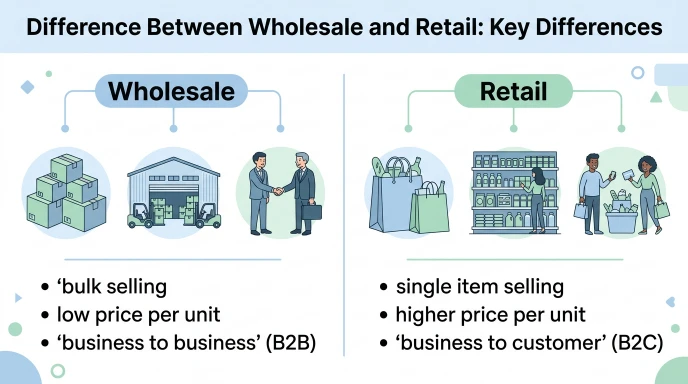
Wholesale sells in bulk to businesses, while retail sells individual products directly to customers.
If you’ve ever wondered why businesses buy products at lower prices than regular customers, you’re not alone.
Many people want to know the difference between wholesale and retail because both play an important role in selling products.
Knowing the difference helps customers buy wisely and helps business owners choose the right way to sell. Simply,wholesale sells in bulk to businesses, while retail sells directly to customers.
This guide explains how both work, their benefits, and which is right for you.
Difference Between Wholesale and Retail
Wholesale sells in bulk to businesses, while retail sells to customers.
Example: A clothing manufacturer may sell 500 T-shirts to a retailer at a wholesale price. The retailer then sells each T-shirt individually to customers at a retail price.
Definition of Wholesale and Retail
Wholesale:
Wholesale means selling products in bulk to businesses at lower prices.
Retail:
Retail is the process of selling products directly to individual consumers in small quantities for personal use.
Pronunciation
| Term | US Pronunciation | UK Pronunciation |
| Wholesale | HOLE-sale (/ˈhoʊl.seɪl/) | HOLE-sale (/ˈhəʊl.seɪl/) |
| Retail | REE-tail (/ˈriː.teɪl/) | REE-tail (/ˈriː.teɪl/) |
Now that you understand the basic definitions, let’s explore the difference between wholesale and retail in detail to see how each business model works and why both are important in today’s economy.
Difference Between Wholesale and Retail: Comparison
| Feature | Wholesale | Retail |
| Target Customers | Businesses, retailers, distributors | Individual consumers |
| Quantity Sold | Large quantities or bulk | Single items or small quantities |
| Selling Price | Lower per-unit price | Higher per-unit price |
| Profit Strategy | Earn through high sales volume | Earn through higher profit margins per item |
| Customer Relationship | Business-to-Business (B2B) | Business-to-Consumer (B2C) |
| Inventory Size | Large warehouses and bulk stock | Smaller stock displayed for customers |
| Marketing Focus | Business partnerships and contracts | Advertising and consumer promotions |
| Purchase Frequency | Less frequent but larger orders | Frequent individual purchases |
| Examples | Manufacturers, distributors, wholesalers | Supermarkets, clothing stores, online shops |
| Best For | Supplying businesses | Selling directly to end users |
Key Differences Explained Between Wholesale and Retail
1. Target Customers
The biggest difference between wholesale and retail is the type of customer each serves.
Wholesalers sell products to businesses and retailers for resale.
Retailers sell directly to everyday consumers.
Real-life example:
A furniture manufacturer sells hundreds of chairs to a furniture store through wholesale. The store then sells one chair at a time to homeowners.
2. Quantity of Products Sold
Wholesale transactions usually involve large quantities.
Retail purchases are generally made one item at a time.
Example:
A grocery store may buy 2,000 bottles of cooking oil from a wholesaler, while a shopper purchases only one bottle.
3. Pricing Structure
Wholesale prices are lower because customers buy in bulk.
Retail prices include additional costs such as:
- Store rent
- Employee salaries
- Marketing
- Packaging
- Customer service
User insight:
Many people think retailers make big profits, but prices also cover business costs.
4. Profit Model
Wholesalers generate profit through high sales volume and repeat business.
Retailers rely on higher profit margins for each individual sale.
Example:
A wholesaler may earn a small profit on each product but sell thousands every week. A retailer sells fewer units but earns more per item.
5. Customer Interaction
Wholesale businesses often have long-term partnerships with retailers.
Retail businesses interact directly with consumers, providing customer service, promotions, and after-sales support.
6. Business Scale
Wholesale businesses usually operate from warehouses or distribution centers.
Retail businesses operate through:
- Physical stores
- Shopping malls
- E-commerce websites
- Mobile shopping apps
Their focus is making products convenient and accessible for consumers.
Why Does the Difference Between Wholesale and Retail Matter?
Knowing the difference helps you make better buying and selling decisions.
For example:
- A restaurant owner buying ingredients in bulk usually purchases from a wholesaler.
- A family buying groceries for the week shops at a retail supermarket.
- A startup opening an online store often buys inventory through wholesale suppliers.
- A customer ordering a single smartphone purchases it from a retail store or website.
Choosing the right model helps save money and improve business.
How Does Wholesale Work?
Wholesale serves as the bridge between manufacturers and retailers.
Here’s how the process typically works:
- A manufacturer produces goods.
- A wholesaler purchases products in large quantities.
- Products are stored in warehouses.
- Retailers place bulk orders.
- Goods are delivered to retail stores or online sellers.
Why businesses choose wholesale
- Lower cost per unit
- Bulk purchasing discounts
- Consistent inventory supply
- Easier large-scale distribution
- Better profit opportunities for retailers
Mini Summary
Wholesale is best for businesses buying products in bulk at lower prices.
How Does Retail Work?
Retail focuses on delivering products directly to consumers.
The process generally follows these steps:
- Retailers purchase inventory from wholesalers or manufacturers.
- Products are displayed in stores or listed online.
- Customers browse and compare products.
- Individual items are purchased.
- Retailers provide customer service, returns, and support.
Advantages of retail
- Convenient shopping experience
- Wide product selection
- Immediate product availability
- Personalized customer service
- Easy returns and exchanges
Mini Summary
Retail sells individual products to customers through stores and online shops.
Why Choose Wholesale Instead of Retail?
Many business owners ask if buying wholesale is worth it. If you buy products in bulk for resale, wholesale is a better choice.
1. Lower Cost Per Unit
The biggest benefit of wholesale is bulk pricing. Buying large quantities reduces the cost of each individual product.
Example:
A café buying 1,000 coffee cups from a wholesaler pays much less per cup than buying small packs from a retail store.
2. Higher Profit Potential
Retailers purchase products at wholesale prices and sell them at retail prices, earning a profit on each sale.
This pricing model is the foundation of many successful businesses.
3. Reliable Inventory Supply
Wholesale suppliers keep large stocks, so businesses don’t run out of products.
4. Better Business Relationships
Many wholesalers offer long-term customers:
- Volume discounts
- Flexible payment terms
- Priority shipping
- Exclusive product access
These benefits help businesses grow over time.
Why Choose Retail Instead of Wholesale?
Retail is the better option when you only need products for personal use or small purchases.
1. Buy Only What You Need
Retail stores let customers purchase a single item instead of an entire carton or pallet.
This is convenient for everyday shopping.
2. Greater Product Variety
Retail stores often carry multiple brands, colors, and styles, making it easier to compare options before buying.
3. Customer Support
Retailers typically provide services such as:
- Product advice
- Returns and exchanges
- Warranties
- Installation assistance
These services add value beyond the product itself.
4. Immediate Access
Retail customers can buy products quickly without minimum orders.
Difference and Similarity
| Feature | Wholesale | Retail | Similarity |
| Purpose | Supplies products to businesses | Sells products to consumers | Both help move products from manufacturers to buyers. |
| Customers | Businesses and retailers | Individual consumers | Both serve important market needs. |
| Sales Volume | Large bulk orders | Small individual purchases | Both involve buying and selling goods. |
| Pricing | Lower per-unit prices | Higher per-unit prices | Both aim to generate profit. |
| Inventory | Large warehouse stock | Store or online inventory | Both require inventory management. |
| Distribution | Business-to-Business (B2B) | Business-to-Consumer (B2C) | Both are essential parts of the supply chain. |
| Marketing | Focuses on business partnerships | Focuses on consumer advertising | Both use marketing to attract customers. |
| Business Goal | Efficient bulk distribution | Convenient customer shopping | Both contribute to a successful marketplace. |
This table clearly shows the difference and similarity between wholesale and retail for quick understanding.
Common Mistakes with Wholesale and Retail
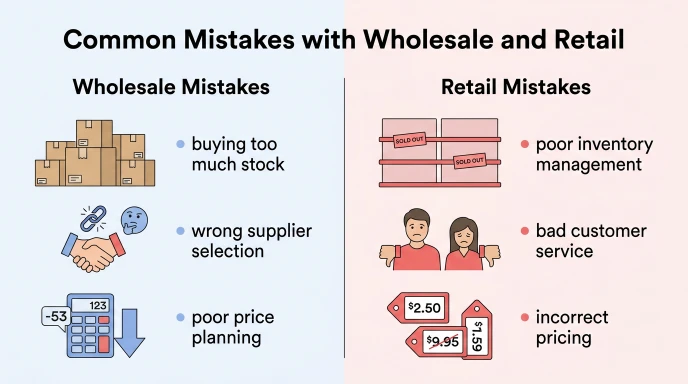
Many beginners misunderstand how wholesale and retail businesses operate. Here are some common mistakes and how to avoid them.
Mistake 1: Thinking Wholesale Is Always Cheaper
Wholesale prices are lower per unit, but you usually need to buy in large quantities.
Correction:
If you only need one or two items, retail is often the more practical choice.
Mistake 2: Assuming Retailers Buy Directly from Manufacturers
Not every retailer purchases products directly from manufacturers.
Correction:
Many retailers source inventory through wholesalers or distributors.
Mistake 3: Ignoring Minimum Order Quantities
Most wholesalers require minimum purchase amounts.
Correction:
Check order requirements before contacting a wholesale supplier.
Mistake 4: Comparing Only Product Prices
People often overlook additional costs like shipping, storage, and inventory management.
Correction:
Calculate the total cost of ownership, not just the purchase price.
Mistake 5: Believing Wholesale Is Only for Large Companies
Small businesses and startups can also buy wholesale if they meet supplier requirements.
Correction:
Many wholesalers now support small businesses with flexible order options.
Real-Life Examples with Wholesale and Retail
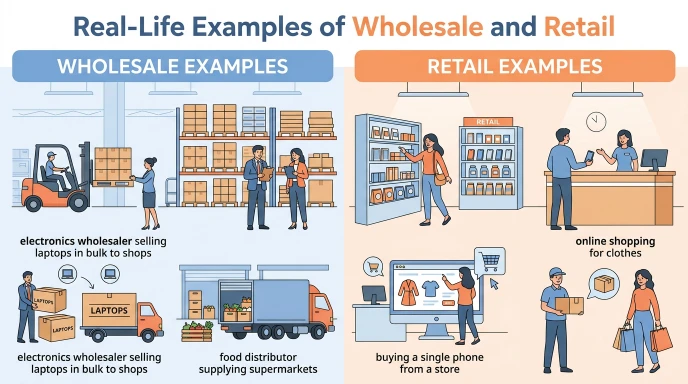
Example 1: Clothing Business
A boutique purchases 500 jackets from a clothing wholesaler.
Wholesale
The boutique then sells each jacket individually to customers.
Retail
Example 2: Grocery Shopping
A supermarket buys hundreds of cartons of milk from a distributor.
Customers purchase one or two cartons during their weekly shopping trip.
Example 3: Online Business
An entrepreneur buys phone accessories in bulk from a wholesaler and sells them through an online store.
This business uses both wholesale purchasing and retail selling.
Example 4: Restaurant Supply
A restaurant orders bulk ingredients from a wholesale food supplier to reduce operating costs.
Example 5: Electronics Store
An electronics store buys laptops in bulk and sells them one by one with a warranty and support.
When to Use Each
Choose Wholesale When:
- You own a retail business.
- You need products in bulk.
- You want lower per-unit costs.
- You’re building inventory for resale.
- Long-term supplier relationships are important.
Choose Retail When:
- You’re shopping for personal use.
- You only need a few items.
- Product variety matters.
- Customer support is important.
- You don’t have storage space for bulk purchases.
Why People Get Confused About the Difference Between Wholesale and Retail
Several reasons cause confusion between these two business models.
Similar Products
Wholesale and retail often sell the same products, making people think they’re the same type of business.
Online Shopping
Many online stores blur the line by offering both wholesale and retail pricing.
Marketing Terms
Some stores use “wholesale prices” to attract customers, even though they sell at retail.
Social Media Influence
YouTube, Instagram, and Meta platforms often share videos and tips about wholesale and retail. Without understanding the supply chain, beginners may assume they are identical.
How Search Engines Understand “Difference Between Wholesale and Retail” and User Intent
Search engines like Google don’t just analyze keywords they interpret the purpose behind the search.
For example:
- A search for “difference between wholesale and retail” usually indicates informational intent.
- “Wholesale vs retail business” often comes from someone planning to start a business.
- “Can I buy from a wholesaler?” reflects buying intent and curiosity about eligibility.
Google also links topics like supply chains, manufacturers, distributors, pricing, inventory, and e-commerce. Articles that answer these connected questions are more likely to satisfy user intent and perform well in search results.
Expert Insight
Wholesale and retail work together as parts of the same supply system.
Wholesalers supply products in bulk to retailers, and retailers sell them to customers with easy access and support.
The best choice depends on your customers, sales, costs, and goals. Understanding the difference helps build a successful business.
FAQs
1. What is the main difference between wholesale and retail?
Wholesale sells products in bulk to businesses at lower prices, while retail sells single items to customers at higher prices.
2. Which is cheaper, wholesale or retail?
Wholesale is generally cheaper per unit because products are sold in large quantities. Retail prices are higher because they include store and service costs.
3. Can individuals buy from wholesalers?
Yes, some wholesalers allow individuals to purchase products. Many wholesalers require a minimum order or a business license.
4. Why do retailers charge higher prices?
Retailers add a markup to cover costs and make a profit.
5. Is wholesale only for businesses?
Traditionally, wholesale serves businesses, retailers, and distributors. Today, some wholesalers also sell directly to customers online or through warehouse stores.
6. Can a business operate as both wholesale and retail?
Yes. Many manufacturers and distributors sell in bulk to businesses and also sell directly to customers.
7. Which business model is more profitable?
Profitability depends on the business strategy. Wholesale businesses usually earn smaller profits per item but sell in high volumes. Retail businesses often earn higher profit margins per product but sell fewer units.
8. What industries commonly use wholesale?
Wholesale is common in industries such as:
- Food and beverages
- Clothing and fashion
- Electronics
- Furniture
- Automotive parts
- Medical supplies
- Construction materials
These industries rely on bulk distribution to supply retailers efficiently.
9. How does online shopping affect wholesale and retail?
E-commerce has made both business models more accessible. Many wholesalers sell online, while retailers sell through websites, apps, and social media.
10. Should I choose wholesale or retail in 2026?
Choose wholesale if you’re purchasing inventory for resale or need products in bulk at lower prices. Choose retail if you’re buying items for personal use, want greater flexibility, or only need small quantities.
Conclusion
Knowing the difference between wholesale and retail helps in shopping and business. They serve different customers and use different pricing.
Wholesale sells products in bulk to businesses at lower prices. Retail sells individual products directly to customers through stores or online.
In 2026, many businesses use both wholesale and retail. However, wholesale sells in bulk to businesses, while retail sells directly to customers.
Knowing the difference between wholesale and retail helps you save money and choose the right option.
Read more about!
Difference Between Inverter and Generator: Which Is Better?
Difference Between Hawk and Eagle: Key Differences

I am James Carter, a professional content writer from the United States. I specialize in writing simple and clear comparison blogs that help students and readers understand difficult topics easily. My writing focuses on everyday language, education, science, and lifestyle topics. I believe that learning should be easy for everyone, so I use simple words and real-life examples in my articles.