An inverter is usually better for homes because it provides silent, clean, and automatic backup power, while a generator is better for long power outages and heavy loads.
Power outages can happen at any time, leaving homes and businesses without electricity. That’s why many people search for the difference between inverter and generator before choosing a backup power solution.
Although both devices provide electricity during a blackout, they work in very different ways and are designed for different needs.
Understanding the difference between inverter and generator helps you select the right option based on your budget, power requirements, noise level, and fuel costs.
If you need backup power for your home office, small business, or an entire house, knowing how each system operates is essential.
In this guide, you’ll learn the difference between inverter and generator, how they work, their pros and cons, real-world uses, and which one is the better choice for your situation.
Difference Between Inverter and Generator
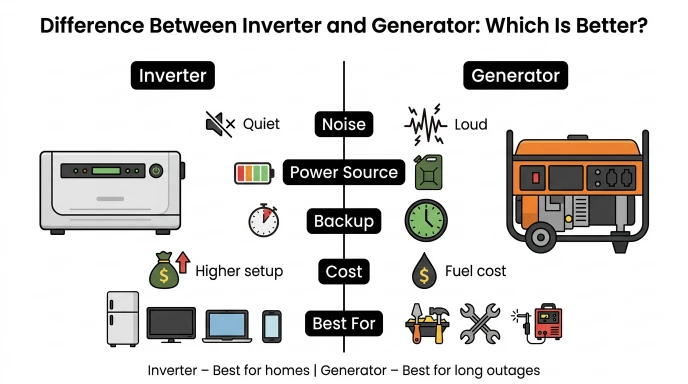
The difference between inverter and generator is simple: an inverter stores electricity in batteries and converts DC power into AC power, while a generator produces electricity by running an engine powered by fuel such as gasoline, diesel, propane, or natural gas.
Example: During a two-hour power outage, an inverter can quietly run lights, Wi-Fi, and a laptop using stored battery power. A generator, however, can power larger appliances like refrigerators and air conditioners by continuously producing electricity as long as fuel is available.
Definition of Inverter and Generator
Inverter:
An inverter is an electrical device that converts direct current (DC) from a battery or solar panels into alternating current (AC) so household appliances can operate during a power outage.
Generator:
A generator is a machine that creates electricity by converting mechanical energy into electrical energy using an engine powered by fuel such as gasoline, diesel, propane, or natural gas.
Pronunciation
| Term | US Pronunciation | UK Pronunciation |
| Inverter | in-VER-ter (/ɪnˈvɝː.tɚ/) | in-VUR-tuh (/ɪnˈvɜː.tə/) |
| Generator | JEN-uh-ray-ter (/ˈdʒen.ə.reɪ.tɚ/) | JEN-uh-ray-tuh (/ˈdʒen.ə.reɪ.tə/) |
Now that you know what each device is and how to pronounce them, let’s explore the difference between inverter and generator in detail to understand which backup power solution fits different situations.
Difference Between Inverter and Generator: Comparison
| Feature | Inverter | Generator |
| Power Source | Uses stored battery power or solar-charged batteries | Produces electricity using gasoline, diesel, propane, or natural gas |
| Working Method | Converts DC electricity into AC electricity | Generates electricity through an engine and alternator |
| Noise Level | Nearly silent | Usually noisy because of the running engine |
| Fuel Requirement | No fuel while operating | Requires continuous fuel supply |
| Maintenance | Minimal battery maintenance | Regular engine servicing and oil changes |
| Running Cost | Low after installation | Higher due to fuel consumption |
| Power Capacity | Best for small to medium loads | Suitable for heavy electrical loads |
| Startup Time | Instant or automatic | Usually takes a few seconds to start |
| Environmental Impact | No direct emissions during use | Produces exhaust emissions and carbon dioxide |
| Best For | Homes, apartments, offices, solar systems | Construction sites, large homes, emergency backup |
Key Differences Explained Between Inverter and Generator
1. How They Produce Electricity
The biggest difference between inverter and generator is how electricity is supplied.
An inverter does not create electricity. Instead, it uses electricity already stored in batteries and converts it into usable AC power.
A generator creates electricity from scratch by burning fuel to rotate an alternator.
Real-life example:
A home solar system stores daytime energy in batteries. At night, the inverter supplies that stored electricity. A portable generator creates power immediately by starting its engine.
2. Power Capacity
Inverters are ideal for running essential appliances such as:
- LED lights
- Wi-Fi routers
- TVs
- Laptops
- Fans
Generators can handle much heavier electrical loads including:
- Air conditioners
- Water pumps
- Refrigerators
- Electric heaters
- Entire home circuits
User insight: Most homeowners only need an inverter for short outages, while businesses often require generators for uninterrupted operations.
3. Noise During Operation
One reason many homeowners prefer inverters is their quiet performance.
Since there is no engine running continuously, most inverters produce almost no noticeable sound.
Generators, however, operate using combustion engines, making them considerably louder.
Example:
If you’re working from home or attending online meetings, an inverter creates a much quieter environment than a generator.
4. Running Cost
Once installed, an inverter has relatively low operating costs because it mainly depends on battery charging. If paired with solar panels, electricity costs can decrease even further.
Generators require ongoing fuel purchases, making long-term operation more expensive.
Real-world scenario:
During frequent power outages, monthly fuel expenses can become significant for generator owners.
5. Environmental Impact
As sustainability becomes more important in 2026, many users compare backup systems based on environmental impact.
Inverters produce no direct air pollution during operation and work especially well with renewable energy systems.
Generators release exhaust gases because they burn fuel continuously while producing electricity.
Why this matters:
Many households looking to reduce carbon emissions choose battery-based inverter systems combined with solar energy.
6. Maintenance Requirements
Inverters require relatively little maintenance.
Typical maintenance includes:
- Checking battery health
- Cleaning battery terminals
- Replacing batteries after several years
Generators require regular servicing, including:
- Oil changes
- Fuel filter replacement
- Spark plug inspection
- Engine maintenance
Practical example:
Someone living in an apartment usually prefers an inverter because it requires much less ongoing maintenance than a generator.
Why Does the Difference Between Inverter and Generator Matter?
Many people assume both devices do the same job simply because they provide electricity during outages. In reality, choosing the wrong backup system can lead to unnecessary costs or inadequate power.
For example:
- A student working on a laptop may only need a compact inverter.
- A hospital or manufacturing facility cannot rely solely on batteries and typically needs a high-capacity generator.
- Families using refrigerators, air conditioners, and water pumps during long outages often benefit from a generator.
- Homes with rooftop solar panels usually pair them with an inverter to maximize renewable energy use.
Understanding your actual power needs helps you avoid overspending while ensuring reliable backup electricity.
How Does an Inverter Work?
An inverter works through a simple but efficient process:
- Batteries store DC (direct current) electricity.
- The inverter detects a power outage automatically.
- It converts DC electricity into AC electricity.
- Household appliances receive usable power almost instantly.
- When grid power returns, the batteries recharge automatically.
Why many homeowners choose inverters
- Silent operation
- Fast automatic switching
- Lower operating costs
- Safe for sensitive electronics
- Compatible with solar energy systems
Mini Summary
An inverter is best for users who need quiet, efficient backup power for everyday electronics and short-to-medium power outages.
How Does a Generator Work?
Unlike an inverter, a generator creates electricity instead of storing it.
Here’s how the process works:
- The engine starts using gasoline, diesel, propane, or natural gas.
- The engine rotates an alternator.
- The alternator converts mechanical energy into electrical energy.
- Electricity flows directly to connected appliances or the building’s electrical system.
- Power continues as long as the generator has fuel.
Advantages of generators
- High power output
- Can run for extended periods with enough fuel
- Supports heavy-duty appliances
- Ideal for emergency services, construction sites, farms, and large homes
Mini Summary
A generator is the better option when you need continuous electricity for large appliances or during long power outages.
Why Choose an Inverter Instead of a Generator?
Many people ask if an inverter is always the better option. The answer depends on your power needs. An inverter is designed for efficiency, convenience, and quiet operation rather than maximum power output.
1. Ideal for Short Power Outages
If electricity usually returns within a few hours, an inverter provides reliable backup without the hassle of starting an engine.
Example: During a two-hour blackout, an inverter can keep your lights, Wi-Fi router, television, and laptop running smoothly.
2. Better for Sensitive Electronics
Modern inverters deliver stable, clean electricity with consistent voltage. This makes them safer for devices such as:
- Computers
- Smart TVs
- Gaming consoles
- Medical equipment
- Wi-Fi routers
Many users working remotely prefer inverters because voltage fluctuations are less likely to damage expensive electronics.
3. Lower Operating Costs
Although the initial investment may be higher for a quality battery system, inverters generally cost less to operate because they do not consume fuel while providing backup power.
If combined with solar panels, electricity costs can be reduced even further.
4. Quiet and Comfortable
One of the biggest advantages of an inverter is its nearly silent operation.
Unlike generators that produce engine noise, inverters can operate without disturbing your family, neighbors, or work environment.
Why Choose a Generator Instead of an Inverter?
Generators remain the preferred choice whenever high power demand or extended outages are expected.
1. Supports Heavy Appliances
Generators can power equipment that most residential inverters cannot handle continuously, including:
- Central air conditioners
- Water pumps
- Electric ovens
- Large refrigerators
- Industrial machinery
Example: During a day-long outage, a generator can keep an entire home functioning normally.
2. Unlimited Runtime with Fuel
Battery capacity limits how long an inverter can operate.
A generator, however, continues producing electricity as long as fuel is available.
This makes generators valuable for emergency response teams, hospitals, farms, and construction sites.
3. Suitable for Commercial Operations
Businesses often cannot afford downtime.
Restaurants, supermarkets, factories, and data centers frequently rely on generators because uninterrupted electricity is essential for daily operations.
Difference and Similarity
| Feature | Inverter | Generator | Similarity |
| Purpose | Supplies stored battery power | Produces electricity using fuel | Both provide backup electricity during outages. |
| Energy Source | Batteries or solar storage | Gasoline, diesel, propane, or natural gas | Both deliver usable AC power to appliances. |
| Noise Level | Very quiet | Louder due to engine operation | Both help maintain electrical supply when needed. |
| Maintenance | Low maintenance | Requires regular engine servicing | Both perform better with proper maintenance. |
| Power Capacity | Best for light to medium loads | Suitable for heavy electrical loads | Both can power essential household devices. |
| Running Time | Limited by battery capacity | Limited mainly by available fuel | Both stop when their energy source is exhausted. |
| Installation | Often installed indoors | Usually operated outdoors for ventilation | Both require correct installation for safe operation. |
| Best Use | Homes, apartments, solar systems | Large homes, businesses, worksites | Both improve preparedness during emergencies. |
This table clearly shows the difference and similarity between inverter and generator for quick understanding.
Common Mistakes with Inverter and Generator
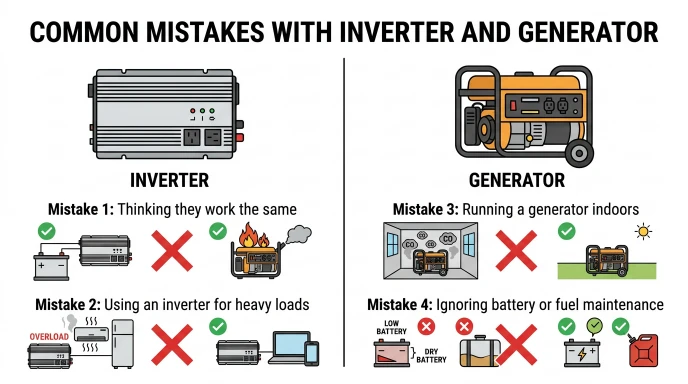
Many beginners misunderstand how these backup systems work. Avoiding these common mistakes can save money and improve safety.
Mistake 1: Thinking They Work the Same Way
Many users assume both devices generate electricity.
Correction:
An inverter converts stored battery power into usable electricity, while a generator creates electricity by burning fuel.
Mistake 2: Buying an Inverter for Heavy Appliances
Some homeowners expect a small inverter to run air conditioners, electric heaters, or multiple high-power appliances.
Correction:
Always calculate your total power requirement before purchasing an inverter.
Mistake 3: Ignoring Generator Maintenance
Some people only use generators during emergencies and forget routine servicing.
Correction:
Regular oil changes, fuel checks, and engine maintenance improve reliability.
Mistake 4: Installing a Generator Indoors
This is one of the most dangerous mistakes.
Correction:
Generators must always operate outdoors in well-ventilated areas because they produce carbon monoxide.
Mistake 5: Choosing Based Only on Price
The cheapest option is not always the most suitable.
Correction:
Consider outage frequency, appliance load, fuel availability, maintenance costs, and long-term efficiency before making a decision.
Real-Life Examples with Inverter and Generator
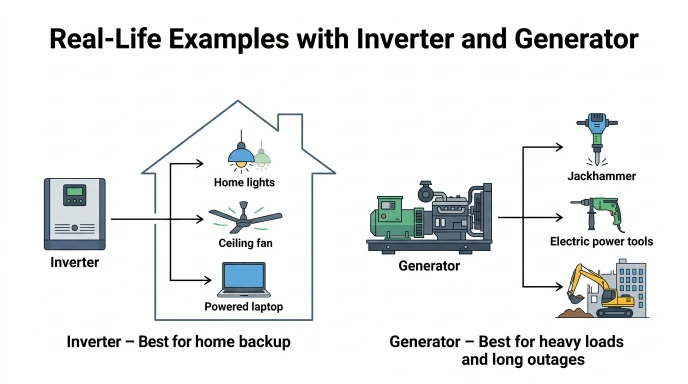
Example 1: Home Office
A freelance graphic designer needs electricity for a laptop, internet connection, and monitor.
Best choice: Inverter
Reason: Quiet operation and stable power for sensitive electronics.
Example 2: Family Home
A family wants backup power for lights, fans, refrigerators, and occasional air conditioner use during long outages.
Best choice: Generator
Reason: Higher power output and longer runtime.
Example 3: Retail Store
A supermarket cannot afford refrigeration failures during a blackout.
Best choice: Generator
Reason: Continuous electricity protects inventory and business operations.
Example 4: Solar-Powered House
A homeowner has rooftop solar panels and wants to maximize renewable energy usage.
Best choice: Inverter with battery storage
Reason: Stores daytime solar energy for nighttime use.
Example 5: Construction Site
Power tools and heavy machinery need reliable electricity where the utility grid is unavailable.
Best choice: Generator
Reason: High-capacity portable power is essential.
When to Use Each
Choose an Inverter When:
- Power outages are short.
- You mainly use lights, fans, Wi-Fi, TVs, and laptops.
- Quiet operation is important.
- You have a solar energy system.
- Low maintenance is a priority.
Choose a Generator When:
- Outages last several hours or days.
- Heavy appliances need continuous power.
- You run a business that cannot stop operating.
- Fuel availability is not a concern.
- High electrical capacity is required.
Why People Get Confused About the Difference Between Inverter and Generator
There are several reasons why this topic causes confusion.
Similar Purpose
Both provide backup electricity, making many people believe they are identical devices.
Marketing Language
Manufacturers often advertise both products as “backup power solutions,” without explaining how differently they operate.
Regional Usage
In some countries, people casually refer to any backup system as a “generator,” even when they actually mean an inverter.
Growth of Solar Technology
As solar energy becomes more common, inverters are increasingly associated with backup power. This overlap sometimes causes users to confuse solar inverters with traditional fuel-powered generators.
How Search Engines Understand “Difference Between Inverter and Generator” and User Intent
Search engines such as Google aim to understand why someone searches for this keyword not just the exact words they type.
For example:
- Someone searching “difference between inverter and generator” is usually comparing two backup power systems before making a purchase.
- A search for “which is better inverter or generator for home” signals buying intent along with a need for practical advice.
- Queries like “how does an inverter work” or “generator vs inverter power backup” indicate informational intent.
Platforms like YouTube often recommend demonstration videos showing real-world performance, installation, and noise comparisons. Meanwhile, discussions on Instagram and Meta communities frequently highlight user experiences, maintenance tips, and solar-powered backup setups.
Because search engines recognize these related questions and entities, comprehensive articles that explain definitions, comparisons, use cases, and buying considerations are more likely to satisfy user intent and perform well in search results.
Expert Insight
From an electrical systems perspective, there is no universal winner in the inverter-versus-generator debate. The right choice depends on matching the backup solution to the expected electrical load, outage duration, and operating environment.
In practical use, most homeowners benefit from an inverter for everyday power interruptions because it is quiet, efficient, and well suited to essential electronics. On the other hand, facilities that rely on uninterrupted operation such as healthcare centers, manufacturing plants, construction projects, and large commercial buildings typically require generators capable of delivering sustained, high-capacity power.
A growing trend in 2026 is the use of hybrid backup systems, where solar panels, battery storage, inverters, and generators work together. This approach combines energy efficiency with dependable long-duration backup, offering greater flexibility than relying on a single power source alone.
FAQs
1. What is the main difference between an inverter and a generator?
The main difference between inverter and generator is that an inverter converts stored DC battery power into AC electricity, while a generator produces electricity by burning fuel such as gasoline, diesel, propane, or natural gas. Inverters are ideal for light loads and quiet operation, whereas generators are better for heavy appliances and extended power outages.
2. Which is better for home use: an inverter or a generator?
It depends on your needs. An inverter is better if you want silent, energy-efficient backup for lights, fans, Wi-Fi, and electronics. A generator is a better choice if you need to power air conditioners, refrigerators, water pumps, or your entire home during long outages.
3. Can an inverter replace a generator?
Not always. A high-capacity inverter can replace a generator for small and medium household loads, but it cannot continuously power heavy electrical equipment unless it has a large battery bank and sufficient capacity. For long outages or industrial use, a generator remains the more practical solution.
4. Which costs less to operate?
An inverter usually has lower running costs because it relies on stored electricity rather than fuel. If paired with solar panels, operating costs can be even lower. A generator requires continuous fuel and regular maintenance, making it more expensive over time.
5. Is an inverter safer than a generator?
For indoor use, an inverter is generally safer because it does not produce exhaust gases during operation. A generator must always be used outdoors in a well-ventilated area to prevent carbon monoxide poisoning and other safety hazards.
6. Can a generator charge an inverter battery?
Yes. Many people use a generator to recharge inverter batteries during extended power outages. This combination provides continuous backup while reducing overall fuel consumption compared to running the generator all the time.
7. Which is better for solar power systems?
An inverter is essential for solar energy systems because it converts the DC electricity generated by solar panels into AC electricity used by household appliances. Traditional generators are not part of a standard solar setup, though they may serve as an emergency backup.
8. Do generators provide more power than inverters?
Yes. Most generators produce significantly more power than residential inverters. This makes them suitable for heavy-duty appliances, commercial buildings, construction sites, and situations where continuous high-power output is required.
9. How long can an inverter run during a power outage?
Runtime depends on the battery capacity and the number of connected appliances. A small inverter may last a few hours, while a larger battery bank can provide backup power for much longer. Reducing the electrical load also extends battery life.
10. Should I buy an inverter or a generator in 2026?
If your power outages are short and you mainly need electricity for essential household electronics, an inverter is usually the better investment. If outages are frequent, last many hours, or require powering heavy appliances, a generator is often the smarter choice. Many homeowners are now choosing hybrid systems that combine solar panels, batteries, inverters, and generators for maximum reliability.
Conclusion
Choosing the right backup power solution starts with understanding the difference between inverter and generator. Although both provide electricity during outages, they serve different purposes and are designed for different situations.
An inverter is an excellent choice for homes, apartments, and small offices that need quiet, efficient backup power for lights, fans, Wi-Fi, laptops, and other everyday electronics. It requires minimal maintenance, produces no direct emissions during operation, and works especially well with solar energy systems. For users who experience short or occasional power cuts, an inverter is often the most practical and cost-effective option.
A generator, on the other hand, is built for higher power demands and longer outages. It can run large appliances, support businesses, and provide continuous electricity as long as fuel is available. While generators require more maintenance and produce engine noise, they remain the preferred solution for heavy-duty applications and emergency preparedness.
Ultimately, there is no single “best” option. The right choice depends on your power requirements, outage frequency, budget, and long-term energy goals. By understanding the difference between inverter and generator, you can confidently choose the backup system that offers the best balance of performance, reliability, and value for your specific needs.
Read more about!
Difference Between Fur and Hair: Simple Guide
Difference Between Wire and ACH: Complete Banking Guide

I am James Carter, a professional content writer from the United States. I specialize in writing simple and clear comparison blogs that help students and readers understand difficult topics easily. My writing focuses on everyday language, education, science, and lifestyle topics. I believe that learning should be easy for everyone, so I use simple words and real-life examples in my articles.