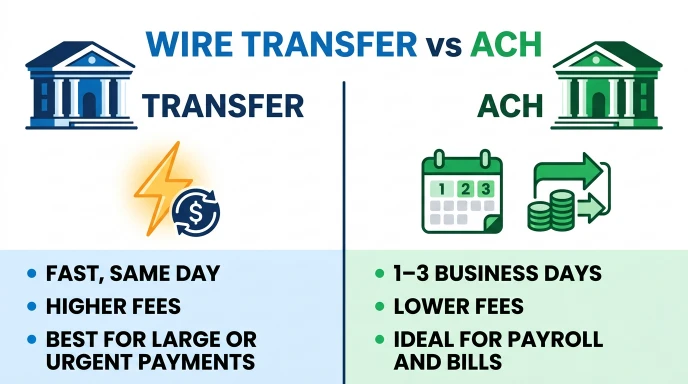
Wire transfers move money directly between banks, while ACH transfers are slower, lower-cost electronic payments used for routine transactions.
Have you ever needed to send money and wondered if to choose a wire transfer or an ACH payment? Many people search for the difference between wire and ACH because both move money electronically, yet they work very differently.
The difference between wire and ACH mainly comes down to speed, cost, processing method, and use cases.
While wire transfers are generally faster and more direct, ACH payments are often cheaper and better for routine transactions.
In this guide, you’ll learn the difference between wire and ACH, how each system works, their advantages and disadvantages, and when to use one over the other.
If you’re sending money to family, paying employees, or handling business transactions, this article will help you make the right choice.
Difference Between Wire and ACH
A wire transfer moves money directly from one bank to another, usually on the same day, but often with higher fees.
An ACH (Automated Clearing House) payment processes transactions in batches through a central network, making it slower but usually less expensive.
Example: Sending $50,000 for a home purchase may require a wire transfer, while receiving your monthly salary typically uses ACH.
Definition of Difference Between Wire and ACH
- Wire Transfer: An electronic transfer that sends money directly between banks or financial institutions, often completed within hours.
- ACH Transfer: An electronic payment processed through the Automated Clearing House network in batches, commonly used for payroll, bill payments, and direct deposits.
Pronunciation
| Term | US Pronunciation | UK Pronunciation |
| Wire | /waɪr/ | /waɪə/ |
| ACH | /eɪ-si-eɪtʃ/ | /eɪ-si-eɪtʃ/ |
Now that you know what each term means, let’s understand the major differences that affect everyday banking and business transactions.
Difference Between Wire and ACH Comparison
| Feature | Wire Transfer | ACH Transfer |
| Processing Method | Direct bank-to-bank transfer | Batch processing network |
| Speed | Same day or within hours | 1–3 business days typically |
| Cost | Usually higher fees | Often free or low cost |
| Best For | Urgent payments | Recurring payments |
| International Use | Widely supported | Mostly domestic |
| Reversibility | Difficult to reverse | Sometimes can be corrected |
| Transaction Limits | Usually high limits | May have lower limits |
| Security | Highly secure | Highly secure |
Key Differences Explained Between Wire and ACH
1. Processing Speed
The biggest difference between wire and ACH is speed.
Wire transfers often arrive the same day. ACH transactions usually take one to three business days.
Example: Closing on a house may require immediate funds, making a wire transfer the better option.
2. Cost Structure
Wire transfers often include sending and receiving fees.
ACH payments are usually free for consumers and inexpensive for businesses.
Example: Employers use ACH for payroll because sending thousands of payments through wires would be expensive.
3. Transaction Method
Wire transfers move funds directly.
ACH transactions move through a central clearing network before reaching the recipient.
This explains why ACH takes longer.
4. International Availability
Wire transfers commonly support international transfers.
ACH networks primarily handle domestic transactions, though some international ACH services exist.
5. Recurring Payments
ACH is ideal for recurring transactions.
Examples:
- Salary deposits
- Utility bills
- Subscription services
- Mortgage payments
6. Payment Finality
Wire transfers are often final once processed.
ACH payments sometimes allow corrections or reversals under specific circumstances.
7. Business Usage
Large corporate transactions frequently use wires.
Routine operational payments often use ACH.
8. Fraud Risk Management
Both systems are secure, but wire fraud can be costly because reversing transactions is difficult once completed.
What Is a Wire Transfer and How Does It Work?
A wire transfer is an electronic movement of funds directly between financial institutions.
How It Works
- Sender submits transfer request.
- Bank verifies information.
- Funds are transmitted directly.
- Recipient receives money.
Because there is little delay, wire transfers are preferred for urgent transactions.
Common Uses
- Real estate purchases
- International business payments
- Large-value transactions
- Emergency transfers
What Is ACH and How Does It Work?
ACH stands for Automated Clearing House.
Rather than moving one payment at a time, ACH processes many payments together in batches.
How ACH Works
- Payment request is submitted.
- Transactions enter ACH network.
- Network sorts transactions.
- Funds settle between banks.
Common ACH Uses
- Direct deposit payroll
- Tax refunds
- Bill payments
- Subscription services
- Business vendor payments
Why Does the Difference Between Wire and ACH Matter for Businesses?
Businesses handle thousands of transactions annually.
Choosing the wrong payment method can increase costs and reduce efficiency.
Wire Benefits for Businesses
- Faster settlement
- Suitable for high-value payments
- Better for urgent transactions
ACH Benefits for Businesses
- Lower processing costs
- Automation support
- Payroll efficiency
- Recurring payment management
In practical use, most organizations combine both systems rather than relying on one exclusively.
Difference Between Wire and ACH for Personal Banking
Most consumers interact with ACH more often than they realize.
Examples include:
- Salary direct deposits
- Online bill payments
- Tax refunds
- Government benefits
Wire transfers are less common but become important during major financial events.
Real Scenario
Buying a home typically requires a wire transfer because sellers need guaranteed funds quickly.
Paying your internet bill each month generally uses ACH.
Which Is Safer: Wire or ACH?
Many users ask, “What is safer, wire or ACH?”
The answer depends on the situation.
Wire Security
- Direct processing
- Strong bank verification
- Less processing delay
ACH Security
- Strong banking regulations
- Fraud monitoring systems
- Consumer protections in many cases
The biggest risk with wires is sending money to the wrong account because recovery can be difficult.
Difference Between Wire and ACH for International Payments
International transactions often favor wire transfers.
Wire Advantages
- Global reach
- Faster cross-border settlement
- Higher transfer amounts
ACH Limitations
- Primarily domestic
- Not universally available internationally
For global business operations, wire transfers remain the preferred solution.
Difference Between Wire and ACH in the Digital Banking Era
Modern banking apps have made electronic payments easier.
Banks integrate ACH systems into mobile apps and online banking portals.
Search engines like Google often show users comparisons between payment methods because millions search financial topics each year.
As digital banking grows, understanding payment systems helps consumers avoid unnecessary fees and delays.
Difference and Similarity
| Feature | Wire Transfer | ACH Transfer | Similarity |
| Purpose | Move funds quickly | Move funds efficiently | Both transfer money electronically |
| Bank Involvement | Direct transfer | Clearing network transfer | Banks participate in both |
| Speed | Hours | Days | Both eventually settle funds |
| Cost | Higher | Lower | Both may include fees |
| Security | High | High | Both use banking safeguards |
| Business Use | Urgent payments | Recurring payments | Common in business finance |
| Personal Use | Large purchases | Everyday banking | Both serve consumers |
| Reliability | Very reliable | Very reliable | Trusted financial systems |
This table clearly shows the difference and similarity between wire and ACH for quick understanding.
Common Mistakes With Difference Between Wire and ACH
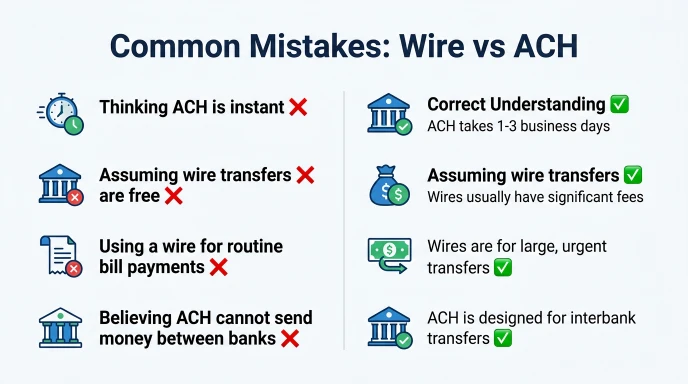
Mistake 1: Assuming ACH Is Instant
Correction: ACH usually takes one to three business days.
Mistake 2: Using a Wire for Small Routine Payments
Correction: ACH is often cheaper for recurring transactions.
Mistake 3: Believing Wires Are Always Better
Correction: Speed isn’t always necessary.
Mistake 4: Ignoring Fees
Correction: Compare costs before choosing.
Mistake 5: Sending Wire Transfers Without Verification
Correction: Confirm account details carefully.
Mistake 6: Thinking ACH Cannot Handle Large Payments
Correction: Many banks support substantial ACH transfers.
Real-Life Examples With Wire and ACH
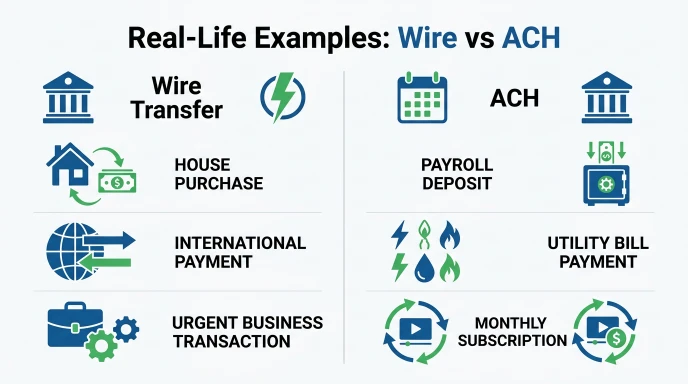
Personal Example
A person receives monthly salary deposits through ACH.
Real Estate Example
A home buyer sends a wire transfer to complete closing.
Small Business Example
A company pays employees using ACH payroll.
International Business Example
An importer sends a wire transfer to an overseas supplier.
Government Example
Tax refunds are commonly delivered through ACH direct deposit.
Enterprise Example
A corporation uses wires for acquisitions while using ACH for recurring vendor payments.
When to Use Each
Use Wire Transfers When:
- Speed is critical
- Sending large sums
- Making international payments
- Completing real estate transactions
Use ACH When:
- Paying employees
- Paying bills
- Receiving direct deposits
- Managing recurring payments
- Reducing transaction costs
Why People Get Confused in Wire and ACH
Several factors create confusion:
- Both are electronic transfers.
- Banks offer both services.
- Online banking interfaces look similar.
- Marketing materials often use broad terms like “bank transfer.”
- Financial terminology can be complex for beginners.
In simple words, both move money electronically, but they use different systems behind the scenes.
How Search Engines Understand Difference Between Wire and ACH and User Intent
Search engines such as Google recognize that users searching “wire vs ACH,” “ACH or wire transfer,” and “difference between wire and ACH” usually want comparison-based information.
Algorithms analyze:
- User engagement
- Click-through rates
- Financial topic relevance
- Content depth
- Authority signals
Platforms like Instagram and YouTube also influence financial education trends because users frequently consume short-form explanations before researching detailed guides.
Expert Insight
From a financial operations perspective, the most overlooked difference between wire and ACH is not speed it’s cost efficiency.
In real scenarios, businesses rarely use wire transfers for everyday payments because transaction fees add up quickly. Most experienced finance teams reserve wires for urgent, high-value transactions and rely on ACH for routine operations.
Understanding this distinction can save organizations thousands of dollars annually while maintaining operational efficiency.
FAQs
What is the difference between wire and ACH?
Wire transfers move money directly and quickly, while ACH transfers use a clearing network and usually cost less.
Which is faster, wire or ACH?
Wire transfers are generally faster.
Is ACH safer than wire transfer?
Both are secure, but wire transfers can be harder to reverse if mistakes occur.
Can ACH be used internationally?
Most ACH transactions are domestic, while wires commonly support international payments.
Why do wire transfers cost more?
They involve direct processing and faster settlement.
Is payroll ACH or wire?
Most payroll systems use ACH.
Can businesses use both ACH and wire transfers?
Yes. Many businesses use ACH for routine payments and wires for urgent transactions.
Which is better for large transactions?
Wire transfers are often preferred for large, time-sensitive payments.
Conclusion
Understanding the difference between wire and ACH is essential for anyone managing personal or business finances. While both systems electronically transfer money, they serve different purposes. Wire transfers prioritize speed and direct delivery, making them ideal for urgent, high-value, and international transactions. ACH payments focus on efficiency and affordability, making them the preferred choice for payroll, recurring bills, and everyday banking.
Many users get confused because both options appear similar inside online banking platforms. However, the real distinction lies in processing speed, cost, transaction method, and intended use.
In practical use, neither method is universally better. The right choice depends on your goal. If time matters most, choose a wire transfer. If reducing fees and automating payments is your priority, ACH is usually the smarter option.
By understanding the difference between wire and ACH, you can make informed financial decisions, avoid unnecessary costs, and ensure your money reaches the right place at the right time.
Read more about!
Difference Between Diploid and Haploid: Easy Guide
Difference Between Nanny and Babysitter: Which Is Better?

I am James Carter, a professional content writer from the United States. I specialize in writing simple and clear comparison blogs that help students and readers understand difficult topics easily. My writing focuses on everyday language, education, science, and lifestyle topics. I believe that learning should be easy for everyone, so I use simple words and real-life examples in my articles.